
From the Victorian Auditor-General’s Report, April 2011. (H/T Joanne Nova)
Here’s the chart:
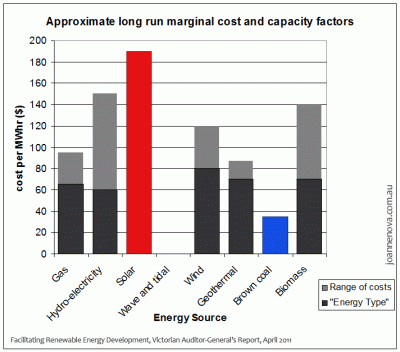
Click here for a bigger version.
Compared to coal, wind power is incredibly expensive, and solar power is even worse.
What happened when the Canadians embraced wind and solar power?
What happened to consumer energy prices in Ontario when the Liberal government embraced unproven wind and solar power?
The Globe and Mail explains:
If you haven’t opened your September hydro bill yet, you’re in for a shock. Rates have risen 18 per cent this year to date, and that’s just the start. By this time next year – election time – Ontario power consumers will be forking over about twice as much (in nominal terms) as they did when Dalton McGuinty took office in 2003.
[…]Power expert Tom Adams may know more about this subject than any other living being. And he’s steamed. Ontario’s rates, he says, have already surpassed the U.S. average and are headed for European levels – “just because of public policy.”
The policy is to go all out on renewables – wind and solar– whether or not it makes sense. The province is paying sky-high rates for power it doesn’t need so we can have wind turbines marching on and on to the horizon, just like Denmark does. “Power demand has been dropping since 2005,” says Mr. Adams. In fact, we have so much excess supply that, from time to time, it threatens to crash the system. Because of this, we’re even paying the neighbours to take the power off our hands.
“Ontario will need new power supplies in the future,” Mr. Adams says. “But why not buy it when we need it?” Instead of waiting, the power authority is signing long-term contracts at the rate of about $1-billion a week, while paying enormous premiums to attract wind and solar producers. In other words, it’s making 20-year commitments to pay stunningly high prices for power we don’t need.
On top of that, the province is building new transmission lines to nowhere while neglecting to ensure that Toronto’s hospitals and banks can keep the lights on. In July, Toronto experienced what Mr. Adams calls “Ontario’s first green blackout.” That blackout occurred because the city’s downtown core is badly underpowered. It has the weakest power system of any financial centre in the developed world.
Why haven’t we done anything about it? Because the green lobby has been campaigning for conservation, instead. And so, when the government started picking sites for transmission upgrades, it decided to build a power line up the shore of Lake Nipigon to connect remote wind turbines to Thunder Bay.
Ever since the days of Adam Beck, the father of public power in Ontario, the province’s energy policy has been linked to economic policy. The motto was reliable power at cost. Now energy policy has been entirely decoupled from economic policy and attached to the runaway train of environmental policy. Everyone in the power system knows it. But they’re so terrified to raise their hands, most of the public is still in the dark.
The National Post wrote about how the Ontario government wastes taxpayer money to subsidize big corporations who experiment with unproven, expensive energy programs, like solar power.
Excerpt:
The Swedish retail giant IKEA announced yesterday it will invest $4.6-million to install 3,790 solar panels on three Toronto area stores, giving IKEA the electric-power-producing capacity of 960,000 kilowatt hours (kWh) per year. According to IKEA, that’s enough electricity to power 100 homes. Amazing development. Even more amazing is the economics of this project. Under the Ontario government’s feed-in-tariff solar power scheme, IKEA will receive 71.3¢ for each kilowatt of power produced, which works out to about $6,800 a year for each of the 100 hypothetical homes. Since the average Toronto home currently pays about $1,200 for the same quantity of electricity, that implies that IKEA is being overpaid by $5,400 per home equivalent.
Welcome to the wonderful world of green economics and the magical business of carbon emission reduction. Each year, IKEA will receive $684,408 under Premier Dalton McGuinty’s green energy monster — for power that today retails for about $115,000. At that rate, IKEA will recoup $4.6-million in less than seven years — not bad for an investment that can be amortized over 20.
No wonder solar power is such a hot industry. No wonder, too, that the province of Ontario is in a headlong rush into a likely economic crisis brought on by skyrocketing electricity prices. To make up the money paid to IKEA to promote itself as a carbon-free zone, Ontario consumers and industries are on their way to experiencing the highest electricity rates in North America, if not most of the world.
The government’s regulator, the Ontario Energy Board, has prepared secret forecasts of how much Ontario consumers are going to have to pay for electricity over the next five years. The government won’t allow the report to be released. The next best estimate comes from Aegent Energy Advisors Inc., in a study it did for the Canadian Manufactures and Exporters group. Residential rates are expected to jump by 60% between 2010 and 2015. Industrial customers will be looking at a 55% increase.Going back to 2003, based on numbers dug up by consultant Tom Adams, the price of residential electricity in Ontario hovered around 8.5¢ a kWh in 2003 — the first year of the McGuinty Liberal regime. By 2015, Aegent Energy estimates the price will be up to 21¢, an increase of 135%. Doubling the price of electricity in a decade is no way to spur growth and investment. In this age of global economic competition IKEA may end up with fewer sales of its Billy bookshelves in Toronto because its customers will be bogged down with soaring power bills and a sliding economy.
How about wind power in a coastal province like New Brunswick? Is that any better? The National post explains the costs and drawbacks of wind power.
Excerpt:
A $200-million wind farm in northern New Brunswick is frozen solid, cutting off a potential supply of renewable energy for NB Power.
The 25-kilometre stretch of wind turbines, located 70 kilometres northwest of Bathurst, N.B. has been completely shutdown for several weeks due to heavy ice covering the blades.
[…]Wintery conditions also temporarily shutdown the site last winter, just months after its completion. Some or all of the turbines were offline for several days, with “particularly severe icing” blamed.
The accumulated ice alters the aerodynamics of the blades, rendering them ineffective as airfoils. The added weight further immobilizes the structures.
[…]Melissa Morton, a spokeswoman for the utility, says the contract isn’t based on power delivered during a specific period, but rather on an annual basis.
“Our hopes is that it will balance out over the 12-month period and, historically, that has been the case.”
Despite running into problems in consecutive winters, Ms. Morton says NB Power doesn’t have concerns about the reliability of the supply from the Caribou Mountain site.
It’s a waste of taxpayer money.
 WINTERY KNIGHT