Tag Archives: Socialism

If socialism is so great, why are people moving from blue California to red Texas?

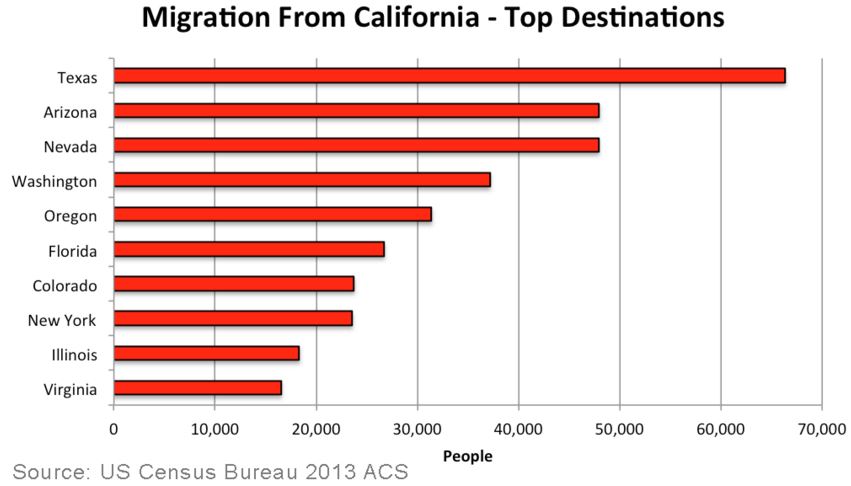
Migration from California to other states
Migration from California to other states – top 3 states are conservative states

A lot of young people seem to be really excited about socialism, and they want the United States to give it a try. They don’t know where socialism has been tried, and they don’t know what happens with it is tried. It just sounds nice to them.

Well, if you were going to pick one of the most socialist states in the United States, no one would fault you for picking California, where Democrats are running everything, and have been for a long time.

The Washington Free Beacon explains what happened next:

The number of Californians leaving the state and moving to Texas is at its highest level in nearly a decade, according to data from the Internal Revenue Service.

According to IRS migration data, which uses individual income tax returns to record year-to-year address changes, over 250,000 California residents moved out of the state between 2013 and 2014, the latest period for which data was available. The tax returns reported more than $21 billion in adjusted gross income to the IRS.

Of the returns, 33,626 reported address changes from California to Texas, which has been the top destination for individuals leaving California since 2007. Californians who moved to Texas between 2013 and 2014 reported $2.19 billion in adjusted gross income.

[…]“California’s taxes and regulations are crushing businesses, and there are more opportunities in Texas for people to start new companies, get good jobs, and create better lives for their families,” said Nathan Nascimento, the director of state initiatives at Freedom Partners. “When tax and regulatory climates are bad, people will move to better economic environments—this phenomenon isn’t a mystery, it’s how marketplaces work. Not only should other state governments take note of this, but so should the federal government.”

According to Tom Gray of the Manhattan Institute, people may be leaving California for the employment opportunities, tax breaks, or less crowded living arrangements that other states offer.

“States with low unemployment rates, such as Texas, are drawing people from California, whose rate is above the national average,” Gray wrote. “Taxation also appears to be a factor, especially as it contributes to the business climate and, in turn, jobs.”

“Most of the destination states favored by Californians have lower taxes,” Gray wrote. “States that have gained the most at California’s expense are rated as having better business climates. The data suggest that may cost drivers—taxes, regulations, the high price of housing and commercial real estate, costly electricity, union power, and high labor costs—are prompting businesses to locate outside California, thus helping to drive the exodus.”

Just recently, I heard some of my Democrat co-workers laughing to each other about “trickle-down economics”, which is the “ridiculous” idea that if you allow businesses and workers to keep what they earn, then you’ll get more economic growth than if the government takes the money to study the drug use patterns of sex workers in the far East. Actually, we’ve been trying socialism-lite in this country for the past 7 years. How has it worked? Well, Obama has averaged 1.2% GDP growth through his presidency, far below average. And in order to get even that little growth, Obama will double the debt from 10 to 20 trillion in just 8 years.
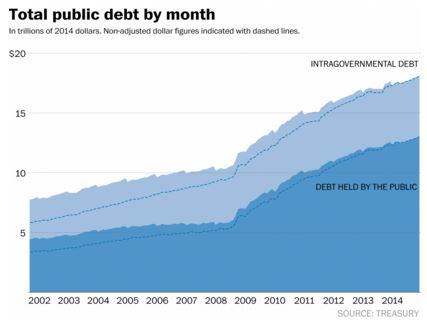
Debt increase under Barack Obama

But what about tax cuts? Do tax cuts create economic growth?

The conservative Heritage Foundation think tank describes the effects of the Bush tax cuts.

Excerpt:

President Bush signed the first wave of tax cuts in 2001, cutting rates and providing tax relief for families by, for example, doubling of the child tax credit to $1,000.

At Congress’ insistence, the tax relief was initially phased in over many years, so the economy continued to lose jobs. In 2003, realizing its error, Congress made the earlier tax relief effective immediately. Congress also lowered tax rates on capital gains and dividends to encourage business investment, which had been lagging.

It was the then that the economy turned around. Within months of enactment, job growth shot up, eventually creating 8.1 million jobs through 2007. Tax revenues also increased after the Bush tax cuts, due to economic growth.

[…]The CBO incorrectly calculated that the post-March 2003 tax cuts would lower 2006 revenues by $75 billion. Revenues for 2006 came in $47 billion above the pre-tax cut baseline.

Here’s what else happened after the 2003 tax cuts lowered the rates on income, capital gains and dividend taxes:

  • GDP grew at an annual rate of just 1.7% in the six quarters before the 2003 tax cuts. In the six quarters following the tax cuts, the growth rate was 4.1%.
  • The S&P 500 dropped 18% in the six quarters before the 2003 tax cuts but increased by 32% over the next six quarters.
  • The economy lost 267,000 jobs in the six quarters before the 2003 tax cuts. In the next six quarters, it added 307,000 jobs, followed by 5 million jobs in the next seven quarters.

The timing of the lower tax rates coincides almost exactly with the stark acceleration in the economy. Nor was this experience unique. The famous Clinton economic boom began when Congress passed legislation cutting spending and cutting the capital gains tax rate.

Regarding the “Clinton economic boom”, that was caused by supply-sider Newt Gingrich passing tax cuts through the House and Senate. Bill Clinton merely signed the bills into law.

Very important to compare times and places where socialism has been tried to times and places where free enterprise and limited government have been tried. We know what works. It may not be what makes us feel smug, but we know what works.


What happens when socialist governments runs out of other people’s money?

The face of socialism
The real face of socialism

Which socialist nation ran out of money? Brazil.

Investors Business Daily explains what happened next:

Back to the wall, Brazil’s biggest socialist manque, Luiz Inacio “Lula” da Silva, has issued a loud call for tax cuts to revive his nation’s moribund economy. Why is it it takes a depression and impending political doom for socialists to recognize the truth about tax relief?

Newly named as cabinet chief by embattled President Dilma Rousseff, the once-popular and much-hailed former socialist president told a press conference Monday that he wanted tax cuts (and more consumer credit) to revive Brazil’s economy. He’s got no support from Dilma’s finance chief, and he won’t improve anything with more consumer credit. But on taxes, you heard right, a heavy-duty socialist had just embraced supply-side economics as a proven means of reviving economic growth.

And no question he believed it: “I am convinced that I can contribute, and it will be possible to change the mood in this country in a few months,” Lula declared. Such a transformation could only come of a near-death experience. Which is about economic situation in Brazil right now.

The country isn’t just experiencing a bad recession. It’s heading for what qualifies as a depression — a third year of economic contraction, with another negative 3.66% of GDP forecast in 2016. Inflation has topped 10% and unemployment is above 18%. Both huge industries and small businesses have gone belly-up. More than half of Brazil’s 95 million consumer credit accounts are delinquent, and sovereign debt has been cut to junk.

Do tax cuts work? Only about every time they are tried. But what about raising taxes – what does that do?

According to the Tax Foundation’s William McBride, citing an aggregation of 26 studies, 26 tax hikes slashed economic growth in all but three instances, while cutting taxes consistently sets the stage for economic growth. McBride found that in one study, a 1% tax hike slashes GDP by 1.3%, while a 1% tax cut yields a 1.4% rise the first year and another 1.8% gain in the second.

McBride also found that the most powerful impact comes from cutting the corporate tax, which mainly affects investment and capital formation, the very thing Lula said Brazil needs. Corporate tax cuts also fuel startups and entrepreneurial activity.  Brazil’s corporate income tax is 34%, the 16th highest in the world last year.

The U.S. corporate tax rate is the third highest in the world, 39.1%. And we just got a number for the most recent GDP change in the US economy – 1.4%. The average GDP growth under Obama is much lower than under George W. Bush.

Real Clear Markets explains:

Right now, the nation is probably already in a recession. The BEA’s first estimate of 4Q2015 RGDP growth was only 0.69%, and there is mounting evidence that this will later be revised downward. However, making the wildly optimistic assumption that 2016 RGDP growth will come in at the CBO’s current forecast (2.67%), Obama will be the only U.S. president in history that did not deliver a single year of 3.0%+ economic growth.

Again, assuming 2.67% RGDP growth for 2016, Obama will leave office having produced an average of 1.55% growth. This would place his presidency fourth from the bottom of the list of 39*, above only those of Herbert Hoover (-5.65%), Andrew Johnson (-0.70%) and Theodore Roosevelt (1.41%)

No matter what happens in 2016, Obama’s record on economic growth will be considerably worse than that of the much-maligned George W. Bush. Bush 43 delivered RGDP growth averaging 2.10%, with two years (2004 and 2005) above 3.0%.

You might remember that Bush cut taxes by over $2 trillion, and that created 8.1 million new jobs before the Democrats took over the House and Senate in January of 2007. Obama? Our labor force participation is around a 38-year low. Economic growth creates jobs, and we haven’t had any under the socialist Barack Obama.

Anyway, enough of that. We’re hearing a lot about socialism these days, and how great it is.  The young people have been taught by their public school teachers and others about how great socialism is. But is it really? It seems to me that in order to make that decision, we should look at countries like Brazil and Argentina and Venezuela and Cuba – where socialism has been tried – and then decide based on their experiences. We know what creates economic growth, and that’s leaving the money in the hands of the people who earn it.

The biggest driver of income inequality is single motherhood

Does government provide incentives for people to get married?
Does government provide incentives for people to NOT get married?

Indian economist Aparna Mathur, whose work I’ve featured here before, writes about it in Forbes magazine.

Excerpt:

The fabric of our society is changing. In 1980, approximately 78 percent of families with children were headed by married parents. In 2012, married parents headed only 66 percent of families with children. In a new report, Bradford Wilcox and Robert Lerman explore the role of family structure with new data and analysis, and document how this retreat from marriage is not simply a social and cultural phenomenon. It has important economic implications for, amongst others, men’s labor force participation rates, children’s high school dropout rates and teen pregnancy rates. Since these factors are highly correlated with economic opportunity and the ability to move up the income ladder, this suggests that income inequality and economic mobility across generations are critically influenced by people’s decisions and attitudes towards marriage. Understanding the role of family structure is therefore key to understanding the big economic challenges of our time.

[…]Wilcox and Lerman document how the shift away from marriage and traditional family structures has had important consequences for family incomes, and has been correlated with rising family-income inequality and declines in men’s labor force participation rates. Using data from the Current Population Survey, the authors find that between 1980 and 2012, median family income rose 30 percent for married parent families, For unmarried parents, family incomes rose only 14 percent.

These differential patterns of changes in family income have exacerbated family-income inequality. Since unmarried parent families generally expand the ranks of low-income families, while high-income, high-education adults increasingly marry partners from similar socioeconomic backgrounds, inequality trends are worsened.

[…]The authors estimate that approximately 32 percent of the growth in family-income inequality between 1979 and 2012 is associated with changes in family structure. Other research, studying the period 1968-2000, finds that the changing family structure, accounted for 11 percent of the rise widening of the income gap between the bottom and top deciles.

So, what specific policies discouraged people from marrying, especially before they have children? Was it conservative policies or liberal policies?

Robert Rector explains in The Daily Signal.

He writes:

It is no accident that the collapse of marriage in America largely began with the War on Poverty and the proliferation of means-tested welfare programs that it fostered.

When the War on Poverty began, only a single welfare program—Aid to Families with Dependent Children —assisted single parents.

Today, dozens of programs provide benefits to families with children, including the Earned Income Tax Credit, Temporary Assistance for Needy Families, the Women, Infants and Children food program, Supplemental Security Income, food stamps, child nutrition programs, public housing and Section 8 housing, and Medicaid.

Although married couples with children can also receive aid through these programs, the overwhelming majority of assistance to families with children goes to single-parent households.

The burgeoning welfare state has promoted single parenthood in two ways. First, means-tested welfare programs such as those described above financially enable single parenthood. It is difficult for single mothers with a high school degree or less to support children without the aid of another parent.

Means-tested welfare programs substantially reduce this difficulty by providing extensive support to single parents. Welfare thereby reduces the financial need for marriage. Since the beginning of the War on Poverty, less-educated mothers have increasingly become married to the welfare state and to the U.S. taxpayer rather than to the fathers of their children.

As means-tested benefits expanded, welfare began to serve as a substitute for a husband in the home, and low-income marriage began to disappear. As husbands left the home, the need for more welfare to support single mothers increased. The War on Poverty created a destructive feedback loop: Welfare promoted the decline of marriage, which generated a need for more welfare.

A second major problem is that the means-tested welfare system actively penalizes low-income parents who do marry. All means-tested welfare programs are designed so that a family’s benefits are reduced as earnings rise. In practice, this means that, if a low-income single mother marries an employed father, her welfare benefits will generally be substantially reduced. The mother can maximize welfare by remaining unmarried and keeping the father’s income “off the books.”

For example, a single mother with two children who earns $15,000 per year would generally receive around $5,200 per year of food stamp benefits. However, if she marries a father with the same earnings level, her food stamps would be cut to zero.

I blogged recently about a study that was done to make sure that welfare programs really do discourage young people from marrying, and that’s exactly what the study found.

The authors of that study found that penalties to marriage “on the margin”, i.e. – at lower income levels where welfare could substitute for a husband – caused lower rates of marriage:

“The supposition that marriage penalties have an impact on decisions to marry gains credence from the simple fact that marriage rates are highest among higher-income groups that are less affected by them and for whom such penalties represent a smaller proportion of total income,” they wrote.

So you see, the thing the left complains about (income inequality) is actually the thing they do the most to cause. Their big spending on welfare programs for the poor makes it easier for them not to get married and stay married before they have children. This is true across all races, too. It’s an economic issue, not a race issue. People on the left are all about taxpayer-funded welfare programs and growing government to make more and more people dependent. They are causing the income inequality, and then complaining about what they have caused.

So what’s the answer? It seems to me that we should be paying people to do what is best for children – marriage. People do more of what they get rewarded for doing. Right now, we’re taking money from high-earning married couples, and paying people to have fatherless children. This creates more dependency, more poverty, and more income inequality. If we want to reduce income inequality, and for children to be happier, we should be encouraging people to marry.