Tag Archives: Socialism

Judge rules that man must pay $50,000 a month to ex-girlfriend for 10 years

When I was younger, I used to think that having definite views on morality and theology was a bad thing. I had my share of rejections by Christian women who didn’t like that I rejected universalism and annihilationism. Others didn’t like that I was pro-life. And today, most Christian women tell me that supporting gay rights is a non-negotiable for them. But maybe being alone was not all bad.

The news story is from one of Canada’s national newspapers, the National Post:

A wealthy businessman will have to pay more than $50,000 a month in spousal support for 10 years to a woman with whom he had a long-term romantic relationship even though they kept separate homes and had no children together, Ontario’s top court has ruled.

Under Ontario law, an unmarried couple are considered common-law spouses if they have cohabited — lived together in a conjugal relationship — continuously for at least three years. But that doesn’t necessarily mean living in the same home, the court found.

[…]When their 14-year relationship finally broke down in May 2015, Climans asked the courts to recognize her as Latner’s spouse and order him to pay her support. He argued she had been a travel companion and girlfriend, nothing more. As such, he said, they were never legally spouses and he owed no support. An eight-day trial ensued.

In her decision in February 2019, Superior Court Justice Sharon Shore sided with Climans. She ruled they were in fact long-time spouses, finding that despite their separate home, they lived under one roof at Latner’s cottage for part of the summer, and during winter vacations in Florida. Shore ordered him to pay her $53,077 monthly indefinitely.

Superior Court Justice Sharon Shore didn’t care that the man never married this woman, or lived with her, or had children with her. He had money, and she wanted it, so the judge gave it to her.

Elsewhere in the article, we learn that he had asked her to sign a pre-nuptial agreement many times, and each time she refused. (Those are not even enforced in divorce courts) It’s like her plan all along was to demand that a judge awarded her all of this man’s money.

Some people will say “well, these are Ontario family courts, this is normal. Haven’t you heard about what happened to Dave Foley?” I think every man knows the story of what the Ontario divorce courts did to Dave Foley.

Here is a story about it from the far-left Toronto Star, otherwise known as the Toronto Red Star.

It says:

Dave Foley of beloved Toronto sketch troupe the Kids in the Hall is starting a new career in standup comedy, but not in Toronto — he suspects he’ll be arrested if he returns to Canada.

The 48-year-old faces a back child-support bill in Ontario of more than half a million dollars: the accumulation of a debt that accrues steadily at more than $17,000 per month. On the set of Servitude, a film shot in Toronto last year, “I told the production guys, I have a court appearance on Monday and there’s a good chance I’ll be in jail on Monday afternoon,’” Foley said in an interview with the Star.

During an appearance on comic Marc Maron’s WTF podcast last month, Foley explained that his marriage to Toronto writer Tabatha Southey ended during his run on NBC’s five-year hit comedy NewsRadio, and he has failed in his efforts to adjust his child support downward to reflect his new life after sitcom stardom.

“My income has dropped in the last 10 years, as anyone can tell from the number of s—ty movies I’ve been in,” says Foley. “I’m not exactly picking and choosing my projects.” However, four years ago, Superior Justice Nancy Backhouse denied his motion to vary his support payments.

[…]Foley says that Ontario’s Family Responsibility Office now has an enforcement order and last year sought a six-month jail sentence for him, which was to extend indefinitely, until the overdue support was paid.

Ontario family courts are notoriously anti-male, and men know this. Unfortunately, the female judges who make these rulings don’t seem to understand that men know what they are doing, and then opt out of marriage. It must be so wonderful for these judges to punish the men who appear before them. But they can’t punish the men who respond to what they are doing by declining to marry women, and then declining to date women, and then declining to even speak to women.

I looked up Superior Justice Nancy Backhouse, and found another article about her decisions, entitled “Judge rejects pre-nup, awards ex-wife $5.3-million”. So, pre-nuptial agreements are also thrown out in Ontario divorce courts.

But it’s not just Ontario. I have two Christian friends here in America who married their Christian wives as virgins, and then their wives divorced them. I heard what happened to them in divorce court. They lost custody of their kids, and they are forced to pay alimony and child support even though their ex-wives poison the children against them, and deny them communication rights and visitation rights. And men know that this is happening to other men. How can women expect men to marry when the financial risks are so high?

Forbes magazine explains:

Of the 400,000 people in the United States receiving post-divorce spousal maintenance, just 3 percent were men, according to Census figures. Yet 40 percent of households are headed by female breadwinners — suggesting that hundreds of thousands of men are eligible for alimony, yet don’t receive it.

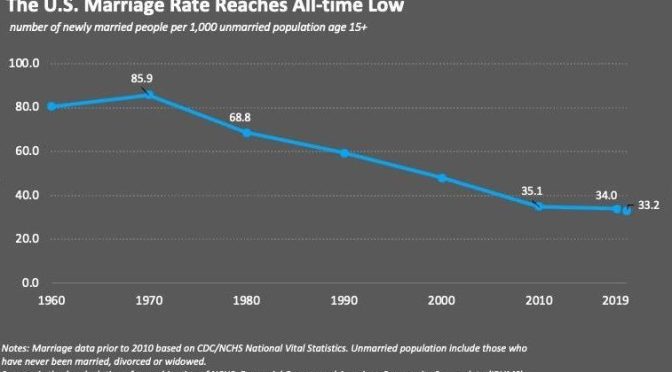
The divorced courts are biased against men, and men are getting the message. They look at these cases, and they understand that marriage is not worth the financial risks. They don’t want to have their possessions stolen by radical feminist judges.

Further reading

An excellent book to read about this issue is Dr. Stephen Baskerville’s book “Taken Into Custody: The War Against Fathers, Marriage, and the Family“. You can read what the book is about here. Dr. Baskerville is a Christian and a conservative. He has a PhD from London School of Economics, and teaches at Patrick Henry College, a conservative Christian college.

Two reasons why Christians and conservatives should not donate to United Way

Well, it’s that time of year again, when corporations bully their employees into donating to the United Way. I thought it might be a good idea to urge all Bible-believing Christians to avoid donating to the United Way.  Please share this post if you agree with it!

Let’s start with abortion. The United Way gives TONS of money to fund abortion providers.

In 2008, United Way affiliates send $1.9 million to Planned Parenthood:

The national United Way does fund Planned Parenthood; their website states:

United Way funded programs through Planned Parenthood include community health maintenance, e.g. communicable disease prevention; medical care service; family planning; health education; public awareness services; and family preservation and strengthening services, e.g. counseling and family life education.

Nationally in 2008, local United Ways distributed an estimated $1.9 million to Planned Parenthood agencies.

Any finances being donated to Planned Parenthood (even if not specifically for abortion services) will free up more of their money to be used toward abortion services.

In 2015, United Way sent $3 million to Planned Parenthood:

Last year, on the heels of shocking videos showing the Planned Parenthood abortion business selling the body parts of aborted babies, a new expose’ from a group that monitors corporations that finance the abortion giant reveals the United Way is a major donor. That expose found United Way agencies giving $2 million to the abortion giant.

A new expose’ released this week shows that figure has increased to $3 million.

In 2016, United Way sent $3 million to Planned Parenthood:

Analysis of the most recent IRS Form 990 filings and other documentation found 62 United Way affiliates sent $2,756,799 to Planned Parenthood abortion organizations in tax year 2016. 2ndVote’s latest findings indicate an increase of $168,806 from the $2,590,994 United Way funneled to Planned Parenthood in 2015.

We’re living in a time when abortion rights involves such issues as sex-selection abortions, race-selection abortions, covering up statutory rapists, Democrat support for infanticide, attacking Supreme Court nominee Brett Kavanaugh, selling the body parts of unborn babies, etc. I don’t think we can count on United Way to come down on the right side of these issues. We’re already being forced to fund abortions with our tax dollars, thanks to Democrats. I don’t think we should give any more money to abortion providers and their secular leftist allies.

That’s abortion. What about gay rights? We’ve seen a lot of pressure on traditional values coming from the secular left lately. They redefined marriage AGAIN to deprive children of their biological mothers or fathers. They’re pushing for the Equality Act, which would have huge religious liberty repercussions for Christians.

Texas attorney Maria Martinez explains on the American Thinker:

The Equality Act is more draconian that any state or city conversion therapy ban to date because it takes away the traditional constitutional exemption for religious freedom.  The act specifically states that the Religious Freedom Restoration Act (RFRA) may not be invoked as a defense, marking the first time in history that Congress has limited the reach of RFRA.  This means that it could become illegal for Christian pastors, churches, schools, and ministries to communicate a message that sexual orientation or gender identity can change.  The Equality Act is unprecedented in its overreach, impacting even adults who are willingly seeking counseling.

By contrast, therapy of any kind that pushes a person toward same-sex attraction or gender transition is not impacted by the law at all.

Banning counseling isn’t the only thing the Equality Act will do:

  • Parents could lose custody of their children if they decline to assist in their gender transition.  Parents in Ohio recently lost custody of their female child because they would not give her testosterone supplements to help her “transition” to look like a male.

  • Doctors and hospitals could be subject to lawsuits for refusing to perform so-called “sex change” surgeries.  In California and New Jersey, Catholic hospitals are already being sued for discrimination for refusing to perform these surgeries.

  • Battered women’s shelters could be required to admit members of the opposite sex.  In Anchorage, Alaska, a male who was refused access to a shelter for abused and trafficked women sued the shelter for “gender identity discrimination.”

  • Faith-based adoption and foster care agencies that believe that children do best with both a mother and a father could be forced to shut down.  This has already occurred in at least six states in this country.

I wonder what United Way thinks about attacks on Bible-believing Christians by LGBT activists? I posted what they shared on Facebook at the top of this post, and this is what I found on their Twitter:

United Way Twitter Gay Rights Pride Month LGBT

I don’t find that very encouraging, do you?

As a Bible-believing Christian, maybe I would be better off giving money to an organization that protects religious liberty, like Alliance Defending Freedom. I understand that many people who call themselves Christians think that the United Way’s positions are compatible with the Bible. But not everyone who calls herself a Christian actually takes the Bible seriously. Especially when it interferes with their career advancement and peer approval. This is especially true of people who work in Human Resources.

Please, don’t give money to the United Way

You don’t HAVE to give money to the United Way, just because the godless progressives in your office try to bully you into it. Instead, why not send the money to the Life Training Institute, or Ratio Christi, or Alliance Defending Freedom? These are groups do operate on Bible-based principles. I do think that Christians need to be careful about who they donate their money to. It doesn’t make sense for Christians to get up and go to work and earn money, and then give it away to anti-Christian groups who want Christianity to disappear from American life. Paul talks about how God rewards those who give gifts to partner for the gospel in Philippians. Make sure that you are not wasting your money on anything less.

How a small, poor country became the top economy in Latin America

One way to learn about whether specific economic policies work or not is to look at different countries that have tried them. Believe it or not, patterns do emerge about what works and what doesn’t work, as you look across different times and places. I’ve been reading a book called “Money, Greed and God” with my friend Carla, which talks about what has worked to reduce poverty.

The author basically outlined two approaches. In the first approach, the government 1) confiscates the wealth of the most productive workers, 2) nationalizes (takes control of) the businesses of the most successful entrepreneurs, 3) restricts trading between citizens and with other countries, with minimum wage, price controls and tariffs. In the second approach, the government does the opposite: 1) lowers taxes on the most productive workers, and 2) lets entrepreneurs compete to provide goods and services to consumers, and 3) lowers restrictions on internal trading and trading with other countries, e.g. – eliminating minimum wage, tariffs and price controls.

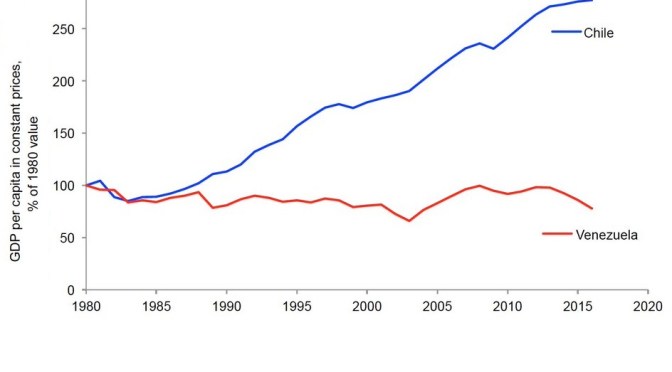
Let’s take a look at two Latin American countries that went in opposite directions. Venezuela and Chile. Then we can finally find out which policies actually achieve results for the people.

Here is how Chile started out in 1973.

PROBLEM: Price controls and tariffs:

Prices for the majority of basic goods were fixed by the government in 1973. Even though Chile was and still is a small economy, the level of protection­ism was high. By the end of 1973, the nominal average tariff for imports was 105 percent, with a maximum of 750 percent. Non-tariff barriers also impeded the import of more than 3,000 out of 5,125 registered goods. Just as economic theory predicts, large queues in front of stores were usual in Santiago and other cities in Chile as a result of the scarcity caused by price controls.

PROBLEM: Government taking over private businesses:

The decline in GDP during 1973 reflected a shrinking productive sector in which the main assets were gradually falling under government control or ownership through expropriations and other government interventions in the economy.

PROBLEM: Deficit spending and government printing money:

The fiscal situation was chaotic. The deficit reached 55 percent of expenditures and 20 percent of GDP and was the main cause of inflation because the Central Bank was issuing money to finance the government deficit.

SOLUTION: lower or eliminate restrictions on trade:

The most important economic reform in Chile was to open trade, primarily through a flat, low tar­iff on imports. Much of the credit for Chilean eco­nomic reforms in the following 30 years should be given to the decision to open our economy to the rest of the world. The strength of Chilean firms, productive sectors, and institutions grew up thanks to that fundamental change.

SOLUTION: let competing entrepreneurs in the private sector provide goods and services to consumers:

A second fundamental reform was to allow the private sector to recover, adding dynamism to the economy. In fact, important sectors such as elec­tricity generation and distribution and telecommu­nications were still managed by state companies. After we implemented a massive privatization plan that included more than 50,000 new direct share­holders and several million indirect (through pen­sion funds) shareholders, these companies were managed by private entrepreneurs that carried out important expansion plans.

SOLUTION: let people take responsibility for their own lives instead of depending on government:

The 1981 reform of the Chilean pension fund system deserves special mention. Under the leader­ship of Minister José Piñera, an individual capitali­zation account program was designed with specific contributions, administered by private institutions selected by the workers. The Chilean Administra­doras de Fondos de Pension (Pension Fund Administrators or AFP) has been replicated in more than 20 countries, and more than 100 million workers in different parts of the world use these accounts to save for retirement.

SOLUTION: allow parents to choose the school that fits their needs from competing education providers, and push school administration down from the federal government to the municipal level, where it would be more responsive to voter’s needs:

In 1981, Chile introduced a universal educational voucher system for students in both its elementary and secondary schools. At the same time, the central government transferred the administration of public schools to municipal governments…  The financial value of the voucher did not depend on family income.

RESULTS: And I was able to find a nice short, description of how all that worked out for them on the far-left Wikipedia, of all places:

The economy of Chile is a high-income economy as ranked by the World Bank, and is considered one of South America’s most stable and prosperous nations, leading Latin American nations in competitiveness, income per capita, globalization, economic freedom, and low perception of corruption.

In 2006, Chile became the country with the highest nominal GDP per capita in Latin America. In May 2010 Chile became the first South American country to join the OECD. Tax revenues, all together 20.2% of GDP in 2013, were the second lowest among the 34 OECD countries, and the lowest in 2010. In 2017, only 0.7% of the population lived on less than US$1.90 a day.

According to the Heritage Foundation, Chile is ranked as the 18th freest economy in the world. The World Bank ranked Chile as the 50th highest GDP per capita for 2018, just below Hungary and above Poland.

Now, you can contrast those results with Venezuela. I have been blogging about Venezuela for years on this blog, and documenting how they raised taxes, banned guns, nationalized private sector companies, raised tariffs, and increased regulations. They are now ranked JUST ABOVE NORTH KOREA for economic freedom – #179 out of 180 countries measured. Basically, they did the opposite of everything that Chile did – transferring power away from parents, workers, business owners, churches and municipal governments to the powerful centralized federal government.

Wikipedia explains how Hugo Chavez took over in 1999 and enacted a communist revolution.

More:

Since the Bolivarian Revolution half-dismantled its PDVSA oil giant corporation in 2002 by firing most of its 20,000-strong dissident professional human capital and imposed stringent currency controls in 2003 in an attempt to prevent capital flight, there has been a steady decline in oil production and exports. Further yet, price controls, expropriation of numerous farmlands and various industries, among other government authoritarian policies… have resulted in severe shortages in Venezuela and steep price rises of all common goods, including food, water, household products, spare parts, tools and medical supplies; forcing many manufacturers to either cut production or close down, with many ultimately abandoning the country as has been the case with several technological firms and most automobile makers.

They confiscated private property, took over private sector businesses, implemented tariffs and price controls, redistributed wealth via massive welfare programs, and pushed all decision-making out of families and municipal governments up to the federal government. By depriving the producers of their earnings, the country caused massive shortages of goods and services, to the point where people are fleeing the country, consuming zoo animals, and selling their bodies as prostitutes in order to get food and water.

Application

In the next election, we are not picking a tribe because of how they make us feel about ourselves. We are not choosing in order to see ourselves as “nice” and “not nice”. We need to look at specific policies being proposed, and see what works and what doesn’t work. The examples of Chile (rags-to-riches) and Venezuela (riches-to-rags) are helpful for voters who want to get RESULTS instead of FEELINGS.

I’ll leave you with a list of links from previous posts so you can see how communism worked out for Venezuela.

Related posts