At a recent symposium, Intel boss Paul Otellini, a contributor to both parties, expressed concern about the “amount of variability in the system” created by the state of policy flux in healthcare, energy and tax policy. “It is very difficult to make a hiring decision,” he said. General Electric chief executive Jeffery Immelt, a strong supporter of Obama’s cap-and-trade proposal, added he would just like to “know what the rules are.”
All in all, a disturbing replay of the 1930s when FDR’s big changes left business reeling with uncertainty and confusion. The “devil you don’t know” and all that.
Small business is certainly with Big Business on this, particularly regarding the mercurial nature of healthcare reform. The substance of ObamaCare continues to morph daily — from the state of the public option to employer mandates to financing expanded coverage – as Senate leader Harry Reid scrounges for votes. On energy, the president will make big promises at Copenhagen even though cap-and-trade looks stillborn in the Senate.
As for financial reform, Senate banking committee chair Chris Dodd has proposed sweeping changes, while the Tim Geithner-Barney Frank version in the House seems beamed in from a universe where the credit crisis never happened. Compromise could prove elusive. Even Obama’s tax reform panel has delayed releasing its findings.
The thing you have to understand about business is that finding and hiring an employee is an expensive process. If this employee has to be laid off later because of government increasing tax rates or regulations, then that layoff poisons the atmosphere in the entire company. If you want businesses to feel comfortable about hiring, you need to convince them that you aren’t going to raise their taxes or expenses, unionize their work force, fine them for hurting the environment, or pass laws that encourage their employees to sue them for being offended, etc.
Legislative initiatives like card-check, health care mandates, cap-and-trade, ENDA, increased government spending, tariffs, “pay equity” laws, restrictions on executive salaries, capital gains tax hikes, etc., make businesses very risk-averse about hiring decisions. If Obama wants to attack businesses, these businesses may just leave the USA and set up shop elsewhere. But more likely they will just stay here and avoid hiring any new employees until the 2012 election.
The Congressional Budget Office figures the House program will cost $1.055 trillion over a decade, which while far above the $829 billion net cost that
[…]All this is particularly reckless given the unfunded liabilities of Medicare—now north of $37 trillion over 75 years.
[…]As for Medicaid, the House will expand eligibility to everyone below 150% of the poverty level, meaning that some 15 million new people will be added to the rolls as private insurance gets crowded out at a cost of $425 billion. A decade from now more than a quarter of the population will be on a program originally intended for poor women, children and the disabled.
[…]All told, the House favors $572 billion in new taxes, mostly by imposing a 5.4-percentage-point “surcharge” on joint filers earning over $1 million, $500,000 for singles. This tax will raise the top marginal rate to 45% in 2011 from 39.6% when the Bush tax cuts expire—not counting state income taxes and the phase-out of certain deductions and exemptions. The burden will mostly fall on the small businesses that have organized as Subchapter S or limited liability corporations, since the truly wealthy won’t have any difficulty sheltering their incomes.
This surtax could hit ever more earners because, like the alternative minimum tax, it isn’t indexed for inflation. Yet it still won’t be nearly enough. Even if Congress had confiscated 100% of the taxable income of people earning over $500,000 in the boom year of 2006, it would have only raised $1.3 trillion. When Democrats end up soaking the middle class, perhaps via the European-style value-added tax that Mrs. Pelosi has endorsed, they’ll claim the deficits that they created made them do it.
Under another new tax, businesses would have to surrender 8% of their payroll to government if they don’t offer insurance or pay at least 72.5% of their workers’ premiums, which eat into wages. Such “play or pay” taxes always become “pay or pay” and will rise over time, with severe consequences for hiring, job creation and ultimately growth. While the U.S. already has one of the highest corporate income tax rates in the world, Democrats are on the way to creating a high structural unemployment rate, much as Europe has done by expanding its welfare states.
Meanwhile, a tax equal to 2.5% of adjusted gross income will also be imposed on some 18 million people who CBO expects still won’t buy insurance in 2019. Democrats could make this penalty even higher, but that is politically unacceptable, or they could make the subsidies even higher, but that would expose the (already ludicrous) illusion that ObamaCare will reduce the deficit.
$1,650,971,205,167 added to the national debt, bringing the total to $7.5 trillion.
99 banks taken over by the Federal Deposit Insurance Company.
684 banks receiving support from the Troubled Asset Relief Program that doesn’t buy troubled assets.
11.2 percent: the percentage of the federal deficit to GDP. This is the highest that ratio has been since Japan surrendered in 1945.
$164 billion spent out of the entire $787 billion in stimulus funding in the American Recovery and Reinvestment Act. Most of this has gone to Medicaid, unemployment and the Making Work Pay Tax Credit.
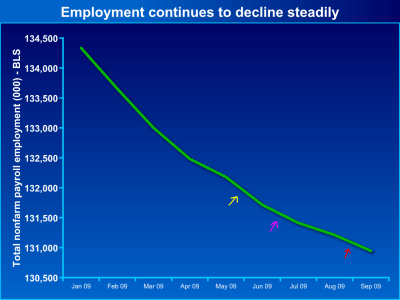
Here’s the graph of total employment since Obama took office:
Employment has declined steadily since Obama took office
Now, you may be hearing Obama say that we’ve turned the corner on unemployment. For instance, look at how the White House is spinning this graph.
Hennessey writes:
Check out the slightly different slopes of the three line segments indicated by arrows. The purple arrow shows a segment that slopes downward slightly less than the yellow arrow. A mathematician would say the shift from yellow to purple was an inflection point, shifting the curve from convex to concave.
This is what led the President in early August to say the economy was “pointed in the right direction.” The red arrow shows the worse news of last Friday’s jobs report, with a line that slopes downward slightly more sharply. The curve shifted back to a convex shape, in which the slope was more sharply downward than in the prior month.
If you’re saying to yourself, “That’s ridiculous! They’re all going down, and the differences in slopes are almost too hard to see!” then you’ve got my point.
And below I’m going to explain why Obama’s massive government spending created this worsening unemployment.
Economics in One Lesson
We are going to have to pay for all this spending on Obama’s favored special interest groups eventually, and that means that taxes will go up, or that the value of the dollar will go down, due to inflation. It has to be one or the other or both. There is no third way. When employers see that higher taxes or inflation are coming, they stop hiring people because they know that higher taxes and/or inflation kills the economy.
Perhaps it is time to review Henry Hazlitt’s Economics in One Lesson, chapter 4, entitled “Public Works Mean Taxes”.
Excerpt:
Therefore, for every public job created by the bridge project a private job has been destroyed somewhere else. We can see the men employed on the bridge. We can watch them at work. The employment argument of the government spenders becomes vivid, and probably for most people convincing. But there are other things that we do not see, because, alas, they have never been permitted to come into existence. They are the jobs destroyed by the $10 million taken from the taxpayers. All that has happened, at best, is that there has been a diversion of jobs because of the project. More bridge builders; fewer automobile workers, television technicians, clothing workers, farmers.
And consider Chapter 5 as well, entitled “Taxes Discourage Production”.
In our modern world there is never the same percentage of income tax levied on everybody. The great burden of income taxes is imposed on a minor percentage of the nation’s income; and these income taxes have to be supplemented by taxes of other kinds. These taxes inevitably affect the actions and incentives of those from whom they are taken. When a corporation loses a hundred cents of every dollar it loses, and is permitted to keep only fifty-two cents of every dollar it gains, and when it cannot adequately offset its years of losses against its years of gains, its policies are affected. It does not expand its operations, or it expands only those attended with a minimum of risk. People who recognize this situation are deterred from starting new enterprises. Thus old employers do not give more employment, or not as much more as they might have; and others decide not to become employers at all. Improved machinery and better-equipped factories come into existence much more slowly than they otherwise would. The result in the long run is that consumers are prevented from getting better and cheaper products to the extent that they otherwise would, and that real wages are held down, compared with what they might have been.
There is a similar effect when personal incomes are taxed 50, 60 or 70 percent. People begin to ask themselves why they should work six, eight or nine months of the entire year for the government, and only six, four or three months for themselves and their families. If they lose the whole dollar when they lose, but can keep only a fraction of it when they win, they decide that it is foolish to take risks with their capital. In addition, the capital available for risk-taking itself shrinks enormously. It is being taxed away before it can be accumulated. In brief, capital to provide new private jobs is first prevented from coming into existence, and the part that does come into existence is then discouraged from starting new enterprises. The government spenders create the very problem of unemployment that they profess to solve.
What Obama did, in effect, is to fire all of those millions of private sector people, so that he could reward the people who voted for him. And jobs are created far more efficiently by small businesses than they are by big government. What creates new jobs is entrepreneurs with ideas who hire people. And government spending diverts money away from these efficient entrepreneurs and towards inefficient government bureaucracies.

 WINTERY KNIGHT