

Tag Archives: Sex

Study: women who have fewer premarital sex partners have lower risk of divorce

Man helping a woman with proper handgun marksmanship

Consider this article from Family Studies that talks about how the number of pre-marital sex partners that a woman has increases her risk of divorce.

It says:

American sexual behavior is much different than it used to be. Today, most Americans think premarital sex is okay, and will have three or more sexual partners before marrying. What, if anything, does premarital sex have to do with marital stability?

This research brief shows that the relationship between divorce and the number of sexual partners women have prior to marriage is complex. I explore this relationship using data from the three most recent waves of the National Survey of Family Growth (NSFG) collected in 2002, 2006-2010, and 2011-2013. For women marrying since the start of the new millennium:

  • Women with 10 or more partners were the most likely to divorce, but this only became true in recent years;
  • Women with 3-9 partners were less likely to divorce than women with 2 partners; and,
  • Women with 0-1 partners were the least likely to divorce.

Earlier research found that having multiple sex partners prior to marriage could lead to less happy marriages, and often increased the odds of divorce.

[…]Even more noteworthy has been the decline in the proportion of women who get married having had only one sex partner (in most cases, their future husbands). Forty-three percent of women had just one premarital sex partner in the 1970s.

[…]By the 2010s, only 5 percent of new brides were virgins. At the other end of the distribution, the number of future wives who had ten or more sex partners increased from 2 percent in the 1970s to 14 percent in the 2000s, and then to 18 percent in the 2010s. Overall, American women are far more likely to have had multiple premarital sex partners in recent years (unfortunately, the NSFG doesn’t have full data on men’s premarital sexual behavior, and in any event they recall their own marital histories less reliably than do women).

Here’s the change:
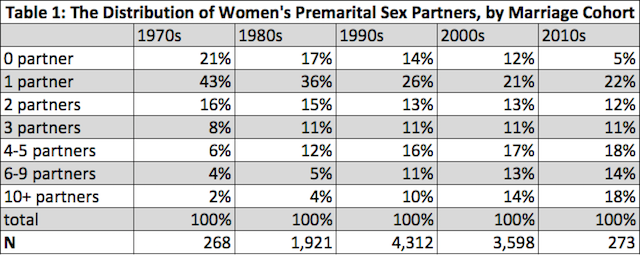
Women have freely chosen to dismiss the Bible and the moral law

And the problem with this, of course, is that more premarital sex partners means a higher risk of divorce:
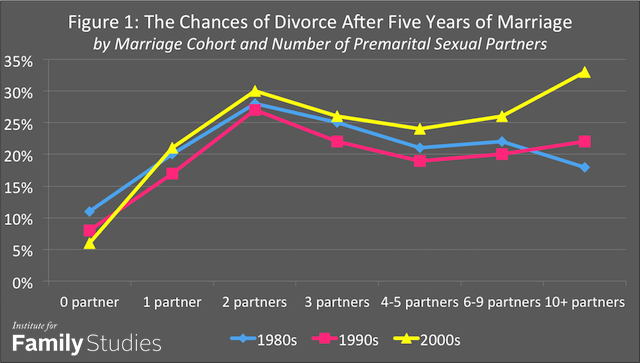
Even one non-husband premarital sex partner raises risk of divorce

Why is the 2-partner number so high?

In most cases, a woman’s two premarital sex partners include her future husband and one other man. That second sex partner is first-hand proof of a sexual alternative to one’s husband. These sexual experiences convince women that sex outside of wedlock is indeed a possibility. The man involved was likely to have become a partner in the course of a serious relationship—women inclined to hook up will have had more than two premarital partners—thereby emphasizing the seriousness of the alternative.

The Christian Post had an article about some recent numbers from the Centers for Disease Control about virgins.

Excerpt:

A new Centers for Disease Control study examines teenage health behaviors in connection to their self-reported sexual activity and shows those who remain abstinent are much healthier on many fronts than their sexually active peers.

The report, titled “Sexual Identity, Sexual Contacts, and Health-Related Behaviors Among Students in Grades 9-12, United States and Selected Sites,” showcased the results from a 2015 survey that monitored several categories of health-related behaviors like tobacco usage, drug and alcohol use, sexual habits, unhealthy dietary behaviors, and behaviors that contribute to unintentional injuries and violence.

The report concludes “that students who had no sexual contact have a much lower prevalance of most health-risk behaviors compared with students” who had sexual contact.

The article quotes Dr. Jennifer Roback Morse, who I have featured on this blog many times:

In a Monday interview with The Christian Post, Jennifer Roback Morse, founder and president of the Ruth Institute, said, “this study is remarkable because it asks questions and reports the answers, rather than avoiding questions or assuming answers.”

As Glenn Stanton noted last week in The Federalist, the results from those questions and answers are remarkable.

With regard to smoking, teenage virgins are 3,300 percent less likely to smoke daily than their peers who are sexually involved with someone of the opposite sex, Stanton computed from the report’s data. Teen virgins are 9,500 percent less likely to smoke daily than their peers who are sexually involved with someone of the same sex or in a bisexual relationship, he added. Chaste young people are also extremely less likely to use indoor tanning beds, binge drink, smoke marijuana, ride in cars as passengers with a drunk driver, and get into physical fights than their sexually active peers. Abstinent youth are also more likely to get a solid eight hours of sleep every night and eat breakfast daily.

[…]The CDC report also included findings from 25 state surveys, and 19 large, urban school district surveys conducted among students in grades 9–12 which took place between December of 2014 and September of 2015.

Now, many pro traditional marriage people will tell young men “feminism and the sexual revolution change nothing about a woman’s suitability for marriage, so go out there and get married to these women anyway”. In my experience, no one is telling women NOT to follow their hearts, and explaining to them the harm that they do by allowing their feelings to determine who they will engage in relationships.

I would like to see women make better decisions with men before they marry, rather than be influenced by their peers and culture to give themselves to men who are not marriage-minded. Maybe a little skepticism should be shown to “follow your heart”? Women need to understand what they are losing when they choose to have premarital sex.

In my group of friends, the men are aware of the Biblical prohibition on premarital sex. My friends know about the research on marriage, and what it takes to make a marriage work. We don’t follow our hearts, because we do what we know will work to achieve the results we want. We don’t listen to the culture, and we don’t listen to radical feminists. Men generally take an engineering approach to marriage – we want to know what the best practices and tradeoffs are, and then we plan and act to succeed.

Study: marriages where husband does not work full-time more likely to end in divorce

Air Force TACPs confirm target locations with their map

This was reported in Family Studies.

Excerpt:

In a recent study published this July in American Sociological Review, Harvard sociology professor Alexandra Killewald, Ph.D., analyzed data on 6,309 heterosexual married couples from the 1968 to 2013 waves of the Panel Study of Income Dynamics (PSID). She looked specifically at the potential effects on marital stability of “spouses’ division of labor, overall financial resources, and wives’ economic prospects following divorce,” comparing couples married before 1975 to those married in 1975 or later (through 2011).

[…]Killewald found that for couples married in 1975 or later, marriages in which the husband was not employed full-time were one-third more likely to divorce. Specifically, a husband who was not employed full-time experienced a “3.3 percent predicted probability of divorce the following year, compared to 2.5 percent if he is employed full-time.”

[…]Killewald is certainly not the first to find an association between men’s employment and marital stability. A study conducted by three economists and published in 2015 found that “In couples where the wife earns more than the husband, the wife spends more time on household chores; moreover, those couples are less satisfied with their marriage and are more likely to divorce.”

And an earlier study by Liana C. Sayer, Paula England, Paul Allison and Nicole Kangas found that when a husband is “nonemployed” (defined as not working at all), both the husband and the wife are more likely to end a marriage. In an email interview with IFS, one of the study’s co-authors, New York University sociology professor Paula England, explained her findings.

“The innovation of our study was to look separately at what predicts a divorce wanted more by the woman versus a divorce wanted more by the man,” England wrote. “We found that a nonemployed man predicts either the woman leaving the man or the man leaving the woman.”

She continued, “Killewald’s data just show her if they got divorced, not who left. We found that women’s employment doesn’t make men leave more, and it only makes women leave more when they are unhappy in the marriage.”

People sometimes ask me why I have all these rules and best practices when it comes to relationships and marriage plans. You know: men must have STEM degrees, no sex before marriage, men have to approach women by speaking to fathers first, etc. Well, why have all these rules? Why not just do what feels good? Why not just do what my peers will approve of?

The answer is this: don’t get your ideas about relationships and marriage from your feelings, your peers or the culture. Think for yourself.

I didn’t get my idea of how courting and marriage works from a culture that dismisses all of the ancient wisdom about love and marriage in favor of the trends of a culture dominated by ideologies that emphasize pleasure over wisdom. The right way to learn about romance, love, marriage and parenting is to go the classics, and then to the scientific studies. We have to learn how the world really works, and abide by the best practices that we find in the classics and in the peer-reviewed publications. And we have to be willing to say no to feelings and friends and even family, when the classics and the peer-reviewed literature say something different. Peer-reviewed studies matter: we cannot escape them by feelings or by peer approval or by cultural trends.

The big problem with this Peter Pan, Disney princess view of relationships popular with women (Christian and non-Christian) is children. Children deserve to have parents who are wise and self-controlled, willing to do things the right way. You can’t break all the rules and then expect things to somehow magically work out because you feel that they will somehow. The rules are there for a reason. If a man cannot demonstrate that he is serious about the husband role by showing you a resume with 5 years of full-time private sector experience in a STEM or vocational job, and $50,000 net worth, then he’s not fit for the role of husband. Women need to rule out every man who has not demonstrated his ability as a provider and saver, then choose from the ones who are left by evaluating for other criteria. Feelings of attraction based on “hot” appearance, non-judgmentalism, liberal politics and lack of leadership, (which often goes along with lack of planning), are not signs that a man is qualified for husband and father roles. Women today have things exactly backwards when choosing men. If your goal is marriage, choose a man who has demonstrated ability to do marriage tasks – like working full time and not wasting all his earnings on fun and thrills.

Two reasons to avoid premarital sex: trust issues and contact with exes

I have a key that will unlock a puzzling mystery

This is from Family Studies blog.  (H/T Brad Wilcox)

Excerpt:.

My own research with working-class young adults leads me to believe that they have basically made peace with sexual permissiveness—at least outside of marriage—even as they retain some ambivalence about it. They tend to move in quickly with new romantic partners, even as they worry that people rush too quickly into relationships. From survey data, we know that people without a college education have more lifetime sexual partners than those with a college education, and that most of them see no problem with premarital sex.

But there is one problem: easy access to sex with multiple partners can make for complicated relationships. As sexual partners accumulate, so does the potential for distrust. As one man whose ex-girlfriend had cheated on him explained, “It’s gonna take a lot more time for me to ever trust somebody again like that. I let her in quick, and now it’s never gonna happen again.” One divorced man said simply, “Everyone has to watch their ass all the time.” There is the feeling that no one is safe—even in marriage. As another young man claimed, “Nowadays, even though you got a ring on your finger, people tend to look past that.”

So people describe keeping vigilant watch over their partners’ cell phones, policing for messages from exes. They live an all but married lifestyle, yet they say that they are hesitant to make the commitment of marriage. Why? Part of the reason is that they don’t trust their partner, or themselves, to remain in the marriage. In one survey, 42.5 percent of low-income, unmarried respondents cited “worry that the marriage would end in divorce” as a reason they might not be pursuing marriage, and 23.5 percent cited “questions about whether your partner is trustworthy.” As one young man that I interviewed said after learning that his fiancée was cheating on him, “I don’t trust nobody.”

That distrust is at least partly the legacy of the libertarian sexual ethic, which assumes that sexual activity outside of marriage is typically okay so long as people are mutually consenting to the acts. And that distrust is why I have a hard time believing—as Noah Smith does—that sexual permissiveness will somehow evolve into more stable marriages for the working class. (Indeed, having more sexual partners prior to marriage is linked to greater odds of divorce, as Nicholas Wolfinger and W. Bradford Wilcox recently documented.) There is no invisible hand that will transform James and Jessica’s distrust and cynicism, which stems in part from their multiple past sexual relationships, into trust and an enduring marriage. What the working class needs—what we all need—to achieve our shared aspirations for lifelong love and a stable family is social permission to date without immediately having sex.

That’s important because today young people often assume that withholding sex is a sign of distrust. As James said, if you begin a relationship and don’t have sex, “they automatically assume that you’re cheating.”  But sliding into sex often translates into sliding into a relationship—and children—without first building trust and discerning for character and compatibility. And that slide often contributes to the erosion of trust in the opposite sex and in lifelong love. We must confront that reality if we’re serious about empowering working young adults to achieve trusting relationships.

“Withholding sex” makes it sound bad. You don’t have sex or even do sexual things before marriage because you are trying to prove to your partner that you have self-control enough that when you are married, he/she need not be concerned that you are OK with sex outside of a lifelong commitment. You restrain yourself in order to prove to the other person that you have what it takes in order to be trusted, and the other person does the same to you. It’s not that you are trying to reduce the amount of “fun” you are having, it’s that you are auditioning for a role, and this is what the other person needs to see from you during the courtship – chastity. Chastity demonstrates to them that the commitment you are offering is not based on things that fade, like beauty or youth.
