
Tag Archives: Self-Denial

Should Christians be motivated by the fear of missing out (FOMO)?

Bible study that hits the spot

My best friend Dina and I recently spent some time talking over some articles that we found on the culture. We specifically talked about what is motivating young people, so I wanted to write something about that.

FOMO: Fear Of Missing Out

Here’s a leftist New York Times article explaining where FOMO comes from:

It’s known as FOMO, or “fear of missing out,” and refers to the blend of anxiety, inadequacy and irritation that can flare up while skimming social media like Facebook, Twitter, Foursquare and Instagram. Billions of Twitter messages, status updates and photographs provide thrilling glimpses of the daily lives and activities of friends, “frenemies,” co-workers and peers.

[…]When we scroll through pictures and status updates, the worry that tugs at the corners of our minds is set off by the fear of regret, according to Dan Ariely, author of “Predictably Irrational” and a professor of psychology and behavioral economics at Duke University. He says we become afraid that we’ve made the wrong decision about how to spend our time.

[…]A friend who works in advertising told me that she felt fine about her life — until she opened Facebook. “Then I’m thinking, ‘I am 28, with three roommates, and oh, it looks like you have a precious baby and a mortgage,’ ” she said. “And then I wanna die.”

It’s like they want to run a race to do fun and exotic things with their peers, and not finish last.

Anyway, I want to begin this post with examples of FOMO behavior I have personally encountered.

FOMO Travel

Dina and I read and discussed this article by Alain de Botton in The European – notice the emphasis on travel and having fun, sophisticated experiences:

We’re continually being bombarded with suggestions about what we might do (go jet skiing, study in Colorado, visit the Maldives or see the Pyramids). We’re always hearing of the amazing things friends have done or are going to do: ‘there was this great bar we all went to …’; ‘she’s getting married in a little country church, then we’re having a picnic…’; ‘the sun was glinting on Sydney Harbour…’ There are endless hints of the allure of life in other places: an article about family-friendly restaurants in Brooklyn, a crime novel set in Trieste, the departure board at the airport with its list of places only a plane trip away: Moscow, Bangkok, Addis Ababa… The modern world makes sure we know at all times just how much we’re missing. It is a culture in which intense and painful doses of FOMO (Fear Of Missing Out) are almost inevitable.

What’s interesting is this – how does FOMO travel affect young, unmarried Christians?

Travel through missions work seems to be the FOMO activity of choice for at least a few young, unmarried Christians. One of my best friends who is married to another of my best friends told me about her missions trip to a European country. I asked her why she did it, since it meant lost savings, lost earnings, lost work experience, etc. (She gave up a year of earnings, and she had a great job in engineering). Her answer was that she did it for the adventure. I have a hard time hearing Jesus say that he was going to do something because he was bored and wanted an adventure. Especially when it’s $30,000 in costs, $60,000 of lost income, and lost work experience – per year. This was before the time of the Internet, though, when missionary work actually made sense. I just don’t think it’s worth spending that kind of money for the impact you make. The people I know who went on missionary trips just wanted to feel spiritual, look spiritual, and have a fun “life experience” vacation. One missionary told me that she was desperate to get away from her boring mid-Western roots.

If you really want to share Christ effectively with people in other countries, then you can start a blog and pay the tiny costs for it out of your earnings from your day job – that’s what I do. I get more people from Europe reading my blog than I could contact in a year of missionary work. I Skype with the people who are interested in Christianity from these countries (Scotland, Northern Ireland, England, Canada, etc.), as well. Meanwhile, I keep working my not-exciting job, so my savings increase, and my resume remains gap-less. This is good stewardship of finances, and self-denial prepares your character for the hard work of marriage and parenting. The Bible says that those who do not work should not eat. And Paul says that he built tents so that no one could accuse him of taking on missionary work for financial gain.

You can tell whether a person is sincere in their missionary intentions by looking at how responsible they’ve been in their decision-making. If a person has gone into debt paying for fun, thrilling activities like skydiving, ziplining, surfing, etc., then it’s FOMO travel. We must look past the spiritual smokescreen, and tell young people to grow up.

After all, if defending God’s honor was the missionary’s main goal, then the real battlefield would be the university.

Bill Craig puts it best:
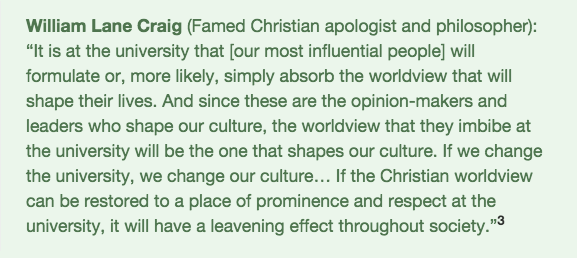
If serving God is your goal, look to the university

There is already a perfectly fine university right next door – no need to fly to Europe to find one! Remember, the university that took your faith away, or maybe the faith of someone you cared about? Yeah, it’s still sitting there in your home town! And it’s still ruining the lives of thousands of young people, by peer-pressuring them into secular, liberal views – and behaviors. It seems to me that it’s better stewardship to stay here and work, then give money to groups like Reasonable Faith. And you can start a blog, teach in church and invite scholars to the local university, too. That costs almost nothing, and it produces better results.

What about Jesus?

Sometimes, it’s a good idea to look beyond the words of the Bible and reflect on the overall message of it at a higher level. When I look in the Bible, I see that Jesus went through a lot of suffering in obedience to God in order to secure the salvation of people who did not even like him. And it’s from this sacrifice on our behalf that his claim on our obedience comes. There are things that I don’t like to do that I do anyway because they work to serve God. Jesus life’s ambition was not to do things that were easy, or that made him happy. Experienced Christians do things that are not fun, because these things are right and because they solve the real problem.

Andy Bannister and Michael Ruse discuss how atheists find meaning in life

Two horses fight it out, may the best horse win!
Two horses fight it out, and may the best horse win!

I’m summarizing the most recent episode of the Unbelievable show.

Details:

Atheist philosopher Michael Ruse joins Justin as we spend a second week looking at Andy Bannister’s new book ‘The atheist who didn’t exist’.

Its amusingly titled chapters include ‘The Peculiar Case of the Postmodern Penguin (or: Why Life without God is Meaningless). Michael and Andy debate whether it’s a problem that atheists can’t have meaning with a ‘capital M’.

Here is a summary of the discussion between Ruse and Bannister, and my comments below the summary.

The MP3 file is here.

Summary:

  • Ruse: ultimate questions are serious questions, and some religions are attempting to provide serious answers to those questions
  • Ruse: there is a psychological element to belief in God but it’s not a complete explanation, but it can apply to non-belief as well
  • Bannister: there are psychological reasons why people would prefer unbelief (quotes Thomas Nagel and Aldous Huxley)
  • Bannister: (to Ruse) what do you think would follow next if you got new information that caused you to believe in God?
  • Ruse: I’d feel scared, I’d think of all the reasons that God would dislike me, rather than any reasons why God would save me
  • Bannister: according to the Bible, God is not so much interested in mere belief, but in active trust in him
  • Ruse: without being smug, I just completed 50 years as a college professor of philosophy, and I have a sense of worth from that
  • Ruse: if God turns up, and says that 50 years of being a professor is not good enough, well, I don’t know God, I’m sorry, I did my best
  • Brierley: Andy, explain to us this story of how a penguin explained to you how he invented a subjective meaning in life for himself?
  • Brierley: (reads the story)
  • Bannister: when it comes to reading a book, the real meaning is the meaning the author intended the book to have
  • Bannister: readers can inject their own meaning into the book that has nothing to do with it, but the author gives the real meaning
  • Bannister: meaning in life is like reading a book – you can make up your own meaning, but the author’s meaning is the real meaning
  • Brierley: (to Ruse) on atheism, is there any objective meaning?
  • Ruse: “obviously, someone like myself cannot have meaning with a capital M in that sense”
  • Ruse: the real question is and atheist can find a sense of self-worth, “I find that I’m happier within myself, I can find meaning”
  • Bannister: what would you say to someone who drinks away the family inheritance and gets the same sense of happiness you have?
  • Bannister: what would you say to all the people who are unable to get “a sense of self-worth” from their career, because of where they are born, sickness, etc.
  • Ruse: I have nothing to offer them, some people are born into such awful situations that they are bound to be bad people
  • Ruse: these unfair accidents of birth, etc.,  fits with atheism better
  • Ruse: what we should do is change society so that more people can build a sense of self-worth through achievements
  • Ruse: that way, they can say to God “I used my talents” so they can create feelings of self-worth and happiness (apart from God)
  • Bannister: meaning in life cannot be answered without answering questions related to identity, value, which are rooted in the overall worldview
  • Bannister: on the Christian worldview, you have an infinite worth, your value isn’t determined by circumstances, earnings, friends, etc.
  • Bannister: your value comes from what Jesus was willing to pay to save you, namely, giving his own life for you
  • Bannister: when I travel to meet other Christians in other parts of the world, they have a happiness that should not be there if they are getting happiness from wealth, fame, achievements, etc.
  • Bannister: but when you come to the West, many people who have wealth, fame, achievement, etc. are unhappy
  • Ruse: well maybe who look after a flock of sheep every day may get a sense of self-worth from that, or from other jobs
  • Ruse: I do take Christianity very seriously, it is a grown-up proposal to answer grown-up questions – it works if it is true
  • Ruse: we don’t have to follow Nietzche’s statement that if there is no God, there is no meaning in life – we can find a middle way, we can achieve meaning in life by using our talents to achieve things
  • Bannister: I disagree with Michael, I don’t think that the meaning you invent for yourself is authentic meaning
  • Bannister: distracting yourself with amusing things and happiness is not an answer to the problem
  • Brierley: (to Ruse) are you saying that you have searched for ultimate meaning, and you are settling for subjective meaning?
  • Ruse: my subjective meaning is not second class to objective meaning, “I feel a real deep sense of achievement, of meaning, of self-worth, of having used my talents properly, and I don’t feel in any sense a sense of regret” (what matters to him is how he feels)
  • Bannister: notice how Michael keeps bringing in value judgments. e.g. – “use my talents well”, that implies that there is a right way and a wrong to use your talents, which assumes an objective scale of right and wrong, which makes no sense in atheism
  • Bannister: an atheist can sit in a sun room and enjoy the feelings of happiness generated by the light and heat of the Sun, without asking whether there is a Sun out there
  • Bannister: ultimately, at the end of the day, my concern is not whether something makes me happy or makes me feel fulfilled
  • Bannister: ultimately, at the end of the day, I think there is only one real reason to wrestle with these questions of meaning, and that is to find truth
  • Ruse: sometimes we reach a point where we cannot get to true answers to some questions, sometimes we look for truth, but then give up and confess “I cannot find it” and then move on from there

Is it possible to dispense with God’s advice on your decision-making and achieve something that affects a lot of people, or makes people like you, or makes you famous, etc., and then have that please God? “Look, God, I did something I liked that affected a lot of people, and made them feel happy as they were on their way to Hell because they rejected you”. Will rap musicians answer God by pointing to 50 years of leading people away from chastity with godless music? A lot of people went to see the “NWA” movie that celebrated musicians who have an anti-Christian view of women and violence. Can NWA present their “artistic work” to God and claim that God should be pleased with their successful efforts to get rich and famous? Having feelings of achievement doesn’t mean anything to God.

So what is the standard? How you imitate Jesus – self-control, self-denial and self-sacrifice to honor God – that is the standard. If I had to choose between giving up two hours of my life to summarize this discussion for my readers, and all the fame and fortune that people who make godless TV shows, movies and music have, I would choose to make this debate summary. My goal in life is not to have fun, thrills, travel and feel happy in this world. I have a Boss. Doing without fun, thrills, travel and happy feelings in order to put points on the board for my Boss is objectively meaningful. It’s may not seem like much compared to what James Bond does in million-dollar movies, but at least I am wearing the right uniform, and playing for the right team.

I was telling Dina recently, isn’t it remarkable how rarely in our culture that people actually talk about the big questions? If you look out at the culture, everything seems to be about feeling good, having fun, being liked by others. Not much about ultimate questions, and certainly not a truth-based assessment of the alternatives. .

Bible study: It’s loving to warn someone who is about to make a mistake

Bible study that hits the spot

A lesson in spiritual leadership, from the excellent Dr. Michael Brown, writing for Townhall.com. (H/T Think Apologetics)

He writes:

[L]ove that does not warn is not love at all.

The parent who doesn’t warn a chain-smoking child about the dangers of nicotine is not a loving parent.

The doctor who doesn’t warn a morbidly obese patient about the dangers of overeating is not a loving doctor.

The preacher who doesn’t warn his straying flock about the dangers of spiritual compromise is not a loving pastor.

Love warns, and it warns loudly and clearly – but that does not mean harshly or with an angry, self-righteous spirit.

Love warns with tears.

Love warns with brokenness.

Love warns with longsuffering.

Love warns.

That’s why Jesus wept in public as He warned Jerusalem about the terrible judgment that was at the door (Luke 19:41-45).

That’s why Jeremiah wept in secret when the nation refused to hear his warnings of impending disaster (Jeremiah 13:17).

That’s why Paul said to the elders of Ephesus, “I know that after my departure fierce wolves will come in among you, not sparing the flock; and from among your own selves will arise men speaking twisted things, to draw away the disciples after them. Therefore be alert, remembering that for three years I did not cease night or day to admonish every one with tears” (Acts 20:29-31).

When is the last time we warned someone with tears? When is the last time we cared enough to weep for them in private?

May God break our hearts with the things that break His heart. May the Lord shatter our indifference.

In the words of the Book of Proverbs, “Better is open rebuke than hidden love. Faithful are the wounds of a friend; profuse are the kisses of an enemy. . . . Whoever rebukes a man will afterward find more favor than he who flatters with his tongue” (Proverbs 27:5-6; 28:23).

We are not called to tickle people’s ears and make them feel good. We are called to speak the truth in love, to have hearts of compassion and backbones of steel, to emulate the true prophets not the false prophets, to do the right thing rather than the convenient thing.

Oh that God would deliver us from a crippling, compromising, man-pleasing mentality!

In your life or ministry, do you really want to be surrounded by a bunch of Yes-men who tell you what you want to hear rather than what you need to hear? Do you really want to work with a bunch of carnal prophets who say, “All is well, all is well,” when nothing is well? (See Jeremiah 6:14.) Then do the same for others and save them from disaster and self-destruction by warning them when they are on the wrong path.

Paul’s final exhortation to Timothy rings as true today – if not even more true – than the day it was written: “preach the word; be ready in season and out of season; reprove, rebuke, and exhort, with complete patience and teaching. For the time is coming when people will not endure sound teaching, but having itching ears they will accumulate for themselves teachers to suit their own passions, and will turn away from listening to the truth and wander off into myths” (2 Timothy 4:2-4).

Lots of good, challenging Bible verses there. It shows that telling people “watch out” is a real thing.  First point I want to make is that you should use data when you warn people, if you can. Notice that in Dr. Brown’s list, he talked about smoking and obesity, which doctors universally frown on. He wants to tell people the consequences for their health if they choose to smoke or be obese. A lot of moral issues are like that, where you want to tell someone the consequences, which they are often ignorant of – especially when they are young and foolish. So do use studies and papers to show the consequences.

I don’t think it’s something you can do flippantly. But if you have life experience in the area that you are warning about, then it is a good idea to tell what you learned to someone who is about to make a mistake. For example, suppose you see someone about to move in with their boyfriend, and their boyfriend has no degree, delivers pizzas, has gaps in his resume, and has no savings. And he’s 30. If you moved in with a deadbeat guy and it went nowhere, then you should tell this other person what happened to you, and what you learned from it. Don’t be afraid to pull out studies about cohabitation to turn your personal experience into something more persuasive.

Even better than a bad experience is how-to knowledge. If you have tried to do something and been successful at it, then you are in a position to say what worked. Suppose you have good STEM degrees, a good long work history and lots of earned income that you’ve saved and invested. You see a guy who is about to do a degree in art history, then he wants to go on vacation for two years in Europe, before finally trying to find a full-time job. You know – based on your own success – that this is bad for his resume, bad for his career, bad for his future marriage (a lot of divorces happen because of money). Well, then say something to him. It’s better to say something and risk losing him as a friend than for him to proceed in ignorance and make a mistake. It’s better to tell the truth than to be liked for lying. That is the loving thing to do.

Finally, if you are the person who is being warned, then respect the people who try to tell you the truth. God knows, it is hard to be the person who speaks the truth in a day and age when people just want to be happy, and be surrounded with positive affirmation. What happens when you chase away the people who have the courage to tell you the truth is that you find yourself surrounded by liars. It’s never going to be the case that you know everything about everything. There will always be people who know more than you. If you keep chasing them all away for disagreeing with you, you’ll only be left with your own judgment and a crowd of people who either don’t know the truth, or won’t tell you it. Be careful how you treat the truth-tellers in your life.