
Tag Archives: Self-Denial

Should Christians be motivated by the fear of missing out (FOMO)?

Bible study that hits the spot

My best friend Dina and I recently spent some time talking over some articles that we found on the culture. We specifically talked about what is motivating young people, so I wanted to write something about that.

FOMO: Fear Of Missing Out

Here’s a leftist New York Times article explaining where FOMO comes from:

It’s known as FOMO, or “fear of missing out,” and refers to the blend of anxiety, inadequacy and irritation that can flare up while skimming social media like Facebook, Twitter, Foursquare and Instagram. Billions of Twitter messages, status updates and photographs provide thrilling glimpses of the daily lives and activities of friends, “frenemies,” co-workers and peers.

[…]When we scroll through pictures and status updates, the worry that tugs at the corners of our minds is set off by the fear of regret, according to Dan Ariely, author of “Predictably Irrational” and a professor of psychology and behavioral economics at Duke University. He says we become afraid that we’ve made the wrong decision about how to spend our time.

[…]A friend who works in advertising told me that she felt fine about her life — until she opened Facebook. “Then I’m thinking, ‘I am 28, with three roommates, and oh, it looks like you have a precious baby and a mortgage,’ ” she said. “And then I wanna die.”

It’s like they want to run a race to do fun and exotic things with their peers, and not finish last.

Anyway, I want to begin this post with examples of FOMO behavior I have personally encountered.

FOMO Travel

Dina and I read and discussed this article by Alain de Botton in The European – notice the emphasis on travel and having fun, sophisticated experiences:

We’re continually being bombarded with suggestions about what we might do (go jet skiing, study in Colorado, visit the Maldives or see the Pyramids). We’re always hearing of the amazing things friends have done or are going to do: ‘there was this great bar we all went to …’; ‘she’s getting married in a little country church, then we’re having a picnic…’; ‘the sun was glinting on Sydney Harbour…’ There are endless hints of the allure of life in other places: an article about family-friendly restaurants in Brooklyn, a crime novel set in Trieste, the departure board at the airport with its list of places only a plane trip away: Moscow, Bangkok, Addis Ababa… The modern world makes sure we know at all times just how much we’re missing. It is a culture in which intense and painful doses of FOMO (Fear Of Missing Out) are almost inevitable.

What’s interesting is this – how does FOMO travel affect young, unmarried Christians?

Travel through missions work seems to be the FOMO activity of choice for at least a few young, unmarried Christians. One of my best friends who is married to another of my best friends told me about her missions trip to a European country. I asked her why she did it, since it meant lost savings, lost earnings, lost work experience, etc. (She gave up a year of earnings, and she had a great job in engineering). Her answer was that she did it for the adventure. I have a hard time hearing Jesus say that he was going to do something because he was bored and wanted an adventure. Especially when it’s $30,000 in costs, $60,000 of lost income, and lost work experience – per year. This was before the time of the Internet, though, when missionary work actually made sense. I just don’t think it’s worth spending that kind of money for the impact you make. The people I know who went on missionary trips just wanted to feel spiritual, look spiritual, and have a fun “life experience” vacation. One missionary told me that she was desperate to get away from her boring mid-Western roots.

If you really want to share Christ effectively with people in other countries, then you can start a blog and pay the tiny costs for it out of your earnings from your day job – that’s what I do. I get more people from Europe reading my blog than I could contact in a year of missionary work. I Skype with the people who are interested in Christianity from these countries (Scotland, Northern Ireland, England, Canada, etc.), as well. Meanwhile, I keep working my not-exciting job, so my savings increase, and my resume remains gap-less. This is good stewardship of finances, and self-denial prepares your character for the hard work of marriage and parenting. The Bible says that those who do not work should not eat. And Paul says that he built tents so that no one could accuse him of taking on missionary work for financial gain.

You can tell whether a person is sincere in their missionary intentions by looking at how responsible they’ve been in their decision-making. If a person has gone into debt paying for fun, thrilling activities like skydiving, ziplining, surfing, etc., then it’s FOMO travel. We must look past the spiritual smokescreen, and tell young people to grow up.

After all, if defending God’s honor was the missionary’s main goal, then the real battlefield would be the university.

Bill Craig puts it best:
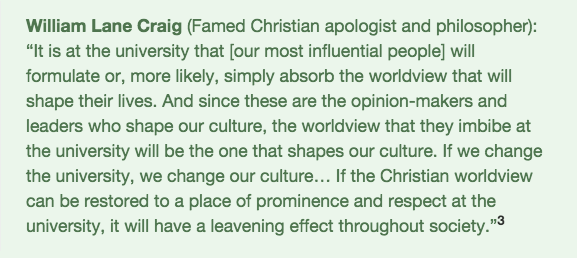
If serving God is your goal, look to the university

There is already a perfectly fine university right next door – no need to fly to Europe to find one! Remember, the university that took your faith away, or maybe the faith of someone you cared about? Yeah, it’s still sitting there in your home town! And it’s still ruining the lives of thousands of young people, by peer-pressuring them into secular, liberal views – and behaviors. It seems to me that it’s better stewardship to stay here and work, then give money to groups like Reasonable Faith. And you can start a blog, teach in church and invite scholars to the local university, too. That costs almost nothing, and it produces better results.

What about Jesus?

Sometimes, it’s a good idea to look beyond the words of the Bible and reflect on the overall message of it at a higher level. When I look in the Bible, I see that Jesus went through a lot of suffering in obedience to God in order to secure the salvation of people who did not even like him. And it’s from this sacrifice on our behalf that his claim on our obedience comes. There are things that I don’t like to do that I do anyway because they work to serve God. Jesus life’s ambition was not to do things that were easy, or that made him happy. Experienced Christians do things that are not fun, because these things are right and because they solve the real problem.

Does the Bible teach that all judging of other people is wrong?

Policeman investigates crime scene for evidence

Today, most people seem to think that the most wonderful thing is to not judge anyone else. We’re told that morality is like personal preference… you just choose what you like. There is no standard of morality that exists objectively, in the same way as mathematics or logic exists. And besides, even if there were, the only reason to judge someone else would be to hurt them. Right?

I found an interesting article about judging from Christian apologist Timothy Fox, on the Freethinking Ministries web site. He starts out right away with one very good reason for judging – judging allows people who have experience and demonstrated ability to help those who are making mistakes to get better.

Timothy writes:

When you study to be an educator, you have to spend a certain number of hours as a student teacher, under the guidance of a veteran teacher. I remember my cooperating teacher telling me one of my strengths was that I took criticism well and was very open to it. I was shocked to hear this! I wanted to tell him he was crazy and that I hate criticism! But I was also well aware that he was the master and I was the apprentice and that it was his responsibility to help me to be the best teacher I could be. So I needed his criticism. (And I received a lot of it!) Whenever he gave me feedback, positive or negative, it wasn’t intended to stroke my ego or hurt my feelings. It was so I can learn and improve, to keep doing the good and to change the bad.

The same goes for many other things, such as sports. Athletes have coaches that train and guide. But what about normal, everyday life? That’s when we want people to leave us alone. Don’t tell me how to live. Don’t judge me.

In my life, I’ve been able to have success at a few things. Education for sure – I have a BS and MS in computer science which has allowed me to earn a good living. Finances… well, I’ve made a lot of mistakes with investing, but I was able to succeed (eventually!) just by maxing out my 401K and Roth IRA contributions every year. And I’m just coming up on my 21st year of full time work. So when I give people advice, it’s usually in those areas, or maybe in apologetics.

But that advice is not always well-received. Usually, the people I’m advising just find themselves some nice yes-men and yes-women who will agree with them that having fun “in the moment” won’t close any doors down the road. It doesn’t work, but that’s how judging is received. Cut off the judge, and find yourself some yes-men and yes-women. And when your plan doesn’t work, just say that it wasn’t your fault.

People often cite a passage in the Bible about not making judgments, Matthew 7:1-6. But does it really say that?

1“Do not judge so that you will not be judged.

For in the way you judge, you will be judged; and by your standard of measure, it will be measured to you.

Why do you look at the speck that is in your brother’s eye, but do not notice the log that is in your own eye?

Or how can you say to your brother, ‘Let me take the speck out of your eye,’ and behold, the log is in your own eye?

You hypocrite, first take the log out of your own eye, and then you will see clearly to take the speck out of your brother’s eye.

“Do not give what is holy to dogs, and do not throw your pearls before swine, or they will trample them under their feet, and turn and tear you to pieces.

Here’s what Timothy Fox had to say about those verses:

Jesus’ point is not not to judge (note the double negative). It’s “Don’t be a hypocrite!” Verse 5 commands us to clean up our own junk, then to help clean up your friends’. He’s stating the obvious, that when you criticize people, they will turn around and criticize you back. So make sure your closet is clean first! And how do you know who the “dogs” and “pigs” are (v. 6)? Wouldn’t you have to judge them?

And then there is John 7:24: “Do not judge by appearances, but judge with right judgment.” Here Jesus is differentiating between proper and improper judgement. But he still commands to judge!

The reason for many of Paul’s letters is to correct some kind of nonsense going on in a church. In 1 Corinthians 5, he writes angrily that the church is not judging sin in their midst (and it’s quite the sin – go read it!). In verse 12, he rhetorically asks “Are you not to judge those inside [the church]?” And in the following verse, he plainly states to remove the “wicked person” from their midst. Here Paul is criticizing the church for not judging when they should have, even to the extent of excommunicating an unrepentant church member.

He concludes:

More often than not, the ones who cry “Don’t judge me!” the loudest are the ones who need it the most, whether it’s due to insecurity, pride, or flat-out rebellion. But let us not forget that Jesus was full of truth and grace. We desperately need both in our dealings with our brothers and sisters in Christ, when we give correction as well as when we receive it. It’s never pleasant to hear some hard (but loving) truth, but remember the first half of Proverbs 27:6: “Faithful are the wounds of a friend.” Do we like it? Of course not. But we need it. And more than that, the Bible commands it.

Obviously, it doesn’t feel good to admit you’re wrong, but if you want to achieve results, then the quickest way to do that is to listen to people who have already achieved results. The world isn’t as “random” as many people want to believe. You get to make choices, and there are best practices. When you see someone failing to achieve their goals, it doesn’t do them any good to tell them to follow their hearts and it’s not their fault when they fail. The best thing to do is to show them what to do differently, and help them to do it.

J. Warner Wallace: I am not a Christian because it works for me

12231469_1518516371799768_1908477683_n

Here’s a must-read post from Cold-Case Christianity author J. Warner Wallace.

Excerpt:

Life on this side of my decision hasn’t always been easy. It’s been nearly seventeen years since I first trusted Jesus as Lord and Savior. I still struggle to submit my prideful will to what God would call me to do. Christianity is not easy. It doesn’t always “work” for me. There are times when I think it would be easier to do it the old way; easier to cut a corner or take a short cut. There are many times when doing the right thing means doing the most difficult thing possible. There are also times when it seems like non-Christians have it easier, or seem to be “winning”. It’s in times like these that I have to remind myself that I’m not a Christian because it serves my own selfish purposes. I’m not a Christian because it “works” for me. I had a life prior to Christianity that seemed to be working just fine, and my life as a Christian hasn’t always been easy.

I’m a Christian because it is true. I’m a Christian because I want to live in a way that reflects the truth. I’m a Christian because my high regard for the truth leaves me no alternative.

I think this is important. There are people who I know who claim to be Christian, but they are clearly believing that God is a mystical force who arranges everything in their lives in order to make them happy. They are not Christians because it’s true, but because of things like comfort and community. But people ought to become Christians because they think it’s true. Truth doesn’t necessarily make you happy, though. Truth can impose intellectual obligations and moral obligations on you. Seeing God as he really is doesn’t help us to “win” at life, as the culture defines winning.

Winning in Christianity doesn’t mean making lots of money, or being famous, or winning human competitions, or being approved of by lots of people. Winning for a Christian might involve things like building relationships with people and leading them to know that God exists and who Jesus is. That has no cash value, and it’s not going to make you famous. Actually, it will probably cost you money and time, and make you unpopular with a lot of people.

The Bible doesn’t promise that people who become Christians will be happier. Actually, it promises that Christians will suffer for doing the right things. Their autonomy will suffer, as they sacrifice their own interests and happiness in order to make God happy, by serving his interests. Christianity isn’t something you add on to your before-God life in order to achieve your before-God goals. When you become a Christian, you get a new set of goals, based on God’s character and his design for you. And although you might be very successful in the world as part of serving God, there is no guarantee of that. Christianity is not life enhancement.