Call this North Korean wall the “Bernie Sanders” socialism wall
I keep meeting young evangelicals who tell me how wonderful life would be if the government ran health care, and if the government regulated energy development and consumption. Well, there are countries where the government runs everything – like Venezuela and North Korea. What’s it like to live there?
The radically-leftist New York Times has an interesting story about what it’s like to live in a socialist country, where the government owns everything.
Excerpt:
North Korean troops fired on a fellow soldier who was defecting to South Korea on Monday across the heavily armed border dividing the countries, South Korean officials said, amid heightened tensions over the North’s nuclear weapons program.
The soldier was shot but succeeded in reaching the South, its military said in a statement.
The North Korean soldier defected through Panmunjom, a village that straddles the border between the two Koreas. Alerted by gunshots, South Korean guards found the North Korean soldier about 55 yards south of the border line that bisects Panmunjom. He was taken to a hospital with gunshot wounds to an elbow and shoulder, South Korean officials said.
[…]The defector drove a vehicle toward the border line inside Panmunjom, and then left the vehicle, running south while he was fired upon by other North Korean soldiers, according to the American-led United Nations Command, which oversees the 1953 armistice that halted the Korean War.
He took cover near a building on the southern side of the Joint Security Area in Panmunjom before South Korean and American troops came to his aid and took him to a hospital, the command said in a statement.
The Joint Security Area, which is 35 miles north of Seoul, the capital, was established after North Korea and its Communist ally China signed the armistice with the United Nations Command, which fought on South Korea’s behalf.
The area is the only place along the border where troops from North and South Korea face off, separated from each other by only a few feet.
A North Korean soldier last defected at the heavily guarded location in 2007.
More than 30,000 North Koreans have fled to the South since a widespread famine hit the impoverished North in the late 1990s. Nearly all of them have traveled through China. But a few North Korean soldiers and civilians have defected by crossing the 2.5-mile-wide demilitarized zone, which is guarded by minefields, sentry posts and tall fences topped with barbed wire, some electrified.
In 2012, a North Korean soldier scaled three barbed-wire fences to defect to the South. That same year, another North Korean soldier fled across the border after killing his platoon and squadron leaders. In 2015, after walking across the border, a North Korean soldier told South Korean investigators that he was fleeing widespread beatings and other abuse within his military barracks.
[…]In 1984, a gunfight erupted at Panmunjom when a citizen from what was then the Soviet Union dashed across the border to defect to the West. North Korean troops opened fire to stop him, and South Korean border guards fired back. One South Korean soldier and three North Korean border guards were killed.
My editors told me not to turn this post into another negative screed against stupid millennials, but to instead offer some encouraging words of advice on how they can educate themselves.
The first thing to realize is that all of your public school teachers are idiots – especially the ones who teach non-STEM classes. Education school degrees are the easiest degrees to get at college. They have the lowest entrance requirements, and the ed school students learn material that is fit for high school English classes. It’s a great degree for low-IQ people who dropped out of math in high school. So you can’t trust your public school teachers to teach you anything about civics or economics. If you were indoctrinated by your teachers to hate the free enterprise system, then you were lied to and indoctrinated. You will have to teach yourself, on your own.
For economics, anything by Thomas Sowell is worth reading, but you might be better off starting out with “The Vision of the Anointed“, “Basic Economics“. “Economic Facts and Fallacies” and “Intellectuals and Society“. The nice thing about Thomas Sowell is that he does studies of economic policies that have been tried in different countries during different time periods, so you learn a lot about history as well.
Finally, the reason that there is a North and South Korea, and not just a North Korea, is because American, British and Australian forces beat back an unprovoked invasion by the North Koreans in 1950. This was probably the most moral war that the United States has ever engaged in, in the history of the United States. We shed our blood and spent our treasure to protect South Korea from becoming one large concentration camp – which is what North Korea is. If you’d like to read a good book about the Korean War, I highly recommend “The Frozen Hours“, a historical novel by Jeff Shaara.
Unbelievable’s radio show featured a discussion with former Christian Dan Barker, the founder and co-President of the Freedom From Religion Foundation.
I thought that I would make some general comments about why I think that many people leave the Christian faith, and what you should be careful of in order to avoid following in Dan Barker’s footsteps, specifically.
Basically, there are four major reasons why people leave Christianity.
They want to do something immoral with impunity. This type of person wants to do something immoral that is forbidden by Christianity, like pre-marital sex or getting drunk in clubs with friends. They dump Christianity in order to have freedom to seek happiness in this life.
They want to make decisions based on their emotions, rather than wisdom. This type of person thinks that God’s job is to save them when they act irresponsibly. When God disappoints them by not make their recklessness “work out”, they leave the faith.
They want to be loved by people, not by God. This type of person thinks that Christianity is a tool that they can use to become popular. When they first try to articulate the gospel in public, they find that people don’t like them as much, and they feel bad about offending people with exclusive truth claims that they cannot back up using logic and evidence. So, they water down Christianity to get along with non-Christians. Finally, they jettison Christianity completely. This happens to a lot of young Christians the moment they hit college / university.
They don’t want to learn to defend their faith. This type of person is asked questions by skeptics that they cannot answer. Usually this happens when people go to university after growing up in the shelter of the Church. The questions and peer pressure make them feel stupid. Rather than investigate Christianity to see if it’s true, they drop it, so they can be thought of as part of the “smart” crowd.
Now listen to the discussion and see if you can identify some of these factors from Barker’s own carefully-prepared words. He is trying very hard to make himself look honest and moderate, because he wants Christians to be sympathetic with his story and his motives for leaving Christianity. But I think that there is enough in his statements to construct a different hypothesis of why he left Christianity.
I’ve grouped the data by risk factor. Some of this is my interpretation of his real motivations, based on my experience dealing with former-Christians.
Non-rational, emotional approach to Christianity
he was raised in a devout Christian family where he probably wouldn’t have faced skeptical questions
he converted to Christianity at age 15 as a result of a religious experience, not a serious investigation
his idea of God was probably idealized and uninformed, e.g. – a loving God who wants us to be happy
he wandered around from church to church preaching, with no fixed address or source of income
he earned money by collecting “love offerings” from churches where he performed his music
he wrote Christian songs and Christian musicals, but nothing substantive on apologetics and theology
he worked in three churches known for being anti-intellectual and fundamentalist
there’s no evidence that of any deep study of philosophy, science and history during this time
Desire to gain acceptance from non-Christians
he began to notice that some people were uncomfortable with sin and Hell
he began to avoid preaching about sin and Hell in order to make these people comfortable
he watered-down the gospel to focus on helping people to be happy in this life
his manic approach to Christian ministry was challenged by the “real life” needs of his growing family
he met liberal pastors while performing his music in their churches
he found it difficult to disagree with them because they seemed to be “good” people
he watered down his message further in order to appeal to people across the theological spectrum
Ignorance of Christian apologetics
he began to think that if there are many different views of religion, then no view can be correct
he was not intellectually capable of using logic and evidence to test these competing claims to see which was true
he decided to instead re-interpret Christian truth claims as non-rational opinions, so they could all be “valid”
he became a theological liberal, abandoning theism for an impersonal “ground of being”
he embraced religious pluralism, the view that all religions are non-rational and make no testable truth claims
he began to see God as a “metaphor” whose purpose is to make people have a sense of meaning and purpose
he jettisoned God completely and focused more on helping people find meaning and morality apart from God
seems to think that religion is about having a “great life”, and felt that you can have a “great life” without religion
seems to think that religion is about being “good”, and felt that you can be “good” without religion
religion makes people feel bad by telling them what to do instead of letting them do anything they want
religion makes people feel bad by telling them what is true, instead of letting them believe whatever they want
religion makes people feel bad by telling them that God will hold them accountable for their beliefs and actions
So what do I think happened?
Barker was generating an income from donations from churches where he entertained them. Gradually, his family grew to the point where conservative churches were not enough to support him. He had to change his message to appeal to liberal churches in order to cast a wider net.
He seems to have thought that Christianity is about having his needs met and being liked by others. I think he wanted to feel good and to make people feel good with his preaching and singing. But Christianity is not a feel-good religion. It’s not a tool to make people like you. He seems to have become aware that the exclusive claims of Christianity made other people feel offended, so he cut them out. Christian apologists learn how to provide evidence for claims that non-Christians find offensive or hard to believe, but Dan hadn’t studied philosophy, science or history so he couldn’t defend it. It’s hard to speak unpopular truths when you have nothing to back it up except your music composing. Eventually, Dan just quit making the truth claims entirely.
I also think money was a factor. It seems to me that it would have hurt his career and reduced his invitations from liberal churches if he had kept up teaching biblical Christianity. In order to appeal to a wider audience, (like many Christian singers do – e.g. – Amy Grant, Jars of Clay, etc.), he would have felt pressured to water down the unpleasant parts of his preaching and singing. Lacking apologetics skill, he instead abandoned his message. He needed to account for his family’s needs and “real life”, and exclusive truth claims and Hell-talk would have reduced his ability to do that. It seems to me that he should have scaled back his extreme schedule of preaching and singing, and instead gotten a steady job so that he could afford “real life” and a family without being pressured into altering his message. The Christian life requires a certain amount of wisdom that Dan did not have.
Life isn’t a fairy tale. God isn’t there to reward risky behavior. We need to be more shrewd about financial matters so that we have the ability to not care about what people think of us. Look at this blog. I work all day as a senior software engineer with two degrees in computer science, so that I don’t have to rely on donations. Additionally, I save most of what I make in case a tragedy strikes. Since I am financially secure, I can say what I think, and disregard anyone who wants me to change my message because they are offended. Becoming a Christian isn’t a license to behave irrationally and immaturely with money. For some people, (like William Lane Craig), stepping out in faith works. But if it doesn’t work, it’s better to retreat and re-trench, rather than to compromise your message for money.
I actually met someone like Dan Barker recently. She grew up in an anti-intellectual hippy Christian home. Her mother came from a good family, and decided on a whim to marry a non-Christian. Like Barker, the family exalted feelings and irrational expectations of miracles from God for “fearless” acts. She got herself into trouble with alcohol and promiscuity in her 20s, by making emotional decisions and mixing with the wrong crowd. Her way of fixing this was to fly off on a one-year missions trip, wrecking her resume and finances. Now, she is in her late 30s, unmarried, and literally blaming Jesus for putting too many demands on her that she doesn’t have time for, e.g – morning quiet time. This causes her to feel guilty, and make her want to reject Christianity. She had no intellectual conception of basic core doctrines like God’s existence or Jesus’ resurrection, which might have acted as a bulwark against her emotions. When I explained to her how I had structured my education and career so that I could have an influence without testing God, she seemed bored and said that I was too “fearful”.
This is apparently widespread, especially among anti-intellectual denominations. Another ex-Pentecostal atheist woman I heard about from people who knew her when she was young decided to drop out of college to travel around North America doing pro-life work. When she found herself penniless, unmarried and without children in her mid-30s, she decided to have a baby out of wedlock. The government will pay for it, she said. Rather than trying to justify this decision as a Christian, she blamed God for not making her madness “work out”. She is now an atheist, because God did not reward her decision to live fearlessly for him with a husband and children. It was all God’s fault. There is a whole subculture within Christianity, where the pursuit of fun and thrills can be masked with pious language, and all talk of prudence and restraint is seen as cowardice and lack of faith.
The Christian life requires a certain level of intelligence, a certain level of practical wisdom, and a certain level of self-control and discipline. Make sure that you don’t walk away from God because of your own bad choices.
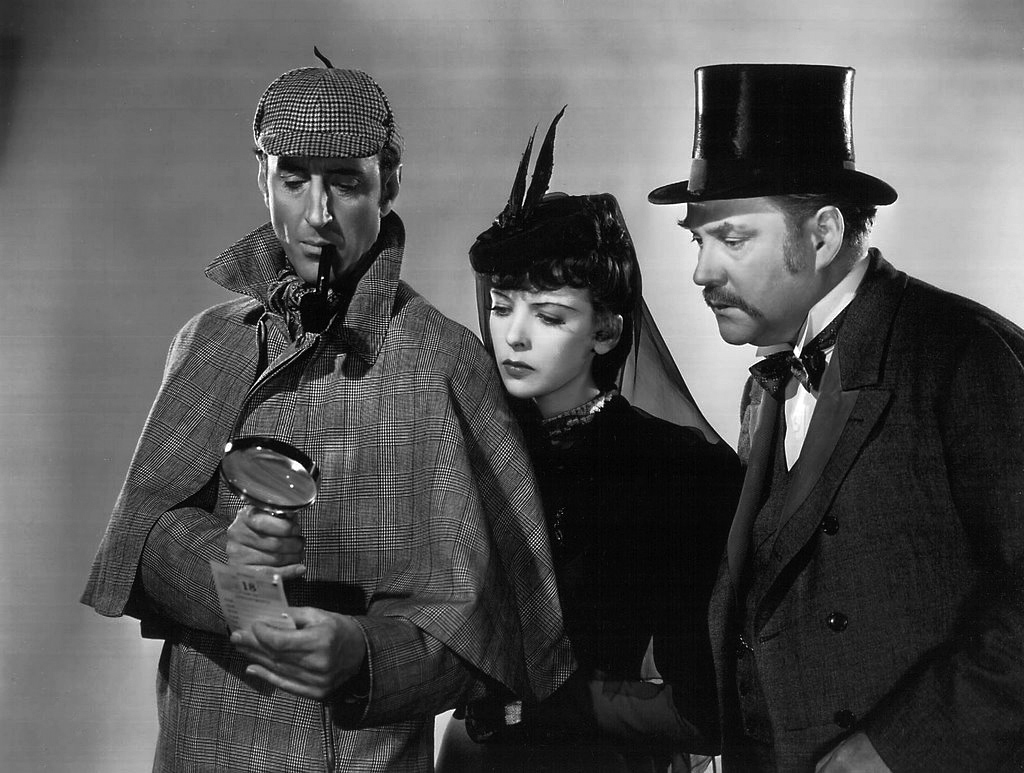
Sherlock Holmes and John Watson about to do philosophy
Let’s review what you need in your worldview in order to have a rationally grounded system of morality.
You need 5 things:
1) Objective moral values
There needs to be a way to distinguish what is good from what is bad. For example, the moral standard might specify that being kind to children is good, but torturing them for fun is bad. If the standard is purely subjective, then people could believe anything and each person would be justified in doing right in their own eyes. Even a “social contract” is just based on people’s opinions. So we need a standard that applies regardless of what people’s individual and collective opinions are.
2) Objective moral duties
Moral duties (moral obligations) refer to the actions that are obligatory based on the moral values defined in 1). Suppose we spot you 1) as an atheist. Why are you obligated to do the good thing, rather than the bad thing? To whom is this obligation owed? Why is rational for you to limit your actions based upon this obligation when it is against your self-interest? Why let other people’s expectations decide what is good for you, especially if you can avoid the consequences of their disapproval?
3) Moral accountability
Suppose we spot you 1) and 2) as an atheist. What difference does it make to you if you just go ahead and disregard your moral obligations to whomever? Is there any reward or punishment for your choice to do right or do wrong? What’s in it for you?
4) Free will
In order for agents to make free moral choices, they must be able to act or abstain from acting by exercising their free will. If there is no free will, then moral choices are impossible. If there are no moral choices, then no one can be held responsible for anything they do. If there is no moral responsibility, then there can be no praise and blame. But then it becomes impossible to praise any action as good or evil.
5) Ultimate significance
Finally, beyond the concept of reward and punishment in 3), we can also ask the question “what does it matter?”. Suppose you do live a good life and you get a reward: 1000 chocolate sundaes. And when you’ve finished eating them, you die for real and that’s the end. In other words, the reward is satisfying, but not really meaningful, ultimately. It’s hard to see how moral actions can be meaningful, ultimately, unless their consequences last on into the future.
Theism rationally grounds all 5 of these. Atheism cannot ground any of them.
Let’s take a look at #4: free will and see how atheism deals with that.
And that’s what neurobiology is telling us: Our brains are simply meat computers that, like real computers, are programmed by our genes and experiences to convert an array of inputs into a predetermined output. Recent experiments involving brain scans show that when a subject “decides” to push a button on the left or right side of a computer, the choice can be predicted by brain activity at least seven seconds before the subject is consciously aware of having made it. (These studies use crude imaging techniques based on blood flow, and I suspect that future understanding of the brain will allow us to predict many of our decisions far earlier than seven seconds in advance.) “Decisions” made like that aren’t conscious ones. And if our choices are unconscious, with some determined well before the moment we think we’ve made them, then we don’t have free will in any meaningful sense.
If you don’t have free will, then you can’t make moral choices, and you can’t be held morally responsible. No free will means no morality.
Here are some more atheists to explain how atheists view morality.
William Provine says atheists have no free will, no moral accountability and no moral significance:
Let me summarize my views on what modern evolutionary biology tells us loud and clear — and these are basically Darwin’s views. There are no gods, no purposes, and no goal-directed forces of any kind. There is no life after death. When I die, I am absolutely certain that I am going to be dead. That’s the end of me. There is no ultimate foundation for ethics, no ultimate meaning in life, and no free will for humans, either.
Richard Dawkins says atheists have no objective moral standards:
In a universe of blind physical forces and genetic replication, some people are going to get hurt, other people are going to get lucky, and you won’t find any rhyme or reason in it, or any justice. The universe that we observe has precisely the properties we should expect if there is, at bottom, no design, no purpose, no evil and no good, nothing but blind, pitiless indifference… DNA neither knows nor cares. DNA just is. And we dance to its music. (Richard Dawkins, River Out of Eden: A Darwinian View of Life (1995))
When village atheists talk about how they can be moral without God, it’s important to ask them to justify the minimum requirements for rational morality. Atheists may act inconsistently with their worldview, believing in free will, expecting praise and blame for complying with the arbitrary standards of their peer group, etc. But there is nothing more to morality on atheism that imitating the herd – at least when the herd is around to watch them. And when the herd loses its Judeo-Christian foundation – watch out. That’s when the real atheism comes out – the atheism that we’ve seen before in countries that turned their backs on God, and the moral law. When God disappears from a society, anything is permissible.



 WINTERY KNIGHT