Tag Archives: Science

Which side of the abortion rights debate is backed by scientific evidence?

Once upon a time I didn’t know much about the case for abortion rights or the case for the right to life of unborn children. My reason for not reading much about it is that I thought that it was kind of a subjective issue. But, I started a project to read 1-2 books on every conceivable topic, including one on abortion. Lo and behold, it turned out that one side did have the backing of science.

This article from The Public Discourse explains: (links removed)

The following are typical examples—only three of the many, many we could cite. These are from standard texts by embryologists, developmental biologists, and microbiologists:

“Human life begins at fertilization, the process during which a male gamete or sperm unites with a female gamete or oocyte (ovum) to form a single cell called a zygote. This highly specialized, totipotent cell marked the beginning of each of us as a unique individual.” “A zygote is the beginning of a new human being (i.e., an embryo).” Keith L. Moore, The Developing Human: Clinically Oriented Embryology, 7th edition.

“Fertilization is the process by which male and female haploid gametes (sperm and egg) unite to produce a genetically distinct individual.” Signorelli et al., Kinases, phosphatases and proteases during sperm capacitation, Cell Tissue Research.

“Although life is a continuous process, fertilization (which, incidentally, is not a ‘moment’) is a critical landmark because, under ordinary circumstances, a new, genetically distinct human organism is formed when the chromosomes of the male and female pronuclei blend in the oocyte” (emphasis added; Ronan O’Rahilly and Fabiola Mueller, Human Embryology and Teratology, 3rd edition.

The genetically distinct part is key – this unborn child is has a different DNA signature (a human signature) than either the mother or the father. Nothing will be added or taken away from this new signature as the unborn child grows. It never changes.

More:

These authorities all agree because the underlying science is clear. At fertilization—or, more precisely, when the sperm (a male sex cell) fuses with the oocyte (a female sex cell, more commonly referred to as an egg)—each of them ceases to be, and a new entity, one that is both genetically and functionally distinct from either parent, is generated. This new entity, initially a single totipotent cell, then divides into two cells, then (asynchronously) three, then four, eight, and so on, enclosed all the while by a membrane inherited from the oocyte (the zona pellucida), which then dissolves during implantation, allowing for continued growth in the direction of maturity as a member of the species. Even prior to implantation, however, these cells and membrane function as parts of a whole that regularly and predictably develops into the more mature stages of a complex human body.

How do we know that the result of sperm-oocyte fusion is a new entity, rather than a continuation of the oocyte? We know that a new entity exists because, once the sperm penetrates the oocyte, a completely new trajectory of biological development commences. The biological activity of an oocyte is directed toward successful fertilization; the biological activity of sperm is directed toward penetration of an oocyte. The biological activity of the new entity that results when sperm and oocyte fuse, however, is directed toward nothing less than the development of a mature human organism, distinct from either parent. Further, this new entity’s activities are directed not by instructions from the mother’s body, as some people wrongly suppose, but by its own unique set of instructions, especially the blueprint for development contained in its unique genetic material. The mother’s body recognizes the zygote and then the embryo as an entity distinct from itself. In fact, the embryo must send out chemical signals to prevent the mother’s immune system from attacking it. The embryo also emits chemical signals that induce changes in the lining of the mother’s uterus to enable successful implantation.

If this embryo is provided a suitable environment, nutrition, and protection from deliberate attack, serious injury, or disease, it will develop to the mature stage of a human organism. Thus, from the zygote stage onward this distinct, new organism has all of the internal resources—in its genetic and epigenetic structure—needed to develop itself (or, rather, himself or herself, since in the human sex is determined from the very beginning) to the mature stage of a human organism. At no point after fertilization—implantation, gastrulation, birth, puberty, etc.—does a fundamental change in biological trajectory occur. These subsequent stages of development are simply the unfolding of the zygote’s inherent dynamism toward human organismal maturity. This shows that the zygote already is a human organism—a member of the species Homo sapiens—albeit at an early stage of his or her development.

So, since I like to win arguments with science, I just took the side of the debate that was backed by science. I really hate to lose debates, you know. I really like to cite scientific evidence when I’m debating.

The crime of abortion, it seems to me, is that you are depriving a human being of his or her future, because of your convenience right now. Human beings don’t have the right to take away the futures of other human beings because they want to be unburdened by the results of their own actions. We shouldn’t resort to violence in order to escape responsibility for our own actions. In almost every case, (except to save the life of the mother), killing the unborn child isn’t justified. It’s actually very scary to me that anyone would think that hurting other people was a reasonable response to one’s own diminished happiness. How did we ever get to a place in society when people don’t think that taking responsibility to care for the unborn child is morally better than killing the unborn child? It’s a baby for goodness sake. We ought to be serious about setting up our lives and controlling ourselves so that we never hurt an unborn child.

William Lane Craig debates atheist Lawrence Krauss: Does God Exist?

Here is the video from the third debate from Dr. William Lane Craig’s speaking tour in Australia.

Format:

  • William Lane Craig (15 min)
  • Lawrence Krauss (15 min, but was actually 21:40)
  • Moderated discussion
  • Question and answer

Dr. Graham Oppy, the moderator, is a well-known atheist philosopher. He let Dr. Krauss speak for 21 minutes and 40 seconds, which is why my summary of Krauss is so long.

The video:

Summary

After careful consideration, I decided not to be snarky at all in this summary. What you read below is what happened. There may be some small mistakes, but I will fix those if people tell me about them. I also included some quotes and timestamps for the more striking things that Dr. Krauss said.

The debate itself starts at 4:50 with Dr. Craig’s opening speech. He does use slides to show the structure of his arguments.

Dr. Craig’s opening speech. (4:50)

  1. The kalam cosmological argument:
    • God is the best explanation of the origin of the universe
    • The Borde Guth Vilenkin theorem supports the absolute beginning of the universe
    • Even if our universe is part of a multiverse, the multiverse itself would have to have an absolute beginning
    • Speculative cosmologies try to challenge the Big Bang theory, but none of them – even if true – can establish that the past is eternal
    • Only two types of things could explain the origin of spece, time, matter and energy – either abstract objects or minds
    • Abstract objects do not cause effects, but minds do cause effects (we do it ourselves)
    • A mind is the best explanation for the origin of the universe
  2. The unreasonable effectiveness of mathematics:
    • The underlying structure of nature is mathematical – mathematics is applicable to nature
    • Mathematical objects can either be abstract objects or useful fiction
    • Either way, there is no reason to expect that nature should be linked to abstract objects or fictions
    • But a divine mind that wants humans to understand nature is a better explanation for what we see
  3. The cosmic fine-tuning for the existence of intelligent life
    • There are two kinds of finely-tuned initial conditions: 1) cosmological constants and 2) quantities
    • These constants and quantities have to be set within a narrow range in order to permit intelligent life
    • There are three explanations for this observation: law, chance or design
    • Law is rejected because they are put in at the beginning or matter – they don’t emerge from matter
    • Chance must be rejected, because they odds are just too long unless you appeal to a world-ensemble
    • We do not observe what the world ensemble hypothesis predicts that we should observe
    • Design is the best explanation for finely-tuned constants and quantities
  4. The existence of objective moral values and duties
    • Our experience of morality (values and duties) is that it is objectively real and incumbent on us
    • When someone goes into a classroom and shoots at innocent children, that is objectively wrong
    • On naturalism, moral values and moral duties do not exist – they are conventional and variable by time and place
    • The best explanation for the existence of objective moral values and duties is that God exists
  5. The historicity of the resurrection of Jesus
    • There are three widely-accepted facts that are best explained by the resurrection hypothesis
    • 1) the empty tomb, 2) the post-mortem appearances, 3) the early church’s belief in the resurrection
    • Naturalistic attempts to explain these 3 boilerplate facts fail
    • The best explanation of the 3 minimal facts is that God raised Jesus from the dead
  6. The immediate experience of God
    • Belief in God is a “properly basic” belief – rational even without arguments because of experience of God

Dr. Krauss’ opening speech. (21:12)

Slides: (1, 2, 3, 4, 5, 6, 7, 8, 9, 10, 11, 12, 13, 14)

  1. Religious pluralism I
    • There have been lots of different gods created by people through history
    • We’ve gotten rid of all of them by understanding how the universe works by doing science
    • Religion is just stories, and the stories are inconsistent with how the universe works
  2. Progress of naturalistic science I
    • Newtonian physics refutes the idea that angels push planets around
    • Darwinian evolution refutes design arguments, including the one that Dr. Craig presented (24:10)
    • Biochemistry hasn’t explained how life originated, but we will have the solution soon
    • Physics shows us that matter can be created and destroyed without need a God
    • Physics shows us that universes can be created and destroyed “no problem”
  3. Religious pluralism II
    • Since we have been able to disprove all the gods we’ve invented, why hang on to the last one
    • It’s unlikely that the God that Dr. Craig presented exists, because we disproved all the others he didn’t present
  4. Hiddenness of God
    • There is a complete lack of evidence for the other 999 gods, so how likely is it that the God Dr. Craig presented exists
  5. Religious pluralism III
    • There are inconsistencies between various religions, so therefore there can be no religion that is right
  6. Progress of naturalistic science II
    • Peasants had a very low level of knowledge about the world and they believed in God
    • But our level of knowledge has increased over time, so we shouldn’t believe in God now
    • Peasants thought that the Earth orbited the Sun, but this is now known to be false
    • The Scriptures said that the Earth orbited the Sun, but now we know that’s false from science
  7. Christianity plagiarizes from other religions I
    • There is nothing new or special about Jesus
    • He’s just as unpleasant as all the other gods
    • Everything particular to Jesus occurs in other religions
  8. Catholics are inconsistent about what they believe
    • I’ll bet most Catholics don’t really believe in transubstantiation
    • I’ll bet most Catholics don’t really believe in the virgin birth
  9. The resurrection is copied from many other religions
    • Dionysus, Osiris, etc.
  10. There is no evidence for the resurrection
    • The stories about Jesus were written “decades or hundreds of years after the fact”
    • The stories are inconsistent with each other
    • Dr. Craig tells me that historical Jesus scholars all accept that the resurrection happened
    • That’s like saying that all alien abductions experts agree that alien abductions happened
    • It’s unreasonable to think that the resurrection happened because no one saw it happen
    • I accept that people reported on appearances, but hallucination theory can explain that
  11. The timeline for the creation and incarnation are all wrong
    • The creation, planet formation, hominids, incarnation, etc. all take place in the wrong times
    • If God knew what he was doing, he would done everything at better times to be more efficient
  12. David Hume’s argument against miracles is sound
    • Extraordinary claims require extraordinary evidence – nothing wrong with this argument
    • Miracles are really just coincidences
    • Catholic apparitions at Lourdes disprove the historical argument that Dr. Craig made for the resurrection
  13. God is petty and jealous
    • God shouldn’t demand that we trust him, esteem him and consider his character when we make decisions
    • The atoning death of Jesus for the sins of the world also makes no sense
  14. Belief is based on geography
    • What you believe is clearly correlated with where you are born
    • There is even an Islamic clone of Dr. Craig who “uses the exact same arguments” that he does to prove Islam
    • Belief in God is decreasing in the Internet-accessible world
  15. Science can develop morals without God
    • Reason is able to guide our actions to be moral
    • Morality evolves over time, so there is no objective morality
    • Catholicism teaches things that are immoral
    • Some things are prohibited by biological revulsion, such as incest
    • But if a brother and sister have sex using condoms “is that morally wrong? I can’t say it is frankly” (37:24)
  16. Dr. Craig is irrational
    • “I came here convinced based on my past interactions and his writing that Dr. Craig was a dishonest Charlatan”
    • “Any argument that validates God is reasonable to him”
    • “And any argument against it is not only unreasonable but wrong and worth distorting”
    • “Because it must be wrong – he’s decided the answer in advance”
  17. Dr. Craig is immoral
    • Dr. Craig thinks it is OK for God to command that Canaanite children are killed
    • “So in fact if they were Canaanite children in that schoolroom that he talked about then it would be OK”
    • It’s not reasonable to justify genocide in that way, but Dr. Craig is willing to go to those lengths
  18. The cause of the origin of the space time universe need not be God
    • Dr. Craig says that if there is an explanation for the origin or space, time, matter and energy it must be God
    • But it could just as easily be turtles or Zeus
  19. Dr. Craig misrepresents the Borde Guth Vilenkin theorem
    • Alexander Vilenkin wrote me an e-mail that says that the theorem doesn’t work in all cases
    • “Dr. Craig is so convinced that these arguments must be true that he won’t listen to the fact that they’re not”
  20. Darwinian evolution explains the fine-tuning
    • “Life was fine tuned – we got rid of it with Darwin”
    • Mutation and natural selection explain the cosmic fine-tuning argument that Dr. Craig presented
  21. Suboptimal design disproves the fine-tuning argument
    • “We get back aches” therefore “This argument that [the universe] is fine-tuned for life is nonsense”
  22. William Lane Craig can be proven to exhibit homosexual behavior using logical arguments
    • Look, you can construct arguments that are clearly wrong
    • Premise 1: “All mammals exhibit homosexual behavior”
    • Premise 2: “William Lane Craig is a mammal”
    • Seems to be saying that logical arguments can prove false things “it’s nonsense”
  23. Dr. Craig distorted a podcast that some group made on pain receptors
    • Dr. Craig’s faith is so strong that it causes him to distort what this group said

Discussion: (44:35)

I will not be summarizing everything that was said, just a few main points.
The segment from 52:18 to 57:12 about the Vilenkin e-mail on the BVG theorem is a must-see. Krauss is standing up and gesticulating while Craig is calmly trying to quote a paper by Vilenkin that shows that Krauss is misrepresenting Vilenkin. Krauss constantly interrupts him. After a while, when Craig exposes him as having misrepresented Vilenkin and gets him to admit that all current eternal models of the universe are probably wrong, he quietens down and can’t even look at Craig in the face.

Cosmological argument:

  • Craig: The e-mail says any universe that is expanding, on average, requires a beginning
  • Craig: There are two models – Aguirre & Gratton and Carroll & Chen – where there is a period of contraction before the expansion
  • Craig: The two models are the ones cited in the e-mail that Dr. Krauss showed
  • Craig: In the very paper by Vilenkin that I cited, he says that both of those models don’t work
  • Krauss: (agitated and interrupting) Vilenkin said that they have to make an assumption about entropy that they have no rationale for
  • (as Craig starts to talk Krauss makes an exaggerated, disrespectful gesture and sits down in a huff)
  • Craig: Yes, an unwarranted assumption means that they don’t have EVIDENCE for their theories being correct
  • Krauss: (agitated and interrupting) “All the evidence suggests that the universe had a beginning but WE DON’T KNOW!!!!!!!” (raising his voice)
  • Craig: I’m not saying that we know that the universe had a beginning with certainty
  • Craig: I am saying that the beginning of the universe is more probably true than false based on the evidence we have
  • Craig: And you agree with me about that – you think the universe had a beginning
  • Krauss: (agitated and interrupting) (Unintelligible)
  • Moderator: One at a time
  • Craig: In your Vilenkin e-mail slide, at the end of the paragraph where the two models are mentioned that Vilenkin specifically shows…
  • (I am guessing that Craig is going to ask why so much of what Vilenkin wrote has been cut out of the e-mail that Krauss showed)
  • Krauss: (agitated and interrupting) Because it was technical…
  • Moderator: Lawrence! Hang on a sec!
  • Craig: He specifically shows that these models are not past eternal, and that they require a beginning just like the others…
  • Krauss: (agitated and interrupting) We can do the math if you want
  • Craig: Now wait. I couldn’t help notice that there on your slide there was a series of ellipsis points indicating missing text…
  • Krauss: (agitated and interrupting) “Yeah, because it was technical!”
  • Craig: “I wonder what you deleted from the original letter”
  • Krauss: (agitated and interrupting) “I just told you!”
  • Craig: “Now wait. Could it have been something like this: (reads a quote from Vilenkin) ‘You can evade the theorem by postulating that the universe was contracting prior to some time. This sounds as if there is nothing wrong with having contraction prior to expansion. But the problem is that a contracting universe is highly unstable. Small perturbations would cause it to develop all sorts of messy singularities, so it would never make it to the expanding phase.’
  • Craig: “That’s Vilenkin.”
  • Krauss: “In this paper, that’s absolutely right”
  • Krauss: But it’s ok for theories to assume things that we know are wrong – they are still good theories – it’s unknown
  • (Craig turns away and looks through his papers)
  • Craig: “Isn’t it true that the only viable quantum gravity models on order today involve a beginning – have a finite past?”
  • Krauss: “No”
  • Craig: “Well, can you give us one then”
  • Krauss: (talks about a variety of possible eternal models) “In my experience in science, all of them are probably wrong”
  • Krauss: “You know most theories are wrong, which is why, you know, it’s hard”
  • Craig: “Right”

I noticed that a huge number of atheist web sites are taking the Vilenkin quote that Krauss used out of context, like this one and this one. There are probably a lot more of them like that, which I think is interesting. That’s why we have these debates, I guess. To set the record straight about who accuses people of being dishonest, and who is actually dishonest.

Fine-tuning:

  • Krauss tried to argue that he had explained the fine-tuning with the Higgs particle, but Dr. Craig said that only applied to the cosmological constant, not all the other examples of fine-tuning. Krauss said that it wasn’t impressive that this universe permitted life and that “It would have been much more surprising if we evolved in a universe in which we couldn’t live”. Krauss argued the fine-tuning was only for “Life like us”. But Dr. Craig explained that the fine-tuning is what allows us to have the basics of any kind of life, like slow-burning stars, chemical diversity, etc. – things that are required for basic minimal life functions in any living system. Craig said that he was working with the current physical laws of this universe (F = ma, etc.) and that he was looking at what changed if we changed those even slightly. Krauss tried to say that if he changed things like the mass of particles then the strength of forces would change. (But the forces aren’t laws!) Krauss argued that the cosmological constant would be even better for life if it was zero, and Craig said that the life permitting range did include zero, but that the range of life-permitting values was narrow.

Jesus’ existence:

  • Craig reponded to the mystery religions charge, the charge that the evidence for the minimal facts is too late/too weak, the charge that grief visions explained the evidence better, and Hume’s argument against miracles. Craig brought up the early creed from 1 Cor 15:3-7 and explained to Krauss that it was 5 years after the events, and that Jewish standards of oral transmission were strong enough to ensure that the creed was reliable, and most of the eyewitnesses would still have been alive.

Audience Q and A: (1:21:09)

The first topic is the grounding of morality. Krauss agrees that there is no objective morality and no objective moral oughts. He also said that that standards of behavior are arbitrary, and that they change over time and they are adopted for promoting social order. Dr. Craig pressed the point that science itself would collapse without ethical values. It assumes them, but cannot ground them.

The next topic was free will. Krauss is a determinist. Craig asked him how he could reconcile moral responsibility with determinism.

The next topic was the effectiveness of mathematics. Krauss didn’t have an explanation for it and didn’t think it needed one. Then they got into whether the Genesis has been verified by science and whether it is meant to be taken literally.

The next topic was whether philosophy makes any progress. Craig gave the example of verificationism being rejected as too narrow, and self-refuting. Krauss: “I’m going to come to the defense of philosophy for the first time”. Craig: “That’s amazing!” Krauss said that science provides new knowledge. Craig said there were some things that could be known apart from science.

How the WMAP satellite confirmed nucleosynthesis predictions and falsified atheism

Prior to certain scientific discoveries, most people thought that the universe had always been here, and no need to ask who or what may have caused it. But today, that’s all changed. Today, the standard model of the origin of the universe is that all the matter and energy in the universe came into being in an event scientists call “The Big Bang”. At the creation event, space and time themselves began to exist, and there is no material reality that preceded them.

So a couple of quotes to show that.

An initial cosmological singularity… forms a past temporal extremity to the universe. We cannot continue physical reasoning, or even the concept of spacetime, through such an extremity… On this view the big bang represents the creation event; the creation not only of all the matter and energy in the universe, but also of spacetime itself.

Source: P. C. W. Davies, “Spacetime Singularities in Cosmology,” in The Study of Time III, ed. J. T. Fraser (Berlin: Springer Verlag ).

And another quote:

[A]lmost everyone now believes that the universe, and time itself, had a beginning at the big bang.

Source: Stephen Hawking and Roger Penrose, The Nature of Space and Time, The Isaac Newton Institute Series of Lectures (Princeton, N. J.: Princeton University Press, 1996), p. 20.

So, there are several scientific discoveries that led scientists to accept the creation event, and one of the most interesting and famous is the discovery of how elements heavier than hydrogen were formed.

Nucleosynthesis: forming heavier elements by fusion

Here’s the history of how that discovery happened, from the National Aeronautics and Space Administration (NASA) web site:

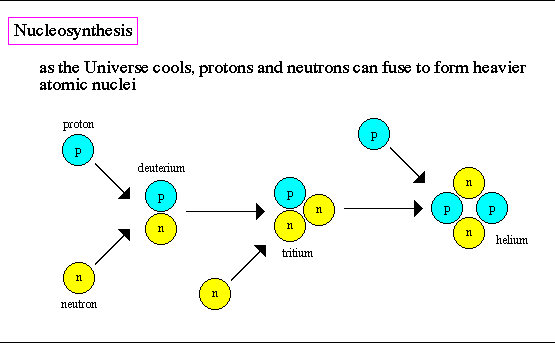
The term nucleosynthesis refers to the formation of heavier elements, atomic nuclei with many protons and neutrons, from the fusion of lighter elements. The Big Bang theory predicts that the early universe was a very hot place. One second after the Big Bang, the temperature of the universe was roughly 10 billion degrees and was filled with a sea of neutrons, protons, electrons, anti-electrons (positrons), photons and neutrinos. As the universe cooled, the neutrons either decayed into protons and electrons or combined with protons to make deuterium (an isotope of hydrogen). During the first three minutes of the universe, most of the deuterium combined to make helium. Trace amounts of lithium were also produced at this time. This process of light element formation in the early universe is called “Big Bang nucleosynthesis” (BBN).

The creation hypothesis predicts that there will be specific amounts of these light elements formed as the universe cools down. Do the predictions match with observations?

Yes they do:

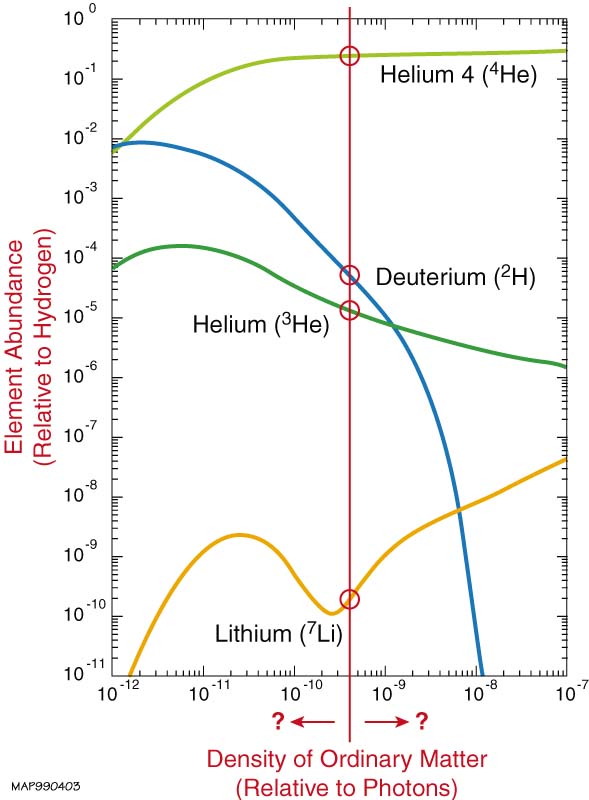
The predicted abundance of deuterium, helium and lithium depends on the density of ordinary matter in the early universe, as shown in the figure at left. These results indicate that the yield of helium is relatively insensitive to the abundance of ordinary matter, above a certain threshold. We generically expect about 24% of the ordinary matter in the universe to be helium produced in the Big Bang. This is in very good agreement with observations and is another major triumph for the Big Bang theory.

Moreover, WMAP satellite measurements of mass density agree with our observations of these light element abundances.

Here are the observations from the WMAP satellite:

Scientific observations match predictions

And here is how those WMAP measurements confirm the Big Bang creation event:

However, the Big Bang model can be tested further. Given a precise measurement of the abundance of ordinary matter, the predicted abundances of the other light elements becomes highly constrained. The WMAP satellite is able to directly measure the ordinary matter density and finds a value of 4.6% (±0.2%), indicated by the vertical red line in the graph. This leads to predicted abundances shown by the circles in the graph, which are in good agreement with observed abundances. This is an important and detailed test of nucleosynthesis and is further evidence in support of the Big Bang theory.

“An important and detailed test”.

For completeness, we should learn how elements heavier than these light elements are formed:

Elements heavier than lithium are all synthesized in stars. During the late stages of stellar evolution, massive stars burn helium to carbon, oxygen, silicon, sulfur, and iron. Elements heavier than iron are produced in two ways: in the outer envelopes of super-giant stars and in the explosion of a supernovae. All carbon-based life on Earth is literally composed of stardust.

That’s a wonderful thing to tell a young lady when you are on a date: “your body is made of stardust”. In fact, as I have argued before, this star formation, which creates the elements necessary for intelligent life, can only be built if the fundamental constants and quantities in the universe are finely-tuned.

Now, you would think that atheists would be happy to find observations that confirm the origin of the universe out of nothing, but they are not. Actually, they are in denial.

Here’s a statement from the Secular Humanist Manifesto, which explains what atheists believe about the universe:

Religious humanists regard the universe as self-existing and not created.

For a couple of examples of how atheistic scientists respond to the evidence for a cosmic beginning, you can check out this post, where we get responses from cosmologist Lawrence Krauss, and physical chemist Peter Atkins.

You cannot have the creation of the universe be true AND a self-existing, eternal universe ALSO be true. Someone has to be wrong. Either the science is wrong, or the atheist manifesto is wrong. I know where I stand.

Positive arguments for Christian theism