
Tag Archives: School Choice

Five liberal Democrat policies that hurt minorities

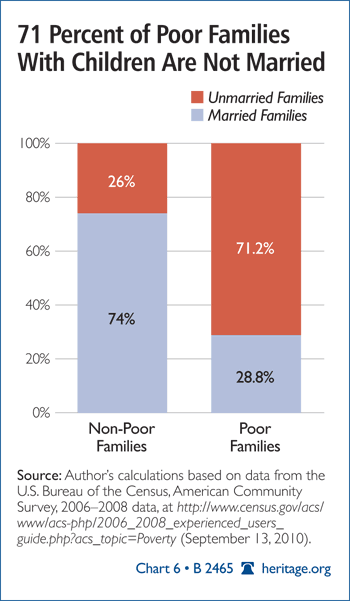
Marriage and Poverty

The five policies are:

  • higher minimum wage rates
  • opposition to school voucher programs
  • releasing criminals from jail
  • affirmative action
  • single mother welfare

This article is by Jason L. Riley, and it appeared in the Wall Street Journal.

Excerpt:

At the urging of labor unions, President Obama has pushed for higher minimum wages that price a disproportionate percentage of blacks out of the labor force. At the urging of teachers unions, he has fought voucher programs that give ghetto children access to better schools.

Both policies have a lengthy track record of keeping millions of blacks ill-educated and unemployed. Since the 1970s, when the federal government began tracking the racial achievement gap, black test scores in math, reading and science have on average trailed far behind those of their white classmates. And minimum-wage mandates have been so effective for so long at keeping blacks out of work that 1930, the last year in which there was no federal minimum-wage law, was also the last year that the black unemployment rate was lower than the white rate. For the past half-century, black joblessness on average has been double that of whites.

Last week the Justice Department said it would release some 6,000 inmates from federal prison starting later this month. The goal, according to the White House, is to ease overcrowding and roll back tough sentencing rules implemented in the 1980s and ’90s.

But why are the administration’s sympathies with the lawbreakers instead of their usual victims—the mostly law-abiding residents in low-income communities where many of these inmates eventually are headed? In dozens of large U.S. cities, violent crime, including murder, has climbed over the past year, and it is hard to see how these changes are in the interest of public safety.

The administration assures skeptics that only “nonviolent” drug offenders will be released, but who pays the price if we guess wrong, as officials have so often done in the past?

When Los Angeles asked the Rand Corp. in the 1990s to identify inmates suitable for early release, the researchers concluded that “almost no one housed in the Los Angeles jails could be considered non-serious or simply troublesome to their local communities” and that “jail capacity should be expanded so as to allow lengthier incarceration of the more dangerous.”

A 2002 federal report tracked the recidivism rate of some 91,000 supposedly nonviolent offenders in 15 states over a three-year period. More than 21% wound up rearrested for violent crimes, including more than 700 murders and more than 600 rapes. The report also noted the difficulty of identifying low-risk inmates. Auto thieves were rearrested for committing more than a third of the homicides and a disproportionate share of other violent offenses.

Keep in mind that when criminals are release, they don’t go move into wealthy progressive neighborhoods. It’s not the wealthy leftists elites who have to deal with the released inmates. It’s the poor, low-income minority neighborhoods that have to deal with them.

By the way, I covered the minimum wage argument here, and I covered the school choice argument here.

That covers the first 3 policies. This article from The College Fix covers the fourth policy, affirmative action.

It says:

A UCLA law professor critiques affirmative action as detrimental to the very people it strives to aid: minority students.

Professor Richard Sander, though liberal-leaning, has deemed affirmative action practices as harmful, a notion that contradicts a liberal view in college admissions, said Stuart Taylor, a nonresident senior fellow at the Brookings Institution.

[…]Sander began teaching law at UCLA in 1989. After a few years he garnered an interest in academic support and asked permission to analyze which strategies most effectively assist struggling students.

After reviewing statistics on performance, especially those of students with lower academic merit, he noticed correlations between race and academic success.

“I was struck by both the degree to which it correlated with having weak academic entering credentials and its correlation with race,” Sander said in a recent interview with The College Fix. “And as I looked into our admissions process I realized that we were giving really a large admissions preference.”

Sander noticed that students admitted into the law school with lower academic credentials than their peers had significantly lower percentages of passing the Multistate Bar Examination, Sander said. This especially pertained to minority students who were given special consideration in the admittance process due to their race rather than their academic preparedness.

He then began thinking about whether or not these students would have better chances of succeeding if they went to a less elite university, he said.

He called this discrepancy a mismatch; when minority students with lower credentials than their peers are accepted into more challenging universities and then suffer academically as a result.

And the fifth policy is welfare. Welfare encourages women to not marry the men that they have sex with, since they will lose their single mother benefits if they do. Children who are raised fatherless are more likely to struggle in a number of areas, and they are especially likely to be poor. What we should be doing (if we really want to help the poor) is paying people to get married and stay married. But Democrats are opposed to that. The connection between welfare, fatherlessness, poverty and crime is explained in a previous post.
New study: voucher program improved odds of poor students graduating by 21 percent

The Daily Signal reports on the study.

Excerpt:

Private school choice initiatives have become increasingly common across the United States. Far from being rare and untested, private school choice policies are an integral part of the fabric of American education policy.

In the United States today, 56 different school choice policies exist in 28 states plus the District of Columbia, and the number of choice policies has approximately doubled every four years from 2000 to 2012.

The District of Columbia Opportunity Scholarship Program remains the nation’s only federally sponsored private school choice initiative. It provides scholarships worth up to $8,000 in grades K-8 and $12,000 in high school to low-income children in D.C. to attend any of more than 50 participating private schools.

When the Opportunity Scholarship Program was launched in 2004, the U.S. Department of Education’s Institute of Education Sciences selected me to lead the initial government evaluation of this pilot program in parental school choice. Demand for scholarships exceeded supply, so most applicants faced a lottery to determine if they would receive an Opportunity Scholarship, permitting us to use a “gold standard” experimental research design to determine what impact the program had on participants.

Students in our pioneering study graduated from high school at a rate 21 percentage points higher than they otherwise would have as a result of using an Opportunity Scholarship. In scientific terms, we are more than 99 percent confident that access to school choice through the Opportunity Scholarship Program was the reason students in the program graduated at these much higher rates.

But that’s just one program, how about some others?

My research team similarly found the Milwaukee Parental Choice Program significantly increased the rates of high school graduation, college enrollment and persistence in college for the low-income students participating in our nation’s oldest urban private school choice program.

Researchers at Harvard University and the Brookings Institution determined that a privately funded K-12 scholarship program in New York City significantly increased the rate at which black and immigrant students enrolled in college. Increasingly and consistently, researchers are finding that private school choice programs like the Opportunity Scholarship Program enable students to go farther in school.

It is so good for the poor, minority children if we let their parents get money for school tuition directly. We should let parents make the choice about which school is best for their child. But, Democrats oppose school choice, because they want their allies in the teacher unions to be insulated from competition from better-performing private schools.

Look how the Democrats have fought to kill the D.C. voucher program. They talk about helping poor kids, but they don’t really mean it. And note, that article is written by ultra-leftist Democrat Juan Williams, but even he cares more about poor, minority kids getting an education than the Obama administration does.

What policies can we enact to help poor children out of poverty?

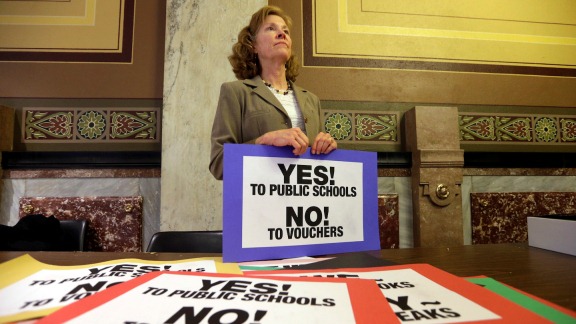
Teacher union says no to vouchers

Well, obviously pro-marriage policies will help – encouraging people to get married before they have children, then sticking together to raise the children. That will help.

Economist Stephen Moore has another idea, which I support.

He writes about it at the Daily Signal.

Excerpt:

The scenes of Baltimore set ablaze have many Americans thinking: What can be done to rescue families trapped in an inner-city culture of violence, despair and joblessness?

There are no easy answers, but down the road from Baltimore in Washington, D.C., an education program is giving children in poor neighborhoods a big lift up.

The D.C. Opportunity Scholarship Program, which George W. Bush signed into law in 2004, has so far funded private school tuition for nearly 5,000 students, 95 percent of whom are African-American. They attend religious schools, music and arts schools, even elite college-prep schools. Last month at The Heritage Foundation in Washington, I met with about 20 parents and children who participate in the program. I also visited several of these families in their homes—which are located in some of the most beaten-down neighborhoods in the city, places that in many ways resemble the trouble spots in Baltimore.

These families have now pulled together to brace for a David vs. Goliath fight to save the program. For the seventh straight year, President Obama has proposed eliminating this relatively tiny scholarship fund, which at $20 million accounts for a microscopic 0.0005 percent of the $4 trillion federal budget.

Why would Obama want to end the program? Because if children can choose schools that don’t fail them, the teachers are the failing schools might lose their jobs. Since Obama needs the votes and the political support of the teacher unions, he cannot put the interests of the children above the interests of the unionized teachers.

More from the article:

An Education Department-funded study at the University of Arkansas recently found that graduation rates rose 21 percentage points—to 91 percent, from 70 percent—for students awarded the scholarship vouchers through a lottery, compared with a control group of those who applied for but didn’t get the scholarships. For all D.C. public schools, the high school graduation rate is closer to an abysmal 56 percent.

“If you’ve got a program that’s clearly working and helping these kids, why end it?” asks Pamela Battle, whose son Carlos received a voucher and was able to attend the elite Georgetown Day School. He’s now at Northeastern University in Boston. She says Carlos “almost surely wouldn’t have gone to college” without the voucher. “We send all this money overseas for foreign aid,” she adds, “why not save the kids here at home first?”

Well, as I said, the Democrats don’t like the law:

Amazingly, these energized parents are opposed by almost every liberal group, even the NAACP, and nearly every Democrat in Congress—including Eleanor Holmes Norton, who represents the District of Columbia in Congress but opposes a program that benefits her own constituents.

There is little question what stirs this opposition. The teachers union sees the program as taking away union jobs, and it is so powerful that the Democratic establishment falls in line. “It is so sad that our public schools aren’t doing what’s best for the kids,” laments Ford, but instead are looking out for “the adults.”

[…]Obama won’t even meet with these parents. A few years ago the voucher supporters held a rally with 3,000 minority and disadvantaged families in front of the Capitol to protest President Obama’s proposed elimination of the program for all new students. Republicans in Congress, including House Speaker John Boehner, one of the program’s strongest supporters, stood in solidarity with the families, while Nancy Pelosi and her Democratic colleagues were nowhere to be seen.

So, the next time someone accuses conservatives of not caring about children, be sure and tell them the story of the D.C. voucher program. We conservatives are very much in favor of helping poor children. It’s the people on the left who are not. Don’t let your conversations with leftists be about vague things like racism and “the rich”. Bring it down to the level of details – “I support voucher programs for poor children to get out of failing schools. Do you? Why don’t your Democrat leaders support them?” Go on the attack with the facts.

By the way, read the whole post by Moore – it’s chock full of parents giving their opinion about the program, and telling stories of how vouchers worked for them. Children first, adults second. That has to be our rule.