Tag Archives: Roman Catholic

Will Obama force Catholics to buy insurance that covers abortions?

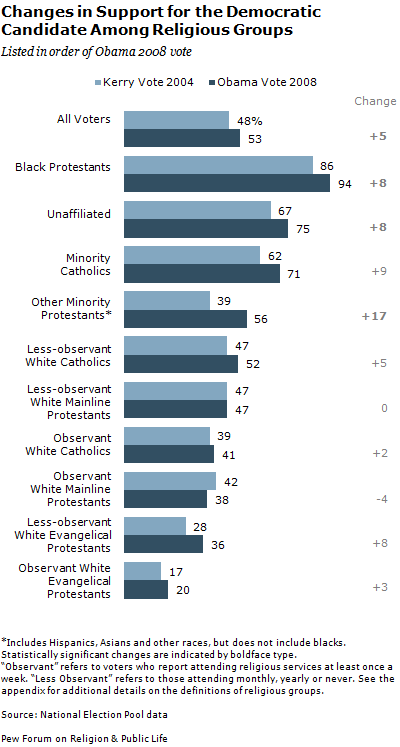
Which religions supported Obama most in 2008?

From CNS News.

Excerpt:

President Barack Obama has not yet decided whether to go forward with a proposed regulation under the health care law he signed last year that would force Catholic individuals and instutions to act against the teachings of the Catholic church.

In August, Health and Human Service Secretary Kathleen Sebelius proposed a regulation–that would take affect next fall–that would require all health care plans to cover sterilizations and all FDA-approved contraceptives, including abortifacients. The proposed regulation includes a very narrow religious exemption that does not cover individual Catholics, or Catholic universities, hospitals or charitable institutions.

The U.S. Conference of Catholic Bishops have called the regulation an “unprecedented attack on religious liberty” and have called on American Catholics to contact HHS and demand that the regulation be rescinded.

[…]Because of Obamacare’s mandate that all individuals must buy health insurance, the “preventive services” regulation would mean individual American Catholics would be forced to buy health insurance that pays for sterilizations, contraceptives and abortions–all of which violate Catholic moral teachings.

Many major Catholic institutions and Catholic business owners would be forced to choose between dropping health insurance coverage for their employees and students or violating their religious beliefs.

“Indeed, such nationwide government coercion of religious people and groups to sell, broker, or purchase ‘services’ to which they have a moral or religious objection represents an unprecedented attack on religious liberty,” the bishops said in commentary on the proposed regulation they submitted to HHS.

As an evangelical Protestant, I get so confused when I see many people who label themselves as “Catholic” voting to equate abortion with health care.

Insurance is about sharing costs. Why should people who choose not to have sex outside of marriage (like me) be compelled to pay the bills of people who freely choose to engage in risky, recreational sex? When you subsidize something, you get more of it. So why should pro-lifers be forced subsidize something that we don’t want more of? Why should pro-lifers want to make it less costly for people to engage in behaviors that result in the killing of an innocent child?

Christianity and the doctrines of exclusivism, inclusivism and pluralism

Are you familiar with the differences between exclusivism, inclusivism and pluralism? This article from Leadership University explains all three of them.

Here’s exclusivism:

The following is a succinct explanation of the central characters and ideas behind each position. The exclusivist position has been the dominant position of the church as a whole through much of its history until the Enlightenment. Major representatives include Karl Barth, Emil Brunner, Hendrick Kraemer, D.A. Carson, William Lane Craig, and R. Douglas Geivett.

Key to this position is the understanding of God’s general and special revelations. God is manifested through creation (general revelation), but Man has responded by freely going against this revelation and, thus, stands guilty before a holy God. However, God has demonstrated a reconciliatory mercy through His word and deed, fulfilled completely in Jesus Christ. The historical person of Jesus, then, is the unique, final, decisive, and normative self-revelation of God to Man (special revelation). Exclusivists believe that Jesus Christ is the sole criterion by which all religions, including Christianity, should be understood and evaluated. Calvin Shenk explains:

Christ did not come just to make a contribution to the religious storehouse of knowledge. The revelation which he brought is the ultimate standard. Since in Christ alone is salvation and truth, many religious paths do not adequately reflect the way of God and do not lead to truth and life. Jesus is not, therefore, just the greatest lord among other lords. There is no other lord besides him.

Specific texts often employed by exclusivists include Acts 4:12; John 14:6; 1 Corinthians 3:11; and 1 Timothy 2:5-6.

And inclusivism:

Inclusivism is a blanket term to characterize a sort of “middle way” between exclusivism and pluralism. Most prominent within mainline Protestantism and post-Vatican II Catholicism, its notable proponents (in one formor another) include Karl Rahner, Raimundo Panikkar and Stanley Samartha, and Hans Kung. Evangelical theologians such as Clark Pinnock, Norman Anderson, and John Sanders have also identified themselves with this position. Herein, the agnosticism associated with the latter option above is replaced with outright optimism. Christian salvation is not confined to the historical or geographic extent special revelation has spread, rather it must be available to all cultures, irrespective of age or geography.Salvation is still posited wholly in Christ and his salvific work. Specific knowledge of this work, however, is not necessary for the effect (i.e., salvation) to apply to those within a different religious culture who have responded to the general revelation available. Once again, Shenk explains:

Inclusivists want to avoid monopolizing the gospel of redemption. They acknowledge the possibility of salvation outside of Christian faith or outside the walls of the visible church, but the agent of such salvation is Christ, and the revelation in Jesus is definitive and normative for assessing that salvation. Jesus Christ is believed to be the center, and other ways are evaluated by how they relate to him. Other religions are not just a preparation for Christ, but Christ is actually present in them.

The fundamental differences between exclusivism and inclusivism… are the nature and the content of “saving faith.” The former emphasizes explicit faith while the latter points to an implicit faith.

And pluralism:

Finally, there is the pluralist position. This is undoubtedly the most difficult of the three to define in any general sense. The spectrum of pluralistic thought is as wide as it is long. The focusof this particular study will examine the contributions of its key figures: Paul Knitter, John Hick, and Wilfred Cantwell Smith. Just as in the previous positions, the interpretative range within just these three individuals varies. It is fitting, however, to focus primarily on them since they are the most vocal and influential figures espousing pluralism today.

Hick and Knitter argue the case for pluralism on the following grounds: (1) ethically, it is the only way to promote justice in an intolerant world; (2) in terms of the “ineffability of religious experience,” so no religion can claim an absolutist stance; and (3) through the understanding that historical and cultural contexts must be the filter for any absolute religious claim. Hick has argued that all world religions attempt to relate to the unknowable Ultimate Reality (or, the Real), but because of their various cultural and historical contexts these attempts are all naturally different. Hence the various conceptions of the Real and the salvation(s) sought. The common soteriological goal, toward which all religions strive, though, is rooted in the desire to transcend self-centeredness and, in turn, encounter a new (unexplainable) experience with the Real. But, he emphatically emphasizes the fact that there is “no public evidence that any one religion is soteriologically unique or superior to others and thus has closer access to Ultimate Reality.”

Therefore, with pluralism, Christ is no more definitive or normative than any religious figure or concept. Or, as Andrew Kirk explains, “Rather than confessing that Jesus Christ is the one Lord over all, this view asserts that the one Lord who has manifested himself in other names is also known as Jesus.” By “crossing the Rubicon,” as Hick and Knitter illustrate, Christians are encouraged to abandon any claim of Christian uniqueness and the possibility of absolute revelation, accepting the fact that the Christian faith is one among many options.

Now maybe you didn’t know this, but Roman Catholics seem to have taken a turn away from exclusivism and towards inclusivism in the last century.

So, I thought I would post a rebuttal to the Roman Catholic embrace of inclusivism from one of my favorite Christian apologists, Greg Koukl.

Excerpt:

There are some issues of Christianity that are intra-Nicene, intramural discussions between believers, in which I think a charitable person can easily see how another Christian can hold a different view because there are things that are difficult to understand in Scripture. For instance, though I’m Reformed in my soteriology, my understanding of salvation–I’m a Calvinist–I am sympathetic to an Arminian perspective because I can see how they, in lines of reasoning from the New Testament and verses themselves from the New Testament, can come to their view. So, though I would disagree, and I think they’re mistaken, I understand how they can see it.But there are other positions that I cannot understand because there is no New Testament evidence in favor of it, and, to the contrary, almost to a word, as the New Testament touches the issue, it says quite the opposite.

Earlier this week, I was honored, flattered, and, frankly, humbled to have a very unique opportunity on Monday to address an audience of about 150 Jewish people that were in the midst of Jewish High Holy Day services–morning services, evening services–at kind of a pause time in the afternoon, in which my host and I and another guest had a discussion about Jews and Christians. The three of us were on the panel:  my host, Dennis Prager, a man I have a tremendous admiration and affection for, and Greg Coiro, a Roman Catholic priest and a professional friend. I’ve known both of these men over 20 years and have been in many discussions, both in private and public on the air with Dennis and Greg Coiro.

It was in this opportunity that, in a sense, the ancient quarrel of sorts, theologically, was revisited, that I’ve had in the past many years ago when we were talking about this in interfaith dialogues. This difference of opinion is a historically new development in Roman Catholicism that stunned me when I first encountered it in the early days of being on Religion on the Line in the late eighties, a radio panel Dennis Prager hosted for many years. The priests on the panel uniformly held the conviction, informed by Vatican II, that Jews don’t have to believe in Jesus in order to receive the benefits of Jesus’ salvation. This is a view called “inclusivism.” It’s not the same as pluralism, but in my view, it seems to have the same impact: “Yes, Jesus is necessary for salvation, but you don’t have to believe in Jesus to benefit from Jesus.”

Now, at this afternoon panel recently, the very first question that came up was whether trust in Jesus is necessary for salvation. “Greg, do you believe that? Do Protestants believe that?” I answered, “Yes, I believe that. And no, not all Protestants believe that. But let me try to explain it to you in a way that doesn’t sound so stark. Let me try to give it some perspective.” I explained that it wasn’t as if God was up there looking down at a bunch of religious clubs and prefers some over others. He used to prefer the Jewish club and now He prefers the Christian club. It may sound that way to many when this doctrine of Christianity is put forward: Jesus is the only way of salvation; you must believe in Jesus in order to benefit from what Jesus did.

Talk about Daniel in the lions’ den. Anyway, click through and read the whole article to get an idea of how to make your stand for exclusivism in difficult places.

For a general article defending the Christian doctrine of exclusivism, check out this article by William Lane Craig. One of my favorites, from way way back to when I was an undergraduate.

And, if you would like to listen to a debate on pluralism, then here is a debate featuring pluralist John Hick.

What does the Bible say about capital punishment?

Note: This post has a twin post which talks about the evidence against capital punishment from science.

First, let’s take a look at what the Bible says in general about capital punishment, using this lecture featuring eminent theologian Wayne Grudem.

About Wayne Grudem:

Grudem holds a BA from Harvard University, a Master of Divinity from Westminster Theological Seminary, and a PhD from the University of Cambridge. In 2001, Grudem became Research Professor of Bible and Theology at Phoenix Seminary. Prior to that, he had taught for 20 years at Trinity Evangelical Divinity School, where he was chairman of the department of Biblical and Systematic Theology.

Grudem served on the committee overseeing the English Standard Version translation of the Bible, and in 1999 he was the president of the Evangelical Theological Society. He is a co-founder and past president of the Council on Biblical Manhood and Womanhood. He is the author of, among other books, Systematic Theology: An Introduction to Biblical Doctrine, which advocates a Calvinistic soteriology, the verbal plenary inspiration and inerrancy of the Bible, the body-soul dichotomy in the nature of man, and the complementarian (rather than egalitarian) view of gender equality.

The MP3 file is here.

A PDF sermon outline is here.

Topics:

  • what kinds of crimes might require CP?
  • what did God say to Noah about CP?
  • what does it mean that man is made in the image of God?
  • is CP just about taking revenge?
  • what does CP say about the value of human life?
  • does CP apply to animals, too?
  • could the statements supporting CP be understood as symbolic?
  • one purpose of CP is to protecting the public
  • another purpose of CP is to deter further wrongdoing
  • but the Biblical purpose of CP is to achieve justice by retribution
  • does the Pope make a good argument against CP?
  • what is the role of civil government in achieving retribution?
  • do people in Heaven who are sinless desire God to judge sinners?
  • should crimes involving property alone be subject to CP?
  • is the Mosaic law relevant for deciding which crimes are capital today?
  • should violent crimes where no one dies be subject to CP?
  • is CP widespread in the world? why or why not?
  • what are some objections to CP from the Bible?
  • how do you respond to those objections to CP?
  • should civil government also turn the other cheek for all crimes?
  • what is the “whole life ethic” and is it Biblical?
  • what do academic studies show about the deterrence effect of CP?
  • how often have innocent people been executed in the USA?
  • should there be a higher burden of proof for CP convictions?

You can find more talks by Wayne Grudem here.

What about the woman caught in adultery?

Some people like to bring up the woman caught in adultery as proof that Jesus opposed capital punishment. But that passage of the Bible was added much later after the canon was decided.

Daniel B. Wallace is an eminent New Testament scholar who also teaches at Dallas Theological Seminary, an extremely conservative seminary.

About Dr. Wallace:

Dr. Daniel B. Wallace

  • Professor of New Testament Studies
  • B.A., Biola University, 1975; Th.M., Dallas Theological Seminary, 1979; Ph.D., 1995.

Dr. Wallace influences students across the country through his textbook on intermediate Greek grammar. It is used in more than two-thirds of the nation’s schools that teach that subject. He is the senior New Testament editor of the NET Bible and coeditor of the NET-Nestle Greek-English diglot. Recently his scholarship has shifted from syntactical and text-critical issues to more specific work in John, Mark, and nascent Christology. However he still works extensively in textual criticism, and has founded The Center for the Study of New Testament Manuscripts, an institute with an initial purpose to preserve Scripture by taking digital photographs of all known Greek New Testament manuscripts. His postdoctoral work includes work on Greek grammar at Tyndale House in Cambridge and textual criticism studies at the Institut für Neutestamentliche Textforschung in Münster.

And Dr. Wallace writes about the passage in John on Bible.org.

Excerpt:

One hundred and forty years ago, conservative biblical scholar and Dean of Canterbury, Henry Alford, advocated a new translation to replace the King James Bible. One of his reasons was the inferior textual basis of the KJV. Alford argued that “a translator of Holy Scripture must be…ready to sacrifice the choicest text, and the plainest proof of doctrine, if the words are not those of what he is constrained in his conscience to receive as God’s testimony.” He was speaking about the Trinitarian formula found in the KJV rendering of 1 John 5:7–8. Twenty years later, two Cambridge scholars came to the firm conclusion that John 7:53–8:11 also was not part of the original text of scripture. But Westcott and Hort’s view has not had nearly the impact that Alford’s did.

For a long time, biblical scholars have recognized the poor textual credentials of the story of the woman caught in adultery (John 7:53–8:11). The evidence against its authenticity is overwhelming: The earliest manuscripts with substantial portions of John’s Gospel (P66 and P75) lack these verses. They skip from John 7:52 to 8:12. The oldest large codices of the Bible also lack these verses: codex Sinaiticus and Vaticanus, both from the fourth century, are normally considered to be the most important biblical manuscripts of the NT extant today. Neither of them has these verses. Codex Alexandrinus, from the fifth century, lacks several leaves in the middle of John. But because of the consistency of the letter size, width of lines, and lines per page, the evidence is conclusive that this manuscript also lacked the pericope adulterae. Codex Ephraemi Rescriptus, also from the fifth century, apparently lacked these verses as well (it is similar to Alexandrinus in that some leaves are missing). The earliest extant manuscript to have these verses is codex Bezae, an eccentric text once in the possession of Theodore Beza. He gave this manuscript to the University of Cambridge in 1581 as a gift, telling the school that he was confident that the scholars there would be able to figure out its significance. He washed his hands of the document. Bezae is indeed the most eccentric NT manuscript extant today, yet it is the chief representative of the Western text-type (the text-form that became dominant in Rome and the Latin West).

When P66, P75, Sinaiticus, and Vaticanus agree, their combined testimony is overwhelmingly strong that a particular reading is not authentic. But it is not only the early Greek manuscripts that lack this text. The great majority of Greek manuscripts through the first eight centuries lack this pericope. And except for Bezae (or codex D), virtually all of the most important Greek witnesses through the first eight centuries do not have the verses. Of the three most important early versions of the New Testament (Coptic, Latin, Syriac), two of them lack the story in their earliest and best witnesses. The Latin alone has the story in its best early witnesses.

[…]It is an important point to note that although the story of the woman caught in adultery is found in most of our printed Bibles today, the evidence suggests that the majority of Bibles during the first eight centuries of the Christian faith did not contain the story. Externally, most scholars would say that the evidence for it not being an authentic part of John’s Gospel is rock solid.But textual criticism is not based on external evidence alone; there is also the internal evidence to consider. This is comprised of two parts: intrinsic evidence has to do with what an author is likely to have written; transcriptional evidence has to do with how and why a scribe would have changed the text.

Intrinsically, the vocabulary, syntax, and style look far more like Luke than they do John. There is almost nothing in these twelve verses that has a Johannine flavor. And transcriptionally, scribes were almost always prone to add material rather than omit it—especially a big block of text such as this, rich in its description of Jesus’ mercy. One of the remarkable things about this passage, in fact, is that it is found in multiple locations. Most manuscripts that have it place it in its now traditional location: between John 7:52 and 8:12. But an entire family of manuscripts has the passage at the end of Luke 21, while another family places it at the end of John’s Gospel. Other manuscripts place it at the end of Luke or in various places in John 7.

The pericope adulterae has all the earmarks of a pericope that was looking for a home. It took up permanent residence, in the ninth century, in the middle of the fourth gospel.

As this debate between Peter Williams and Bart Ehrman shows, there are only TWO disputed passages in the entire NT that are theologically significant. The long ending of Mark and this adultery passage. A good case can be made for the long ending of Mark, but it’s best not to assume it in a debate. The adultery passage is practically impossible to defend as authentic. Dr. Wallace talks about both passages in this Parchment & Pen article. Wallace has also debated Bart Ehrman in the Greer-Heard Forum. What that debate showed is that the New Testament text is actually quite reliable except for those two passages, but it’s important to be honest about the two places that are not well supported.