
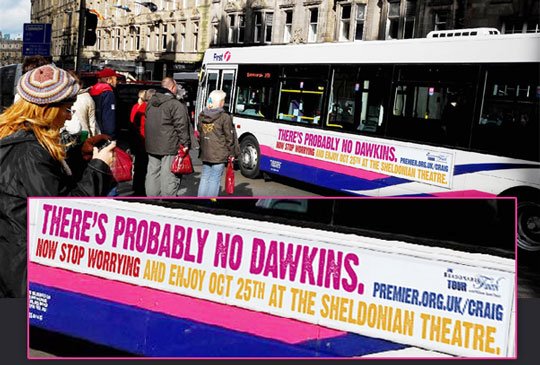
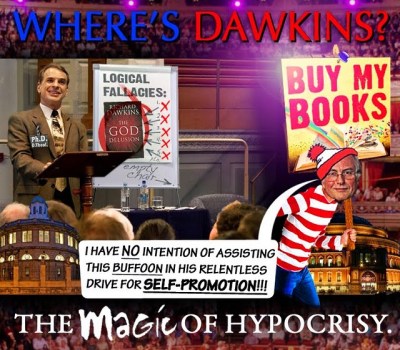
Atheist Richard Dawkins explained why he wouldn’t debate Craig in this UK Guardian column. This is his latest excuse for not debating Craig, (see the full list of excuses here). I guess this is Dawkins’ way of striking at Craig without giving Craig a chance to respond. If he wanted to hear a response, he would have attended the debate at Oxford, and put his arguments on the table to be answered.
Defeating the column
His entire column is easily dispatched using Dawkins’ own words against him, because he contradicts himself.
Dawkins has previously written this:
The total amount of suffering per year in the natural world is beyond all decent contemplation. During the minute that it takes me to compose this sentence, thousands of animals are being eaten alive, many others are running for their lives, whimpering with fear, others are slowly being devoured from within by rasping parasites, thousands of all kinds are dying of starvation, thirst, and disease. It must be so. If there ever is a time of plenty, this very fact will automatically lead to an increase in the population until the natural state of starvation and misery is restored. In a universe of electrons and selfish genes, blind physical forces and genetic replication, some people are going to get hurt, other people are going to get lucky, and you won’t find any rhyme or reason in it, nor any justice. The universe that we observe has precisely the properties we should expect if there is, at bottom, no design, no purpose, no evil, no good, nothing but pitiless indifference.
(“God’s Utility Function,” Scientific American, November, 1995, p. 85)
Meanwhile, in his column, Dawkins claimed that God’s command to destroy the Canaanites was an instance of evil:
Most churchmen these days wisely disown the horrific genocides ordered by the God of the Old Testament. Anyone who criticises the divine bloodlust is loudly accused of unfairly ignoring the historical context, and of naive literalism towards what was never more than metaphor or myth. You would search far to find a modern preacher willing to defend God’s commandment, in Deuteronomy 20: 13-15, to kill all the men in a conquered city and to seize the women, children and livestock as plunder.
So, in one statement, there’s no good or evil, and in the next statement, there’s evil. That’s a contradiction, and it undermines his entire column, Q.E.D. You can’t claim that there is no standard of good and evil in one breath, and then make judgments of good and evil in the next. It’s self-refuting. Dawkins didn’t even try to respond to any of Craig’s standard arguments for God’s existence in the editorial, he just went off on a tangent about a few Bible verses that, even if true, might only defeat Judaism and Christianity in particular, but not the existence of God in general. And the debate “Does God Exist?” is about the latter.
Responding to the argument
If we ignore Dawkins’ first statement denying that morality is real, and just respond to the verses he is complaining about, then we can look at this response online by William Lane Craig, or we can watch a lecture in two parts featuring Christian philosopher Paul Copan (part 1, part 2). So, a response to this objection is not hard to find. We have entire books written to answer this challenge – to say nothing of academic papers.
It’s troubling to me that Dawkins would not reference any responses to his argument in his editorial, since they clearly exist, and can easily be found just by searching the world wide web. Dawkins’ failure to interact with his critics is not surprising, though, given the fact that he didn’t reference any opposing scholars in his latest book. Moreover, Dawkins has cited a professor of German language as an authority on the historical Jesus and suggested that unobservable aliens could explain the origin of life. These are not actions of a genuine scholar, and the refusal to debate William Lane Craig in public is part of that same pattern.
But the main point to realize is that Richard Dawkins refuses to debate William Lane Craig, and that means that nothing Richard Dawkins says can be taken seriously. He isn’t willing to take the stage with an opponent and defend his views. He prefers to take pot shots at peripheral matters, (disputing particular Bible passages has nothing whatsoever to do with the question of whether a Creator of the universe exists or not), from the safety of the UK Guardian’s editorial page. I cited responses to the passages from Craig and Copan above, but Craig could even just reject the passages as mistaken and Dawkins’ argument would be neutralized – the debate is about the existence of God – the bare philosopher’s God who creates and designs the universe. The debate is not about the Christian God in particular, or even about the inerrancy of the Bible. Evidence against inerrancy is not evidence against a Creator and Designer of the universe.
Finally, it’s important to note that Richard Dawkins has peculiar views on morality himself. Not only does he support abortion, which resulted in the death of over 50 million unborn babies since 1973 in the United States alone, but he actually has no problem with infanticide.
(H/T Anglican Samizdat)
That’s why it’s important to make these arguments in a debate – instead of preaching them in an editorial to the UK Guardian choir. Theists do have responses to these and other objections, and it would be nice to be able to give those responses in public. If truth is the goal, then hearing both sides is the best way to reach the goal. It’s part of the scientific method that we should be open to being disproved by the evidence.
About William Lane Craig
William Lane Craig is currently conducting a debating and speaking tour of the UK, with stops at Oxford, Cambridge, London and points in between.
Let’s review William Lane Craig’s qualifications:
William Lane Craig is Research Professor of Philosophy at Talbot School of Theology in La Mirada, California.
Dr. Craig pursued his undergraduate studies at Wheaton College (B.A. 1971) and graduate studies at Trinity Evangelical Divinity School (M.A. 1974; M.A. 1975), the University of Birmingham (England) (Ph.D. 1977), and the University of Munich (Germany) (D.Theol. 1984). From 1980-86 he taught Philosophy of Religion at Trinity… In 1987 they moved to Brussels, Belgium, where Dr. Craig pursued research at the University of Louvain until assuming his position at Talbot in 1994.
He has authored or edited over thirty books, including The Kalam Cosmological Argument; Assessing the New Testament Evidence for the Historicity of the Resurrection of Jesus; Divine Foreknowledge and Human Freedom; Theism, Atheism and Big Bang Cosmology; and God, Time and Eternity, as well as over a hundred articles in professional journals of philosophy and theology, including The Journal of Philosophy, New Testament Studies, Journal for the Study of the New Testament, American Philosophical Quarterly, Philosophical Studies, Philosophy, and British Journal for Philosophy of Science.
Craig’s list of publications is here.
Here are some of Craig’s recent publications: (it’s a little out of date, now)
From 2007:
- Ed. with Quentin Smith. Einstein, Relativity, and Absolute Simultaneity. Routledge Studies in Contemporary Philosophy. London: Routledge, 2007, 302 pp.
- “Theistic Critiques of Atheism.” In The Cambridge Companion to Atheism, pp. 69-85. Ed. M. Martin. Cambridge Companions to Philosophy. Cambridge University Press, 2007.
- “The Metaphysics of Special Relativity: Three Views.” In Einstein, Relativity, and Absolute Simultaneity, pp. 11-49. Ed. Wm. L. Craig and Quentin Smith. Routledge Studies in Contemporary Philosophy. London: Routledge, 2007.
- “Creation and Divine Action.” In The Routledge Companion to Philosophy of Religion, pp. 318-28. Ed. Chad Meister and Paul Copan. London: Routledge, 2007.
From 2008:
- God and Ethics: A Contemporary Debate. With Paul Kurtz. Ed. Nathan King and Robert Garcia. With responses by Louise Antony, Walter Sinnott-Armstrong, John Hare, Donald Hubin, Stephen Layman, Mark Murphy, and Richard Swinburne. Lanham, Md.: Rowman & Littlefield, 2008.
- “Time, Eternity, and Eschatology.” In The Oxford Handbook on Eschatology, pp. 596-613. Ed. J. Walls. Oxford: Oxford University Press, 2008.
From 2009:
- Ed. with J. P. Moreland. Blackwell Companion to Natural Theology. Oxford: Blackwell.
- “The Kalam Cosmological Argument.” With James Sinclair. In Blackwell Companion to Natural Theology. Ed. Wm. L. Craig and J. P. Moreland. Oxford: Blackwell.
- “In Defense of Theistic Arguments.” In The Future of Atheism: Alister McGrath and Daniel Dennett in Dialogue. Ed. Robert Stewart. Philadelphia: Fortress Press.
Forthcoming:
- “The Cosmological Argument.” In Philosophy of Religion: Classic and Contemporary Issues. Ed. Paul Copan and Chad Meister. Cambridge: Blackwell.
- “Cosmological Argument”; “Middle Knowledge.” In The Cambridge Dictionary of Christian Theology. Ed. G. Fergusson et al. Cambridge: Cambridge University Press.
- “Divine Eternity.” In Oxford Handbook of Philosophical Theology. Ed. Thomas Flint and Michael Rea. Oxford: Oxford University Press.
He seems eminently qualified to debate the existence of God, doesn’t he? And he’s done it dozens of times, against the top atheist scholars.
What is Richard Dawkins is afraid of?
Here’s an example of William Lane Craig debating the famous atheist Christopher Hitchens, arguably the top popular atheist in the world today.
Here’s a review of that debate from Common Sense Atheism, a popular and respected atheist web site.
Excerpt:
I just returned from the debate between William Lane Craig and Christopher Hitchens at Biola University. It was a bigger deal than I realized. Over 3,000 people were there, and groups from dozens of countries – including Sri Lanka, apparently – had purchased a live feed.
[…]The debate went exactly as I expected. Craig was flawless and unstoppable. Hitchens was rambling and incoherent, with the occasional rhetorical jab. Frankly, Craig spanked Hitchens like a foolish child. Perhaps Hitchens realized how bad things were for him after Craig’s opening speech, as even Hitchens’ rhetorical flourishes were not as confident as usual. Hitchens wasted his cross-examination time with questions like, “If a baby was born in Palestine, would you rather it be a Muslim baby or an atheist baby?” He did not even bother to give his concluding remarks, ceding the time instead to Q&A.
The atheist web site “Debunking Christianity” called it a “landslide” victory for Craig. And I want to suggest that this outcome is exactly what Richard Dawkins was afraid of.
Craig has also debated other prominent atheists like Sam Harris, Daniel Dennett, Bart Ehrman, Peter Atkins, Victor Stenger, and so on. And many of these can be seen for free on Youtube.
What William Lane Craig offers in his debates is a set of deductive arguments that are logically valid, and supported by 1) the latest scientific evidence (which he has published in peer-reviewed scientific journals), and 2) the consensus of academic historians of all persuasions, using standard historical methods. Dawkins should have no trouble debating empirical arguments from science and history, if his beliefs were testable against objective evidence. The debate is about scientific and historical evidence, and we can investigate that evidence.
Finally, I want to note that Craig is not the only person who Dawkins refuses to debate. He was challenged to debate Stephen C. Meyer, whose Ph.D is from Cambridge, and again declined to have his ideas debated in a public forum. Meyer’s book was as a Times Literary Supplement Best Book of 2009 – and it was nominated by the respected atheist philosopher Thomas Nagel.
 WINTERY KNIGHT