
Tag Archives: Revenue

Guttmacher Institute: states enact record number of abortion restrictions

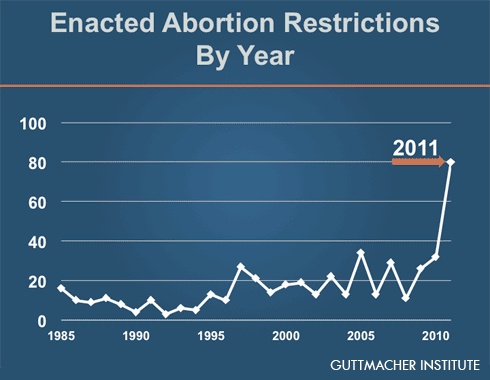
Enacted Abortion Restrictions By Year

Great news from the Guttmacher Institute, a pro-abortion think tank. (H/T John from Truth in Religion & Politics)

Excerpt:

In the first six months of 2011, states enacted 162 new provisions related to reproductive health and rights. Fully 49% of these new laws seek to restrict access to abortion services, a sharp increase from 2010, when 26% of new laws restricted abortion. The 80 abortion restrictions enacted this year are more than double the previous record of 34 abortion restrictions enacted in 2005—and more than triple the 23 enacted in 2010. All of these new provisions were enacted in just 19 states.

The post breaks down the pro-life measures by category:

  • Counseling and waiting periods
  • Gestational bans
  • “Heartbeat” bill
  • Banning abortion coverage in new insurance exchanges
  • Medication abortion
  • Cuts to abortion subsidies

All of these bills were supported by Republicans, and opposed by Democrats.

Elections have consequences. We elected a massive number of Republicans in 2010, and now we are seeing the results of that effort. I could not be more proud of the Republicans who voted in these measures to protect the unborn.

Related posts

How did the Reagan tax cuts and Bush tax cuts affect unemployment?

Consider this article by the Cato Institute, a libertarian think tank, which discusses how the Reagan tax cuts affected the unemployment rate.

Excerpt:

In 1980, President Carter and his supporters in the Congress and news media asked, “how can we afford” presidential candidate Ronald Reagan’s proposed tax cuts?

Mr. Reagan’s critics claimed the tax cuts would lead to more inflation and higher interest rates, while Mr. Reagan said tax cuts would lead to more economic growth and higher living standards. What happened? Inflation fell from 12.5 percent in 1980 to 3.9 percent in 1984, interest rates fell, and economic growth went from minus 0.2 percent in 1980 to plus 7.3 percent in 1984, and Mr. Reagan was re-elected in a landslide.

[…]Despite the fact that federal revenues have varied little (as a percentage of GDP) over the last 40 years, there has been an enormous variation in top tax rates. When Ronald Reagan took office, the top individual tax rate was 70 percent and by 1986 it was down to only 28 percent. All Americans received at least a 30 percent tax rate cut; yet federal tax revenues as a percent of GDP were almost unchanged during the Reagan presidency (from 18.9 percent in 1980 to 18.1 percent in 1988).

What did change, however, was the rate of economic growth, which was more than 50 percent higher for the seven years after the Reagan tax cuts compared with the previous seven years. This increase in economic growth, plus some reductions in tax credits and deductions, almost entirely offset the effect of the rate reductions. Rapid economic growth, unlike government spending programs, proved to be the most effective way to reduce unemployment and poverty, and create opportunity for the disadvantaged.

The conservative Heritage Foundation describes the effects of the Bush tax cuts. (H/T The Lonely Conservative)

Excerpt:

President Bush signed the first wave of tax cuts in 2001, cutting rates and providing tax relief for families by, for example, doubling of the child tax credit to $1,000.

At Congress’ insistence, the tax relief was initially phased in over many years, so the economy continued to lose jobs. In 2003, realizing its error, Congress made the earlier tax relief effective immediately. Congress also lowered tax rates on capital gains and dividends to encourage business investment, which had been lagging.

It was the then that the economy turned around. Within months of enactment, job growth shot up, eventually creating 8.1 million jobs through 2007. Tax revenues also increased after the Bush tax cuts, due to economic growth.

In 2003, capital gains tax rates were reduced. Rather than expand by 36% as the Congressional Budget Office projected before the tax cut, capital gains revenues more than doubled to $103 billion.

The CBO incorrectly calculated that the post-March 2003 tax cuts would lower 2006 revenues by $75 billion. Revenues for 2006 came in $47 billion above the pre-tax cut baseline.

Here’s what else happened after the 2003 tax cuts lowered the rates on income, capital gains and dividend taxes:

  • GDP grew at an annual rate of just 1.7% in the six quarters before the 2003 tax cuts. In the six quarters following the tax cuts, the growth rate was 4.1%.
  • The S&P 500 dropped 18% in the six quarters before the 2003 tax cuts but increased by 32% over the next six quarters.
  • The economy lost 267,000 jobs in the six quarters before the 2003 tax cuts. In the next six quarters, it added 307,000 jobs, followed by 5 million jobs in the next seven quarters.

The timing of the lower tax rates coincides almost exactly with the stark acceleration in the economy. Nor was this experience unique. The famous Clinton economic boom began when Congress passed legislation cutting spending and cutting the capital gains tax rate.

Those are the facts. That’s not what you hear in the media, but they are the facts.

Obama administration threatens Indiana for defunding Planned Parenthood

From Life Site News.

Excerpt:

The Obama administration is not happy with Indiana for being the first state to defund Planned Parenthood. According to reports, the administration is considering taking away the state’s Medicaid money in retaliation.

Pro-life Gov. Mitch Daniels recently signed into law a measure that bars state agencies from entering into contracts with abortion providers, aside from hospitals. The law also bans abortion past 20 weeks gestation, with an exception for the life or physical health of the mother.

The law effectively cuts Planned Parenthood off from approximately $3 million in state family planning funds, unless the state organization divides into separate independent affiliates that have nothing to do financially with abortion-providing affiliates.

The New York Times reports that federal officials are considering withholding some or all of the state’s Medicaid money in order to pressure the state to allow the nation’s largest abortion provider to tap into family planning funds.

The Times reports that the administration has 90 days to take action.

The federal Centers for Medicare and Medicaid Services said in a statement approved by the White House: “Federal law prohibits federal Medicaid dollars from being spent on abortion services. Medicaid does not allow states to stop beneficiaries from getting care they need — like cancer screenings and preventive care — because their provider offers certain other services. We are reviewing this particular situation and situations in other states.”

Marcus J. Barlow, representing the Indiana Family and Social Services Administration, pointed out to the Times, however, that the state was not cutting off funds for family planning services. “It’s a change in providers,” he explained, observing that clients of Planned Parenthood could go to other non-abortion providing clinics for those services.

Bioethicist Wesley J. Smith posed the question on his blog: “Is PP so important to Obama that he and his HHS Secretary are willing to materially hurt poor people by cutting off Medicaid funding to try and leverage restored funding for PP?”

“So long as those services are available, what business is it to the Feds which facilities provide them? Or, are we to believe that PP has a right to receive public money?” he said.

Well, the other service providers didn’t donate massive amounts of money to the Demcorat Party, like Planned Parenthood did. (See below) Some people who claim to be pro-life voted for Barack Obama, and I think those people really need to reconsider the facts. The Democrats are a pro-abortion party.

Related posts