
Tag Archives: Religious Pluralism

India Supreme Court exonerates eleven Hindus who murdered three Christians

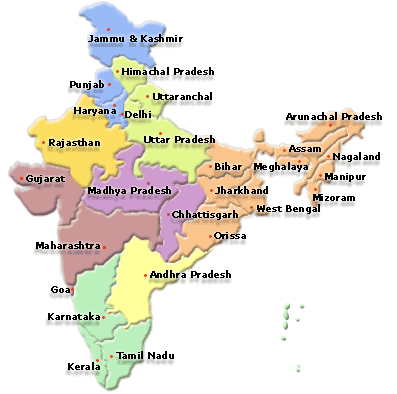
Map of India
Map of India

First, let’s hear about an anti-Christian crime that occurred in Orissa, the most anti-Christian area in India.

Excerpt:

The Central Bureau of investigation (CBI) wanted the death penalty for Singh, who was linked to extreme right-wing Hindu group Bajrang Dal. The GCIC has opposed the request for a death sentence. The wife of the slain pastor, Gladys Staines, had already forgiven Dara and his accomplices involved in the brutal murder of her husband and children. (20/01/2009 Widow of Graham Staines: “Do not give up hope, pray for India”).

Twelve years ago, Graham Staines was burnt alive with his children aged eight and ten years in the small village of Manoharpur, in the tribal area of Orissa. Graham Staines had worked for thirty years with leprosy patients in Orissa, and was sleeping with his children in a car, on his journey home on a cold December night. A group of attackers poured petrol on the car, and burned them alive.

The Staines tried to escape, but the assailants, fifty in all, prevented them. A witness said the attackers shouted slogans in praise of Dara Singh, the Hindu movement and the god Hanuman.

In 2003 a court in Khurda judged all 13 accused guilty. Life in prison for everyone else, a death sentence for Dara Singh. In 2005, the Orissa High Court commuted the death penalty to life imprisonment, judged Hembran guilty and exonerated the others.

Shalini sent me this story about how the Supreme Court upheld the High Court’s decision.

Excerpt:

Dara Singh killed Australian missionary Graham Staines and his two minor sons by setting fire to the vehicle in which they were sleeping, but the Supreme Court on Friday ruled that it was not a “rarest of rare” category crime to warrant death penalty for him.

In a judgment drawing curtains on court proceedings in the sensational incident of January 1999, a bench of Justices P Sathasivam and B S Chauhan upheld the Orissa High Court judgment imposing life sentence on Singh alias Rabindra Kumar Pal and Mahendra Hembram. The trial court had awarded death penalty to Singh.

The bench said the Orissa HC was justified in awarding life term to Singh and Hembran as the crime was committed in the passion to teach Staines a lesson for his alleged attempts to convert tribals.

“Though Graham Staines and his two minor sons were burnt to death while they were sleeping inside a station wagon at Manoharpur, the intention was to teach a lesson to Staines about his religious activities, namely, converting poor tribals to Christianity,” it said.

“All these aspects have been correctly appreciated by the high court and modified the sentence of death into life imprisonment with which we concur,” the bench said.

Justice Sathasivam, writing the judgment for the bench, also dismissed the CBI`s appeal challenging the HC`s decision to acquit 11 other accused. “We have highlighted the weakness and infirmities of the prosecution case insofar as acquitted accused, who are poor tribals,” he said. The CBI had taken over the probe from Orissa Police on May 3, 1999.

“In the absence of definite assertion from the prosecution side about their specific role and involvement, it is not safe to convict them. We entirely agree with the reasoning and conclusion of the high court,” it said.

While condemning killings in the name of religion, the bench also expressed its disapproval of conversion. “It is undisputed that there is no justification for interfering in someone`s belief by way of `use of force`, provocation, conversion, incitement or upon a flawed premise that one religion is better than the other,” said the bench.

This story is interesting because it shows how the pluralist view that “all religions are valid” can actually lead to violence. The pluralist view is itself a point of view that takes itself to be true. Pluralists think that religions like Christianity, which claim to be true, are actually FALSE. In short, pluralism DOES disagree with Christianity. If disagreement with other religions is bad, then pluralists are just as guilty of being bad as Christians.

Is what they say about Christians being “exclusive” true? Does being “exclusive” make Christians dangerous? Well, the reason why the practice of Christianity DOES NOT result in violence is because part of the “truth” that Christians believe is that they should love their enemies and pray for the people who persecute them. That’s why the victim’s wife forgave the murderers for their crimes.

I actually have Hindus and Muslims in my family. They treat religion as a cultural or national identity – not really something to investigate to see if it is true or false. Hindus are not usually Hindus because they did some big investigation and found Hinduism to be true. (Hinduism requires an eternally oscillating cosmology, which contradicts physics and the Big Bang theory). It’s more like that they do it for personal reasons or community reasons – it’s like part of their national/cultural identity.

Why do some Hindus oppose evangelism?

A while back I posted this debate featuring a Hindu who disagreed with Christian evangelism and wanted to make it illegal. He complained about Christians using “force” (being kind and giving gifts) to convince people to become Christians. In the next breath he was pushing the government to use force his anti-Christian views onto Christians. He did not want them to evangelize, so he wanted to pass that view into law and force his neighbors to accept HIS views by force. He thought his view of Christianity and evangelism was TRUE, and he thought the traditional, Biblical Christian view was false. He actually insisted that his interpretation of the Bible was correct and all the Christian theologians were misinterpreting the Bible. He expected Christians to act like Hindus! And he thought that Christianity WAS Hinduism – or that it should be redefined to be understood to be Hinduism. Then he complained about Christians who thought that their views were TRUE and that his were FALSE.

The difference between Christians and Hindus is that committed Christians think they are right and use ideas and words to persuade, while militant Hindus think they are right and are willing to use force to make people agree with them. I think the difference is that a Christian can appeal to facts like the Big Bang theory, and the Hindu cannot really do that, as this Hindu commenter to another post showed.

I really recommend that you listen to that debate, and there is a play-by-play summary that I wrote in case the bandwidth is too high. And read my exchange with the Hindu commenter, too.

Here is the major persecution story in Orissa that I blogged about before. And here’s another small story from Orissa that I found.

Why do so many people oppose debating about religion?

Consider this article by Barbara Johnson in the Dallas Morning News. Her title is “Don’t bother debating faith”.

Full article:

Recently Prestonwood Baptist Church invited Christopher Hitchens, a renowned atheist, to debate his views with William Dembski of Southwestern Baptist Theological Seminary. While I applaud Prestonwood for having the courage to expose their young students to views which are so unlike those taught in their very conservative school, I question the idea of debating religious views at all. Debate or argument, while exposing us to the beliefs and convictions of others, can breed animosity, partisanship and an “us against them” mentality, as each side fights to defend a predetermined stance.

Because religious or spiritual views and experiences are deeply personal, I don’t believe they belong in the debate arena at all.

The spectacle of religious thinkers arguing and cutting down one another’s beliefs, practices and spiritual experiences makes little sense and is a detriment to what religion should stand for. Each individual must be allowed to walk his or her spiritual journey without outside pressure and condemnation. When one is pressured to “believe” a certain set of doctrines, or operate within a pre-set paradigm, true expression is suppressed.

Psychologist Carl Jung notes that “many of our institutions throw obstacles in the way of the individual’s self-discovery” and that through the institution of the church “people are effectively defended and shielded against immediate religious experience,” an experience I feel cannot be imposed upon anyone through argument or even reasoning.

The vast majority of the world’s population understandably practices the religious traditions of their own childhood. Having grown up Christian in the largest Muslim country in the world, surrounded by its good people, I have the privilege of a broad world view. Consequently, I feel that the all-too-prevalent idea that one entire group is misguided and needs to be enlightened with the ideas and dogmas of another group possessing a monopoly on truth is off the mark.

I don’t have the answer to the mystery and purpose of life, and I am convinced that no one else on earth does either. I like to heed Václav Havel’s advice: “Keep the company of those who seek the truth – run from those who have found it.” All people of the world must be free to practice their culture and religion as they please or to define their own individual spirituality through the wisdom they accumulate with life experience. Too much time, energy and focus is spent by many “religious” folks trying to figure out who is right and who is wrong; who is saved and who is doomed; who should be included and who should be excluded from their institutions.

If they are honestly seeking a personal relationship with the divine, they are wrestling with the wrong angel. True spirituality will never be achieved this way. More time should be spent searching for and recognizing the glimpses of God that are available each and every day in such things as expressions of love, acts of kindness and beautiful moments in nature.

As Henri Nouwen so perfectly puts it, “My highest vocation is to be a witness to the glimpses of God I have been allowed to catch.” I so admire the Zen Buddhists who don’t expend energy defending dogmas or condemning those with varying practices or beliefs. They concentrate on inclusiveness, peaceful meditation, private introspection, acceptance, and respect for people and environment. They see glimpses of the divine in the simple miracles around them every day. How can anyone argue with that?

Here’s a short bio of the woman who wrote the article:

Barbara B. Johnson is a life coach living and working in Dallas. She is also a Community Voices volunteer columnist.

I think that people with expertise in philosophy, a science, history or even engineering are more likely to disagree with her. But I think that her view is shared by many leaders in the church, and by many parents of children who attend church (H/T Tory Ninja).

Refuting her view is simple, it takes only one line. If she is saying that debating with people to persuade them of your view is wrong, then she should not be debating with we narrow-minded believers in truth to persuade us that she is right and we are wrong, that her view is… true, and that our view is… false. But maybe being good at recognizing self-refuting statements is not a prerequisite for being a “life coach”. Certainly a developed ability to reason logically is not a prerequisite for being published in the Dallas Morning News. One the one hand, she is telling us to accept her view, and on the other hand, she claims not to know anything.

And the worst thing is that it is people like this who protest apologetic debates, lectures and book studies who have marginalized the church from the public square. It is because the church is populated by people like Barbara, and because the pastors cater to the Barbaras in the church, that I struggle enormously with church attendance. I see her attitude everywhere in the church. In fact there is an entire movement called the emergent church, which is dedicated to reinventing Christianity based on Barbara’s view of religion.

Instead of reading books like “The Case for Christ”, “The Case for a Creator” and “The Case for Faith”, we have a generation of church people reading “The Shack”, “Conversations With God”, “Blue Like Jazz”, “Left Behind”, “The Da Vinci Code”, “Twilight” and other nonsense.

By the way, if you want to here someone like Barbara in a debate with a Christian Philosopher, check out this debate.

William Lane Craig asks John Dominic Crossan: do you believe in God?

The answer is NO, Crossan does not believe in God.

And here is the proof from William Lane Craig. (H/T Glenn Peoples)

This exchange with Crossan occurred in their debate entitled “Will the Real Jesus Please Stand Up?”.

The MP3 file of that debate is here.

Now look over this post about theological liberals, from philosopher Glenn Peoples.

Excerpt:

Secondly there’s a palpable dishonesty at work here too. If you’re going to present ideas, it’s helpful to name them. But if you name them, you need to be conscious of the fact that some names are already taken, and already have meaning. Some of these names are covered by copyright (such as Coca Cola), so you wouldn’t be able to use those, but others aren’t. When you identify as a Christian theologian and say “I believe that God exists and that Jesus rose from the dead,” you’re using terminology and also theological phrases and concepts that have recognisable meaning. In a Christian context there’s an existing understanding of what those concepts are and what those terms mean. God is the being who created the Universe, and Jesus rose from the dead by coming back to life and exiting his tomb. That’s what Christians have always meant when they say those things. But how honest is it to say “I’m a Christian, God exists, and Jesus rose from the dead” when what you actually mean is “I have a healthy respect for the teachings of a man who was no saviour, I believe that there is such a thing as goodness, and Jesus’ teachings still have some relevance for today”? Surely the respectable thing to say is “Look, Christianity is false, there’s no God, but we can still gleam a thing or two from what Jesus said.”

And more:

I have no doubt that for people who – for whatever reason – have an emotional or wistful connection to chapels, ecclesiastical robes and moving liturgy but who cannot stomach the perceived balderdash about inconvenient things like God, liberal (or “progressive”) Christianity is perceived as more intellectually respectable and credible. But those on the outside are a little more discerning and quite frankly aren’t this easily duped. However wrong they might be, they are not uniformly stupid. The genuinely honest and self respecting thing would be to stop receiving the church salary or pension, stop using its land, buildings and resources, admit that you reject Christianity outright and be done with it. Do something a little less duplicitous with your life. Start your own religion if you must, but face the fact that a more respectable version of religion is not what you have created.

That’s an excellent assessment of theological liberalism.I would have liked it even more if Glenn had talked about Crossan’s other pre-supposition – of religious pluralism – which requires that nothing in Christianity be exclusive such that people in other religions would be mistaken in their view of God and face whatever consequences that entails.

By the way, if you like that kind of frankness, I really recommend getting hold of the Greer-Heard forums with John Dominic Crossan (2005), Bart Ehrman (2008) and Paul F. Knitter (2009) – three apostates who are strongly questioned by the other respondents to the debate. Especially by the philosophers, Paul Copan and Doug Geivett. That is one excellent thing about philosophers. While historians and theologians see to me to often what to cloud things over, philosophers (analytical philosophers anyway), seem to want to clear things up.

I do not yet have the 2010 MP3s yet, but will buy them this weekend. Greer-Heard does a great job on these MP3 recordings – $15 for an entire forum with respondents. You learn a ton, but it is definitely intermediate level material.

Disclaimer: I don’t agree with Glenn on some things – I believe in non-material souls and I believe in Hell, and he seems to be more for material body only and annihilationism. But he keeps writing these amazing posts, so I keep linking.