
Tag Archives: Regulation

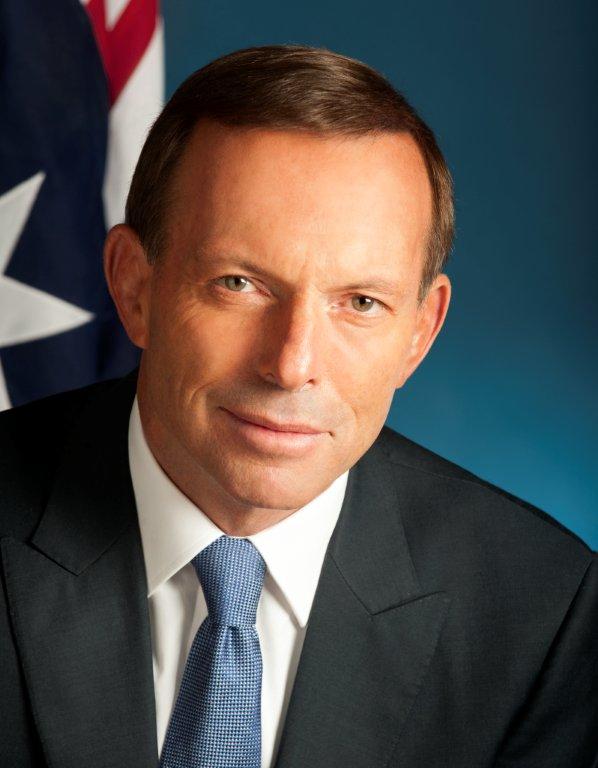
Conservative coalition leader Tony Abbott leads by 6 points in latest Australia election poll

Tony Abbott, future Prime Minister of Australia

First the latest Nielsen poll results from the Australian Broadcasting Corporation (ABC).

Excerpt:

Latest opinion polls show a further drop in support for Labor two weeks out from an election, with one indicating the Prime Minister may struggle to hold his own seat.

The Nielsen poll, published on Fairfax websites, shows Labor’s primary vote has fallen two points to 35 per cent.

After preferences, that gives the Coalition a six-point lead – 53 per cent to 47 per cent.

If the results were replicated evenly across the country on election day, Labor would lose 10 seats.

The poll of 2,500 respondents has a margin of error of 2.6 per cent.

Meanwhile, a Newspoll published in The Australian newspaper, shows Prime Minister Kevin Rudd is behind the Coalition candidate, Bill Glasson, in his Brisbane seat of Griffith.

The poll of 500 voters shows Mr Rudd trails his opponent 52 per cent to 48 per cent on a two-party preferred basis. The margin of error is 4.4 per cent.

Another Newspoll of almost 1,400 voters in the Coalition’s eight most marginal seats in Queensland shows the Coalition’s primary vote has surged eight points to 54 per cent, while the ALP’s primary vote has slipped to 32 per cent.

It shows the Coalition has a commanding two-party preferred lead of 60 per cent to Labor’s 40 per cent.

Mr Rudd’s personal support has also fallen to 39 per cent, with 49 per cent of voters across the marginal seats preferring Opposition Leader Tony Abbott.

The Coalition is is composed of the Liberal party (which is actually the conservative party) and the National party (which is also conservative).

I found an interview with Tony Abbott posted on India Today, when I searched for some keywords related to his policies. I searched for a detailed policy-oriented interview in the mainstream media, but couldn’t find much. Strangely enough, the Australian media seemed to be more concerned with gaffes and fear-mongering about Abbott’s socially conservative views. It’s as if the mainstream media is aiming for some sort of Jon Stewart coverage of the election, instead of telling us about each candidate’s plans and proposals.

Here’s some of the interview:

1. What are your plans to grow the economy?
The Liberal Party understands that successful businesses generate prosperity for the entire community by creating jobs, investing in growth and earning important export income.

We will lower costs for Australian businesses by removing Labor’s carbon tax. We will take the shackles off Australian businesses by cutting $1 billion in red tape every year. And we will boost productivity by encouraging more people into the workforce with better child care and a paid parental leave scheme and we will build 21st century infrastructure.

The economy will be strengthened by a new lowered company tax rate of 28.5% from 1 July 2015. This builds on the Coalition’s track record of delivering real tax reform focussed on cutting and simplifying taxation in Australia. Our fully funded tax cut will restore confidence in the management of Australia’s economy and boost job creation and investment.

The Coalition will also build a more diverse, world-class economy – a 5 pillar economy – to unleash Australia’s real economic potential. In particular, we will build on our strengths in manufacturing innovation, agriculture exports, advanced services, world class education and research as well as boosting mining exports.

2. The cost of living has gone up in the recent years, how will the Liberals help families cope with the rising costs?
We will start reducing cost of living pressures for families by immediately scrapping Labor’s carbon tax, taking the pressure off rapidly rising electricity and gas prices.

The average family will be $500 better off next year alone and seniors will still keep their fortnightly pension and benefit increases- all without a carbon tax. We will not proceed with Labor’s FBT changes on cars. And we will restore the Private Health Insurance Rebate as soon as we responsibly can.

3. We have a lot of small businesses in our community, how will Liberals help them? 
The Liberal Party understands the small businesses are the real job creators in the economy, employing almost half of the workforce in Australia. We will reduce costs for every business by abolishing the carbon tax, directly reducing electricity, gas and transport costs. By removing $1 billion of red tape each year, small businesses will be able to put more time, effort and resources in their ‘real’ work, rather than complying with complex and unnecessary government requirements.

The Coalition’s paid parental leave scheme will mean small businesses would no longer be disadvantaged in the ‘war for talent’, attracting and keeping quality staff.

We will also ease expense pressures on small businesses by delaying the increase of compulsory superannuation contributions to 12 per cent by a further two years.

8. Do you have a view about same-sex marriage?
There are very strong feelings on both sides of this particular issue right now. I take a conservative position on it myself. I think that we should not lightly change something which has been this way since time immemorial. But I don’t believe that I can necessarily impose my view on society for all time, all I can do is candidly and honestly tell people what my view is. I support the traditional definition of marriage as between a man and a woman. Now I know that others dispute this, because I have lots of arguments inside my own family on this subject now. But my position, it’s always been clear, it’s always been consistent, and as long as I’m in the Parliament if the issue comes up that’s the way I will vote. Whether it remains for all time the Liberal Party, and the Coalition’s position, well that will be a matter for our party, for our Coalition if it were to come up in a future Parliament.

11. Everyone is talking about the Asian Century, what does this mean for the Liberals? What are your plans?
An important element of our economic plan for Australia is to strengthen our trading relationships with Asia, welcome investment from the region, boost our exports and deepen Australia’s knowledge of and engagement with countries in Asia. We recognise the rapid emergence of both China and India and the opportunities this will afford Australia in the future.

Specifically, we will take real action to increase economic activity by fast-tracking Free Trade Agreements with China and India amongst others.

We will strengthen our diplomatic relationship and trade ties with India and boost mining exports by exporting uranium to that country.

We will help Australians gain study and work experience, strengthen the ties with the region, learn to adapt behaviour to Asian contexts and work more effectively with Asian governments.

The Coalition’s new Colombo Plan would encourage and support Australian undergraduates to study for part of their degrees in a university in the Asia-Pacific region, so promoting Australia’s deeper engagement with the region to the benefit of both.

It’s nice to see what policies a conservative would propose. We haven’t had much of that around here for a long time, have we?

The Australian election will be held on September 7th. I would appreciate it if my Australian readers can keep me informed about stories related to the election campaign.
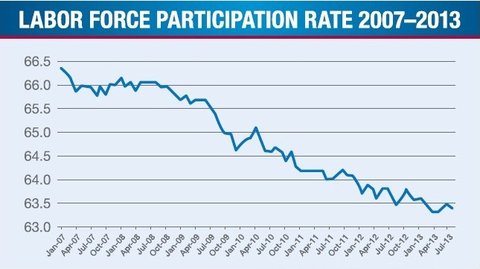
What happened to the economy after Democrats won the House and Senate in 2007?

Labor Force Participation Rate from 2007 (Pelosi/Reid) to 2013

Three data points explain what happens when government gets bigger, and job creators get smaller.

First from Investors Business Daily, Obama’s failure to reduce health insurance premiums with his big government takeover of health care.

Excerpt:

The average employer-provided family health insurance premiums have climbed $2,976 since 2009, according to an annual Kaiser Family Foundation survey released this week. They’re up $3,671 compared with the year before President Obama took office. That’s despite Obama’s repeated promises that the health care reform law he championed would cut premiums by $2,500 in his first term.

And while annual premium increases have moderated over the past two years, that’s due to trends in the insurance market largely unrelated to ObamaCare, and trends the law could actually reverse.

The Kaiser survey found that the average family premium this year is $16,351, up 4% over last year, and up 22% since 2009. After adjusting for inflation, premiums climbed an average 3.2% a year in Obama’s first term, higher than the 2.7% average during President Bush’s last four years in office.

During his first campaign for president, Obama repeatedly claimed that his health reform plan would, as he said at a Virginia rally in 2008 “lower premiums by up to $2,500 for a typical family per year.”

Now, let’s take a look the second failure, as reported by the Weekly Standard.

Excerpt:

President Obama likes to talk about income inequality, but what matters far more is the actual income of the typical American.  And how has the typical American household income fared on Obama’s watch?  Well, the economic “recovery” has now spanned an Olympiad, and during that time the typical American household income has not only dropped—it has dropped more than twice as much as it did during the recession.

New estimates derived from the Census Bureau’s Current Population Survey by Sentier Research indicate that the real (inflation-adjusted) median annual household income in America has fallen by 4.4 percent during the “recovery,” after having fallen by 1.8 during the recession.  During the recession, the median American household income fell by $1,002 (from $55,480 to $54,478). During the recovery—that is, from the officially defined end of the recession (in June 2009) to the most recent month for which figures are available (June 2013)—the median American household income has fallen by $2,380 (from $54,478 to $52,098).  So the typical American household is making almost $2,400 less per year (in constant 2013 dollars) than it was four years ago, when the Obama “recovery” began.

Importantly, these income tallies include government payouts such as unemployment compensation and cash welfare. So Obama’s method of funneling ever-more money and power to Washington, and then selectively divvying some of it back out, clearly isn’t working for the typical American family.

And finally, the third example, from the Daily Caller.

Excerpt:

 In 35 states, welfare benefits pay more than a minimum wage job, according to a new study by the libertarian Cato Institute, and in 13 states welfare pays more than $15 per hour.

“One of the single best ways to climb out of poverty is taking a job, but as long as welfare provides a better standard of living than an entry-level job, recipients will continue to choose it over work,” said Michael Tanner, senior policy analyst and co-author of the study.

The study is an updated version of one Tanner put out in 1995 that estimated the full value of welfare benefits packages across the states. The 1995 study found that such tax-free welfare benefits greatly exceeded the poverty level and “their dollar value was greater than the amount of take-home income a worker would receive from an entry-level job.”

Despite efforts to curb welfare spending, many welfare programs and benefits have continued to outpace the income that many workers can receive for working an entry-level job, which disincentivizes work, according to the study.

“The current welfare system provides such a high level of benefits that it acts as a disincentive for work,” reads the study. “Welfare currently pays more than a minimum-wage job in 35 states, even after accounting for the Earned Income Tax Credit, and in 13 states it pays more than $15 per hour.”

According to the study, the federal government funds 126 separate programs designed to support low-income earners. Seventy-two of these programs provide cash or in-kind benefits to recipients. This is on top of additional welfare programs operated by state and local governments.

Welfare recipients in Hawaii get the most benefits, according to Tanner, at $29.13 per hour — or $60,590 pre-tax income annually. However, the state’s minimum wage is only $7.25 per hour, according to the Labor Department. Hawaiians on welfare also earn 167 percent of the median salary in the state, which is only $36,275.

What if a fireman showed up in front of your house on your birthday and claimed that he wanted to put out the candles on your birthday cake because they were a fire hazard? What if he read out a long, passionate, prepared speech about how much he wanted to put out fires? What if he then dumped a bucket of gasoline on your cake? What if your house caught fire and he claimed that you should let him keep throwing gas on the fire to put it out? What if you found out that this person was a lawyer and a community organizer, and knew nothing at all about putting fires out? Obama was not prepared to run the economy, and, as expected, he spent a ton of money without getting the results he said he was going to get. He gave speeches about jobs and poverty and everything he’s done has been to increase unemployment and increase poverty – and now we are $17 trillion dollars in debt. Speeches about achieving objective X during a campaign don’t necessarily translate into achieving objective X. You actually have to know what you are doing in order to achieve objectives, preferably because you’ve done it before in real life.

Is environmentalism good for the environment?

Although I am not a global warming alarmist, I am concerned with conservation. So, all things being equal, I think it’s a good idea not to pollute the environment unnecessarily. Now, you might think that environmentalists agree with me on that.

Let’s take a look at this article by Bret Stephens from the Wall Street Journal where he writes about how a train that was transporting shale oil was derailed and then exploded. (H/T Dennis Prager)

Excerpt:

The derailed 72-car train belonged to a subsidiary of Illinois-based multinational Rail World, whose self-declared aim is to “promote rail industry privatization.” The train was carrying North Dakota shale oil (likely extracted by fracking) to the massive Irving Oil refinery in the port city of Saint John, to be shipped to the global market. At least five people were killed in the blast (a number that’s likely to rise) and 1,000 people were forced to evacuate. Quebec’s environment minister reports that some 100,000 liters (26,000 gallons) of crude have spilled into the Chaudière River, meaning it could reach Quebec City and the St. Lawrence River before too long.

Now the question is, why is it that trains are used instead of pipelines, when pipelines are safer than trains?

Let’s see why:

The reason oil is moved on trains from places like North Dakota and Alberta is because there aren’t enough pipelines to carry it. The provincial governments of Alberta and New Brunswick are talking about building a pipeline to cover the 3,000-odd mile distance. But last month President Obama put the future of the Keystone XL pipeline again in doubt, telling a Georgetown University audience “our national interest will be served only if this project does not significantly exacerbate the problem of carbon pollution.”

[…]Like water, business has a way of tracing a course of least resistance. Pipelines are a hyper-regulated industry but rail transport isn’t, so that’s how we now move oil. As the Wall Street Journal’s Tom Fowler reported in March, in 2008 the U.S. rail system moved 9,500 carloads of oil. In 2012, the figure surged to 233,811. During the same period, the total number of spills went from eight to 69. In March, a derailed train spilled 714 barrels of oil in western Minnesota.

Predictable, you would think. And ameliorable: Pipelines account for about half as much spillage as railways on a gallon-per-mile basis. Pipelines also tend not to go straight through exposed population centers like Lac-Mégantic. Nobody suggests that pipelines are perfectly reliable or safe, but what is? To think is to weigh alternatives. The habit of too many environmentalists is to evade them.

Investors Business Daily has more on the benefits of pipelines:

Railways suffer spills 2.7 times more often than pipelines, according to the Washington-based Association of American Railroads. If that seems self-serving, the State Department, citing a 2012 study from the free-market Manhattan Institute, said trains spill 33 times more oil than pipelines.

[…]”The evidence is so overwhelming that railroads are far less safe than pipelines,” says Charles Ebinger, director of the Brookings Institution’s energy security initiative.

Brookings is a left-leaning think tank, and they agree: pipelines are safer than trains.

It does make sense, I think, for Christians and conservatives to ask ourselves sensible questions about the environment. How do we make air clean enough? How do we make water clean enough? How do we avoid impacting nature unnecessarily? But I think this story about the train should help us realize that fundamentalist environmentalists are not the best people to be making these sorts of policy decisions. These decisions should be made by rational thinkers, who can consider all sides of an issue and think critically about the needs of everyone concerned. This is not a problem for secular leftist idealists who are more motivated by blind faith than by facts.