Tag Archives: Recession

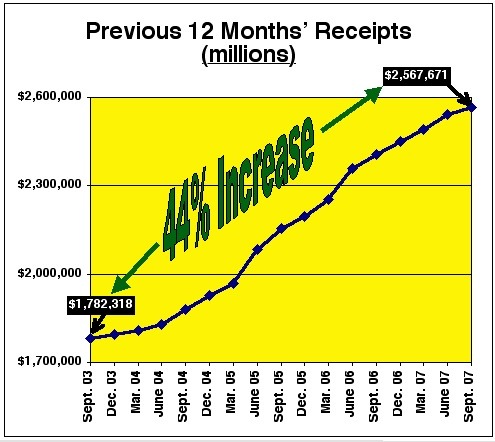
Bush’s tax cuts led to a 44% increase in revenues from 2003 to 2007

Federal Receipts 2003 through 2007

From Newsbusters. It turns out that Bush’s tax cuts in 2001 and 2003 were not responsible for adding to the deficit. They actually increased the amount of tax money being collected, as the economy grew, and more jobs were created. People pay more in taxes when they have jobs.

Excerpt:

The graph doesn’t show collections tanking, does it? Instead, the graph shows that collections increased by 44%, or almost $800 billion, in four years. Adding up the individual increments in each of the four years compared to 2003 (2004 – $98B; 2005 – $371B; 2006 – $624B; 2007 – $785B; 2008, not shown, treating IRS stimulus payments as outlays instead of negative receipts – $835B), what really happened is that in the five full fiscal years after George W. Bush got the across-the-board and investment-related tax cuts he had been pushing for since taking office in 2001, the cumulative increase in tax collections was over $2.7 trillion.

Doubtless, the static analysis crowd will claim that collections would have been even higher (I guess by a cumulative $1.6 trillion, given the AP’s Democratic Party talking point above) if the Bush cuts hadn’t been enacted. Two words, guys: Prove it. Two follow-up words: You can’t.

We can argue all day long about the how much of the increase in collections was due to the incentive effects of the tax cuts and how of the improvement might have occurred anyway, but no one can credibly act as if it’s an established fact that the Bush cuts somehow caused collections to go $1.6 trillion in the opposite direction. There is absolutely no proof for this contention, and plenty of evidence that the Bush cuts jump-started an economy and federal collections, both of which had been flat or declining during the two years leading up to mid-2003. The more reasonable conclusion to reach is that the country would already be dead in the water if the Bush tax cuts hadn’t passed in 2003. Instead, the wire service hopes that its “Bush tax cuts cost us” meme will be gullibly recited during the next several days at its subscribing newspaper, TV, and radio outlets. “Disgraceful” doesn’t even begin to describe this pathetic promotion of self-evident falsehood.

The fact is that the federal budget was one good year away from balancing after the $162 deficit reported in fiscal 2007. Unfortunately, that was the last budget passed by a Republican-controlled Congress, and it was the only year which showed a modest increase in overall spending. Beginning in 2007 with effects beginning in fiscal 2008, the House and Senate controlled by Nancy Pelosi and Harry Reid began increasing spending at rates far beyond what profligate Republicans spent earlier in the decade, and, unfortunately, Bush 43 made no real effort to stop them…

Read the whole thing.

UPDATE: Reggie sent me this article showing that the Reagan tax cuts also increased revenues.

Excerpt:

In 1980, the last year before the tax cuts, tax revenues were $956 billion (in constant 1996 dollars).

Revenues exceeded that 1980 level in eight of the next 10 years. Annual revenues over the next decade averaged $102 billion above their 1980 level (in constant 1996 dollars).

The graph is here.

When you get people to start engaging in the economy, you can collect more taxes from them. They engage when they think that they will be able to keep more of what they make from their labor.

Would the Republican “cut, cap and balance” plan solve the debt crisis?

Let’s take a look at the Republican “Cut, Cap and Balance” plan, as reported by CBS News.

Excerpt:

The House next week will take a vote to raise the debt ceiling and pass a balanced budget amendment, House Republican leaders said today.

The plan is unlikely to go anywhere, since a balanced budget amendment would likely fail in the Democrat-led Senate, but GOP leaders nevertheless called it a serious plan to raise the debt ceiling. They said President Obama and Democrats have failed to come up with an equally serious plan.

“We asked the president to lead,” House Speaker John Boehner said in a press conference today. “We asked him to put forward a plan — not a speech, a real plan — and he hasn’t. We will.”

The “cut, cap and balance” proposal would make raising the debt ceiling contingent on Congress sending a balanced budget amendment to the states. It would also cap government spending at 18 percent of Gross Domestic Product over the next 10 years.

The plan would raise the debt ceiling by $2.4 trillion, since that is the increase requested by the president. However, the plan would actually make even more in spending cuts — as much as $111 billion in 2012 alone.

[…]Boehner said the House would vote on the “cut, cap and balance” plan and then decide how to proceed from there.”I don’t want to preclude any chance of coming to an agreement, but [Democrats have] been unwilling to put a real plan on the table,” Boehner said. “Without serious spending cuts or real reform to entitlement programs, this problem is not going to be solved.”

That’s what the Republicans would do if they were in control. The balanced budget amendment would cap spending at 18% of GDP, so that we would never have a debt crisis ever again. That’s the right solution, except that the Democrats cannot give up the idea of buying votes with the money they steal from job creators. They just can control their addiction to spending.

Now, let’s take a look at who caused the debt crisis, with this House Budget Committee article by fiscal hawk Paul Ryan. (H/T Washington Post)

Excerpt:

While President Obama has recently professed a newfound — and vague — desire to cut government spending, it’s useful to recall what the President has actually done since taking office in 2009. The President signed into law a massive spending spree that plunged us deeper into debt, and failed to deliver on its promise to create jobs.

  • 24% Increase in Base Spending. Non-defense discretionary spending grew by 24% for the first two years of the Obama Administration, adding $734 billion in spending over the next 10 years.
  • Record Government Spending. The Federal government will spend $3.6 trillion this year, 24% of gross domestic product (GDP) and the highest burden on the economy since World War II. Spending has historically averaged a little over 20% of GDP.
  • President’s Budget Makes Matter Worse. According to CBO, the President’s budget never spends less than 23% of GDP and by the end of the decade rises to 24% of GDP. His budget’s failure to address the drivers of our debt threatens the health and retirement security of America’s seniors, and the economic security of all Americans. The President’s budget seeks to spend $46 trillion in government spending over the next decade, and has subsequently fought against House Republican efforts to restrain his spending appetite down to $43.5 trillion.

During the four years when Nancy Pelosi was the Speaker of the House, and Harry Reid was in control of the Senate, the Democrats packed 5.34 trillion dollars onto the national debt.

Taxing the rich at 100% doesn’t cover Obama’s 1.6 trillion dollar deficit

An amazing, must-read article from Arthur C. Brooks, president of the American Enterprise Institute. He writes about the national debt problem.

Excerpt:

The practical answer to this problem involves common sense. What do most of America’s families do when they find they are overspending? They don’t send the kids out to get part-time jobs in order to increase family revenues–they cut back on their spending. Why? Because that’s what works to solve the problem.

The government can learn from families. In fact, the data show that when countries are trying to find their way out of a debt crisis, the more they rely on tax increases as opposed to spending cuts, the more likely they are to fail. My colleagues Kevin Hassett, Andrew Biggs, and Matt Jensen studied 21 developed countries that have attempted fiscal consolidation over the last 37 years. Some succeeded and returned to economic health; -others failed.

On average, failed attempts to close budget gaps relied 53 percent on tax increases and 47 percent on spending cuts. Successful consolidations averaged 85 percent spending cuts and 15 percent tax increases. Some of the most successful financial comebacks–like Finland’s in the late 1990s–involved more than 100 percent spending cuts, so that taxes could be lowered. The spending cuts by the successful countries centered on entitlements and government personnel.

Now let’s look at the moral argument against raising taxes. Why does the president want to increase America’s tax burden? You may think it’s just a way to increase revenues and reduce the deficit. But even the president knows he can’t solve the fiscal crisis by helping himself to bigger and bigger chunks of the income of America’s most successful people. Even if individuals earning more than $200,000 were taxed at a 100 percent marginal rate–and we confiscated their passports so they could not flee–the take would come to $1.27 trillion, or just 77 percent of this year’s deficit.

For the administration, it’s not about the money–as we have heard again and again, it’s about “fairness.” The president believes that we will be a better nation if we redistribute more money from those who have more to those who have less. How much more do we need to redistribute until our system is fair?

As you ponder this question, remember the facts: The wealthiest 5 percent of Americans already account for 59 percent of federal income taxes. Nearly half of our citizens pay no federal income taxes at all–yet two-thirds of us believe that everybody should at least pay something, even if just to remind ourselves that government isn’t free. The Tax Foundation reports that the percentage of Americans who are net takers from the tax system is nearing 70 percent.

Arthur C. Brooks is an expert in making moral arguments for the free market. He is a Christian, and has debated against Jim Wallis on Christianity and economics. I think we have to take his advice (elsewhere in the article) where