
Tag Archives: Reason

Atheist Jerry Coyne explains why morality is impossible for atheists

Let’s review what you need in your worldview in order to have a rationally grounded system of morality.

You need 5 things:

1) Objective moral values

There needs to be a way to distinguish what is good from what is bad. For example, the moral standard might specify that being kind to children is good, but torturing them for fun is bad. If the standard is purely subjective, then people could believe anything and each person would be justified in doing right in their own eyes. Even a “social contract” is just based on people’s opinions. So we need a standard that applies regardless of what people’s individual and collective opinions are.

2) Objective moral duties

Moral duties (moral obligations) refer to the actions that are obligatory based on the moral values defined in 1). Suppose we spot you 1) as an atheist. Why are you obligated to do the good thing, rather than the bad thing? To whom is this obligation owed? Why is rational for you to limit your actions based upon this obligation when it is against your self-interest? Why let other people’s expectations decide what is good for you, especially if you can avoid the consequences of their disapproval?

3) Moral accountability

Suppose we spot you 1) and 2) as an atheist. What difference does it make to you if you just go ahead and disregard your moral obligations to whomever? Is there any reward or punishment for your choice to do right or do wrong? What’s in it for you?

4) Free will

In order for agents to make free moral choices, they must be able to act or abstain from acting by exercising their free will. If there is no free will, then moral choices are impossible. If there are no moral choices, then no one can be held responsible for anything they do. If there is no moral responsibility, then there can be no praise and blame. But then it becomes impossible to praise any action as good or evil.

5) Ultimate significance

Finally, beyond the concept of reward and punishment in 3), we can also ask the question “what does it matter?”. Suppose you do live a good life and you get a reward: 1000 chocolate sundaes. And when you’ve finished eating them, you die for real and that’s the end. In other words, the reward is satisfying, but not really meaningful, ultimately. It’s hard to see how moral actions can be meaningful, ultimately, unless their consequences last on into the future.

Theism rationally grounds all 5 of these. Atheism cannot ground any of them.

Let’s take a look at #4: free will and see how atheism deals with that.

Atheism and free will?

Here’s prominent atheist Jerry Coyne’s editorial in USA Today to explain why atheists can’t ground free will.

Excerpt:

And that’s what neurobiology is telling us: Our brains are simply meat computers that, like real computers, are programmed by our genes and experiences to convert an array of inputs into a predetermined output. Recent experiments involving brain scans show that when a subject “decides” to push a button on the left or right side of a computer, the choice can be predicted by brain activity at least seven seconds before the subject is consciously aware of having made it. (These studies use crude imaging techniques based on blood flow, and I suspect that future understanding of the brain will allow us to predict many of our decisions far earlier than seven seconds in advance.) “Decisions” made like that aren’t conscious ones. And if our choices are unconscious, with some determined well before the moment we think we’ve made them, then we don’t have free will in any meaningful sense.

If you don’t have free will, then you can’t make moral choices, and you can’t be held morally responsible. No free will means no morality.

Here are some more atheists to explain how atheists view morality.

William Provine says atheists have no free will, no moral accountability and no moral significance:

Let me summarize my views on what modern evolutionary biology tells us loud and clear — and these are basically Darwin’s views. There are no gods, no purposes, and no goal-directed forces of any kind. There is no life after death. When I die, I am absolutely certain that I am going to be dead. That’s the end of me. There is no ultimate foundation for ethics, no ultimate meaning in life, and no free will for humans, either.

Richard Dawkins says atheists have no objective moral standards:

In a universe of blind physical forces and genetic replication, some people are going to get hurt, other people are going to get lucky, and you won’t find any rhyme or reason in it, or any justice. The universe that we observe has precisely the properties we should expect if there is, at bottom, no design, no purpose, no evil and no good, nothing but blind, pitiless indifference… DNA neither knows nor cares. DNA just is. And we dance to its music. (Richard Dawkins, River Out of Eden: A Darwinian View of Life (1995))

When village atheists talk about how they can be moral without God, it’s important to ask them to justify the minimum requirements for rational morality. Atheists may act inconsistently with their worldview, believing in free will, expecting praise and blame for complying with the arbitrary standards of their peer group, etc. But there is nothing more to morality on atheism that imitating the herd – at least when the herd is around to watch them. And when the herd loses its Judeo-Christian foundation – watch out. That’s when the real atheism comes out – the atheism that we’ve seen before in countries that turned their backs on God, and the moral law. When God disappears from a society, anything is permissible.

Are Mormon doctrines supported by philosophy, science and history?

This post presents evidence against Mormonism/LDS in three main areas. The first is in the area of science. The second is in the area of philosophy. And the third is in the area of history.

The scientific evidence

First, let’s take a look at what the founder of Mormonism, Joseph Smith, believes about the origin of the universe:

“The elements are eternal. That which had a beggining will surely have an end; take a ring, it is without beggining or end – cut it for a beggining place and at the same time you have an ending place.” (“Scriptural Teachings of the Prophet Joseph Smith”, p. 205)

“Now, the word create came from the word baurau which does not mean to create out of nothing; it means to organize; the same as a man would organize materials and build a ship. Hence, we infer that God had materials to organize the world out of chaos – chaotic matter, which is element, and in which dwells all the glory. Element had an existance from the time he had. The pure principles of element are principles which can never be destroyed; they may be organized and re-organized, but not destroyed. They had no beggining, and can have no end.”
(“Scriptural Teachings of the Prophet Joseph Smith”, p. 395)

A Mormon scholar named Blake Ostler summarizes the Mormon view in a Mormon theological journal:

“In contrast to the self-sufficient and solitary absolute who creates ex nihilo (out of nothing), the Mormon God did not bring into being the ultimate constituents of the cosmos — neither its fundamental matter nor the space/time matrix which defines it. Hence, unlike the Necessary Being of classical theology who alone could not not exist and on which all else is contingent for existence, the personal God of Mormonism confronts uncreated realities which exist of metaphysical necessity. Such realities include inherently self-directing selves (intelligences), primordial elements (mass/energy), the natural laws which structure reality, and moral principles grounded in the intrinsic value of selves and the requirements for growth and happiness.” (Blake Ostler, “The Mormon Concept of God,” Dialogue: A Journal of Mormon Thought 17 (Summer 1984):65-93)

So, Mormons believe in an eternally existing universe, such that matter was never created out of nothing, and will never be destroyed. But this is at odds with modern cosmology.

The Big Bang cosmology is the most widely accepted cosmology of the day. It denies the past eternality of the universe. This peer-reviewed paper in an astrophysics journal explains. (full text here)

Excerpt:

The standard Big Bang model thus describes a universe which is not eternal in the past, but which came into being a finite time ago. Moreover,–and this deserves underscoring–the origin it posits is an absolute origin ex nihilo. For not only all matter and energy, but space and time themselves come into being at the initial cosmological singularity. As Barrow and Tipler emphasize, “At this singularity, space and time came into existence; literally nothing existed before the singularity, so, if the Universe originated at such a singularity, we would truly have a creation ex nihilo.”

[…]On such a model the universe originates ex nihilo in the sense that at the initial singularity it is true that There is no earlier space-time point or it is false that Something existed prior to the singularity.

Christian cosmology requires such a creation out of nothing, but this is clearly incompatible with what Mormons believe about the universe. The claims about the universe made by the two religions are in disagreement, and we can test empirically to see who is right, using science.

Philosophical problems

Always Have a Reason contrasts two concepts of God in Mormonism: Monarchotheism and Polytheism. It turns out that Mormonism is actually a polytheistic religion, like Hinduism. In Mormonism, humans can become God and then be God of their own planet. So there are many Gods in Mormonism, not just one.

Excerpt:

[T]he notion that there are innumerable contingent “primal intelligences” is central to this Mormon concept of god (P+M, 201; Beckwith and Parrish, 101). That there is more than one god is attested in the Pearl of Great Price, particularly Abraham 4-5. This Mormon concept has the gods positioned to move “primal intelligences along the path to godhood” (Beckwith and Parrish, 114). Among these gods are other gods which were once humans, including God the Father. Brigham Young wrote, “our Father in Heaven was begotten on a previous heavenly world by His Father, and again, He was begotten by a still more ancient Father, and so on…” (Brigham Young, The Seer, 132, quoted in Beckwith and Parrish, 106).

[…]The logic of the Mormon polytheistic concept of God entails that there is an infinite number of gods. To see this, it must be noted that each god him/herself was helped on the path to godhood by another god. There is, therefore, an infinite regress of gods, each aided on his/her path to godhood by a previous god. There is no termination in this series. Now because this entails an actually infinite collection of gods, the Mormon polytheistic concept of deity must deal with all the paradoxes which come with actually existing infinities…

The idea of counting up to an actual infinite number of things by addition (it doesn’t matter what kind of thing it is) is problematic. See here.

More:

Finally, it seems polytheistic Mormonism has a difficulty at its heart–namely the infinite regress of deity.

[…]Each god relies upon a former god, which itself relies upon a former god, forever. Certainly, this is an incoherence at the core of this concept of deity, for it provides no explanation for the existence of the gods, nor does it explain the existence of the universe.

Now let’s see the historical evidence against Mormonism.

The historical evidence

J. Warner Wallace explains how the “Book of Abraham”, a part of the Mormon Scriptures, faces historical difficulties.

The Book of Abraham papyri are not as old as claimed:

Mormon prophets and teachers have always maintained that the papyri that was purchased by Joseph Smith was the actual papyri that was created and written by Abraham. In fact, early believers were told that the papyri were the writings of Abraham.

[…]There is little doubt that the earliest of leaders and witnesses believed and maintained that these papyri were, in fact the very scrolls upon which Abraham and Joseph wrote. These papyri were considered to be the original scrolls until they were later recovered in 1966. After discovering the original papyri, scientists, linguists, archeologists and investigators (both Mormon and non-Mormon) examined them and came to agree that the papyri are far too young to have been written by Abraham. They are approximately 1500 to 2000 years too late, dating from anywhere between 500 B.C. (John A. Wilson, Dialogue: A Journal of Mormon Thought, Summer 1968, p. 70.) and 60 A.D. If they papyri had never been discovered, this truth would never have come to light. Today, however, we know the truth, and the truth contradicts the statements of the earliest Mormon leaders and witnesses.

The Book of Abraham papyri do not claim what Joseph Smith said:

In addition to this, the existing papyri simply don’t say anything that would place them in the era related to 2000BC in ancient Egypt. The content of the papyri would at least help verify the dating of the document, even if the content had been transcribed or copied from an earlier document. But the papyri simply tell us about an ancient burial ritual and prayers that are consistent with Egyptian culture in 500BC. Nothing in the papyri hints specifically or exclusively to a time in history in which Abraham would have lived.

So there is a clear difference hear between the Bible and Mormonism, when it comes to historical verification.

If unborn babies don’t have consciousness or don’t feel pain, may we kill them?

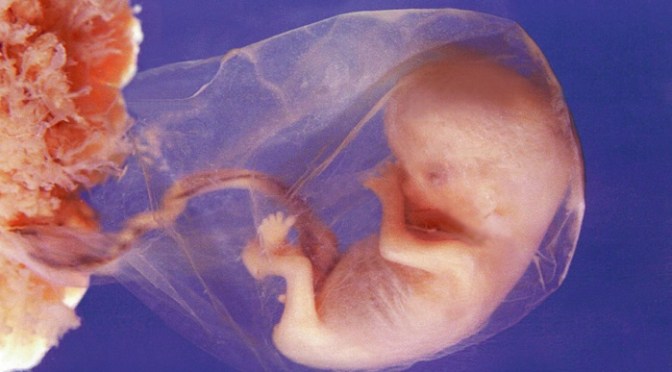
Was having a conversation by e-mail yesterday with a pro-abortion atheist, and he gave two reasons why he supported abortion in the first and second trimester. First, he said that unborn babies can’t feel pain, so it’s OK to kill them. Second, he said that unborn babies don’t have consciousness, so it’s OK to kill them. I thought it might be useful to link to something that answers both of these objections.

Frank Beckwith is the author of “Defending Life: A Moral and Legal Case Against Abortion Choice“, which was published by Cambridge University Press, a top academic press. But before Cambridge University Press, Beckwith wrote four easy-to-understand essays for the Christian Research Journal. Part IV is the one that has the response to the two questions raised by my atheist friend.

Part I. The Appeal to Pity

Part II. Arguments from Pity, Tolerance, and Ad Hominem

Part III. Is The Unborn Human Less Than Human?

Part IV. When Does a Human Become a Person?

Excerpt:

Some ethicists argue that the unborn becomes fully human sometime after brain development has begun, when it becomes sentient: capable of experiencing sensations such as pain. The reason for choosing sentience as the criterion is that a being that cannot experience anything (i.e., a presentient unborn entity) cannot be harmed. Of course, if this position is correct, then the unborn becomes fully human probably during the second trimester and at least by the third trimester. Therefore, one does not violate anyone’s rights when one aborts a nonsentient unborn entity. [13]

There are several problems with this argument. First, it confuses harm with hurt and the experience of harm with the reality of harm. [14] One can be harmed without experiencing the hurt that sometimes follows from that harm, and which we often mistake for the harm itself. For example, a temporarily comatose person who is suffocated to death “experiences no harm,” but he is nevertheless harmed. Hence, one does not have to experience harm, which is sometimes manifested in hurt, in order to be truly harmed.

Second, if sentience is the criterion of full humanness, then the reversibly comatose, the momentarily unconscious, and the sleeping would all have to be declared nonpersons. Like the presentient unborn, these individuals are all at the moment nonsentient though they have the natural inherent capacity to be sentient. Yet to countenance their executions would be morally reprehensible. Therefore, one cannot countenance the execution of some unborn entities simply because they are not currently sentient.

Someone may reply that while these objections make important points, there is a problem of false analogy in the second objection: the reversibly comatose, the momentarily unconscious, and the sleeping once functioned as sentient beings, though they are now in a temporary state of nonsentience. The presentient unborn, on the other hand, were never sentient. Hence, one is fully human if one was sentient “in the past” and will probably become sentient again in the future, but this cannot be said of the presentient unborn.

There are at least three problems with this response. First, to claim that a person can be sentient, become nonsentient, and then return to sentience is to assume there is some underlying personal unity to this individual that enables us to say that the person who has returned to sentience is the same person who was sentient prior to becoming nonsentient. But this would mean that sentience is not a necessary condition for personhood. (Neither is it a sufficient condition, for that matter, since nonhuman animals are sentient.) Consequently, it does not make sense to say that a person comes into existence when sentience arises, but it does make sense to say that a fully human entity is a person who has the natural inherent capacity to give rise to sentience. A presentient unborn human entity does have this capacity. Therefore, an ordinary unborn human entity is a person, and hence, fully human.

Second, Ray points out that this attempt to exclude many of the unborn from the class of the fully human is “ad hoc and counterintuitive.” He asks us to “consider the treatment of comatose patients. We would not discriminate against one merely for rarely or never having been sentient in the past while another otherwise comparable patient had been sentient….In such cases, potential counts for everything.” [15]

Third, why should sentience “in the past” be the decisive factor in deciding whether an entity is fully human when the presentient human being “is one with a natural, inherent capacity for performing personal acts?” [16] Since we have already seen that one does not have to experience harm in order to be harmed, it seems more consistent with our moral sensibilities to assert that what makes it wrong to kill the reversibly comatose, the sleeping, the momentarily unconscious, and the presentient unborn is that they all possess the natural inherent capacity to perform personal acts. And what makes it morally right to kill plants and to pull the plug on the respirator-dependent brain dead, who were sentient “in the past,” is that their deaths cannot deprive them of their natural inherent capacity to function as persons, since they do not possess such a capacity.

These four essays are a very good introduction to common responses to pro-abortion arguments. I recommend that people get familiar with this, as once you look into it, you will see that the abortion issue can be debated with as much confidence as William Lane Craig defends Christian theism. You will have the same access to scientific evidence and rational arguments on this topic, and so you will have the upper hand. And that’s fun.

The best introductory book on the abortion / right to life issue is “The Case for Life” by pro-life debater Scott Klusendorf. The best comprehensive book is a tie between “The Ethics of Abortion” by Christopher Kaczor, and Frank Beckwith’s “Defending Life: A Moral and Legal Case Against Abortion Choice“.