Tag Archives: Radical Feminism

How will men adapt to violence against men and false accusations?

A massive decline in marriage rate
A massive decline in marriage rate (per 1,000 of population in America)

A couple of women who write for the Daily Wire keep posting scary stories of men being mistreated by women. I’m going to link to a few of their stories below, from last week. Then I want to say something about why these sorts of events are happening so frequently, and what message it sends to men who might want to have a committed relationship with a woman.

The two women writers at Daily Wire are Amanda Prestigiacamo and Ashe Schow.

Here is one from May 8th, by Amanda:

Thirty-six-year-old Kenan Basic spent weeks in jail, lost his relationship, and was repeatedly slandered after a woman falsely accused him of sexual misconduct.

According to Australia-based 7NEWS, Basic was accused of “indecently assaulting and stalking” Caitlyn Gray, a 19-year-old woman, after he stopped to help her when her car broke down late last year.

Basic apparently spent two hours fixing Gray’s vehicle. As shown by surveillance footage, the smiling pair seem happy, hugging after the car is fixed and eventually parting ways. But according to the news station, “Gray told police Basic had allegedly propositioned her for sex in return for his help before he pursued her in the car and later indecently assaulted her at a different location.” Authorities investigating the incident called Basic’s behavior “predatory.”

Months later, however, the truth about the incident finally came out: Basic never assaulted the woman. The 19-year-old confessed to police during an interrogation that she fabricated evidence and made up the assault whole-cloth.

So what lesson would a man learn from this? Well, he would learn that women can’t be trusted to be grateful when they are given help.

More:

The falsely accused man noted that he’s “never been jailed, never had a criminal record or anything.”

“I always help people, all my life,” he said. “And this was the first time a snake bit me.”

The 36-year-old said he’ll “probably never help again, ya know. I don’t want that to happen again.”

I don’t know why this woman made this false accusation. Studies show that women generally make false accusations for attention, for an alibi, to get revenge, or to get sympathy after they’ve chosen to have sex with someone who ignored them after. This case doesn’t fit any of these scenarios. Maybe she felt slighted because he didn’t try anything with her, and that made her feel unattractive. But the message to good men who want to help women is clear: the risk is too great.

Here’s another story from May 11th, by Ashe:

Ah to be one of those poor, oppressed women who have fewer privileges than men.

A woman like Jazzmin Fry, who was so oppressed that when she stabbed a complete stranger — a man — with one of her stilettos for literally no reason, she only had to pay a $250 fine as punishment. Her conviction wasn’t even recorded outside of the press.

[…]The victim, Kyle Johns, 19, was taken to the hospital and needed two staples in his head to repair the wound.

What lesson will men learn from stories like this one? Well, they’ll learn that there is a double standard in the justice system, such that men are held accountable for their choices, but women are not. That’s because men are seen as responsible for their actions, and women are not seen as responsible – no matter how much harm they cause.

Ashe says:

Women in the justice system — whether in Australia, or the U.K., or the U.S. — get off much easier than men for the same crimes. One of the biggest disparities can be found in sexual assaults against minors. When women commit these crimes — whether against a young boy or girl, or teenager — they receive much lighter sentences than men do for the same crime.

As I have written previously, men who abuse children (rightly) receive harsh punishments. A 32-year-old man who sexually abused a young girl over the course of several years faced 366 years to life in prison. Yet a 25-year-old woman who pleaded guilty to raping young boys at a trailer park only received five years probation.

[…]In 2012, University of Michigan professor Sonja Starr researched the gender disparities in federal criminal cases and found that “men receive 63% longer sentences on average than women do” and that “Women are … twice as likely to avoid incarceration if convicted.”

Men are very aware of disparities in the criminal justice system, but when I talk to women about it, they are rarely aware of it. But this is just one example of an area where men are at a disadvantage, and the problem only gets worse as more and more feminists take control of legislation, law enforcement and criminal courts. Almost every man knows a story of about how divorce courts treated a man badly, whether it be with unfair alimony or child support, false accusations, or even jail. And it seems like all the momentum in society is to make everything better for women, and worse for men. This is easily seen by looking at studies of how the public schools – which are dominated by  female teachers and administrators – discriminate against boys.

Here’s a third one from May 13th, by Amanda:

A false accusation of sexual assault turned deadly last month in Utah when a teen girl’s brother sought vengeance over the claim of sexual assault that never was.

A 16-year-old girl, whose identity has not been revealed because she’s a minor, told her 17-year-old brother that Michael Fife, 62, sexually assaulted her on a Cache Valley Transit District (CVTD) bus. The 17-year-old tracked down Fife and physically attacked him when he got off the bus; wounds from the altercation left him dead.

According to Logan Police Department, reviewed surveillance footage from the bus revealed that the alleged assault never happened.

According to the police, “the video showed Mr. Fife walking past the girl, but no sexual assault occurred.” Did she lie just to see what effect it would have on her brother?

My thoughts

Here is a fourth story about an NFL player who refused to have sex with a woman, and he was falsely charged with raping her, as reported on May 10th, in The College Fix.

This one is important, because this guy lost millions of dollars in salary, because he was kept out of the NFL two years, when his accuser had no evidence whatsoever. That’s how unfair the system has become for men, and men with more to lose have more reason to avoid any relationships with women. Men with more money have more to lose to a false accusation. And these stories are so common in our age.

When a man measures up how much a woman adds to his life, and compares it to the risk of being cleaned out on a fact-free false accusation, it’s not a good value proposition. Women often look at things only from the woman’s point of view, and so they are mystified by how men could think like this. They just can’t seem to put themselves into men’s shoes to understand how dangerous women have become to men. And then men get told how weak and cowardly they are for refusing to ask women out, for refusing to commit, etc.

I think that the only women who are safe are women who have put in the effort to learn about these injustices towards men. If you are interested in a woman for a relationship, then ask her to name a few challenges that men face in this anti-male society. Ask her if she has a male relative who has faced a false accusation. Ask her if she has experience battling for men’s rights. If she doesn’t stand up for good men before marriage, she won’t respect you after marriage.

Women of the previous generation knew how to prepare herself for wife and mother roles, and present herself to a man in order to persuade him to marry her. Too many women in today’s generation have lost that ability to be feminine. They have lost the ability to be a real friend and support to a man. They don’t want to nurture his ability to be a masculine leader in a home.

It is rare to find a woman who is putting in the work to learn about things like abortion, divorce, and same-sex marriage. Most of them are instead focused on single motherhood by choice, delaying marriage for career, surrogacy, etc. Most women aren’t prepared to fight against anti-marriage, anti-child forces, and men sense from this that they aren’t serious about marriage as it really is: a self-sacrificial commitment requiring female and male natures.

Most young, unmarried women take on the priorities of the culture: animal rights, global warming, equal pay, abortion rights, gun control, higher taxes, single payer healthcare, public schools, etc. But most know very little about how to prepare themselves for a husband, or prepare themselves to provide for their children.

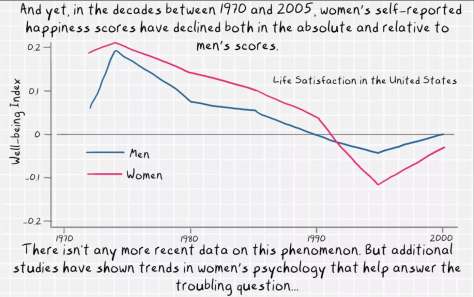
Are feminists right to think that gender-neutral marriage makes women happier?

Male And Female Happiness After Feminism And Socialism
Male and female happiness throughout America’s adoption of radical feminism

I was reading this article by a feminist fiction writer on Vox, where she explains that although feminists have gotten what they wanted (careers, contraceptives, promiscuity, abortion, no-fault-divorce, daycare, etc. it hasn’t made them happier. So, what does this feminist fiction writer think would make feminists happier?

She gives two reasons why women women are still unhappy after feminism has been adopted by our society:

  • men don’t do enough housework
  • women are not as successful as men because they are discriminated against, the so-called “glass ceiling”

I think those complaints are pretty popular among feminists. Let’s take a look at some studies to see if her opinions are supported by peer-reviewed studies.

First study:

COUPLES who share housework duties run a higher risk of divorce than couples where the woman does most of the chores, a study has found.

The divorce rate among couples who shared housework equally was around 50 per cent higher than among those where the woman did most of the work.

“The more a man does in the home, the higher the divorce rate,” Thomas Hansen, co-author of the study entitled Equality in the Home, said.

Second study:

Researchers at the University of Illinois examined data on nearly 1,500 men and 1,800 women, aged between 52 and 60. Their well-being was evaluated through surveys.

The researchers first found that men’s well-being decreased once they had exited the workforce to become home-makers.

Meanwhile, the inverse was not so for women: Women’s psychological well-being was not affected by leaving their jobs to become stay-at-home mothers.

Third study:

A study called “Egalitarianism, Housework and Sexual Frequency in Marriage,” which appeared in The American Sociological Review last year, surprised many, precisely because it went against the logical assumption that as marriages improve by becoming more equal, the sex in these marriages will improve, too. Instead, it found that when men did certain kinds of chores around the house, couples had less sex. Specifically, if men did all of what the researchers characterized as feminine chores like folding laundry, cooking or vacuuming — the kinds of things many women say they want their husbands to do — then couples had sex 1.5 fewer times per month than those with husbands who did what were considered masculine chores, like taking out the trash or fixing the car. It wasn’t just the frequency that was affected, either — at least for the wives. The more traditional the division of labor, meaning the greater the husband’s share of masculine chores compared with feminine ones, the greater his wife’s reported sexual satisfaction.

Regarding the pay gap, that is entirely caused by women’s own choices. E.g. – the choice to study creative writing instead of petroleum engineering, the choice to work 35 hour weeks instead of 70 hour weeks, etc.

Fourth study:  (summarized by AEI economist)

When the [Bureau of Labor Statistics] reports that women working full-time in 2018 earned 81.4% of what men earned working full-time, that is very much different from saying that women earned 81.4% of what men earned for doing exactly the same work while working the exact same number of hours in the same occupation, with exactly the same educational background and exactly the same years of continuous, uninterrupted work experience, and with exactly the same marital and family (e.g., number of children) status. As shown above, once we start controlling individually for the many relevant factors that affect earnings, e.g., hours worked, age, marital status, and having children, most of the raw earnings differential disappears.

Fifth study:

This study leads to the unambiguous conclusion that the differences in the compensation of men and women are the result of a multitude of factors and that the raw wage gap should not be used as the basis to justify corrective action. Indeed, there may be nothing to correct. The differences in raw wages may be almost entirely the result of the individual choices being made by both male and female workers.

I think that women are entitled to make their own decisions, but they aren’t allowed to force the rest of us to subsidize their failures and celebrate their destructive outcomes.

I could go on, but I think enough has been said to show that research is very much at odds with feminist rhetoric. They feel they know what will make them happy and we gave them everything they asked for. They eliminated shaming of promiscuity with sex education. They get preferential treatment in the schools in a female-dominated education system. They are hired because of affirmative action quotas. They get expensive daycare, government schools, welfare and other programs. Taxes are raised to equalize outcomes for divorced women who choose men for feelings, and then nuke their own marriage enterprise. We have been on a long experiment of giving feminists everything they felt they wanted, at the expense of men’s rights and children’s rights, and it hasn’t even produced the results that feminists felt it would.

The social costs of feelings-based decision-making

Let’s look at two examples of policies that feminists asked for in the past, which didn’t work out the way they wanted.

I can understand why feminists would introduce sex education. They felt that “if everyone is having sex, then I won’t be the only one chasing attention from hot no-commitment bad boys by giving them recreational sex before marriage”.  They wanted to eliminate the standards of chastity and marriage-focused dating and normalize fun-focused drunken promiscuity. And they got that. But since they didn’t consult any research and evidence about how that would affect their future marriage stability and marriage happiness, they are even more unhappy than before.

How about no-fault divorce? No-fault divorce was brought in by a coalition of feminists, Marxists and trial lawyers. The Marxists want to destroy the family in order to increase dependence on the state. The trial lawyers wanted to make money. And the feminists thought that the standard approach to courting and marriage was just too much work. They didn’t want to be chaste. They didn’t want to be sober. They didn’t want to evaluate a man for traditional husband and father roles. The no-fault divorce laws gave them an escape from the messes caused by their own feelings-driven choices. But divorce just makes makes men and women much poorer, and passes the costs of supporting single mothers onto taxpayers.

And the costs of the failures of feminism are passed onto taxpayers.

Consider this study:

This paper examines the growth of government during this century as a result of giving women the right to vote. Using cross-sectional time-series data for 1870–1940, we examine state government expenditures and revenue as well as voting by U.S. House and Senate state delegations and the passage of a wide range of different state laws. Suffrage coincided with immediate increases in state government expenditures and revenue and more liberal voting patterns for federal representatives, and these effects continued growing over time as more women took advantage of the franchise. Contrary to many recent suggestions, the gender gap is not something that has arisen since the 1970s, and it helps explain why American government started growing when it did.

We are already $28 trillion in debt, partly because of feminism’s replacement of husbands and families with higher taxes and big government. Every time we transfer money from tax-paying men to feminists to fix their mistakes, it leaves less money in the hands of the men who actually want to get married. The declining value of marriage after feminism for men explains why marriage is being delayed, and why marriage rates are plunging.

New study: Contraceptives double risk of depression in teenage girls

The Sydney Morning Herald reports:

A Danish study of a million women has found a link between the use of hormonal contraception such as the the pill and increased risk of depression.

Compared with non-users, women and teenage girls aged 15 to 34 who used hormonal contraception had a 1.23 times higher risk of being diagnosed with depression, especially adolescents, according to a paper published in the journal JAMA Psychiatry.

Researchers at the University of Copenhagen in Denmark analysed health registry data of one million Danish women from 2000 and followed them up after an average of six years.

Of the 55 per cent of those who used hormonal contraception, there were just over 23,000 first diagnoses of depression at the time of follow up.

More than 133,000 had received their first prescription of antidepressants.

The highest risk of depression was among the adolescent girls, who had a 1.8-times higher risk of first use of an antidepressant.

The risk varied slightly among the different types of hormonal contraception, but the risk was three times higher among those who used non-oral products, such as progestogen implants.

Few studies have quantified the effect of low-dose hormonal contraception on the risk for depression, but study author Ojvind Lidegaard says their research warrants the need for further studies into the potential adverse effects of the pill.

“Use of hormonal contraceptives was associated with subsequent antidepressant use and first diagnosis of depression at a psychiatric hospital among women living in Denmark.

“Adolescents seemed to be more vulnerable to this risk than women 20 to 34 years old,” Lidegaard said.

Of course, one wonders where these studies were BEFORE the pill was championed by the radical feminists. We didn’t have studies before we adopted abortion, no-fault divorce, single mother welfare and gay marriage, either. Do you think that those might have unintended consequences? Shouldn’t we care about the consequences before we adopt policies that go against traditional moral values?

Anyway, let’s review some studies on birth control pills, since no one ever tells young people these things before it’s too late.

This is from the ultra-leftist Time magazine, of all places.

Excerpt:

Dr. David Gaist, a neurologist at Odense University Hospital and the University of Southern Denmark, and his colleagues found that women taking hormonal contraceptives — those containing estrogen, progestin or a combination of both — showed higher rates of a rare brain tumor known as glioma. Their results, published Thursday in the British Journal of Clinical Pharmacology, raise questions about the connection between oral contraceptives and brain cancer, but shouldn’t yet be interpreted as a reason to stop taking birth control, says Gaist.

Using data from Denmark’s national registries of health records, cancer cases and prescriptions, Gaist zeroed in on the women aged 15 years to 49 years diagnosed with glioma, and then analyzed whether they were prescribed contraceptives and for how long. Overall, women who had used hormonal contraceptives at any point in their lives showed a 50% higher risk of developing the brain tumors compared to those who had not used them. And women who used the birth control for more than five years nearly doubled their risk of the cancer.

Let’s take a look at some previous studies on the effects of contraceptives.

From the Times of India.

Excerpt:

 Women who take oral contraceptives regularly are at a higher risk of developing breast cancer compared to others, shows a study by AIIMS doctors. Breast cancer risk was found to be 9.5 times more in women with a history of consuming such pills. Early menstruation cycle, late marriage and lower duration of breastfeeding were the other major factors responsible for the disease among Indians, according to the study published in the latest issue of the Indian Journal of Cancer.

The study was conducted on 640 women, of which 320 were breast cancer patients. “We found long-term use of oral contraceptive pills (OCP) higher among those suffering from breast cancer-11.9%-compared to healthy individuals-1.2%,” said Dr Umesh Kapil, a professor at the public health nutrition unit, AIIMS. He said breast cancer is caused by repeated exposure of breast cells to circulating ovarian hormones, and long-term use of OCPs, which contain estrogen and progesterone, may be increasing this risk by causing hormonal imbalance.

The study mostly had women who used OCPs for birth control. Emergency contraceptives, popularly called morning-after pills, were not included.

This is not the first study, nor even the second study, to confirm this link.

Birth control pills

Many studies showed that taking birth control pills caused an increased risk of breast cancer.

Study 1: (March 2003)

RESULTS: Among the youngest age group (<35 years, n = 545), significant predictors of risk included African-American race (RR = 2.66: 95% CI 1.4-4.9) and recent use of oral contraceptives (RR = 2.26; 95% CI 1.4-3.6). Although these relationships were strongest for estrogen receptor-negative (ER-) tumors (RRs of 3.30 for race and 3.56 for recent oral contraceptive use), these associations were also apparent for young women with ER+ tumors. Delayed childbearing was a risk factor for ER+ tumors among the older premenopausal women (Ptrend < 0.01), but not for women <35 years in whom early childbearing was associated with an increased risk, reflecting a short-term increase in risk immediately following a birth.

Study 2: (October 2008)

Oral contraceptive use ≥1 year was associated with a 2.5-fold increased risk for triple-negative breast cancer (95% confidence interval, 1.4-4.3) and no significantly increased risk for non-triple-negative breast cancer (Pheterogeneity = 0.008). Furthermore, the risk among oral contraceptive users conferred by longer oral contraceptive duration and by more recent use was significantly greater for triple-negative breast cancer than non-triple-negative breast cancer (Pheterogeneity = 0.02 and 0.01, respectively).

When people talk about a war on women, maybe they should be thinking about this practice of promoting behaviors to women that make them sick. And eventually, we all have to pay for the increased costs of health care when we encourage people to do things that make them sick. We should not be promoting birth control to young women in order to enable them to have recreational sex. It’s not worth the harm it causes them. When you add in the psychological damage and the risk of abortion if the contraception fails, it really is not the right thing to tell a young woman.