
Tag Archives: Radical Feminism

Do Christian pastors think that premarital sex is morally wrong?

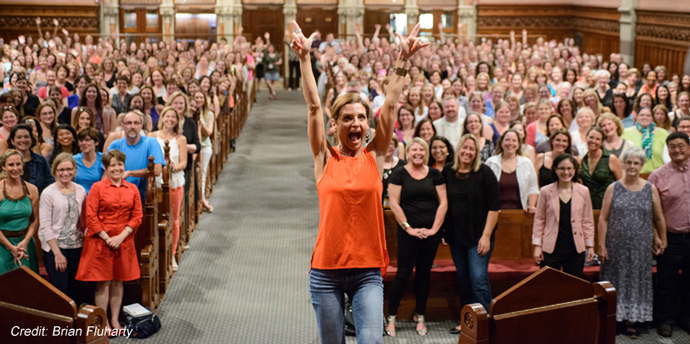
Glennon Doyle Melton in a church
Lesbian Glennon Doyle Melton in a church, surrounded by female Christian fans

My friend Wes posted an article from Dalrock’s blog about how Spain is trying to get people to make babies after repeated laws punishing men for marrying and having children, such as forcing men to do housework, assuming that men are guilty of domestic violence without any evidence, making no-fault divorce more unfair for men, and now allowing children to sue their parents for maintenance throughout their 20s. Spain is feminist, and no sane, intelligent man marries and has children there.

That article was fine, so I decided to run through his last dozen posts. In many of them, he talked about how pastors, confronted with the decreasing numbers of marriage-minded men, were blind to the root cause of the problem: radical feminism. In fact, the pious pastors continued to blame men for refusing to marry like they did before radical feminism removed all the incentives for them to marry.

Let’s just take a look at this one.

Excerpt:

[…][O]ver the past decades we have witnessed an explosion in out of wedlock births.  Feminists have been entirely open about their desire to make single motherhood an attractive option for women, and after decades of social and legal “progress” 40% of all children are now born out of wedlock in the US.

For feminist Christians this isn’t a problem, as they can simply celebrate their victory while pushing for even more “progress”.  But for complementarians and other conservative Christians, this poses a huge challenge.  How can they appear to take biblical morality (and the welfare of innocent children) seriously while avoiding upsetting women in our thoroughly feminized culture?  There is only one answer, no matter how absurd it is.  The answer is to pretend that feminists aren’t really in the final mopping up stages in the culture war, and assert instead that what we are experiencing is a sudden and mysterious change in men.  Here is how Glenn Stanton, the Director of Family Formation Studies at Focus on the Family (FotF), explains the incredible increase we are seeing in out of wedlock births*:

Women want to marry and have daddies for their babies.  But if they can’t find good men to commit themselves to, well…  Our most pressing social problem today is a man deficit.

The level of denial here is astonishing, and would be laughable if it weren’t entirely commonplace.  Even more astounding, often times the denial of feminism is expressed using feminist terminology, and even includes calls to join feminists in their push to re order our society**:

Whatever our views on specific economic policies, we must recognize that much economic hardship of women in our age is the result of men who abandon their commitments. We should eschew obnoxious “welfare queen” rhetoric and work with others of goodwill to seek economic and social measures to provide a safety net for single mothers and abused women in jeopardy. We should join with others, including secular feminists, in seeking legal protections against such manifestations of a rape culture as sexual harassment, prostitution, and sex slavery.

The quote above is from Dr. Russell Moore, president of the Ethics & Religious Liberty Commission of the Southern Baptist Convention.

In the past, I’ve blogged about pastor Mark Driscoll, an otherwise excellent pastor, who was asked by a Christian woman in a premarital sexual relationship with a non-Christian man how to get him to commit to her. His answer was not to rebuke the woman for choosing a hawt bad boy because of her feelings of attraction. His answer was to bellow how dare this non-Christian man who signed up for recreational sex with this fake Christian woman not act as if he were actually a Christian man (even though she was not acting like a Christian woman). It’s rare (I mean really rare) to hear a sermon where the pastor actually says that prohibitions against premarital sex apply to men and women. Instead, you get people like Moore and Driscoll refusing to confront these sinful women, because that’s just too scary! It doesn’t matter if women’s choice of bad men has caused abortion, divorce, fatherlessness, etc. to skyrocket. Pious pastors can’t hold women accountable for putting feelings above the Bible – that would take courage, and the pious pastors don’t have that. Women need to be told that they should be focused on marriage when they are choosing men. They shouldn’t choose the exciting promiscuous binge-drinking bad boy with the spotty resume and the empty balance cheat. They should choose the man who can actually do the job.

50 Shades of Feminism

The refusal to apply the Bible to women’s decisions can be seen in the response from pious pastors to the widespread popularity of 50 Shades of Gray among Christian women.

Excerpt:

Christian women are just as enthralled with 50SOG as non Christian women are:

What is surprising is who is viewing the film and reading the book—and why in the world they even would. Many refer to the book as “mommy porn” because of its wild popularity among adult women. And ticket sales are briskest in the typically-conservative deep south…

…it’s also reaching our young daughters. According to IMDB (Internet Movie Database), the movie drew the highest reviews by far from girls under 18.

And just in case you’re wondering, a Barna survey found that women who identify themselves as Christians are reading the books at the same rate as the general public. It’s captivating women everywhere.

Christian women are reading these books for the same reason as non-Christian women: because they like the sociopath man.

What is the solution to this? To tell Christian women that their feelings of attraction are morally wrong? Oh no, that’s too frightening to the pious pastors. Women are protected when we tell them not to be responsible with alcohol, responsible with their choice of man, responsible with their sexual choices.

You would think that pious pastors would confront women about their attraction for 50 Shades, but they don’t. The solution is always to get the sane, moral men have to bullied to “man up” so that women don’t act badly. The pious pastors simply refuse to see what the problem is: women being taught that their feelings are a hotline to God’s will for their happiness, so that the rules don’t apply to them, and they can choose godless men and try to make things work out by giving them recreational sex. Pious pastors are flat out teaching women in their churches that God’s job is to make them happy, that their feelings are God speaking to them, that the Bible doesn’t apply to their decision making about men and marriage, and that if their crazy, emotional selfishness blows up in their faces, then it’s somehow the innocent male bystander’s fault that it happened.


Debating forgiveness: must a person admit wrongdoing before being forgiven?

Two horses fight it out, may the best horse win!

I was traveling outside the country when this debate came out, so I couldn’t blog about it right away. I’ve now listened to it three times. I liked it so much that I even ordered Chris’ book for Dina. She has listened to the debate, and is currently split between the two debaters. I am in firm agreement with the pastor Chris.

Here’s a link to the debate page on Moody Bible Institute’s “Up For Debate” program with Julie Roys. (H/T Kris)

Details:

Should Christians Forgive No Matter What?

Should Christians forgive someone even if he’s not sorry?  Or does true forgiveness require repentance and a desire to reconcile?  This Saturday, on Up For Debate, Julie Roys will explore this issue with Chris Brauns, a pastor who believes forgiveness requires repentance, and Remy Diederich who believes it does not.

Although I disagree with Remy, I only disagree with him about whether the guilty person must admit guilt and feel remorse and make restitution (depending on the severity of the offense). I agree with him on other things like no revenge, attitude of love, expressing willingness to forgive and be reconciled, etc. I also disagree with Remy on “forgiving God”, which I think is just crazy, because when God is engineering a person’s salvation, he never fails. I think that God is the Great General, and his strategies never fail to achieve the outcomes he desires (while still respecting free will). Whatever suffering or inadequacy or longing that you experience as a Christian is not some sort of mistake, horrible as it may be for you at the time. God is not your cosmic butler, although a lot of people these days seem to think that he is, and then they get disappointed.

Anyway, please listen to that debate and comment on it about who you think is right. I think my view (and Chris’ view) is in the minority in the church, because the church is so utterly dominated by feelings and radical feminism. I think my view (and Chris’ view) is the masculine view – the view that upholds moral standards, sets moral boundaries and defends the rightness of making moral judgments.

Below, I have pasted in some of my other thoughts on forgiveness from a previous post.

I think this is the key passage – Luke 17:3-4:

Be on your guard! If your brother sins, rebuke him; and if he repents, forgive him.

And if he sins against you seven times a day, and returns to you seven times, saying, ‘I repent,’ forgive him.”

That’s Jesus speaking, there.

Also, I was having a debate with someone who disagrees with all this, and while debating with her, I thought of another example.

Luke 18:9-14:

And He also told this parable to some people who trusted in themselves that they were righteous, and viewed others with contempt:

10 “Two men went up into the temple to pray, one a Pharisee and the other a tax collector.

11 The Pharisee stood and was praying this to himself: ‘God, I thank You that I am not like other people: swindlers, unjust, adulterers, or even like this tax collector.

12 I fast twice a week; I pay tithes of all that I get.’

13 But the tax collector,standing some distance away, was even unwilling to lift up his eyes to heaven, but was beating his breast, saying, ‘God, be merciful to me, the sinner!’

14 I tell you, this man went to his house justified rather than the other; for everyone who exalts himself will be humbled, but he who humbles himself will be exalted.”

So again, no forgiveness without repentance.

Forgiveness is what happens when someone who is sinned against treats the sinner as if he had never sinned. It is not on the balance sheet. It is not brought to mind. It is not held against them in the future. The forgiver trusts the sinner again as if the previous sin had never happened.

In divine (vertical) forgiveness, there is no forgiveness without repentance. There are Bible verses above to show that.

My argument is twofold. First, there is a clear teaching of Jesus explaining the sequence of sin and forgiveness. Repentance precedes forgiveness, between humans (Luke 17:3). The verses cited by the forgive without repentance crowd don’t show the mechanics of how to forgive, they are making the point that if you want God to forgive you, you should forgive others. The parable in Luke 18:9-14 affirms this again – repentance always precedes forgiveness.

Second, we have an obligation to imitate God, and that means imitating the way he forgives those who sin against him. When I raise that with the unconditional forgiveness crowd, they want to insist that there is a difference, that the word “forgive” means different things. I’m not convinced.

Finally, I do think that forgiving someone is obligatory if they sincerely repent, and even if they screw up again and again. So long as the repentance is sincere, (like if there is restitution and a genuine effort to show an understanding how the sin affected the wronged party in writing), then forgiveness should be automatic. Depending on how bad the sin is, there maybe be more to do than just say “I’m sorry”. If the repentance is genuine, then I think the person who is sinned against must forgive, if they expect to be forgiven by God for the things they repent of.

Alan E. Kurschner adds one final point about the unconditional forgiveness view. He argues that there is serious textual doubt about the originality of Luke 23:34a, a text used by the pro-unconditional-forgiveness crowd. He has a journal article coming out on it, but a synopsis of his argument is here.

He also wrote this in a comment on this blog:

Second, on Matt 6:15, this is what I have to say. Notice the then-clause: “neither will your Father forgive your sins.” This would require universalism on the Father’s part according to the unconditional interpretation given the first half: “But if you do not forgive others their sins.” Since everyone has wronged the Father is the Father required to forgive everyone even if they are not seeking forgiveness?

So I think the case for the forgiveness being conditional on repentance is pretty strong, especially when serious harm has been caused.

Men on strike: the social changes that caused men to opt out of marriage

SurveyMonkey election poll cross tabs for unmarried women Nov 2016
SurveyMonkey election poll cross tabs for unmarried women only Nov 2016

I read and enjoyed Dr. Helen Smith’s book “Men on Strike” last year. The book explains a few of the developments that have led to men underperforming in school and in the workplace, and opting out of marriage and fatherhood.

Dr. Helen comes to this problem as a secular libertarian, not as a Christian conservative.

A review of Dr. Helen’s book appeared in Salvo magazine. The review is written by Terrell Clemmons, who has the best Christian worldview of any woman I know – I frequently rely on her advice.

Terrell writes:

While the feminist movement may originally have been about equal respect for both sexes, what it has morphed into, she argues, is female privilege. From rape laws that empower women but not the men they may falsely accuse, to divorce laws tilted in favor of the wife, to the feminization of the U.S. education system, men have become the sex under the gun, while women enjoy the status of a protected class.

But unlike their mothers or grandmothers, men today are not taking to the streets burning their undergarments and shrieking demands (thank God). They’re doing just the opposite, which is far worse. They’re going on strike. The strike zones are manifold:

Higher Education.In addition to the enrollment imbalance, which is approaching a 60/40 ratio of women to men, college has become, in the words of one professor, “a hostile working environment [in which] males increasingly feel emasculated.” Smith quotes a student named John, who had this to say about his college experience: “I had already been cautious around women, having grown up with Tawana Brawley in my backyard and daily stories of sexual harassment; I played it safe and passive every time. But it doesn’t matter. The only way not to lose is to not play. So I’m out.”

Work,including community involvement. With higher female graduation rates and salaries, men today are falling behind their fathers economically and professionally. Consequently, their efforts to prove themselves worthy mates through hard work and higher earnings don’t win female attention the way they used to. Discouraged, too many retreat to a man cave, and inertia sets in from there.

Marriage.Marriage rates are down, and honest men opting out will tell you why. Smith cites a Rutgers University study of single heterosexual men which turned up the top reasons they hadn’t married. They can get sex and the companionship of cohabitation without marriage more easily than in times past, and they don’t want to open themselves up to the risk of divorce and financial loss. It really isn’t that complicated a decision. In fact, it’s often not an actual decision at all. It just happens.

The simplest explanation for the difficulties that boys face in an education system that is dominated by women (teachers and administrators) is discrimination. And in the workplace, the government requires employers to report on male and female head counts, and promote women who are not qualified. I have seen receptionists with tattoos and no college degrees promoted to six-figure manager jobs in companies where I worked.

There is one more which to me was the most surprising one in the book – paternity fraud, and the laws that support paternity fraud:

Take the following cases of nonconsensual insemination: Nathaniel from California, age 15, had sex with 34-year-old Ricci, which, due to his age, was legally considered nonconsensual. Emile from Louisiana was visiting his parents in the hospital when a nurse offered him oral sex, if he wore a condom, which she conveniently offered to dispose of for him afterward. S. F. from Alabama passed out drunk at the home of a female friend and awoke undressed the following morning. In all three cases, including the one involving the minor, a woman got sperm and, nine months later, a child, and the man got ordered by a court of law to pay support for eighteen years.

Less devious, but similarly amiss, are those cases in which a man, having been betrayed by his wife or girlfriend, was nevertheless held financially responsible for a child genetically proven to be another man’s offspring. While not as sensational as sperm-jacking, it is another form of paternity extortion.

In each of those cases, the man was found liable to pay child support – including the case of the 15-year-old boy, who was forced to pay child support to his statutory rapist when he turned 18. This is how the court system works, and more and more men are understanding the risks.

I often encounter “pro-marriage” people while gathering stories for the blog. These pro-marriage people come in two varieties.

On the one end of the spectrum are people like Terrell Clemmons and Jennifer Roback Morse, who understand marriage, but who also understand the social changes that have made marriage unattractive for men. Both Clemmons and Morse have a background in STEM fields, so they are able to understand incentives and tradeoffs. They understand that society has to rollback the changes to education, divorce laws, etc. if they expect men to be interested in marriage again. They understand that men are not just accessories of women, but instead have their own desires, feelings and reasons for marrying.

On the other end of the spectrum are feminist men, who are not able to understand the changing incentives that face men in a world that has evolved under the influence of radical feminism. It is just simpler (less thinking) for these men to accept the radical feminism as a given, and then urge men to “man up”. I think a much better idea would be for the “man up” crowd to realize how marriage has changed, and how the schools and the workplace have changed, then make all of these things more attractive to men. It doesn’t do any good to try to “dare” men into jumping off a cliff. Men aren’t stupid, and they do what is in their own best interests. If the man-up crowd wants younger men to marry, then they need to change the incentives offered to men. And that means changing women first.