
Tag Archives: Public Sector

How exposed is your state to the problem of underfunded pensions?

I am thinking about moving to a new state in the future, and one of the factors I am considering is underfunded pension liabilities. This basically refers to the ability of a state to pay out pensions to retiring public sector employees going forward. I’m going to tell you everything you need to know to solve this problem in this post.

First, Investors Business Daily explains the problem:

A new report by Hoover Institution Senior Fellow Joshua Rauh shows that, unless action is taken soon, many local governments could face bankruptcy because they can’t meet their pension obligations.

[…]The problem is surprisingly simple: States and cities overestimate returns on their pension fund investments, while systematically underfunding them. The result is a growing deficit that will require massive tax hikes or dramatic and painful cuts in government services and promised pensions to public workers.

Rauh’s study looked at 564 state and local pension systems, representing $4.8 trillion in pension liabilities and $3.6 trillion in assets — for an apparent current deficit of just $1.19 trillion.

So far, so good. But Rauh notes the average expected return on pension assets is about 7.6% — which means a doubling every 9.5 years. He calls that assumption “wildly optimistic,” and says a more realistic assumption would be the Treasury bond rate of 3% or lower — less than half the expected return.

Unless pension managers, politicians and voters do something now, the unfunded liabilities of the national system will continue to grow out of control, reaching $3.4 trillion in just 10 years. States and cities across the country would have to raise taxes massively to keep from becoming insolvent.

Right now, state and local governments set aside about 7.3% of revenues for public pensions. To keep the funding gap from exploding and taking down governments across the nation, pension spending would have to rise to  17.5% of revenues on average — roughly equal to a 240% tax increase.

How did things get so bad? Generations of feckless politicians have refused to face down public employee unions, which have negotiated massively expensive pensions for their members while concealing their true cost. Politicians have gone along with it because, heck, it’s not their money and anyway, the problems will take place long after they’re out of office. That’s where we are now.

States and cities will come under intense pressure to raise taxes on local citizens to pay for this travesty. Instead, they should get rid of the public employee unions that have plundered the public for too long and have made local government inefficient, expensive and dysfunctional. If not, they can expect to face the same economy-crippling effects as Detroit, San Bernardino and a number of other cities have — financial insolvency.

Now, obviously states with kick-ass governors like Scott Walker of Wisconsin are not going to have the same exposure to such problems as incompetent governors like Maggie Hassan of New Hampshire. Scott Walker know how to rein in public sector unions.

Let’s get the numbers to confirm this hypothesis.

Bloomberg has the numbers:

Bloomberg ranked 49 U.S. states based on their pension funding ratios in 2014 under GASB 25. (Delaware is not included because of insufficient data for GASB 25.)

Here are the best states… Wisconsin is 100% funded:
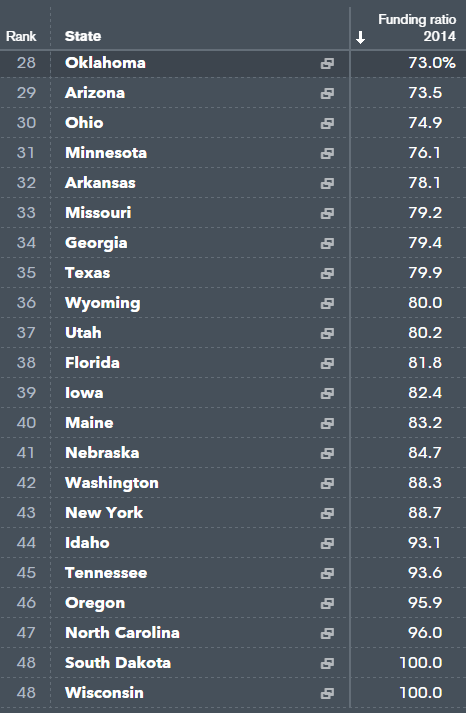
States with the best-funded pension liiabilities

And actually there is a comprehensive analysis of the fiscal solvency of all the states right here from George Mason University.

Here’s the map:
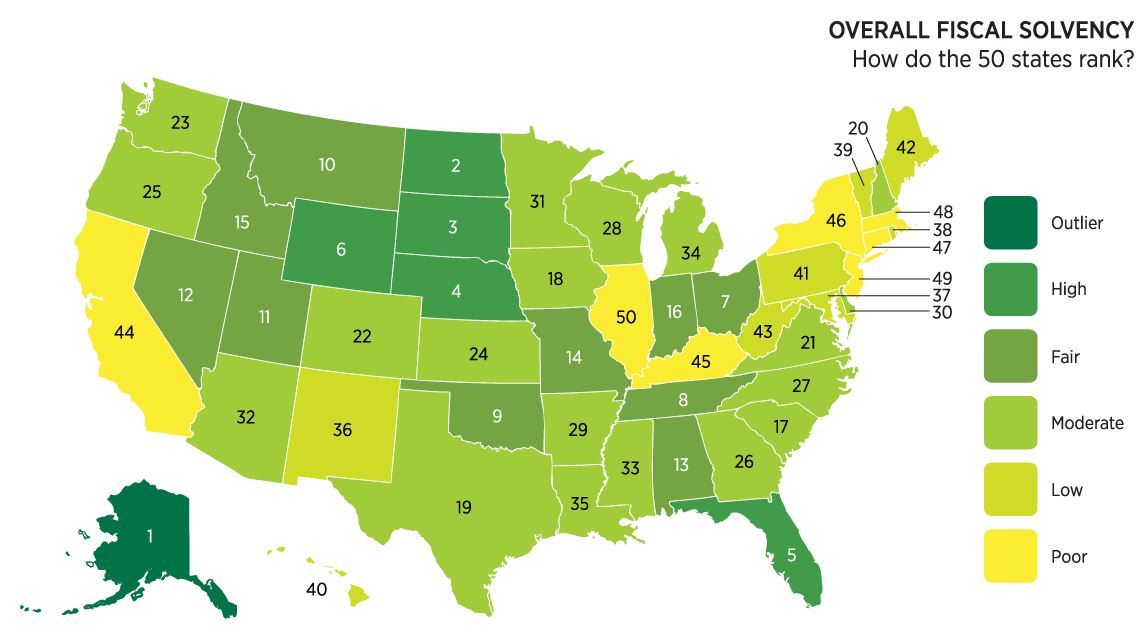
Overall fiscal solvency by state

I notice that the deep blue states like California, Massachusetts, Illinois, Connecticut, New Jersey, etc. are just horrible states. No wonder everyone is fleeing them in droves. Socialism doesn’t work. Eventually, the money runs out.

So, if you’re thinking of moving to a new state, look at that. And if you don’t want to move, then vote for governors like Scott Walker who will take on public sector unions – otherwise, you’re headed for a big tax hike in the future, to pay for the big spending liberals of the past.

Good news: Venezuela and Argentina eject socialist governments

Political Map of South America

Investors Business Daily has some good news for us. The Democrat Party of Venezuela has been CRUSHED in a recent election.

Excerpt:

Venezuela’s voters delivered a sledgehammer blow to the country’s ruling Chavista socialists Sunday, winning a likely supermajority in the National Assembly. It’s a great awakening from a 17-year nightmare.

Given the past two decades of near-victories, electoral fraud, chicanery and fractious political opposition mistakes, many Venezuelans are still in disbelief at the scale of the victory in the nation’s legislative elections, which have decisively handed one of Venezuela’s leading governing bodies over to the democratic, pro-free-market opposition.

As this was written, the opposition, known by its Spanish initials MUD, had declared a 112-seat, or two-thirds, supermajority in the National Assembly as a result of Sunday’s vote. The Chavistas won just 46 seats.

It’s total victory in legislative terms and will enable the legislature to throw out politicized Supreme Court justices and appoint honest ones.

The new Congress can also boot corrupt election officials and appoint fair ones. And they will even be able to declare President Nicolas Maduro — the late dictator Hugo Chavez’s hand-picked successor — mentally unstable and unfit for office, or remove him for incompetence. They can also stop his executive orders dead.

The Congress also will have the power to free the 71 or so political prisoners now rotting in Chavista dungeons without trial, including top opposition leader Leopoldo Lopez. And Venezuela’s central bank will stop destroying the country’s money, now nearly worthless.

[…]Most important, the leftist government’s mismanagement of the economy — through currency controls that prevented imports of spare parts, created shortages of basics such as toilet paper and devastated the health care system — and the central bank’s infamous money-printing spree, which has pushed Venezuelan inflation to near 700%, made ordinary life for Venezuelans hellish. There also was corruption, with as much as 1 trillion dollars in oil earnings stolen or misappropriated over the years by high-living Chavista elites, whose lavish lifestyles mocked ordinary, poor Venezuelans.

Top it with the monstrous infiltration of the country by the drug lords, and the likelihood of an electoral housecleaning was perfectly clear.

Still, an element of disbelief remains, given how dirty the Chavista rulers have played their democracy game.

They have broken election rules, violated ballot secrecy, shut voters out and banned popular candidates from running. Many of those dirty tricks were evident in this election, too — the Chavistas illegally extended voting hours and campaigned at polling stations, to cite just a couple of examples.

But the opposition won anyway — with turnout so high, at 74.5%, and margins of victory so wide that the election was impossible to steal.

It helped that the the opposition had the wind at its back with the disastrous result of socialism. But it also helped that MUD had improved its electoral game over the years, learning from each near-miss election.

It also helped that MUD had strong leaders such as Maria Corina Machado and put out strong candidates with a clear, unified message — often summed up as “Down with the left.” And with all the pain of 17 years, it helped most of all that they never lost heart.

There is literally no different between the socialists of Venezuela and the Democrat Party in the United States. They are in lock step on every issue. Should the Democrat Party continue to hold power in America, we can look forward to a reckoning like this one in the future.

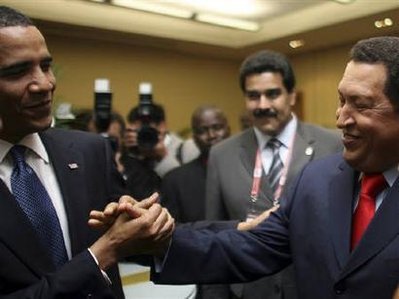
Two socialists shake hands: Barack Obama and Hugo Chavez

The Wall Street Journal says that the whole country is basically in the grip of ignorant socialists at every level, so there is lots to do.

Excerpt:

Pulling out of that death spiral, economists say, will require a series of painful and unpopular adjustments, rolling back more than a decade of populist and statist policies. Among the measures needed is raising the price of the world’s cheapest gasoline—which goes for less than one U.S. penny a gallon—overhauling a cumbersome and inefficient foreign-exchange system, and cutting generous social programs on which Venezuela’s poor depend.

[…]The government still controls more than 20 governorships, hundreds of mayors, the judiciary, much of the press and all auditing agencies. It will be up to Mr. Maduro whether to take steps to stabilize the economy, like loosening currency or price controls.

It’s not just Venezuela that has hit bottom under socialism. Recently, the people of Argentina also threw out their socialists after years and years of disastrous leftist policies.

The Chicago Tribune reports on last month’s election in Argentina.

Excerpt:

Under the current president, Cristina Fernandez, Argentina has become an international financial pariah. The country defaulted on debt last year in a long-running feud with hedge funds — remarkably, that was the eighth default in Argentina’s history.

Fernandez refused to settle. That’s left the country to squeak by in isolation, using protectionism and capital controls in a quixotic battle with globalism. The economy is stagnant, foreign currency reserves are dwindling and the inflation rate is around 30 percent. Last week, American Airlines said it stopped accepting pesos for ticket sales because it was tired of collecting revenue it couldn’t convert to dollars.

At times Argentina has embraced trade and economic openness, only to slip back into bad habits thanks to populist Peronistas like Fernandez. Macri, a conservative, wants to re-establish free market principles, but there are a lot of details he didn’t fully explain before his November victory because they will require some short-term pain, and he wanted to win the election.

Everything Macri is talking about makes sense. He says he will lift the capital controls that have wrecked the peso’s credibility. Like other backwaters it shouldn’t resemble, Argentina has a thriving black market because the government insists the peso is worth a lot more than its actual value. Freeing the currency would devalue it, a first step toward making Argentina more competitive.

The next big step would be to negotiate a settlement with the hedge funds that bought up Argentina’s debt after its previous default in 2002 and demand repayment. Fernandez got political mileage from attacking the “vultures,” but Macri seems to understand Argentina can’t get unstuck when it’s essentially shut out of international capital markets. He sounds like he wants to do a deal.

Macri’s got a tremendous balancing act to pull off: He’ll need to cut spending and reduce taxes without destroying the country’s big social safety net, while walking the country through a devaluation.

This is how countries that are ruled for a prolonged period by the political left eventually end up. I know so many of you lose heart and think that there is no hope, but there is hope. Even in countries where the left is running everything from the universities, to the judiciaries, to the mainstream media, there is hope.

Over the last 7 years, Obama added $10 trillion to the national debt. And although few of his Democrat low-information voters know about that, they will be able to tell the difference between prosperity and poverty when the United States reaches the Venezuela / Argentina tipping point. There comes a time when there are no more bailouts for the economics deniers. Reality wins in the end.

Amazing: California teachers challenge forced payment of union dues

Dad sent me this article from the Washington Free Beacon. It’s good news!

Excerpt:

A group of California teachers is preparing for a Supreme Court battle to overturn forced union dues in a groundbreaking lawsuits filed in June.

For nearly three decades, the Supreme Court has allowed closed-shop unionism, in which public employees must pay dues to labor groups handling collective bargaining negotiations.

The Supreme Court established Beck Rights in 1988 allowing workers to opt out of union dues for political activities, while continuing to pay for union negotiating expenses. The teachers are hoping to take that battle one step further by putting an end to all coercive union dues.

Ten California schoolteachers are challenging California’s policy of forcing all public employees to pay union dues for collective bargaining. The Center for Individual Rights (CIR) is aiding their suit. The CIR views the issue through the lens of the Constitution, rather than as a contest of labor policy.

“Our efforts are not anti-union; we are trying to solidify the First Amendment rights of public employees to freely assemble,” CIR president Terry Pell said.

The plaintiffs filed a preliminary injunction on Tuesday asking the court to waive the teachers’ union dues during the ongoing trial. Pell is certain the motion will fail, which is all the better for the plaintiffs because it will “fast-track” the litigation to the 9th Circuit Court of Appeals and eventually the Supreme Court.

“This is a piece of strategic litigation—we’re trying to get the issue of compulsory union dues to the Supreme Court as quickly as possible,” he said. “We know that lower courts can’t overrule Supreme Court precedent, but this will expedite us through the system.”

The Roberts court opened the door to ending coercive unionism last year when it ruled 5-4 that Service Employees International Union improperly charged non-union members for political activities. Justice Samuel Alito, writing for the majority in Knox v. Service Employees International Union, said the forced dues on non-union members were “indefensible”

One of the biggest problems with California is the stranglehold that public sector unions have on the state. This would be a good first step to getting the state to turn around. Even liberals stop paying dues when it’s not mandatory, because they want to keep their own money just like anyone does.