Tag Archives: Public Opinion

Survey: 69% believe scientists falsified global warming data

From the respected polling firm Rasmussen Reports. (H/T Reason to Stand)

Excerpt:

The latest Rasmussen Reports national telephone survey of American Adults shows that 69% say it’s at least somewhat likely that some scientists have falsified research data in order to support their own theories and beliefs, including 40% who say this is Very Likely. Twenty-two percent (22%) don’t think it’s likely some scientists have falsified global warming data, including just six percent (6%) say it’s Not At All Likely. Another 10% are undecided. (To see survey question wording, click here .)

The number of adults who say it’s likely scientists have falsified data is up 10 points from December 2009 .

Fifty-seven percent (57%) believe there is significant disagreement within the scientific community on global warming, up five points from late 2009. One in four (25%) believes scientists agree on global warming. Another 18% aren’t sure.

Republicans and adults not affiliated with either major political party feel stronger than Democrats that some scientists have falsified data to support their global warming theories, but 51% of Democrats also agree.

Men are more likely than women to believe some scientists have put out false information on the issue.

Democrats are more likely to support immediate action on global warming compared to those from other party affiliations.

I’m not surprised by this. Scientists had every reason to falsify their research. The more of a “crisis” they can generate, the more government money they get. And government is always happy to fund “research” that shows that more government is needed to solve the “crisis”. And public schools get more money too, to educate the impressionable children on the evils of unrestrained capitalism, and the need for higher taxes and more government restrictions on individual spending.
Did Obama’s foreign policy make America more respected abroad?

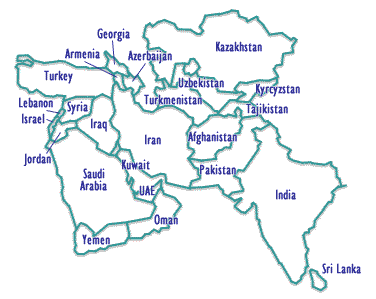
Map of the Middle East

From Investors Business Daily.

Excerpt:

In the Middle East, where U.S. military involvement and diplomacy are most closely watched, President Obama is held in lower regard in the Arab world than President Bush was in the last year of his presidency.

Obama is not only less liked than the supposedly hated Bush, he can’t even hold a candle to Iran’s grubby, menacing Mahmoud Ahmadinejad. Zogby reports that in Egypt, 31% of Egyptians agree with Iran’s policies compared with 3% for Obama’s, with similar figures in Jordan. Among Egyptians, just 5% hold a favorable attitude toward the U.S. compared with 9% in 2008.

[…]Clinton will do no better in bilateral talks with the Turks — a nation that has moved so far away from its long alliance with the U.S. it can only be called a former ally — on Syria, Iran and Israel/Palestine.

In these countries, Obama’s policy can be summed up in a litany of ineffectual maneuvers.

On Syria, the first move was to succor, then to scold as the dictatorship indifferently sheds streams of blood in the streets of Damascus — showing the fundamental disconnect between what the brutal Syrian regime is and what the Obama administration thinks it is.

After throwing Tunisia and Egypt, two pro-Western allies, overboard, the administration ineffectually grasps a problem in Syria as the bodies pile up.

On Iran, Obama policy shows even more weakness. The president wasted two years coddling the monster regime that threatens a region of more than a billion people. He missed a chance to support a student uprising in 2009 and now watches as Iran’s illegal nuclear program speeds ahead with little fear of consequences, more brazen and closer to realization.

Whatever this learning-curve policy amounts to, it garners no international respect.

Then there’s the stance the White House has taken on Israel, abusively telling its ally to retreat to 1967 borders. It emboldened provocations from Palestinian terrorist groups and showed the rest of the Arab world that it pays more to be America’s enemy than its friend. Now the Arab League is moving to recognize Palestine.

It turns out that what foreign powers respect is strength, not weakness.