Tag Archives: Protectionism

Fiscally conservative Canada campaigns against global bank tax

Canadian Prime Minister Stephen Harper

Story from Breitbart.

Excerpt:

Canada will “resist” a bank tax, Industry Minister Tony Clement said Tuesday as ministers fanned out across the world to raise opposition to the proposal for avoiding another financial crisis.

“Canada is, and will remain, opposed to a tax that would penalize financial institutions that remained strong and prosperous while many of the world’s banks failed,” Clement told a press conference with Foreign Minister Lawrence Cannon.

“We will resist the bank tax here at home and we seek to convince other heads of government of the virtue of our position,” he said as senior ministers echoed his message in Mumbai, Beijing and Washington.

Attempts to reach international agreement on coordinated bank taxes at last month’s G20 and IMF meetings ran aground.

Nations including Canada and Brazil, whose banking sectors emerged largely unscathed from the financial crisis, objected to the plan, favoring higher capital reserve requirements instead.

[…]Clement said the bank tax would “encourage risky behavior” if it is used to create a bank bailout fund and “reward bad behavior” of those institutions responsible for the recent financial crisis in the first place.

As well, it would “unduly burden” Canadian banks and put them at a “competitive disadvantage” to other financial institutions.

“This tax would reach into consumers’ pockets and punish our financial institutions which have taken precautions to avoid the very turmoil that is afflicting other parts of the globe,” Clement lamented.

Stephen Harper is a fiscal conservative. He knows that low interest rates are bad, so he created tax-free savings accounts to get people to work and save their money. And he knows that people who buy houses need to be able to pay for them, and his banking policies reflect that. There is no Democrat-sponsored “Community Reinvestment Act” in Canada to allow the socialist mafia (ACORN) to pressure private banks into making risky loans. And there are no Democrats taking political contributions while blocking attempts to investigate Fannie Mae and Freddie Mac. And there are no bank bailouts!

The Conservative Party of Canada keeps its banking sector squeaky clean. They even plan to cut spending! And the Canadian people support fiscal conservatism. That’s why they aren’t facing the mess we are facing. And they have lower unemployment, too – 8.1% compared to our 9.9%. Canada is kicking our tails! How can this be? How did they manage to elect an economist, while we are stuck with this perpetually-bowing flibbertigibbet and his legions of bloviating boffins, each more corrupt and incompetent than the last? Democrats have no real-life experience! They just had rich parents!

Look at this article from the Financial Post.

Excerpt:

“In Canada, there were no taxpayer bailouts of financial institutions, so we believe there is no justification for levies on banks and financial institutions,” Harper said at a news conference following meetings with European Commission President Jose Manuel Barroso and European Council President Herman Van Rompuy.

[…]Canada and the EU are in the midst of negotiating an ambitious trade deal. The Comprehensive Economic and Trade Agreement (CETA) was launched at the 2009 Canada-EU summit and to date, three rounds of negotiations have taken place. There are at least two more to go over the next year.

The deal will give Canada greater access to the markets of the EU’s member countries and will strengthen an economic relationship that is already worth $75-billion in trade. The EU is Canada’s second-largest trading partner after the United States and is also Canada’s second-largest source of direct foreign investment, putting $162-billion into Canada in 2009.

This is grown-up fiscal policy. Government should stay out of the mortgage-lending industry, and sign as many free-trade deals as possible. The exact opposite of what the Obama administration is doing.
Indian auto sales surge 71.9% while free trade vaults Chile into the first world

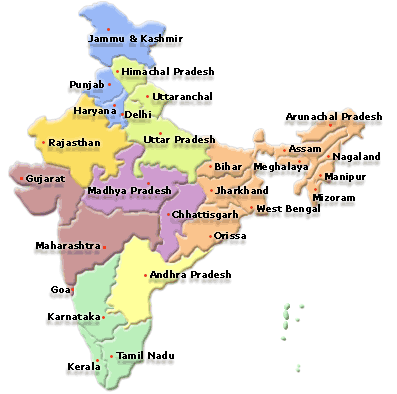
Map of India
Map of India

Before, I wrote about India’s election results and the decision of the ruling Congress Party to drastically cut income taxes. And I also wrote about China’s decision to cut taxes on purchases of new automobiles. So did those tax cuts work out for India and China?

Story from the Associated Press

Excerpt:

China extended its lead over the U.S. as the world’s biggest auto market in November, with production and sales both surpassing 1 million vehicles, and India saw sales jump 71.9-percent.

[…]China’s auto market is sizzling, thanks largely to tax cuts and subsidies aimed at supporting the industry and encouraging use of more fuel-efficient vehicles. The boom has clinched China’s status as the world’s biggest vehicle market due to languishing sales in the U.S.

[…]The surge is also a sign of how the Indian consumer — encouraged by government tax cuts, a big disbursement of back pay for government employees and falling interest rates — is fueling economic growth in Asia’s third-largest economy.

As everyone knows, the Democrats chose to bail out auto companies with taxpayer money and reward people with taxpayer money for destroying fully functional vehicles. And we all know how well that has worked out.

Chile poised to jump from the third world to the first world

Check out this editorial from Investors Business Daily. (podcast here)

Excerpt:

Chile is expected to win entry to OECD’s club of developed countries by Dec. 15 — a great affirmation for a once-poor nation that pulled itself up by trusting markets. One thing that stands out here is free trade.

[…]It’s not like Chile was born lucky. Only 30 years ago, it was an impoverished country with per capita GDP of $1,300. Its distant geography, irresponsible neighbors and tiny population were significant obstacles to investment and growth. And its economy, dominated by labor unions, wasn’t just closed, but sealed tight.

In the Cato Institute’s 1975 Economic Freedom of the World Report it ranked a wretched 71 out of 72 countries evaluated.

Today it’s a different country altogether. Embracing markets has made it one of the most open economies in the world, ranking third on Cato’s index, just behind Hong Kong and Singapore. Per capita GDP has soared to $15,000.

Besides its embrace of free trade, other reforms — including pension privatization, tax cuts, respect for property rights and cutting of red tape helped the country grow not only richer but more democratic, says Cato Institute trade expert Daniel Griswold.

But the main thing, Griswold says, is that the country didn’t shift course. “Chile’s economy is set apart from its neighbors, because they have pursued market policies consistently over a long period,” he said. “Free trade has been a central part of Chile’s success.”

Democrats oppose free trade, and their hostility to free trade angers many other countries in the world.

What does it take for a country to succeed?

I gave my Dad my copy of “Money, Greed and God” by Jay Richards, and although he thought that it started out slow, he’s warmed up to it. He calls me on the phone at least twice a day, and last night he alerted me to this web site, where you can track each countries average citizen’s life span and per-capita GDP over time. My Dad was pretty liberal on economics before, so naturally I’ve been working on him with lots of introductory books on economics. He’s read about a dozen now, and Thomas Sowell is his favorite.

Anyway, my Dad says that this is what a country needs to succeed:

  • free trade with other nations
  • the rule of law
  • low judicial activism
  • low tax rates
  • private property protections
  • currency not threatened by inflation
  • low government spending
  • minimal regulation of commerce

And at that web site, you can track the success of countries like Singapore and Hong Kong, which embrace conservative small government free market fiscal policies, and compare them with countries like Zimbabwe and North Korea, which embrace big government protectionist fiscal policies. Countries fail because they adopt the wrong policies. They succeed when they adopt the right policies. It doesn’t matter how poor they start, if they have the right policies, they grow rich over time.

Why are the Democrats so incompetent on economic policy?

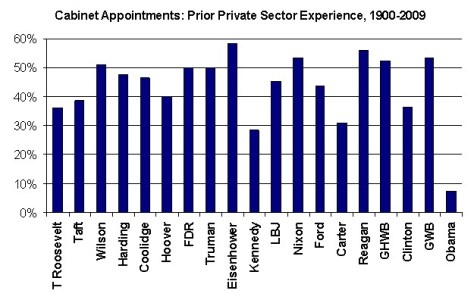
Well, it’s because there is almost no one in the Obama socialist regime who has ever run a business or worked in a business. Check out this graphic. (H/T Flopping Aces)

You can read more about the Obama administration’s ignorance of business and economics here in Forbes magazine.

This Reuters article discusses the price of economic ignorance: (H/T Gateway Pundit)

Excerpt:

Hunger is spreading while the number of homeless families is increasing as a result of the recession and other factors, according to a report on Tuesday.

The U.S. Conference of Mayors said cities reported a 26 percent jump in demand for hunger assistance over the past year, the largest average increase since 1991.

Middle-class families as well as the uninsured, elderly, working poor and homeless increasingly looked for help with hunger, which was mainly fueled by unemployment, high housing costs and low wages.

Democrats really don’t know what they are doing. It’s like putting pre-schoolers in charge of Amazon.com. It doesn’t work. Their ivory tower, silver-spoon worldview cannot comprehend real-world, grown-up complexities. So long as the Democrats continue to attack the businesses that employ citizens while redistributing wealth from people who produce to people who vote Democrat, our economic troubles will continue.

Related Cato Institute podcasts

Canadian prime minister Stephen Harper seeks increased trade with India


Canadian Prime Minister Stephen Harper


Story here from CTV News.

Excerpt:

Prime Minister Stephen Harper spent his first day in India selling Canada as a desirable place to invest and highlighting the need for greater trade ties between the two countries.

Harper visited the cities of Mumbai and New Delhi on Monday, the first stops on a high-profile, three-day tour of the country that is home to 1.2 billion people. It is his first visit to India as prime minister.

[…]He spoke about the advantages of investing in Canada, and he recited the many ties that the two countries share — including pluralistic parliamentary democracy, federalism and more than 1 million Canadians who claim Indian heritage.

Canada, said Harper, has “one of the most welcoming environments for investment in the world and has the resources necessary to meet India’s growing energy and infrastructure needs.”

While Harper talked much about investment opportunities in Canada, he downplayed any suggestion that he would be signing two anticipated bilateral deals that have been expected for some time.

“On the subject of nuclear energy, it is my sincere hope that our two governments will complete our bilateral nuclear co-operation agreement soon,” said Harper, alluding to a pending deal that was first announced back in January.

Harper said Canada is also “keen” to complete a foreign investment protection deal, but that too remains under negotiation.

Stephen loves his country, he doesn’t apologize for Canada when he goes abroad. He wants to reach out to other countries by signing trade deals, so that Canadians will be able to pay the lowest prices for imported goods, and will be able to export Canadian products to more markets. Meanwhile, Obama screws American consumers by shunning free trade deals and raising tariffs against other countries.

Stephen Harper on stage again, in Mumbai

In other news, Blue Like You reports that Harper also took part in a dance on stage at a popular Indian reality TV show.

Now, if only Canada could get a cricket team to participate in all the tournaments, as well as a rugby team, and a soccer team.