Tag Archives: Profit

State regulators ignored abortionist who killed born-alive infants with scissors

This story was sent to me by four different people (Wes, ECM, Mary and Roo). Each person sent me a different versions of the story.

Here’s the one that Roo sent from ABC News.

Excerpt:

A doctor who gave abortions to minorities, immigrants and poor women in a “house of horrors” clinic was charged with eight counts of murder in the deaths of a patient and seven babies who were born alive and then killed with scissors, prosecutors said Wednesday.

Dr. Kermit Gosnell, 69, made millions of dollars over 30 years, performing as many illegal, late-term abortions as he could, prosecutors said. State regulators ignored complaints about him and failed to inspect his clinic since 1993, but no charges were warranted against them given time limits and existing law, District Attorney Seth Williams said. Nine of Gosnell’s employees also were charged.

Gosnell “induced labor, forced the live birth of viable babies in the sixth, seventh, eighth month of pregnancy and then killed those babies by cutting into the back of the neck with scissors and severing their spinal cord,” Williams said.

[…]Bags and bottles holding aborted fetuses “were scattered throughout the building,” Williams said. “There were jars, lining shelves, with severed feet that he kept for no medical purpose.”

[…]Gosnell has been named in at least 46 malpractice suits, including one over the death of a 22-year-old mother who died of sepsis and a perforated uterus in 2000. Many others also involve perforated uteruses. Gosnell sometimes sewed up the injury without telling women their uteruses had been perforated, prosecutors said.

Gosnell charged $325 for first-trimester abortions and $1,600 to $3,000 for abortions up to 30 weeks.

ECM sent me this one from CBS News.

Excerpt:

The grand jury investigation revealed that, for over two decades, government health and licensing officials had received repeated reports about Gosnell’s dangerous practices.  However, no action was ever taken, even after the agencies learned that Mrs. Mongar had died during routine abortions under Gosnell’s care (see related story).

Dr. Gosnell, who has practiced in the West Philadelphia neighborhood for decades, is also the target of a federal grand jury investigation into illegally prescribing prescription drugs. Investigators say during a search of his home, they found $240,000 in cash.

[…]Gosnell is suspected of killing hundreds of living babies over the course of his 30-year practice. However, he is not charged because the records do not exist.

DA Williams said Gosnell made approximately $1.8 million in one year alone performing the procedures.

Many people actually agree with Gosnell that babies who are born during abortions have no right to live.

Did you know that even some politicians agree with Gosnell?

Obama also likes to give speeches to Planned Parenthood, the largest provider of abortions in the United States.

Why does Planned Parenthood perform abortions?

Excerpt:

[Planned Parenthood] took home $85 million in “excess of revenue over expenses” (a nifty way of saying profits) and had an operating budget of over $1 billion for the 2007-2008 fiscal year, according to its latest annual report. Included in that budget was $350 million in “government grants and contracts” (an equally nifty way of saying your tax dollars). An increase in the number of abortions performed helped fuel the profits.

Abortion is a very profitable business, and the pro-abortion politicians subsidize the abortion industry with taxpayer dollars, including dollars from pro-life taxpayers, in exchange for political contributions to their campaigns. Yes, the contributions go almost entirely to Democrats.

Relaated posts

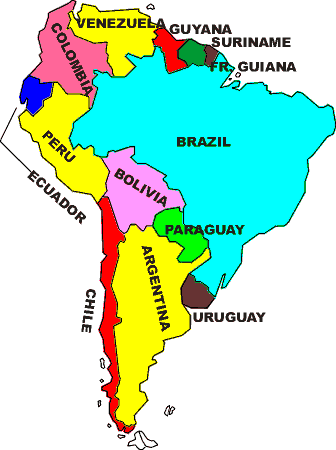
What happened when Chile privatized its retirement program?

Map of South America

Here’s an editorial about how Chile privatized their government-run retirement program.

Excerpt:

Nearly 30 years ago, on the very day Ronald Reagan was sworn in as U.S. president, Chile became the first nation to privatize its social security system. Three decades hence, it has surpassed all expectations.

[…]Thirty years on, Pinera’s plan, adapted from the ideas of Milton Friedman, is, along with free trade, one of the two pillars of Chile’s success story, surpassing all predictions.

Pinera’s proposal began with scrapping the payroll tax on the country’s social security system and inviting all workers to take the money they were contributing and move it into a private pension.

Workers would be free to choose the fund, how much to put in, and at what age they would retire, with a minimal safety net built into the design. Past contributions would be refunded to workers by government bond. And anyone who didn’t like the idea was free to remain with the system as it was. It was a huge success: 95% of Chile’s workers chose the private system.

Pinera told the public to expect a compounded 4% rate of return under the private plan. But as of 2010, the average annual rate of return was 9.23%, far higher than promised.

By contrast, the U.S. social security system, which today accounts for a quarter of the U.S. government budget, is slated to give retiring workers in the next decade a 1% to 2% rate of return. And those entering the system today will see a negative return.

Chile’s implicit pension debt fell to just 6% of GNP — compared with 100% in the U.S., 300% in France and 450% in Italy, leaving Chile with no net debt.

Better still, the accumulated savings in the pension funds fueled Chile’s spectacular economic ascent, taking real incomes from about $4,000 per capita in the early 1980s to $15,000 today, and GDP to the 6% range most years for nearly 20 years. With that record, is it any surprise that Chile this year earned itself a membership card into the club of rich nations, the OECD?

The U.S. could have similar result if it had started on Chile’s path 30 years ago, with no debt and a phenomenal rate of growth.

But U.S. politicians, just like Chile’s fascist generals, have insisted the public is too stupid to fend for itself without big government. Given U.S. politicians’ fraudulent mismanagement and abuse of Social Security in recent years, such claims are outrageous.

And it even works in Canada – they privatized their air traffic control program.

Excerpt:

In 1996, Canada privatized its air traffic control system, in part due to the long waits endured by passengers. Today, it should take the same approach to improve its miserable health care waiting times.

Canada’s air traffic control might not have been a major embarrassment — though its health-care system might be — but it was performing poorly enough that policymakers felt they had to do something about it. So they sold it for $1.5 billion.

In turning over its air traffic control system to Nav Canada, the country relieved itself of a multitude of air travel issues.

Lengthy delays have been minimized, flight times have been cut, circling while awaiting a landing slot has been decreased and routes are more efficient. The overall flying experience has improved as has the business environment for airlines.

According to a Christmas Eve story in the Financial Post, privatization of the air traffic control system has “cut the fuel bill of airlines flying into Canada and above it by an estimated $1.4 billion collectively.” Nav Canada “estimates it will be able to save airlines a further $2.9 billion on fuel by 2016.”

At the same time, the private company, which does not operate through a command-and-control arrangement like a state-run system would, has kept airlines’ landing fees stable “and in some cases, like in 2006,” even reduced them.

Taxpayers have benefited. The system is no longer being propped up by $100 million to $200 million a year in public funds.

Though Nav Canada is a nonprofit company, it still makes money. Its profits go to pay down debt and are plowed back into the company for new innovations — an incentive that the clumsy government-owned air traffic control system didn’t have.

Why don’t we try things that we know will work – like privatizing wasteful government agencies and social programs? If it works for Chile and Canada, then it should work for us. If massive government spending did not work for Japan, then it shouldn’t work for us, either. Why govern by rhetoric and demonizing the opposition, when we can easily do what has worked for others? They are not really so different from us, are they?

How well do pro-tithing people perform in debates?

I was having a debate with pro-tithing people and I asked them whether they thought that pastors today were providing good value for the money they demanded from parishioners. In particular, I told them that at a bare minimum, a Christian pastor ought to KNOW whether God exists and KNOW whether Jesus rose from the dead. If the pastor doesn’t know these things, then how is his flock supposed to KNOW these things and so by knowing them and knowing them to be true, take the final step of trusting in them?

I wrote this:

It seems to me that Christianity requires the existence of a Creator and Designer of the universe as a matter of knowledge. (that they may know FOR CERTAIN that there is a God in Israel). Please tell me some of the initiatives that pastors you know have taken in order to supply the laity with KNOWLEDGE of the existence of a supernatural creator as a matter of objective knowledge, not subjective belief.

The resurrection must also be KNOWN to be a real, objective historical even in order to sustain a robust Christian worldview. Please list some initiatives that pastors have spearheaded to encourage the laity to know the bodily resurrection of Jesus as a historical fact, and to defend against critics ranging from scholarly to popular. In your reply, be sure to reference their leveraging of scholars like Gary Habermas, William Lane Craig, Ben Witherington, Mike Licona, N.T. Wright and Richard Bauckham, which I am sure that most pastors are familiar with. I am especially interested in hearing about pastors who have shown our scholars in formal debates on this resurrection topic in the church, from the pulpit, as was done in Acts 2 by Peter in the early church.

Also, there is a think out there called the New Atheism. Please list some initiatives that pastors you know have taken to equip their flocks to understand and respond to that as well.

And then we got responses from the pro-tithing people.

Well, there was a refusal to answer, ridicule, laughter, personal attacks, accusations of heresy,  etc. No one would answer whether pastors were doing their jobs. (A different debater was in charge of asking them whether tithing was Biblical or not, and they just attacked his character over and over and over). Mostly, people completely dodged the question about whether pastors had to do anything useful in order to deserve the money they were demanding.

Then a pastor responded to me:

As for @Wintery, not sure why you think I’m required to humble myself to your demands. I don’t know you and don’t feel the need to defend myself or the Lord against you.

I leave you with this from Titus 3:9-11
But avoid foolish controversies and genealogies and arguments and quarrels about the law, because these are unprofitable and useless. Warn a divisive person once, and then warn him a second time. After that, have nothing to do with him. You may be sure that such a man is warped and sinful; he is self-condemned.

He has to know me, otherwise he doesn’t have to answer my questions. Otherwise, I’m not worth his time.

This pastor reminds me of a unionized public school teacher. He wants his money whether he performs his duty or not, and if you question whether he is performing his duty, he distorts your words and dismisses you. A person could attend his church for 40 years and not know anything at all about whether the Bible was reliable, whether God exists, whether the universe shows signs of being designed, whether there is a good response to why God allows evil, whether Hell is unjust, whether all religions are true, whether God has a reason for remaining hidden, whether miracles are possible, etc. He doesn’t have to know anything about those kinds of questions, apparently. He just has to collect money and threaten people who don’t pay him with God’s wrath. Nice work if you can get it.

Yes there is a place for theology and preaching from the Bible. But shouldn’t we be presented with some reasons to believe that there is a God, before we find out what he is like? Shouldn’t we have some reasons to think that the Bible is reliable, before using it as an authority? What does it say about the Bible that we treat it as untestable? What does that say that we cannot ask questions in church without having the worship leader try to cast demons out of us?

Maybe I was being harsh but I just want to know why pastors have very definite convictions about people giving them money, but no definite convictions on whether God exists or not, or whether Jesus rose from the dead or not. I am not the nicest most tactful person in the world, but pastors have usually been opposed to what I think is important, so I want to know why I should pay them instead of using the money to bring in a Christian scholar to defend the reliability of the Bible or the resurrection at a university instead. What’s the value proposition for me as someone who is looking to serve God?

There are non-Christians in my office are always telling me about Joel Osteen and preachers they see on TV. When I say that the Bible doesn’t sanction that, they tell me that I ought to go into the ministry. I say “why?” and they respond “because you actually think that Christianity is true and you try to tell use why instead of just asking us for money all the time.”

Some pastors have no clue how they look to non-Christians.

My last comment was really mean:

So you haven’t done anything to equip your flock to defend the existence of God as an objective fact, or to defend the resurrection of Jesus as an objective event in history.

But you want your flock to pay you a mandatory 10% of their… gross income.

What exactly do you think that Christians ought to do in the face of a non-Christian culture that rejects the existence of God and the resurrection of Jesus? What did Paul do in Acts 17 and Peter in Acts 2? What did Jesus do with “the sign of Jonah”? How about some evidence?

Do you care whether people in your church KNOW that God exists the way they KNOW that water boils at 100 Celsius? Do you care whether people in your church KNOW that Jesus rose from the dead the way they KNOW that who won the battle of Waterloo?

And what about the people outside the church? Does God care whether you prepare your flock to deal with them?

You seem to not want to answer these questions… yet you want to have people pay you. What exactly is it that you do? Do you know whether these things you talk about on Sunday are true? Are you able to show them to be true so that your flock can trust in them?

There is only one thing that causes me to lose my temper and it’s leaders in the church who prefer to be lazy, ignorant and cowardly rather than being effective.

And yes, there are good churches where they do amazing things – Lee Strobel Bible studies, showing Bill Craig debates, inviting Christian scholars to lecture and debate at the university and teach classes to the flock. Yes – it happens. It doesn’t happen enough.