People’s retirement savings are a convenient source of revenue for governments that don’t want to reduce spending or make privatizations. As most pension schemes in Europe are organised by the state, European ministers of finance have a facilitated access to the savings accumulated there, and it is only logical that they try to get a hold of this money for their own ends. In recent weeks I have noted five such attempts: Three situations concern private personal savings; two others refer to national funds.
The most striking example is Hungary, where last month the government made the citizens an offer they could not refuse. They could either remit their individual retirement savings to the state, or lose the right to the basic state pension (but still have an obligation to pay contributions for it). In this extortionate way, the government wants to gain control over $14bn of individual retirement savings.
The Bulgarian government has come up with a similar idea. $300m of private early retirement savings was supposed to be transferred to the state pension scheme. The government gave way after trade unions protested and finally only about 20% of the original plans were implemented.
The article describes 3 other countries that are grabbing more individual retirement contributions.
This is exactly where the Democrats would take us.
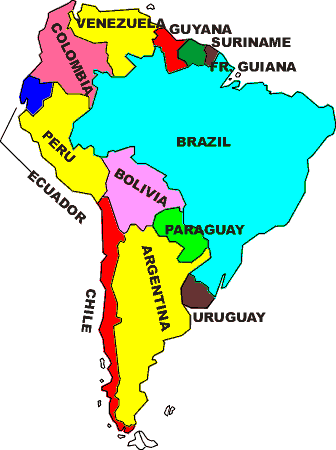
Nearly 30 years ago, on the very day Ronald Reagan was sworn in as U.S. president, Chile became the first nation to privatize its social security system. Three decades hence, it has surpassed all expectations.
[…]Thirty years on, Pinera’s plan, adapted from the ideas of Milton Friedman, is, along with free trade, one of the two pillars of Chile’s success story, surpassing all predictions.
Pinera’s proposal began with scrapping the payroll tax on the country’s social security system and inviting all workers to take the money they were contributing and move it into a private pension.
Workers would be free to choose the fund, how much to put in, and at what age they would retire, with a minimal safety net built into the design. Past contributions would be refunded to workers by government bond. And anyone who didn’t like the idea was free to remain with the system as it was. It was a huge success: 95% of Chile’s workers chose the private system.
Pinera told the public to expect a compounded 4% rate of return under the private plan. But as of 2010, the average annual rate of return was 9.23%, far higher than promised.
By contrast, the U.S. social security system, which today accounts for a quarter of the U.S. government budget, is slated to give retiring workers in the next decade a 1% to 2% rate of return. And those entering the system today will see a negative return.
Chile’s implicit pension debt fell to just 6% of GNP — compared with 100% in the U.S., 300% in France and 450% in Italy, leaving Chile with no net debt.
Better still, the accumulated savings in the pension funds fueled Chile’s spectacular economic ascent, taking real incomes from about $4,000 per capita in the early 1980s to $15,000 today, and GDP to the 6% range most years for nearly 20 years. With that record, is it any surprise that Chile this year earned itself a membership card into the club of rich nations, the OECD?
The U.S. could have similar result if it had started on Chile’s path 30 years ago, with no debt and a phenomenal rate of growth.
But U.S. politicians, just like Chile’s fascist generals, have insisted the public is too stupid to fend for itself without big government. Given U.S. politicians’ fraudulent mismanagement and abuse of Social Security in recent years, such claims are outrageous.
In 1996, Canada privatized its air traffic control system, in part due to the long waits endured by passengers. Today, it should take the same approach to improve its miserable health care waiting times.
Canada’s air traffic control might not have been a major embarrassment — though its health-care system might be — but it was performing poorly enough that policymakers felt they had to do something about it. So they sold it for $1.5 billion.
In turning over its air traffic control system to Nav Canada, the country relieved itself of a multitude of air travel issues.
Lengthy delays have been minimized, flight times have been cut, circling while awaiting a landing slot has been decreased and routes are more efficient. The overall flying experience has improved as has the business environment for airlines.
According to a Christmas Eve story in the Financial Post, privatization of the air traffic control system has “cut the fuel bill of airlines flying into Canada and above it by an estimated $1.4 billion collectively.” Nav Canada “estimates it will be able to save airlines a further $2.9 billion on fuel by 2016.”
At the same time, the private company, which does not operate through a command-and-control arrangement like a state-run system would, has kept airlines’ landing fees stable “and in some cases, like in 2006,” even reduced them.
Taxpayers have benefited. The system is no longer being propped up by $100 million to $200 million a year in public funds.
Though Nav Canada is a nonprofit company, it still makes money. Its profits go to pay down debt and are plowed back into the company for new innovations — an incentive that the clumsy government-owned air traffic control system didn’t have.
Why don’t we try things that we know will work – like privatizing wasteful government agencies and social programs? If it works for Chile and Canada, then it should work for us. If massive government spending did not work for Japan, then it shouldn’t work for us, either. Why govern by rhetoric and demonizing the opposition, when we can easily do what has worked for others? They are not really so different from us, are they?
People who commit their lives to going green are just better people. They’re more moral, more honest. At least, they keep telling us that, and apparently many students believe it, say University of Toronto psychologists:
They initially quizzed the students on their impressions of people who buy eco-friendly products, and for the most part, they considered such consumers to be more “more cooperative, altruistic and ethical” than ordinary consumers…
Then the researchers took it an extra step: They ran a test to see who would be more likely to cheat and steal: Greens? Or conventional shoppers?
They divided the greens and conventional shoppers, and then gave the students a test that tempted them to steal money. The researchers found:
The green consumers were more likely to cheat than the conventional purchasers, and they stole more money when asked to withdraw their winnings from envelopes on their desks.
This concept of moral license has been demonstrated before, writes Wray Herbert in his blog for the Association for Psychological Science.
(W)hen they have reason to feel a little superior, that positive self image triggers a sense of moral license. That is, the righteous feel they have some latitude to stray a bit in order to compensate. It’s like working in a soup kitchen gives you the right to cheat on your taxes later in the week.
Maybe that’s why sanctimonious stewards of the environment like Al Gore are comfortable lecturing the rest of us while living large in mega-mansions.
Beware of those who select an alternative moral standard (global warming, foreign aid, animal rights, veganism, yoga, etc.) that gives them self-esteem and respect from others. I think real morality is the old morality, where people had to restrain themselves in their own personal lives. E.g. – chastity, frugality and sobriety.
Today it seems to be popular to do anything you want with alcohol, consumerism, and sex, as long as you take on some fashionable cause that doesn’t involve you having to give up the pursuit of pleasure. But the real measure of a man is the moral law, which does not change. It’s moral values like chastity, frugality and sobriety that require you to not hurt those around you.
There are a lot of Hollywood actors and famous/rich people who are apparently terribly concerned (in public) about things like global warming and animal rights. But in private, they act in the most selfish ways destroying the lives of those around them. Being associated with glamorous causes makes them happy, just like cheating on their spouses makes them happy.

 WINTERY KNIGHT