Tag Archives: Premarital Sex

Does more relationship experience lead to better relationship success?

Published in the Journal of Marriage and Family

Consider this article from the Institute for Family Studies.

It says:

In most areas of life, having more experience is good. Want to be great in your chosen field? Sustained experience is essential. Want to be great at a sport? There’s no substitute for practice. And anyone who runs a business can tell you that their best employees are those who have been in the job long enough to have learned how to handle the normal well and the unexpected with wisdom.

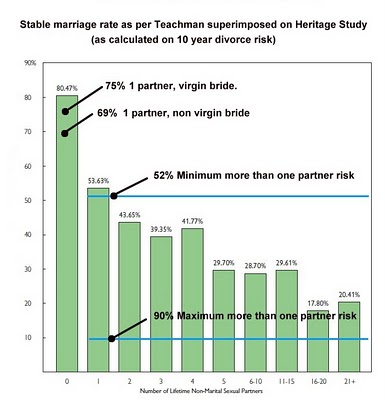
While more experience is often beneficial in life, the story looks different when it comes to some types of experience before marriage. For example, in our Before “I Do” report, we surveyed a national longitudinal sample of young adults about their love lives prior to marriage to examine factors associated with future marital quality. We found that having more sexual and cohabiting partners before marriage is associated with lower relationship quality once married. In particular, having only ever lived with or had sex with one’s spouse was associated with higher marital quality. Our findings are consistent with other studies showing that cohabiting with more partners before marriage is associated with greater likelihood of divorce1 and that a higher number of sexual partners before marriage is associated with lower marital quality and greater likelihood of divorce.2 As we noted, what happens in Vegas may not always stay in Vegas. But why?

There are many reasons why having more romantic partners before marriage may put one at higher risk of difficulties in marriage. One of the most important explanations comes under the heading of what some call selection effects. For many people, an elevated risk of difficulties in marriage was present before they had their first relationship experience. Background characteristics such as parental divorce, low education, and economic disadvantage are associated both with having more sexual and cohabiting partners and also with lower marital quality and/or divorce.3So it may not be that having more sexual or cohabiting partners causes further risk because a lot of risk was already in motion. Selection is a big part of how relationships unfold, but is it the whole story? We believe that, in addition to selection, behavior matters and has plausible connections to marital outcomes. We are going to explain four reasons why having more relationship experience before tying the knot might make it harder to succeed in marriage.

Here are the 4 reasons:

  1. More Awareness of Alternatives
  2. Changed Expectations: The Perfect Sexual Lover (in Your Mind)
  3. More Experience Breaking It Off
  4. Babies

I have to quote the one that I’ve personally encountered in my mentoring – number three: more experience breaking it off. I’ve seen this commitmentphobia in two women who had “wild” periods in their past who had broken up with cohabitating boyfriends.

It says:

Cohabitation has characteristics that seem paradoxical. Living with a partner makes it harder to break up than dating, all other things being equal, and often now comes at a time in relationship development where people have not really chosen each other for the future.8 And yet, cohabiting couples frequently break up, and they are more likely than any other time in history not to end up marrying.9

These days, cohabitation has become more a part of the dating scene than a lead-up to marriage. Let’s call the phenomenon cohabidating. In this context, some people are getting a lot of experience at leaving serious relationships (or surviving being left). Just as with our prior point, that does not sound bad in one way—at least insofar as people are breaking off relationships that had no future. But it’s also true that people tend to get good at things they have a lot of experience doing. People can get good at moving out and moving on.

How does that impact marriage? Some people probably so deeply learn that they can survive leaving a relationship when they are unhappy with it that they leave reasonably good marriages that would have given them and their children the best outcomes in life. They bail too quickly.

Obviously, many others leave very poor or even dangerous marriages only after a lot of agonizing and effort. We’re not suggesting divorce is ever easy or that it is not sometimes the best course. But in a day and age when people get so much experience moving out and moving on, we think many may learn to do so too rapidly, and to their detriment.

If you want to get good at relationships, experience may not be the answer. Reading good studies like this, and making decisions that line up with the research is much wiser. As always, never follow your heart. Always follow rational arguments and evidence, and keep connected to a good panel of advisors who have had long-term relationships success. That’s the best way to avoid disaster.

People ask me how to learn how to do relationships well if your parents are divorced and the culture is a cesspool. The answer is to go back in time to before radical feminism, to the time when men and women had distinct roles, and had to attract each other without using sex. Men had to prove their feelings to women with actions, and when women chose men for the roles of husband and father. Parents were consulted to give advice about courtship and marriage. Where can you find this today? Well, books by Christian authors like Jane Austen are very helpful. If you like DVDs, go out and get yourself the BBC production of “North and South”, which is based on the book by Christian author Elizabeth Gaskell. My favorite romance is Edmund Rostand’s “Cyrano de Bergerac”, just make sure you get the Brian Hooker translation if you are reading it in English. Although the best version is the original French. Shakespeare is also good – I got my rule of saving the first kiss for the proposal / engagement from Henry V.

You have to dig if you are going to get away from a culture that trains people to fail to prepare for marriage. You have to fight to develop and maintain your ability to love another person well, in a Christ-like way. The culture says to treat the opposite sex like a commodity, but you should instead think of them as something designed to be presented to God. Never treat them in a way that causes damage to that vertical relationship, that’s the most important thing about them – how they see God.

Why are Christians allowed to eat shellfish but not allowed to have sex before marriage?

I have a key that will unlock a puzzling mystery

Here’s a wonderful article from Peter Saunders.

The challenge:

An argument frequently advanced by those attempting to defend homosexual practice is that Christians ‘cherry pick’ the commands in the Bible – that is, they chose to emphasise some commands while ignoring others.

The Old Testament may forbid homosexual acts (Leviticus 18:2; 20:13) but it also forbids eating seafood without fins and scales (Leviticus 11:9-12; Deuteronomy 14:9, 10).

So how can Christians then justify upholding laws on sexual morality whilst at the same time ignoring the food laws from the very same books of the Bible? Why may they eat shellfish but not be allowed to have sex outside marriage? Isn’t this inconsistent and hypocritical?

The solution is that God enters into “covenants” with his people, and the terms of those covenants change.

Especially dietary laws:

The answer to this question lies in an understanding of biblical covenants.

A covenant is a binding solemn agreement made between two parties. It generally leaves each with obligations. But it holds only between the parties involved.

There are a number of biblical covenants: Noahic, Abrahamic, Sinaitic (Old), Davidic and New.

Under the Noahic covenant, which God made with all living human beings (Genesis 9:8-17), people were able to eat anything:

‘Everything that lives and moves about will be food for you. Just as I gave you the green plants, I now give you everything’ (Genesis 9:3).

But under the Sinaitic (Old) Covenant, which God made with the nation of Israel, people were able to eat certain foods, but not others.

Jesus clearly created a new covenant with his followers, where the dietary laws are lifted:

Jesus said that he had come to fulfil the ‘Law and the Prophets’ (Matthew 5:17; Luke 24:44). He would establish this new covenant with new laws, with himself as high priest based on his own sacrificial death on the cross.

This new covenant would completely deal with sin (Hebrews 10:1-18) and protect all those who put their faith in him from God’s wrath and judgement…

[…]‘In the same way, after the supper (Jesus) took the cup, saying, “This cup is the new covenant in my blood, which is poured out for you”’ (Luke 22:20). ‘…we have been made holy through the sacrifice of the body of Jesus Christ once for all’ (Hebrews 10:10)

People would come under the protection of this new covenant, not by virtue of belonging to the nation of Israel, but through faith in Christ. In fact the function of the Old Testament Law (Sinaitic covenant) was to point to Christ as its fulfilment.

[…]So what then did Christ say about foods? He pronounced all foods clean for his followers to eat:

‘ “Don’t you see that nothing that enters a person from the outside can defile them?  For it doesn’t go into their heart but into their stomach, and then out of the body.” (In saying this, Jesus declared all foods clean.) He went on: “What comes out of a person is what defiles them.  For it is from within, out of a person’s heart, that evil thoughts come—sexual immorality, theft, murder,  adultery, greed, malice, deceit, lewdness, envy, slander, arrogance and folly.  All these evils come from inside and defile a person.” (Mark 7:18-23)

Jesus was making that point that under the new covenant God required purity of the heart. Internal thoughts and attitudes were as important as external actions.

Food is OK for Christians, but sexual immorality – which includes premarital sex and adultery – are NOT OK for Christians.

I think sometimes when you are talking to people whose motivation is just to get rid of any objective moral law entirely, they tend to ask questions without really wanting a good answer. This is especially true when it comes to the morality of sex. They ask the question not to get an answer, but to justify getting rid of the moral rules governing sexuality. The answers are there for people who are willing to respect God in their decision-making to find. The answers are not found only by people who have a reason to not want to find them.

In case you’re wondering, I am one of those Christian men who takes chastity seriously. Marriage is about having a close connection with your spouse. Sure, I could break the rules and have a lot of fun now. A lot of Christians have a hard time turning down fun. But when I look at Jesus, I don’t see a man who is pursuing fun and thrills. I see a man who sees a need and then sacrifices his own interests to rescue others from peril.

Two reasons to avoid premarital sex: trust issues and contact with exes

I have a key that will unlock a puzzling mystery

This is from Family Studies blog.  (H/T Brad Wilcox)

Excerpt:.

My own research with working-class young adults leads me to believe that they have basically made peace with sexual permissiveness—at least outside of marriage—even as they retain some ambivalence about it. They tend to move in quickly with new romantic partners, even as they worry that people rush too quickly into relationships. From survey data, we know that people without a college education have more lifetime sexual partners than those with a college education, and that most of them see no problem with premarital sex.

But there is one problem: easy access to sex with multiple partners can make for complicated relationships. As sexual partners accumulate, so does the potential for distrust. As one man whose ex-girlfriend had cheated on him explained, “It’s gonna take a lot more time for me to ever trust somebody again like that. I let her in quick, and now it’s never gonna happen again.” One divorced man said simply, “Everyone has to watch their ass all the time.” There is the feeling that no one is safe—even in marriage. As another young man claimed, “Nowadays, even though you got a ring on your finger, people tend to look past that.”

So people describe keeping vigilant watch over their partners’ cell phones, policing for messages from exes. They live an all but married lifestyle, yet they say that they are hesitant to make the commitment of marriage. Why? Part of the reason is that they don’t trust their partner, or themselves, to remain in the marriage. In one survey, 42.5 percent of low-income, unmarried respondents cited “worry that the marriage would end in divorce” as a reason they might not be pursuing marriage, and 23.5 percent cited “questions about whether your partner is trustworthy.” As one young man that I interviewed said after learning that his fiancée was cheating on him, “I don’t trust nobody.”

That distrust is at least partly the legacy of the libertarian sexual ethic, which assumes that sexual activity outside of marriage is typically okay so long as people are mutually consenting to the acts. And that distrust is why I have a hard time believing—as Noah Smith does—that sexual permissiveness will somehow evolve into more stable marriages for the working class. (Indeed, having more sexual partners prior to marriage is linked to greater odds of divorce, as Nicholas Wolfinger and W. Bradford Wilcox recently documented.) There is no invisible hand that will transform James and Jessica’s distrust and cynicism, which stems in part from their multiple past sexual relationships, into trust and an enduring marriage. What the working class needs—what we all need—to achieve our shared aspirations for lifelong love and a stable family is social permission to date without immediately having sex.

That’s important because today young people often assume that withholding sex is a sign of distrust. As James said, if you begin a relationship and don’t have sex, “they automatically assume that you’re cheating.”  But sliding into sex often translates into sliding into a relationship—and children—without first building trust and discerning for character and compatibility. And that slide often contributes to the erosion of trust in the opposite sex and in lifelong love. We must confront that reality if we’re serious about empowering working young adults to achieve trusting relationships.

“Withholding sex” makes it sound bad. You don’t have sex or even do sexual things before marriage because you are trying to prove to your partner that you have self-control enough that when you are married, he/she need not be concerned that you are OK with sex outside of a lifelong commitment. You restrain yourself in order to prove to the other person that you have what it takes in order to be trusted, and the other person does the same to you. It’s not that you are trying to reduce the amount of “fun” you are having, it’s that you are auditioning for a role, and this is what the other person needs to see from you during the courtship – chastity. Chastity demonstrates to them that the commitment you are offering is not based on things that fade, like beauty or youth.