Tag Archives: Power

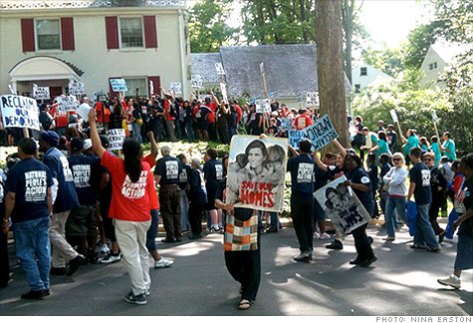
SEIU union thugs rage against private citizen on his own front lawn

SEIU union thugs storm private citizen's home

Story here from CNN Money. (H/T Peter Sean Bradley at Lex Communis)

Excerpt:

Last Sunday, on a peaceful, sun-crisp afternoon, our toddler finally napping upstairs, my front yard exploded with 500 screaming, placard-waving strangers on a mission to intimidate my neighbor, Greg Baer. Baer is deputy general counsel for corporate law at Bank of America (BAC, Fortune 500), a senior executive based in Washington, D.C. And that — in the minds of the organizers at the politically influential Service Employees International Union and a Chicago outfit called National Political Action — makes his family fair game.

[…]As bullhorns rattled with stories of debtor calls and foreclosed homes, Baer’s teenage son Jack — alone in the house — locked himself in the bathroom. “When are they going to leave?” Jack pleaded when I called to check on him.

[…]Now this event would accurately be called a “protest” if it were taking place at, say, a bank or the U.S. Capitol. But when hundreds of loud and angry strangers are descending on your family, your children, and your home, a more apt description of this assemblage would be “mob.” Intimidation was the whole point of this exercise, and it worked-even on the police. A trio of officers who belatedly answered our calls confessed a fear that arrests might “incite” these trespassers.

And why were the SEIU trying to intimidate a private citizen on his own property?

[Bank of America] is the union’s lender of choice — and SEIU, suffering financially, owes the bank nearly $4 million in interest and fees. Bank of America declined comment on the loans.

Now you know everything you need to know about the people who get Democrats elected. When I think of the SEIU, I think of Hitler’s brown-shirts. (Just as when I think of Obama’s former employer ACORN, I think of the mafia).

This new tactic of violent intimidation defines what it means to be a Democrat today. They don’t want to debate with those who disagree with them, they want to shout obscenities and intimidate dissenters with threats of violence and vandalism – or to attack people and their property, if that’s what is needed. There was a time when Democrats were a mainstream, respectable party – the party of JFK. But that time is gone.

It’s not difficult for me to compare Democrats gangs with the socialist Greek rioters who murdered three people while burning down a bank – it’s the next stage of the “striking” and “community organizing” that the left is so fond of. They want their inflated salaries, their pensions, and their generous health care plans – and they will use violence and intimidation in order to get someone else’s money to pay for it.

Wes Widner’s suggestions for improving the effectiveness of church

Here’s a blog post from Reason to Stand. In it, Wes Widner examines some problems with the way churches operate today, and makes some recommendations for improvement.

Excerpt:

In the first place, a hierarchical system where non-preachers are viewed as less spiritual, where the gift of preaching is exalted above all other gifts is plainly against many passages found in scripture including Jesus’s own admonition that his own disciples not follow the pattern of the world in setting up hierarchical “power over” systems.

Secondly I would point to the perpetual spiritual immaturity that is fostered and festering in most churches (particularly Southern Baptist and Methodist churches as those are the ones I have the most experience in). When people are told that rigorous study of the word of God is limited to an elite few “chosen” men the end result is a logical abdication of serious study on the part of the “average” churchgoer. This is one of the reasons I believe areas such as apologetics have historically had such a hard time making inroads into the local church because most pastors feel threatened by the prospect of their congregation actually being educated and able (empowered?) to ask serious questions. Sadly it doesn’t have to be like this and I’ll explain in my third line of reasoning below.

Finally, I believe that the system we’ve manufactured (sure, as early as 300AD, but early errors are still errors) and have come to accept as an unquestionable fact is harmful to the Body of Christ is because it leads directly to pastors either being burned out or becoming dictators (I believe in some cases merely for self-preservation). Nowhere in Scripture are we presented with a description of a man who is supposed to shoulder the load that we expect the average “professional” pastor to carry. Nowhere in Scripture are we told that one man in a local group of believers is in charge of visiting the sick, ministering to all the members, responsible for the bulk of spiritual instruction, etc.

J.P. Moreland also recommends having a team of pastors instead of just one main pastor in his book “Love Your God With All Your Mind”, or LYGWYM, for short.

I chose this post to link to because I’ve experienced the problems he talks about here personally. But I’ve also noticed some practices I liked while listening to sermons online. One thing I like about Mark Driscoll is that he gives the sermon then takes questions from the audience. I also like Wayne Grudem because he preaches in a normal voice and isn’t afraid to talk about politics and other serious issues. And I like it when William Lane Craig surveys all points of view on interesting topics when he teaches Sunday school.

And I have some ideas of my own, too. Speaking as a man, I learn better when things are presented to me as an overview of conflicting viewpoints. I get bored when only one point of view is presented. It makes me sleepy. I like to fight, so that would be my recommendation to improve church – more apologetics, more debates and more disagreements. And I think having events where the church hosts debates for the public to attend at the local university is also good.

Salvo Mag reviews Mark Levin’s Liberty and Tyranny

Mark Levin’s “Liberty and Tyranny” is my favorite book on the vision of American government.

Here’s a review from Salvo, a Christian magazine.

Excerpt.

In “Liberty and Tyranny: A Conservative Manifesto”, Mark Levin identifies and analyzes two divergent, mutually exclusive philosophies of governance. Tracing the threads of each through American history, Levin discusses America’s founding, the Constitution, federalism, the free market, environmentalism, immigration, and the rise of the welfare state and shows how the conservative principles upon which America was founded have fostered opportunity, prosperity, and strength, and have preserved freedom.

Established on belief in divine providence and natural law, conservative principles recognize “a harmony of interests” and “rules of cooperation” that foster “ordered liberty” and a social contract, which brings about what Levin calls the civil society. In the civil society, the individual is recognized as “a unique, spiritual being with a soul and a conscience.” Though civil society recognizes and sanctions a transcendent, objective moral order, which the citizen has a duty to respect, it acknowledges man’s imperfection and anticipates flawed observance.

In stark contrast to the civil society stands modern liberalism, which Levin says would be more accurately described as statism because it effectively abandons faith in divine providence for faith in the supremacy of the state. Consider this distinction concerning the origin of unalienable rights: “The Founders believed, and the Conservative agrees . . . that we, as human beings, have a right to live, live freely, and pursue that which motivates us not because man or some government says so, but because these are God-given natural rights.” But statism replaces the recognition of unalienable rights as rights inherent to an individual because he is a human being created by God, with the perception that it is the state that is the grantor of rights.

Having dismissed divine providence, it follows that statism would abandon natural law as the objective basis for civil law and replace it with relativism, where truth is, in theory, a matter of opinion, but in effect, it becomes whatever those in power say it is. The combined shift works to change the understanding of a right as something inherent to an individual, which the state is obligated to respect, to pseudo-rights or benefits the state bestows (or promises to bestow), usually in return for popular support. Consider the “right” to health care or affordable housing.

Highly recommended read, in case you missed it. Sold well over a million copies.