
Tag Archives: Poverty

EPA: Obama’s energy plan raises electricity rates but has no effect on climate

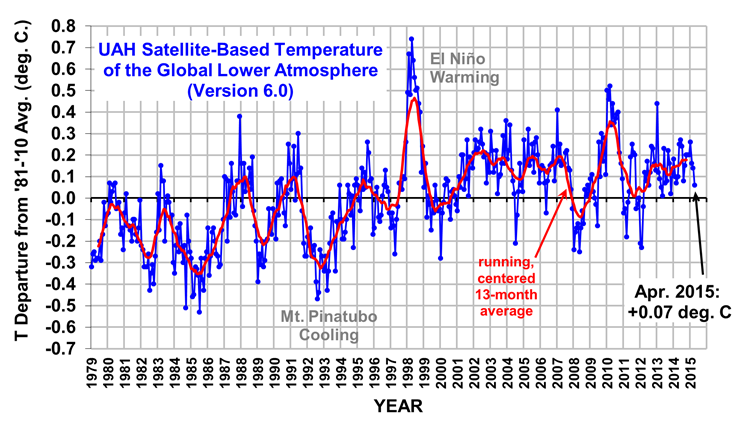
Atmospheric temperature measurements though April 2015

This article from Investors Business Daily. It talks about Obama’s plan to save the planet from global warming. The plan is called the “Clean Power Plan”.

Excerpt:

Unveiled in August, this sweeping regulation will force states to slash their carbon dioxide emissions by between 7% and 48%, potentially costing families and businesses some $366 billion in higher electricity costs over the next 15 years. Yet EPA-funded models show that it will have no detectable impact on climate, if it has any impact at all.

E&E Legal unearthed documents showing systemic collusion to promote this scheme. The coordination involves the White House, state governors and attorneys general, and a host of nongovernmental organizations affiliated with “major environmental donors” — especially billionaire Tom Steyer.

The campaign quietly began in December 2013, when the White House met with aides to Gov. Jerry Brown, D-Calif.; Gov. Jay Inslee, D-Wash.; and then-Gov. John Kitzhaber, D-Ore. (Kitzhaber has since resigned following revelations about his office’s unethical conduct while promoting green energy policies.)

They wanted to ensure that states governed by Republicans felt significant pressure to implement this dubious federal mandate. They even hoped to “compel” utility companies operating across blue and red state lines to bring Republicans around.

This plan required hiring so-called “orchestrators” in key states. These positions, underwritten by private benefactors, would be “closely tied to each governor.” Their ultimate goal was to organize state-based campaigns involving renewable-energy companies, nongovernmental organizations, state officeholders and more.

As the White House wrote at the time, “We’ve got a few other tracks with private sector and unusual allies.” They included an extended campaign to enlist public officeholders beyond coastal liberal enclaves — the “flyover states,” as one email called them. More than a dozen governors’ offices were brought on board. Some are particularly surprising.

For example, Kentucky’s governor is now on record publicly saying that the president’s plan would be economically “disastrous,” yet the documents show his office among the “core group” and one of five that “welcomed quiet engagement” but couldn’t “commit … publicly.”

Other states keeping their interest under wraps included Arkansas, Pennsylvania, Colorado and Tennessee.

Wow. If the global warming alarmists at the EPA don’t think that Obama’s plan will do anything to the climate, then why would we raise our own electricity rates to achieve nothing? What is most striking to me is some of the supposedly red states that are showing interest in this crap sandwich. Tennessee? Arkansas? Those two states have Republican governors. What is going on here?

Are the poor in America really poor?

Let's take a look at the data
Let’s take a look at the data

This article is from the Daily Signal.

Excerpt:

Today, the Census Bureau will release its annual poverty report. It will almost certainly report that over 40 million Americans “live in poverty.”

But what does it mean to be poor in America? To the average American, the word “poverty” suggests significant material deprivation. But the actual living conditions of those the government defines as poor differ greatly from this perception.

According to the government’s own reports, the typical American defined as poor by the Census Bureau has a car, air conditioning, and cable or satellite TV. Half of the poor have computers, 43 percent have Internet, and 40 percent have a wide-screen plasma or LCD TV.

Far from being overcrowded, poor Americans have more living space in their home than the average non-poor person in Western Europe. Some 42 percent of all poor households actually own their own homes; on average, this is a well-maintained three-bedroom house with one and a half baths, a garage, and a porch or patio.

According to the U.S. Department of Agriculture, only 4 percent of poor children were hungry for even a single day in the prior year because the family could not afford food. By its own report, the average poor person had sufficient funds to meet all essential needs and was able to obtain medical care for his family throughout the year whenever needed.

The left likes to claim that the U.S. has far more poverty than other advanced nations. But those claims are based on comparisons that set a higher standard for escaping poverty in the U.S. than elsewhere.

When a single uniform standard is used, the U.S. is shown to have poverty rates that are very similar to other advanced nations, slightly higher or lower depending on the exact measure used.

I think we definitely want to be careful about the outcry on the secular left about “poverty”. Their solution always seems to be that we need to move in the direction of socialism. And socialism means that the government gets bigger by taking money and liberty away from families, churches and businesses.

As a Christian, my goals are all gospel-centric. My interest in politics is because I want to live in a society that respects my right to work, earn and save, so that I can spend and give in a way that advances the gospel. My job is not to transfer my money to lazy people in their dependence on government. I go to work so that I can have the fuel I need to respect God in my decision-making. The secular government is interested in other goals – like getting elected. I don’t want them using my money for their goals. I have my own goals.

Darrell Bock and Eric Chabot discuss the challenges of campus ministry

A conflict of worldviews

My good friend Eric Chabot did an episode of the The Table podcast, which is the culture podcast of Dallas Theological Seminary. Eric does campus ministry at Ohio State University, one of the largest universities in the United States. He has a frontline view of the challenges that Christians face on campus, which is a battle I am so passionate about.

Here’s the podcast:

The MP3 file is here.

Summary:

  • 00:15  What does a typical RC meeting look like at Ohio State?
  • 02:44  Key social issues facing Ohio students
  • 05:30  How do you engage with the same-sex issue on campus?
  • 11:01  How do you engage with political issues on campus?
  • 13:08  How do you engage with social justice issues on campus?
  • 16:19  How would you describe the Christian environment on campus?
  • 18:33  Advice for parents considering Ohio State for their child

I give this podcast and the discussion my highest recommendation. It’s so practical, and so different from what you hear in church from pastors who seem to be totally unaware of how worldviews conflict on the university campus. This podcast is practical and hands-on.

There is also a transcript (PDF).

I just want to excerpt a few questions to get you interested enough to listen:

Dr. Darrell Bock:

Ok. Well, that’s the intellectual background. Let’s move on to the other questions I told you we were going to discuss. The social pressures of campus? This, and I’ve done a handful of these interviews, in fact I think you’re the 5th or 6th campus that we’ve done.

We’ve done UCLA, UC Irvine, California, San Diego, A&M and Princeton, and the interesting thing is that as we move from campus to campus and I go to social issues, that – those kind of are more varied than the intellectual stuff. The intellectual stuff seems to be pretty consistent from campus to campus.

But the social challenges really are a reflection of the environment of the campus itself and certain emphasis are tied to certain campuses. So, what are the social challenges that students face in terms of their walk at Ohio State?

And:

Dr. Darrell Bock:

Ok. Well, let’s turn our attention to the final two questions that I want to be sure and get through, and that is you’re giving advice – let’s start with parents – you’re giving advice to parents. They’re thinking about, you know, sending their kid to Ohio State.

What do you regard as the, as keys for the preparation of that student that a parent should be thinking about? Perhaps in particular, thinking about their junior and senior years, they’re getting ready to think about college and the way you prepare a student for college and the choices and the freedom that they’re gonna fall into. How do you, what advice would you give to parents?

And:

Dr. Darrell Bock:

Ok. This may seem like a related question, but I do think the demands are slightly different and that is what advice do you give to youth leaders and to pastors as they are preparing kids who are going through their church programs for university?
And here, I sorta have in mind what kinds of things would you hope a youth leader who’s dealing with high school students, what kinds of issues do you hope that they’re dealing with and treating so that the student is prepared for the campus experience?

That’s why I focus so much on same-sex marriage and politics on this blog. We really have to explain to young people why natural marriage is best, and why the free enterprise system is best. We are seeing now the challenge that the combination of same-sex marriage and big secular government (socialism) poses for religious liberty.