
Tag Archives: Police

Could tougher gun control laws lower the violent crime rate?

Let’s look at what happened after gun laws changed in Washington, D.C. and Chicago.

Excerpt:

Murder and violent crime rates were supposed to soar after the Supreme Court struck down gun control laws in Chicago and Washington, D.C.

Politicians predicted disaster. “More handguns in the District of Columbia will only lead to more handgun violence,” Washington’s Mayor Adrian Fenty warned the day the court made its decision.

Chicago’s Mayor Daley predicted that we would “go back to the Old West, you have a gun and I have a gun and we’ll settle it in the streets…”

The New York Times even editorialized this month about the Supreme Court’s “unwise” decision that there is a right for people “to keep guns in the home.”

But Armageddon never happened. Newly released data for Chicago shows that, as in Washington, murder and gun crime rates didn’t rise after the bans were eliminated — they plummeted. They have fallen much more than the national crime rate.

Not surprisingly, the national media have been completely silent about this news.

One can only imagine the coverage if crime rates had risen. In the first six months of this year, there were 14% fewer murders in Chicago compared to the first six months of last year – back when owning handguns was illegal. It was the largest drop in Chicago’s murder rate since the handgun ban went into effect in 1982.

Meanwhile, the other four most populous cities saw a total drop at the same time of only 6 percent.

Similarly, in the year after the 2008 “Heller” decision, the murder rate fell two-and-a-half times faster in Washington than in the rest of the country.

It also fell more than three as fast as in other cities that are close to Washington’s size. And murders in Washington have continued to fall.

If you compare the first six months of this year to the first six months of 2008, the same time immediately preceding the Supreme Court’s late June “Heller” decision, murders have now fallen by thirty-four percent.

Gun crimes also fell more than non-gun crimes.

Robberies with guns fell by 25%, while robberies without guns have fallen by eight percent. Assaults with guns fell by 37%, while assaults without guns fell by 12%.

Just as with right-to-carry laws, when law-abiding citizens have guns some criminals stop carrying theirs.

And it’s not just in big cities. MSNBC explains how legal gun ownership reduces crime.

Excerpt:

Americans overall are far less likely to be killed with a firearm than they were when it was much more difficult to obtain a concealed-weapons permit, according to statistics collected by the federal Centers for Disease Control. But researchers have not been able to establish a cause-and-effect relationship.

In the 1980s and ’90s, as the concealed-carry movement gained steam, Americans were killed by others with guns at the rate of about 5.66 per 100,000 population. In this decade, the rate has fallen to just over 4.07 per 100,000, a 28 percent drop. The decline follows a fivefold increase in the number of “shall-issue” and unrestricted concealed-carry states from 1986 to 2006.The highest gun homicide rate is in Washington, D.C., which has had the nation’s strictest gun-control laws for years and bans concealed carry: 20.50 deaths per 100,000 population, five times the general rate. The lowest rate, 1.12, is in Utah, which has such a liberal concealed weapons policy that most American adults can get a permit to carry a gun in Utah without even visiting the state.

The decline in gun homicides also comes as U.S. firearm sales are skyrocketing, according to federal background checks that are required for most gun sales. After holding stable at 8.5 to 9 million checks from 1999 to 2005, the FBI reported a surge to 10 million in 2006, 11 million in 2007, nearly 13 million in 2008 and more than 14 million last year, a 55 percent increase in just four years.

In fact, just this week a pregnant woman thwarted burglars who invaded her home by pumping a shotgun to load a shell. The noise alone was enough to scare them off.

If you ever need to debate this, I recommend buying these academic studies published by the University of Chicago Press and by Harvard University Press. The former shows how crime rates dropped in the USA when Americans rescinded gun control laws, and the latter shows how crime rates rose in the UK when the British strengthened their gun control laws. Sometimes is good to have the data handy.

Want both sides? Then watch a debate on gun control

This debate is in 13 parts, featuring the two of the best proponents of legal firearm ownership – John Lott and Gary Kleck. The real sparks fly during the Q&A, so don’t miss that. (If you can’t watch the debate, then you can read this post and this post instead).

Here’s part 1, which contains the introduction.

Here are the remaining speeches:

This is everything you need to know about whether legal ownership of firearms reduce crime.
Pregnant woman uses her shotgun to scare burglars out of her home

From CBS News. (H/T Wes from Reason to Stand)

Excerpt:

It’s the last thing two burglary suspects expected to hear when they broke into a Coon Rapids home. From within the house came the unmistakable sound of a pump shotgun. At the other end of that gun was a 22-year-old woman who is nine weeks pregnant.

The young woman asked not to be identified because the two suspects are still at large. However, she says when the men ignored her barking pit bull and black lab, and broke through a kitchen door, she had no other choice but to chamber a round into the 12-gauge shotgun.

There’s perhaps no other sound that commands as much respect and fear. The young woman at the business end of that gun was home alone and prepared to protect herself.

[…]With a single pump of her 12-gauge shotgun, the would-be burglars bolted out the door and through the backyard.

“Yes, a shotgun racking is something you don’t forget if you’ve ever heard one. So, it frightened these two suspects off right away, they took off running,” said Coon Rapids Police Captain John Hattstrom.

They ran across the backyard and into a nearby church parking lot where they were seen getting into a two-door, newer model automobile. But they didn’t escape without notice. The woman was able to get a long look at the two and provided police with a description.

The thing that liberals never understand about legally-owned firearms is that the people who own them are law-abiding people and they would prefer not to have to fire the weapon at all when they have to use the weapon to deter or halt a crime. This is known as peace through strength – the best way to stop an evil person from doing something evil is to raise the cost of doing evil. And weapons in the hands of law abiding people accomplishes that.

For those who would like to know what the Bible says about self-defense, check out this podcast featuring famous theologian Wayne Grudem.

The case for legal firearm ownership… in videos!

ABC News explains in this short 6-minute clip:

And here is a longer 44-minute show from Fox Business: (featuring a debate between economist John Lott and the Brady Campaign spokesman)

There are other debates in the show as well.

What is issue 2? Should you vote no on Ohio issue 2?

In the 2010 mid-term elections, Republican John Kasich won the governorship and promised to balance the state’s budget by reining in the state’s spending on salaries and benefits for public sector union employees. To accomplish this, the Ohio legislature pass Senate Bill 5. However, an effort is on the ballot to repeal the law, and Ohio voters will get a chance to keep or scrap the law on Tuesday, November 8th, 2011.

Here’s what Ohio’s State Issue 2 is all about:

Issue 2 makes some very fair and common sense requests of our government employees to give local communities the flexibility they need to get taxes and spending under control, while providing the essential services that we rely on.

  • It allows an employee’s job performance to be considered when determining compensation, rather than just awarding automatic pay increases based only on an employee’s length of service.
  • It asks that government employees pay at least 15 percent of the cost of their health insurance premium. That’s less than half of what private sector workers are currently paying.
  • It requires that government health care benefits apply equally to all government employees, whether they work in management or non-management positions. No special favors.
  • It asks our government employees to pay their own share of a generous pension contribution, rather than forcing taxpayers to pay both the employee and employer shares.
  • It keeps union bosses from protecting bad teachers and stops the outdated practice of laying off good teachers first just because they haven’t served long enough.
  • Finally, it preserves collective bargaining for government employees, but it also returns some basic control of our schools and services to the taxpayers who fund them, not the union bosses who thrive on their mismanagement.

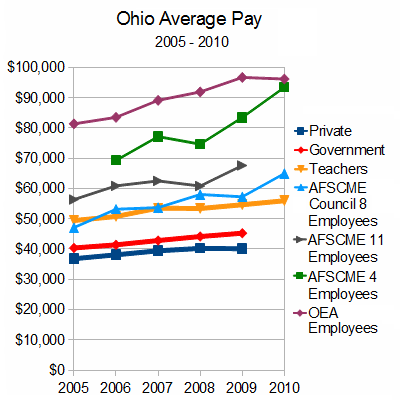
Even under the reforms of State Issue 2, Ohio’s government employees will still receive better pay, better health care and better retirement benefits, on average, than the vast majority of Ohioans who work in the private sector.

There are a number of myths going around about Issue 2, and it’s important to set the record straight, so I’ll do that below.

Ohio Average Pay: Public vs. Private
Ohio Average Pay: Public Unions vs. Private

Myths and truths about Ohio State Issue 2

Here’s a common myth:

State Issue 2 would “cut salaries and benefits.”

The truth:

Issue 2 would not cut salaries or benefits for any government employee. Employees would simply be asked to pay a modest share of their benefits, just like employees in the private sector do. For health care coverage, they would pay at least 15% of their overall plan. (Many local government employees currently pay less than 9% of their health care premium, while the average private sector worker pays upwards of 30%.) In addition, employees would be required to pay their personal share of a retirement plan (only 10%), rather than asking taxpayers to pay that share. That’s not too much to ask at a time when many private sector workers get no retirement benefit at all. Finally, Issue 2 requires that benefits apply equally to all public employees, so no one gets special treatment.

And another common myth:

State Issue 2 will eliminate government employee pensions.

The truth:

Government employees will still get a very generous pension benefit – an annual payment that averages their three highest annual salaries. That’s a pretty nice deal, when many private sector workers get no retirement benefit at all. State Issue 2 only ends a practice where some government union contracts require taxpayers to pick up the tab for BOTH the employer AND employee shares of a required pension contribution. In this economy, it’s simply not right to ask struggling taxpayers to foot the bill so government employees can get a free retirement. Issue 2 simply says government employees should pay their required share (10 percent) and taxpayers will contribute the employer share (14 percent).

Another myth:

State Issue 2 will cut teacher salaries.

The truth:

That’s one of the scare tactics government unions are using to turn people against these reforms. Nothing in Issue 2 determines salary levels. It only ends the practice of handing out automatic pay raises, or “step” increases, and longevity pay – or bonuses just for holding the job for a certain period of time. Issue 2 also asks that performance be added as a factor in teacher compensation, a goal President Barack Obama set out in his national education policy in 2009.

And another myth:

State Issue 2 will cost jobs

The truth:

Just the opposite is true. Ohio’s state and local tax burden ranks among the top third in the nation. As a result, companies large and small have left our state in pursuit of better tax incentives elsewhere, taking hundreds of thousands of jobs with them. If Ohio hopes to compete for new job growth, we have to make our state a more affordable place to live, work and do business. That starts with getting the cost of government under control so we can direct more of our limited resources into economic development, community revitalization and better schools.

More myths about Ohio State Issue 2 are corrected on this page.

Newspaper endorsements

So far, Issue 2 has been endorsed by several Ohio newspapers, including the biggest ones.

The Cleveland Plain Dealer:

The fiscal picture of local governments and school districts, especially, will improve as they are able to right-size their work forces and their expenditures on services. That will happen over time, not overnight, as new contracts are established.

Repeal SB 5, though, and it’s going to be awfully hard for local governments to manage their payrolls without resorting to larger-scale layoffs than would otherwise be necessary. And local governments will continue to be hamstrung by anti-merit seniority rules that lead to worker complacency and protect dead weight and time-servers.

Voting YES on Issue 2 will prevent layoffs by keeping public sector wages and benefits in line with what the private sector can afford to pay.

The Columbus Dispatch:

Despite the insistence of opponents, the effort to reform Ohio’s out-of-balance collective-bargaining law is not an expression of disrespect for or dissatisfaction with Ohio teachers, police officers, firefighters and other government employees. It is a much-needed attempt to restore control over public spending to the public officials elected to exercise that control.

It does not assert that public employees are worth less than the compensation they’re receiving, only that the compensation has grown faster than the public’s ability to pay for it.

[…]With more ability to control the escalation of salary and benefit costs, governments won’t be forced as often to impose layoffs, and might be able to afford to keep even more police and firefighters on the streets.

Again, no one is saying that public sector workers don’t matter – the question is whether we can afford to give them better wages and benefits than the private sector workers who are their customers and their employers. Public sector workers work for the public, and the public can only afford to pay so much.

Conclusion

Government employees are paid 43% more than private sector employees, in salary and benefits:

I think that people who care about the long-term prosperity of Ohio should vote “YES” on Issue 2 to make public and private salaries and benefits MORE EQUAL. Ohio is facing enormous economic pressure from the global recession, and everyone has to make sacrifices. Now is not the time for public sector workers to insist on higher wages and benefits, especially when the private sector workers who pay their salaries don’t make as much money, nor do they get the pensions, nor do they get the better job security. Ohio voters can certainly go back and renegotiate union salaries and benefits when Ohio is out of the recession.

Click here to learn more about Ohio State Issue 2.