
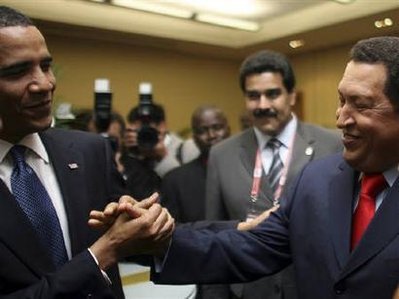
From Reason magazine. (H/T Ian L.)
Excerpt: (links removed)
Hugo Chávez’ presidency has been a disaster for the Venezuelan people. Chávez’ “Socialism of the 21st Century” changed Venezuela from one of the most prosperous and politically free countries in Latin America to one of the least competitive and most repressive countries worldwide. Venezuelans who go to the polls today will ponder many of the President’s policy failures, including a long list of Chávez’nblunders in the last year alone.
Under Chávez’ rule, oil-rich Venezuela has become one of the least economically competitive countries in the world. In 2012, the country ranked 126 of 144 in a study by the World Economic Forum. According to the report, Venezuela now has some of the lowest scores worldwide in functioning of public institutions, trust in the justice system and domestic competition. It has some of the highest scores in terms of regulation, trade tariffs, and rules that deter foreign investment. The country has an inflation rate of 26 percent, and has also suffered several food shortages this year.
Venezuelan infrastructure has been falling apart under Chávez. On August 15th, the Cupira bridge near Caracas collapseddespite repeated warnings from engineers that it was in disrepair. Last month, poor drainage infrastructure led to nationwide flooding, resulting in over 400 families losing their homes and 1,500 people ending up in shelters. Chávez also mismanages Venezuela’s oil wealth. Since the government effectively took control of the national oil company in 2004, it has become much less efficient and production is 25 percent lower than when Chávez took office. Accidents are common—an offshore oil rig sank into the sea in 2010 and an oil refinery explosion in August killed at least 48 people. Despite sitting atop the world’s largest proven oil reserves, Venezuela nowimports and rations gasoline.
According to USA Today, Venezuela has the fourth highest murder rate in the world and is now the most violent South American country. Between the time Chávez took power in 1998 and 2012, kidnappings have risen from a few hundred annually to a record of 16,000 in 2011. Homicide rates have nearly tripled and suspect arrests have fallen by 61 percent. Only eight in every 100 murder investigations lead to an arrest. Murder of police officers has risen by 45 percent in the last year alone. Violence is much worse for Venezuela’s inmates despite Chávez’ campaign promises of prison reform. A prison riot on August 24 left 26 people dead and 43 injured after inmates took over the compound and held it for four hours. Venezuelans are 20 times more likely to be killed in penitentiaries than outside of them. More than three hundred people have died and 572 have been injured in Venezuelan prisons this year alone.
Venezuelans have also witnessed alarming revocations of political liberties during Chávez’ presidency. On September 10th, Chávez decided to withdraw from the Inter-American Court of Human Rights. He regularly targets media who expose his failures. He recently arrested two journalists for writing a satirical article about his leadership. In addition, he demanded the names of voters who participated in the opposition’s primary election last February, just as he did to those who unsuccessfully voted to remove him from office in 2004. Chávez has banned foreign funding for civil society watch dogs, which will make electoral transparency in upcoming elections difficult.
UPDATE: Reformed Seth sent me this article from Human Rights Watch as well.
Excerpt:
Hugo Chávez’s presidency (1999-2013) was characterized by a dramatic concentration of power and open disregard for basic human rights guarantees.
After enacting a new constitution with ample human rights protections in 1999 – and surviving a short-lived coup d’état in 2002 – Chávez and his followers moved to concentrate power. They seized control of the Supreme Court and undercut the ability of journalists, human rights defenders, and other Venezuelans to exercise fundamental rights.
By his second full term in office, the concentration of power and erosion of human rights protections had given the government free rein to intimidate, censor, and prosecute Venezuelans who criticized the president or thwarted his political agenda. In recent years, the president and his followers used these powers in a wide range of prominent cases, whose damaging impact was felt by entire sectors of Venezuelan society.
Many Venezuelans continued to criticize the government. But the prospect of reprisals – in the form of arbitrary or abusive state action – forced journalists and human rights defenders to weigh the consequences of disseminating information and opinions critical of the government, and undercut the ability of judges to adjudicate politically sensitive cases.
[…]Chávez also rejected international efforts to promote human rights in other countries. In recent years, Venezuela consistently voted against UN General Assembly resolutions condemning abusive practices in North Korea, Burma, Iran, and Syria. Moreover, Chávez was a vocal supporter of Syria’s Bashar al-Assad, Libya’s Muammar Gaddafi, and Iran’s Mahmoud Ahmadinejad, bestowing upon each of these leaders the “Order of the Liberator,” Venezuela’s highest official honor.
Under Chávez, Venezuela’s closest ally was Cuba, the only country in Latin America that systematically represses virtually all forms of political dissent. Chávez identified Fidel Castro – who headed Cuba’s repressive government until his health deteriorated in 2006 – as his model and mentor.
That’s the dream of people on the left like Sean Penn. They love the idea of doing away with liberty and human rights. They want to force their secular leftist ideology on everyone at gunpoint.
Everyone who is praising this communist dictator today should be ashamed. None of them would move out of the United States to live in Venezuela – it’s nothing but hypocrisy.
Related posts
- What causes Colombia’s economy to grow? What causes Venezuela’s economy to shrink?
- Socialist government of Venezuela announces devaluation of their currency
- Obama’s buddy Chavez nationalizes an American company
- Venezuela legislature votes to nationalize 11 US-owned oil rigs
- 80,000 tons of food rotting in Venezuela government warehouse
- Hugo Chavez confiscates private property as Venezuelan economy declines
- Owner of the last anti-Chavez TV station arrested in communist Venezuela
- OAS report details violence and lost freedoms in communist Venezuela
- Photos from the revolution against communism in Venezuela
- Venezuelans riot as communist Hugo Chavez seizes control of TV channel
- Hugo Chavez says that Haiti earthquake was caused by secret US weapon
- Chavez marches Venezuela down the road to serfdom at gunpoint
- Communist Venezuela introduces energy rationing in 2010
- Hugo Chavez shuts down 34 radio and TV stations in Venezuela
- Venezuela nationalizes Spanish-owned bank
- Obama restores diplomatic ties with Venezuela and Syria
 WINTERY KNIGHT