Tag Archives: Philosophy of Religion

Michael Murray explains how to talk about religion in public

In this post, I want to discuss a research paper by evangelical Christian philosopher Michael J. Murray. The title of the paper is “Who’s Afraid of Religion?”

Murray begins with a distinction, as philosophers love to do:

…we would be perfectly happy to have a discussion of claims like…”Mahayana Buddhism emerged in the first century BCE with the appearance of the Mahayana sutras.” … It is OK to speak of religion… as a historical phenomenon or a socio-cultural influence. It is something altogether different to discuss religious commitments that one owns. That is the sort of religion that troubles us.

People who aren’t religious feel discomfort about hearing about the religious beliefs of others, because those beliefs influence public policy, but (they think) those beliefs are based non-rational factors, such as place of birth, parental beliefs, peer groups, emotions, prejudices, superstitions, etc. They are uncomfortable living in a government that was voted in by people whose views are based on irrational religious beliefs.

Murray has some illustrations of this “theo-phobia” here:

…think about the last time you heard a devoutly religious person argue, on explicitly religious grounds, that gay marriage should be banned, or that intelligent design should be taught in the public school biology curriculum, or that abortion is murder and thus should be outlawed.

He thinks that arguing for views on pureliy religious grounds makes people uncomfortable.

And I agree with that. I feel uncomfortable when people argue for positions from faith-based premises, especially if I don’t believe in their religion. But do discussions of religious beliefs necessarily have to be about faith-based personal preferences? Or is there another way to discuss religion that doesn’t make non-religious people squirm with discomfort?

In the remainder of the paper, Murray explores five reasons why theo-phobia exists in academic settings:

  1. Religion supports oppression, violence, and tyranny and is thus best ignored, excluded or perhaps even actively opposed.
  2. Religion is a personal or subjective matter and as a result can’t be subjected to canonical standards of rational scrutiny. It thus has no place in the academy.
  3. Religion can’t have a role in scholarly inquiry since it at best plays a balkanizing role in the scholarly world.
  4. If religion is allowed to have a role in the academy it will quickly intrude into domains where it does not belong.
  5. Reason #5 is kept secret until the end of the paper.

Regarding point 1, Murray argues that religious excesses can be controlled by falsifying the religion using reason and evidence, because religions make testable claims. So, if academics are afraid of the excesses of a dangerous religion, they should falsify it by arguing that its claims are false. There is no reason to be afraid of expressions of religious belief when you are free to argue against the testable truth claims of that religion.

I repeat: different religions make different claims about the external world. Either the universe had a beginning (Christianity) or it didn’t (Mormonism). Either Jesus died on the cross (Christianity) or he didn’t (Islam). If academics are worried about the effects of some religion, they can argue against it! If a religious person is not willing to defend the testable truth claims, then they are discredited anyway by refusing to engage.

For the remaining 4 points, especially the last one, I recommend you read the whole article. Give it to your friends, religious and non-religious, who believe that faith is fundamentally different from other academic disciplines. Some truth claims of different religions can be tested. And Christians especially should help others to feel comfortable talking to them by sticking to testable truth claims and publicly accessible evidence.

I’ll give you a hint about reason #5, from atheist philosopher Thomas Nagel of New York University. Nagel is quoted as follows:

“In speaking of the fear of religion, I don’t mean to refer to the entirely reasonable hostility toward certain established religions and religious institutions, in virtue of their objectionable moral doctrines, social policies, and political influence. Nor am I referring to the association of many religious beliefs with superstition and the acceptance of evident empirical falsehoods. I am talking about something much deeper–namely, the fear of religion itself. I speak from experience, being strongly subject to this fear myself: I want atheism to be true and am made uneasy by the fact that some of the most intelligent and well-informed people I know are religious believers.
(“The Last Word” by Thomas Nagel, Oxford University Press: 1997)

So we learn from Murray that religions stand or fall based on logical consistency and empirical validation against the external world, just like any other academic discipline. So long as you stick to discussing the public, testable claims of religions, there is no reason to be uncomfortable about discussing religions. Don’t discuss the parts of a religion that can’t be tested, only discuss the parts that can be tested.

(Note: Nagel isn’t all bad, he defends intelligent design as science in a research paper summarized here).

If you would like to see how you can discuss religion in a public forum, check out this debate between a Christian philosopher, William Lane Craig, and an atheist Christopher Hitchens:

It can be done.

Positive arguments for Christian theism

Frank Turek: can God bring good effects out of evil events?

From Townhall.com.

Excerpt:

The atheist persisted, “But if God exists, why do some babies die such horrible deaths?”

Well, if the atheist is granting that God exists, then he has a valid question. While he can’t explain evil and suffering from his atheistic worldview, I need to explain it from mine.

My explanation went this way. Although I know why evil in general occurs (see the video), I don’t know why every specific evil occurs. But I know why I don’t know why—because I’m finite and can’t see into the future. Since God is infinite and can see all the way into eternity, he may allow evil events that ultimately work together for good. In other words, he can still bring good from evil even if we can’t see how.

To illustrate, I referred back to the classic Christmas movie “It’s a Wonderful Life.” That’s where George Bailey, played by Jimmy Stewart, falls on hard times, becomes despondent and tries to commit suicide. He’s saved by an angel and is permitted to see how life in his town would have turned out if he had never existed. George sees that everything would have turned out far worse without him, and thus realizes that even though evil infects life, good can prevail in the end. George could only see this with God’s timeless perspective. Only God can see how trillions of free choices and events can interact ultimately for good even if some of them seem hopelessly negative at the time. (In fact, that’s one reason why God told Job to trust him.)

At that point, a man sitting ten feet from the atheist raised his hand.

“Go ahead, sir.”

He first looked over at the atheist, then back at me and said, “I know of a young woman who was raped and became pregnant. The rape nearly destroyed her.” His voice began to crack . . . “But she decided that she would not punish the baby for the sin of the father. She later gave birth to a baby boy.” (By this point he was weeping openly.) “And that boy grew up to be a pastor whom God has used to help bring many people to Christ. He ministers to people to this day. That boy grew up to be me.”

He then looked back at the atheist and said, “My mother turned evil into good, and God can too.”

The atheist left immediately after the event ended, but I did get to meet that brave pastor who spoke up. His name is Gary Bingham, and he’s the pastor of Hillside Wesleyan Church in Marion, Indiana. Gary told me that his mom had self-confidence issues for many years but is doing much better since becoming a Christian a few years ago. I thanked him and asked him to let his mom know that she touched many for good that night. I hope through this column she has touched many more today.

Sometimes a good witness can help to illustrate a good argument. If you would like to hear a good debate on the problems of evil and suffering, then click here: William Lane Craig vs Walter Sinnott-Armstrong.For a book length treatment of the problems of evil and suffering, see the book “God?: A Debate between a Christian and an Atheist“, published by Oxford University Press, 2003. This is part of their famous Point/Counterpoint series, where you get both sides of controversial issues from top scholars. Oxford University Press is the top academic press in the world, so this is a good book to have.

If you would like to learn more about the problems of evil and suffering, see the related posts below. The first link in the list tells you everything you need to know to get started.

Related posts

Angus Menuge explains the ontological argument from reason

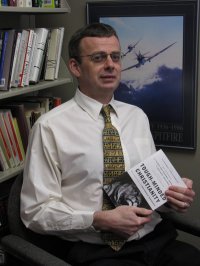
Dr. Angus Menuge
Dr. Angus Menuge

Here’s some information about Dr. Menuge:

Dr. Angus Menuge joined Concordia University Wisconsin in 1991. He earned his BA from the University of Warwick, England, and his MA and Ph.D. degrees from the University of Wisconsin-Madison, where he studied philosophy, computer science and psychology. Menuge’s dissertation was on the philosophy of action explanation, and his current research interests include philosophy of mind, philosophy of science and Christian apologetics.

In 2003, Menuge earned a Diploma in Christian Apologetics from the International Academy of Apologetics, Evangelism and Human Rights, which meets each July in Strasbourg, France. His thesis, a critique of scientific materialism, went on to become the book Agents Under Fire: Materialism and the Rationality of Science (Lanham, MD: Rowman and Littlefield, 2004).

Menuge has also edited volumes on C. S. Lewis, Christ and culture and the vocation of scientist, and has written several Bible studies. He is currently working with Joel Heck (Concordia Texas) on a collection of essays defining Lutheran education for the 21st century, entitled Learning at the Foot of the Cross (Concordia University Press, forthcoming).

A frequent speaker, Menuge has given presentations on Christianity and culture, science and vocation, philosophy of mind, C. S. Lewis, Intelligent Design and the case against scientific materialism. He is a member of the Evangelical Philosophical Society.

Dr. Menuge presented a paper at the real Evangelical Philosophical Society conference for students and professors of philosophy, and you can download the paper here in Word format. (here’s a PDF version I made)

Here is the introduction to the paper that Dr. Menuge read at the EPS conference:

The argument from reason is really a family of arguments to show that reasoning is incompatible with naturalism. Here, naturalism is understood as the idea that foundationally, there are only physical objects, properties and relations, and anything else reduces to, supervenes on, or emerges from that. For our purposes, one of the most important claims of naturalism is that all causation is passive, automatic, event causation (an earthquake automatically causes a tidal wave; the tidal wave responds passively): there are no agent causes, where something does not happen automatically but only because the agent exerts his active power by choosing to do it. The most famous version of the argument from reason is epistemological: if naturalism were true, we could not be justified in believing it. Today, I want to focus on the ontological argument from reason, which asserts that there cannot be reasoning in a naturalistic world, because reasoning requires libertarian free will, and this in turn requires a unified, enduring self with active power.

The two most promising ways out of this argument are: (1) Compatibilism—even in a deterministic, naturalistic world, humans are capable of free acts of reason if their minds are responsive to rational causes; (2) Libertarian Naturalism—a self with libertarian free will emerges from the brain. I argue that neither of these moves works, and so, unless someone has a better idea, the ontological argument from reason stands.

The paper is 11 pages long, and it is awesome for those of you looking for some good discussion of one of the issues in the area of philosophy of mind. The thing you need to know about Dr. Menuge is that he is quite strong and forceful in his writing and presentation, and to me, that is an excellent thing for a scholar to be. He reminds me of Doug Geivett, Paul Copan and William Lane Craig. Very direct, and very confrontational. You can even read an account of his debate with that radical atheist nutcase P.Z. Myers in 2008 here.

By the way, the epistemological argument from reason (P(R) on N & E is low) is the argument made by the famous Christian philosopher Alvin Plantinga. I blogged about that argument before here. You need to know BOTH of these arguments. Plantinga also spoke at the EPS apologetics conference, explaining exactly this argument.

Powerpoint slideshow

But there is more than just the paper! At the EPS apologetics conference, which is meant for lay people as well as scholars, he presented this Powerpoint slideshow, (here’s a PDF version I made) . The slides are easier to understand than the paper, but the paper is not too bad.

And here is another article by Dr. Menuge on intelligent design.