One of the most left-wing places in the country is Washington, D.C. – which votes 90% Democrat.
How good are schools run by Democrats?
Only 14 percent of Washington’s fourth-graders score at or above proficiency in the reading and math portions of the National Assessment of Educational Progress (NAEP) test. Their national rank of 51 makes them the nation’s worst. Eighth-graders are even further behind with only 12 percent scoring at or above proficiency in reading and 8 percent in math and again the worst performance in the nation. One shouldn’t be surprised by Washington student performance on college admissions tests. They have an average composite SAT score of 925 and ACT score of 19.1, compared to the national average respectively of 1017 and 21.1. In terms of national ranking, their SAT and ACT rankings are identical to their fourth- and eighth-grade rankings — dead last.
And how expensive are schools run by Democrats?
During the 2006-07 academic year, expenditures per pupil averaged $13,848 compared to a national average of $9,389. That made Washington’s per pupil expenditures the third highest in the nation coming in behind New Jersey ($14,998) and New York ($14,747). Washington’s teacher-student ratio is 13.9 compared with the national average of 15.3 students per teacher, ranking 18th in the nation. What about teacher salaries? Washington’s teachers are the highest paid in the nation, having an average annual salary of $61,195 compared with the nation’s average $46,593.
Public schools cost too much and perform too little.
Consumer choice guided by transparency. We need a system where individuals choose an integrated plan that adopts the best disease-management practices, as opposed to fragmented care. Pricing and outcomes data for all tests, treatments and procedures should be posted on the Internet. Portable electronic health-care records can reduce paperwork, duplication and errors, while also empowering consumers to seek the provider that best meets their needs.
Aligned consumer interests. Consumers should be financially invested in better health decisions through health-savings accounts, lower premiums and reduced cost sharing. If they seek care in cost-effective settings, comply with medical regimens, preventative care, and lifestyles that reduce the likelihood of chronic disease, they should share in the savings.
Medical lawsuit reform. The practice of defensive medicine costs an estimated $100 billion-plus each year, according to the American Academy of Orthopaedic Surgeons, which used a study by economists Daniel P. Kessler and Mark B. McClellan. No health reform is serious about reducing costs unless it reduces the costs of frivolous lawsuits.
Insurance reform. Congress should establish simple guidelines to make policies more portable, with more coverage for pre-existing conditions. Reinsurance, high-risk pools, and other mechanisms can reduce the dangers of adverse risk selection and the incentive to avoid covering the sick. Individuals should also be able to keep insurance as they change jobs or states.
Pooling for small businesses, the self-employed, and others. All consumers should have equal opportunity to buy the lowest-cost, highest-quality insurance available. Individuals should benefit from the economies of scale currently available to those working for large employers. They should be free to purchase their health coverage without tax penalty through their employer, church, union, etc.
Pay for performance, not activity. Roughly 75% of health-care spending is for the care of chronic conditions such as heart disease, cancer and diabetes—and there is little coordination of this care. We can save money and improve outcomes by using integrated networks of care with rigorous, transparent outcome measures emphasizing prevention and disease management.
Refundable tax credits. Low-income working Americans without health insurance should get help in buying private coverage through a refundable tax credit. This is preferable to building a separate, government-run health-care plan.
These are conservative solutions – they will preserve out liberty and prosperity.
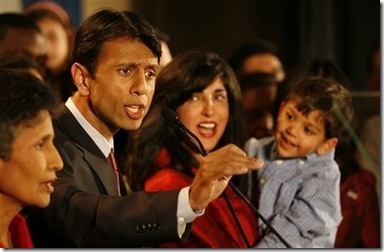
Bobby Jindal is my pick for Secretary of Health and Human Services in 2012, if he isn’t elected President. So remember his name!
Commenter ECM alerted me to Cornelius Hunter’s new blog “Darwin’s God”. Cornelius is a software engineer like me who rose up the ranks of the firm through “sweat equity”, and was able to eventually pursue a PhD in Biophysics from the University of Illinois. I have his first book “Darwin’s God” and I read it. His thesis is basically that theological beliefs about what God would and would not do are the driving force behind evolution.
Alexander is a theist and Jones an atheist. But they both agree that God would not have created what we find in this world. Everything from programmed cell death to the extinction of so many species and the food chain points to a massive economy of death in nature. With this sort of evidence, “What kind of a designer,” asks Alexander, “are you going to end up believing in?
…According to Alexander, this problem of death and evil does not leave much room for a divine creator. Alexander concludes that God did not create the details of the world. He is thus absolved of the world’s many evils. He implemented a framework of sorts, but let unguided processes do the rest.
And here’s what the atheist evolutionist said:
As with Alexander, Jones also finds that biology does not meet with his expectations of divine creation. “The feeblest of designer,” Jones has written, could improve the design of the human eye. This and other examples, says Jones, shows that complex organs are “not the work of some great composer but of an insensible drudge: an instrument, like all others, built by a tinkerer [i.e., the evolutionary process] rather than by a trained engineer.” As with Alexander, Jones’ religious sentiment mandates some sort of evolution to be true.
So let’s think about what causes people to become evolutionists, beyond the normal answers of peer-pressure, career preservation, wanting to be thought of as smart, wanting to rebel against parents, wanting to have sex and drink alcohol, etc. Is it about science? No. It’s about knowing what God would do and observing that the world does not correspond to these ideas of what atheists think God would do.
Remember that post I wrote a while back about Christopher Hitchens’ case against God. None of his arguments against God were based on evidence, but only on his personal preferences. God wouldn’t have done it that way. God should have done it this way. I don’t like this theology. I don’t like that feature of the universe. It’s just a long-running temper tantrum against any kind of authority, regardless of the evidence.
Here’s Dawkins explaining how unobservable aliens must ave evolved, even if Dawkins doesn’t have any evidence:
He doesn’t even need to see the evidence that we evolved. He knows that God wouldn’t have created the life this way, and so the evidence is irrelevant.
Evolution and the problem of sub-optimal design
Another way that assume that evolution is true, other than childhood trauma and the desire to be morally evil, is by assuming that if material forces did not do the creating, then the design must be optimal. Now I am a software engineer, with undergraduate and graduate degrees, a published paper that I presented at the IEEE and a patent in wireless technology. My specialty is architecture. So I will tell you.
There is no such thing as an optimal design.
As part of my graduate course work, I had to study the work done at the Software Engineering Institute at the Carnegie-Mellon University. They have invented an entire methodology for designing software based on analyzing trade-offs between alternative architectural candidates. They use use case scenarios, disaster scenarios, maintenance scenarios and other scenarios in order to evaluate how well each architecture performs.
All of the architectures can satisfy the so-called “functional requirements”. But the architectures differ in their ability to satisfy non-functional requirements, the “-ilities”. These can include performance, maintainability, security, extensibility, testability, simplicity, re-usability. This is the bread and butter that software engineers like me have to deal with every day.
It is simply impossible for one architecture to have all the “ilities” because many conflict. For instance, if I want high “security” I am going to have to give up a good deal of “interoperability”. A large part of architecture is actually deciding what you are going to give up, which incidentally affects how the architecture can change in the future (i.e. usually it cannot “evolve” to conform to different “ilities”). This is all still fairly new, but we are now able to judge architectures in terms of the “ilities” they match and the “ilities” they do not match. A better understanding of the conflicts between certain “ilities” is gradually developing.
When I worked in the embedded space on operating systems like VxWorks, we regularly traded-off memory against speed. It’s the nature of the engineering business. And make no mistake – God is a software engineer. He writes code.
Conclusion
Hunter’s article concludes with this:
Have the theists sold out? Have the theists been duped? Are they afraid to stand up for themselves? Are the atheists taking over? No, no, no, and no. The theists and atheists are united in their religious beliefs about God and how he would interact with the world. They may have their differences, but regarding evolution those differences are irrelevant. Their shared religious convictions mandate evolution. Religion drives science and it matters.
I have an idea. Let’s keep religion out of science and decide how we really got here, no holds barred. Instead of blocking debates and persecuting dissent, let’s actually have a debate about origins, and not rule intelligent causes out before we look at the evidence.

 WINTERY KNIGHT