Let’s take a look at the UK economy after over a decade of rule by the socialist Labor party.
Here’s an article from the UK Telegraph about the pensions of unionized public sector workers.
Excerpt:
It is estimated that, on average, private sector workers would need to put 37pc of their salary into their pension to match the retirement income paid to a public sector worker on a similar wage, if you believe a report by accountants PricewaterhouseCoopers.
Even public sector workers on modest final salary schemes might be surprised to learn how much they would need to save if they were in the private sector.
To get the average civil service pension of £5,928 a year you would need a pension pot of £189,151. The average NHS pension of £6,931 is equivalent to a pension pot of £221,155 and the average teachers’ pension of £9,358 is equivalent to a pot of £298,596, according to Hargreaves Lansdown, the financial adviser.
[…]The figures showed that average total pay, including bonuses, in the private sector in February was £451 a week. Excluding bonuses it was £418 a week. In the public sector the corresponding figures were £462 a week and £459 a week. Public sector pay, on average, is also rising at twice the rate of private sector wages.
Government workers have pensions and salaries that are higher than in the private sector, and those costs have to be paid by private sector workers who actually generate revenue and pay taxes. Public sector employees don’t actually have to do any work for the most part, (excluding things like military, etc.). People only work when they have customers to please, who can choose them or choose a competitor. Government has no competitors, and so they really don’t need to work hard to please a customer.
Another UK Telegraph article explains who pays for public sector union pensions.
Excerpt:
By 2015, almost £10 billion of public money will be spent every year supporting the retirement of millions of public sector employees – up from £4 billion this year, the independent body said.
[…]In 2010-11, the amount spent by the taxpayer on public sector pensions will be £4 billion, rising to £5.5 billion the following year, the report said.
The cost will then rise, on average, by 20 per cent each year until the commitment reaches £9.4 billion in 2014-15. This equates to almost £400 for each of Britain’s 26 million households. The sharp increase, according to the Treasury, is a result of Britain’s ageing population.
[…]There are more than two million public sector workers receiving pensions from “unfunded” schemes.
The schemes are heavily supported by the taxpayer, with employees generally contributing less than their counterparts in the private sector.
And another UK Telegraph article explains how taxes on the productive private sector will have to rise to pay for the pensions.
Here’s one of several proposed tax increases:
We already know that [the capital gains tax] is due to increase, said Grant Thornton, although we don’t know what new rate or rates will be. “We do know that it will be more in line with income tax, so it could go up to 40pc, but the option of taxing up to the highest rate of 50pc has not been ruled out,” the firm said, adding that the measure was “likely to go down like a lead balloon” with investors with share portfolios and anyone with a second home.
Any raise to the capital gains tax is a direct assault on capital investment, and will damage the economy more than raising consumption taxes. The worst thing that you can do in a recession is to punish investors and private businesses. You end up losing jobs, which decreases your tax revenue even more.
And they are going to raise consumption taxes:
The Chancellor may face an “irresistible temptation” to increase the rate of VAT to 20pc now that he has had the opportunity to review the country’s books, said Grant Thornton. The standard rate of 17.5pc is relatively low relative to other EU countries and many economists predict a rise to 20pc, which would cost someone on average earnings about £150 a year.
That one will hit the poor as well as the rich.
And one last UK Telegraph article to explain how the recession has hurt men most.
Excerpt:
Malcolm Hurlston, chairman of the [Consumer Credit Counselling Service], said: “Men have been hard hit by the recession and are emerging as the new underclass. Debt alone is no longer the problem. It is loss of income and other rising costs.
“This deterioration in the economic circumstances for men, still the main breadwinner in most homes, has serious implications for many households.”
The charity said it had seen the number of men contacting it for help soar from 146,00 in 2007 to 221,000 last year, a 51pc jump.
It added that the number of women seeking help had increased by only half this amount over the period, although women were still more likely to contact it than men, accounting for 52pc of its caseload.
Men who contacted the charity during 2009 owed an average of £26,957, down from nearly £30,000 in 2008, but still significantly higher than the £21,915 that women typically owed.
The main reason men gave for getting into debt was a fall in their income, with this cited by 26pc, while 23pc said they had become unemployed or been made redundant. A further 20pc of men blamed their situation on overcommitting themselves on credit.
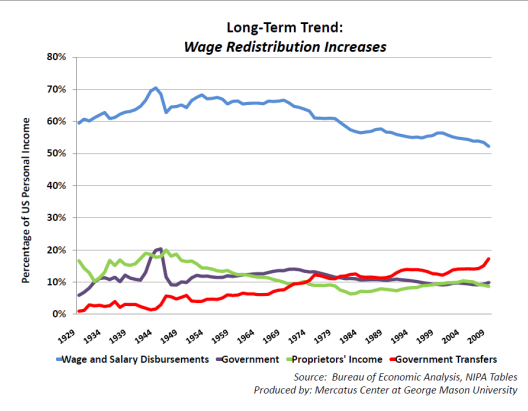
When one group of people vote themselves higher benefits without any additional productivity, some other group is going to be taxed to pay for it. And higher taxes lower incomes and produce unemployment. The UK is replacing working men with big government dependency.
Be effective and influential:


 WINTERY KNIGHT