Tag Archives: Outsourcing

How are big companies responding to Obamacare?

Caterpillar and John Deere. (H/T Hot Air via ECM)

Excerpt:

Caterpillar Inc. said Wednesday it will take a $100 million charge to earnings this quarter to reflect additional taxes stemming from newly enacted U.S. health-care legislation.

[…]The charge is expected to be a one-time cost, but Caterpillar has argued that higher taxes and other potential cost increases related to insurance coverage mandates in the legislation will hinder the company’s recovery this year after a 75% plunge in income during 2009.

“From our point of view, a tax increase like this cannot come at a worse time,” said Jim Dugan, a Caterpillar spokesman.

[…]Farm equipment maker Deere expects after-tax expenses to rise by $150 million this year as a result of the health care reform law President Barack Obama signed this week.

Most of the higher expense will come in Deere’s second quarter, the company said on Thursday. The expense was not included in the company’s earlier 2010 forecast, which called for net income of about $1.3 billion.

The law could raise expenses for large U.S. employers. Industrial companies, which typically have large numbers of retirees, may be among those facing the biggest bill. Caterpillar had argued before the legislation passed that health reform would put it at a disadvantage against global competitors.

And National Review reports on Verizon. (H/T ECM)

Excerpt:

Yesterday I posted a memo that Verizon sent to its employees concerning its view that the Democrats’ health-care bill would probably cause its costs to go up. Specifically, the memo keyed in on a change in the tax treatment of the Medicare Part D retiree drug subsidy. This is a subsidy that the government pays to employers that offer prescription-drug coverage to their retirees; it was created as part of the Medicare prescription-drug entitlement to encourage employers not to dump their retirees into the public system. As the Wall Street Journal editorial board reports today, the subsidy costs taxpayers $665 per person, “while the same Medicare coverage would cost $1,209.”

As part of their effort to keep their health-care bill deficit-neutral, the Democrats changed the law and exposed the subsidy to the 35 percent corporate income tax rate, adding $5.4 billion in revenue to the bill. In its memo to employees, Verizon warned that this tax change would make the subsidy “less valuable to employers, like Verizon, and as a result, may have significant implications for both retirees and employers.” This is a clear sign that Verizon and other employers will probably drop their retiree prescription-drug coverage, leaving Medicare Part D to pick up the slack.

UPDATE: More from National Review. (H/T ECM)

Excerpt:

AK Steele Holding Corp., “the third largest U.S. steelmaker by sales, said it will record a non-cash charge of about $31 million resulting from the health-care overhaul signed into law by President Barack Obama. The charge will be recorded in the first quarter of 2010.”

Valero Energy “will take a $15 million to $20 million charge to second-quarter earnings for the same reason.”

Medical-device maker Medtronic “warned that new taxes on its products could force it to lay off a thousand workers.”

And more from National Review. (H/T ECM)

Excerpt:

Wow: “U.S. companies employed 3.9 million fewer workers in January 2010 than they did one year earlier.”

If you will recall, when touting the stimulus, President Obama and his team declared that “a package in the range that the President-Elect has discussed is expected to create between three and four million jobs by the end of 2010 . . . More than 90 percent of the jobs created are likely to be in the private sector.”

90 percent of three million jobs would be 2.7 million jobs. Yet we’re 3.9 million lower than when we started.

To meet the goal by the deadline, the country would have to create 6.6 million jobs in the next nine months. or more than 733,000 jobs per month for three quarters of the year.

UPDATE 2: Now Business Week reports that AT&T is screwed.

Excerpt:

AT&T Inc. will book $1 billion in first-quarter costs related to the health-care law signed this week by President Barack Obama, the most of any U.S. company so far.

A change in the tax treatment of Medicare subsidies triggered the non-cash expense, and the company will consider changes to the benefits it offers current and retired workers, Dallas-based AT&T said today in a regulatory filing.

Hey! Do you know what causes outsourcing of jobs? DEMOCRATS. Democrats cause jobs to be shipped overseas. Democrats hate companies. Companies hire people. Democrats cause American manufacturing jobs to be shipped overseas. Democrats cause unemployment. That’s why the unemployment rate is double what it was under Ronald Reagan and George W. Bush. Democrats cause unemployment.

How do jobs get created, anyway?

Do you know what really works to create jobs?

I mean – do you know what actually has worked in the past to create jobs?

The Heritage Foundation reports:

President Ronald Reagan’s record includes sweeping economic reforms and deep across-the-board tax cuts, market deregulation, and sound monetary policies to contain inflation. His policies resulted in the largest peacetime economic boom in American history and nearly 35 million more jobs.

See:
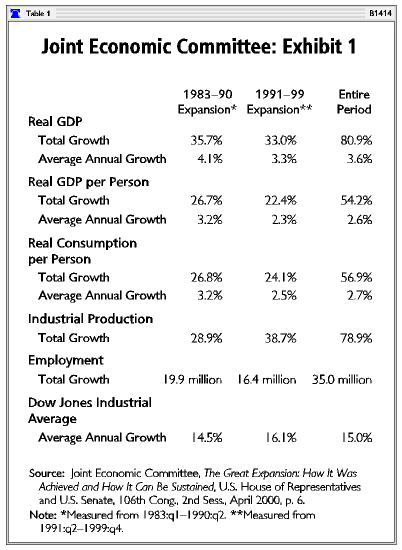
That’s what actually worked.

Free. Market. Capitalism. Works.

What will the Copenhagen conference mean to ordinary Americans?

Article from Forbes magazine. (H/T Muddling Towards Maturity)

Excerpt:

Whatever the results of the Copenhagen conference on climate change, one thing is for sure: Draconian reductions on carbon emissions will be tacitly accepted by the most developed economies and sloughed off by many developing ones. In essence, emerging economies get to cut their “carbon” intensity–a natural product of their economic evolution–while we get to cut our throats.

[…]Our leaders will dutifully accept cuts in our carbon emissions–up to 80% by 2050–while developing countries increasetheirs, albeit at a lower rate. Oh, we also pledge to send billions in aid to help them achieve this goal.The media shills, scientists, bureaucrats and corporate rent-seekers gathered at Copenhagen won’t give much thought to what this means to the industrialized world’s middle and working class. For many of them the new carbon regime means a gradual decline in living standards. Huge increases in energy costs, taxes and a spate of regulatory mandates will restrict their access to everything from single-family housing and personal mobility to employment in carbon-intensive industries like construction, manufacturing, warehousing and agriculture.

You can get a glimpse of this future in high-unemployment California. Here a burgeoning regulatory regime tied to global warming threatens to turn the state into a total “no go” economic development zone. Not only do companies have to deal with high taxes, cascading energy prices and regulations, they now face audits of their impact on global warming. Far easier to move your project to Texas–or if necessary, China.

Now consider this Wall Street Journal article regarding the EPA decision to call carbon dioxide a threat to public health.

Excerpt:

An endangerment finding would allow the EPA to use the federal Clean Air Act to regulate carbon-dioxide emissions, which are produced whenever fossil fuel is burned. Under that law, the EPA could require emitters of as little as 250 tons of carbon dioxide per year to install new technology to curb their emissions starting as soon as 2012.

The EPA has said it will only require permits from big emitters — facilities that put out 25,000 tons of carbon dioxide a year. But that effort to tailor the regulations to avoid slamming small businesses with new costs is expected to be challenged in court.

Legislators are aware that polls show the public appetite for action that would raise energy prices to protect the environment has fallen precipitously amid the recession.

Congressional legislation also faces plenty of U.S. industry opposition. Under the legislation, which has been passed by the House but is now stuck in the Senate, the federal government would set a cap on the amount of greenhouse gas the economy could emit every year. The government would distribute a set number of emission permits to various industries. Companies that wanted to be able to emit more than their quota could buy extra permits from those that had figured out how to emit less.

Proponents of the cap-and-trade approach say emission-permit trading will encourage industries to find the least-expensive ways to curb greenhouse-gas output. But opponents say it will saddle key industries with high costs not borne by rivals in China or India, and potentially cost the U.S. jobs.

There will be an economic impact on ordinary Americans from the Democrats trying to “do something” about global warming. The economic impact will not be felt primarily by liberal elites in government.

Business leaders blame Obama for high unemployment rate

Story from Reuters about a recent jobs summit. (H/T American Spectator via ECM)

Excerpt:

At a recent symposium, Intel boss Paul Otellini, a contributor to both parties, expressed concern about the “amount of variability in the system” created by the state of policy flux in healthcare, energy and tax policy. “It is very difficult to make a hiring decision,” he said. General Electric chief executive Jeffery Immelt, a strong supporter of Obama’s cap-and-trade proposal, added he would just like to “know what the rules are.”

All in all, a disturbing replay of the 1930s when FDR’s big changes left business reeling with uncertainty and confusion. The “devil you don’t know” and all that.

Small business is certainly with Big Business on this, particularly regarding the mercurial nature of healthcare reform. The substance of ObamaCare continues to morph daily — from the state of the public option to employer mandates to financing expanded coverage – as Senate leader Harry Reid scrounges for votes. On energy, the president will make big promises at Copenhagen even though cap-and-trade looks stillborn in the Senate.

As for financial reform, Senate banking committee chair Chris Dodd has proposed sweeping changes, while the Tim Geithner-Barney Frank version in the House seems beamed in from a universe where the credit crisis never happened. Compromise could prove elusive. Even Obama’s tax reform panel has delayed releasing its findings.

The thing you have to understand about business is that finding and hiring an employee is an expensive process. If this employee has to be laid off later because of government increasing tax rates or regulations, then that layoff poisons the atmosphere in the entire company. If you want businesses to feel comfortable about hiring, you need to convince them that you aren’t going to raise their taxes or expenses, unionize their work force, fine them for hurting the environment, or pass laws that encourage their employees to sue them for being offended, etc.

Legislative initiatives like card-check, health care mandates, cap-and-trade, ENDA, increased government spending, tariffs, “pay equity” laws, restrictions on executive salaries, capital gains tax hikes, etc., make businesses very risk-averse about hiring decisions. If Obama wants to attack businesses, these businesses may just leave the USA and set up shop elsewhere. But more likely they will just stay here and avoid hiring any new employees until the 2012 election.