Tag Archives: Origin of Life

New study: first life pushed back earlier, leaving less time for naturalist magic

Christianity and the progress of science

Whenever you discuss origins with naturalists, it’s very important to get them to explain how the first living organism emerged without any help from an intelligent agent. The origin of life is an information problem. A certain minimal amount of biological information for minimum life function has to be thrown together by chance. No evolutionary mechanisms have the potential to work until replication is already in place.

Evolution News reports on a new study that makes the window for naturalistic forces to create the first self-replicating organism even smaller.

Excerpt:

A paper in Nature reports the discovery of fossil microbes possibly older, even much older, than any found previously. The lead author is biogeochemist Matthew Dodd, a PhD student at University College London. If the paper is right, these Canadian fossils could be 3.77 billion years old, or even as old as — hold onto your hat, in case you’re wearing one — 4.28 billion years.

From the Abstract:

Although it is not known when or where life on Earth began, some of the earliest habitable environments may have been submarine-hydrothermal vents. Here we describe putative fossilized microorganisms that are at least 3,770 million and possibly 4,280 million years old in ferruginous sedimentary rocks, interpreted as seafloor-hydrothermal vent-related precipitates, from the Nuvvuagittuq belt in Quebec, Canada. These structures occur as micrometre-scale haematite tubes and filaments with morphologies and mineral assemblages similar to those of filamentous microorganisms from modern hydrothermal vent precipitates and analogous microfossils in younger rocks. The Nuvvuagittuq rocks contain isotopically light carbon in carbonate and carbonaceous material, which occurs as graphitic inclusions in diagenetic carbonate rosettes, apatite blades intergrown among carbonate rosettes and magnetite–haematite granules, and is associated with carbonate in direct contact with the putative microfossils.

This new paper is interesting to compare with a paper from last year, Nutman et al., “Rapid emergence of life shown by discovery of 3,700-million-year-old microbial structures,” also in Nature, which found microbial structures that are a bit younger.

But the “microbial structures” from Nutman et al. 2016 are different from these new “microfossils” presented by Dodd et al. 2017. In Nutman et al., they only found stromatolite-type structures rather than actual microfossils. Some stromatolite experts were a bit skeptical that what they found were really stromatolites.

But the new paper by Dodd and his colleagues, “Evidence for early life in Earth’s oldest hydrothermal vent precipitates,” seems to offer potential bacteria-like microfossils. They are tiny black carbonaceous spheres and “hematite tubes” which the authors think are biogenically created. We’ve seen more convincing ancient microfossils, but these aren’t bad.

According to Dodd et al., these new finds would be the oldest known microfossils, if that is in fact what they are. Very interesting. If so, that just keeps pushing unquestionable evidence of life’s existence on Earth further and further back, which leaves less and less time for the origin of life to have occurred by unguided chemical evolution after Earth became habitable.

If they are in fact 4.28 billion years old, then that would mean there was life very, very early in Earth’s history — as Cyril Ponnamperuma said, it’s like “instant life.”

Instant life is “rational” for naturalistic fideists, but for evidence-driven people who understand the long odds on generating even a simple protein by chance, it’s irrationality.

Let’s recall exactly how hard it is to make even a simple protein without intelligent agency to select the elements of the sequence.

The odds of creating even a single functional protein

I’ve talked about Doug Axe before when I described how to calculate the odds of getting functional proteins by chance.

Let’s calculate the odds of building a protein composed of a functional chain of 100 amino acids, by chance. (Think of a meaningful English sentence built with 100 scrabble letters, held together with glue)

Sub-problems:

  • BONDING: You need 99 peptide bonds between the 100 amino acids. The odds of getting a peptide bond is 50%. The probability of building a chain of one hundred amino acids in which all linkages involve peptide bonds is roughly (1/2)^99 or 1 chance in 10^30.
  • CHIRALITY: You need 100 left-handed amino acids. The odds of getting a left-handed amino acid is 50%. The probability of attaining at random only L–amino acids in a hypothetical peptide chain one hundred amino acids long is (1/2)^100 or again roughly 1 chance in 10^30.
  • SEQUENCE: You need to choose the correct amino acid for each of the 100 links. The odds of getting the right one are 1 in 20. Even if you allow for some variation, the odds of getting a functional sequence is (1/20)^100 or 1 in 10^65.

The final probability of getting a functional protein composed of 100 amino acids is 1 in 10^125. Even if you fill the universe with pre-biotic soup, and react amino acids at Planck time (very fast!) for 14 billion years, you are probably not going to get even 1 such protein. And you need at least 100 of them for minimal life functions, plus DNA and RNA.

Research performed by Doug Axe at Cambridge University, and published in the peer-reviewed Journal of Molecular Biology, has shown that the number of functional amino acid sequences is tiny:

Doug Axe’s research likewise studies genes that it turns out show great evidence of design. Axe studied the sensitivities of protein function to mutations. In these “mutational sensitivity” tests, Dr. Axe mutated certain amino acids in various proteins, or studied the differences between similar proteins, to see how mutations or changes affected their ability to function properly. He found that protein function was highly sensitive to mutation, and that proteins are not very tolerant to changes in their amino acid sequences. In other words, when you mutate, tweak, or change these proteins slightly, they stopped working. In one of his papers, he thus concludes that “functional folds require highly extraordinary sequences,” and that functional protein folds “may be as low as 1 in 10^77.”

The problem of forming DNA by sequencing nucleotides faces similar difficulties. And remember, mutation and selection cannot explain the origin of the first sequence, because mutation and selection require replication, which does not exist until that first living cell is already in place.
Stephen C. Meyer and Doug Axe discuss 5 major problems with macro-evolution

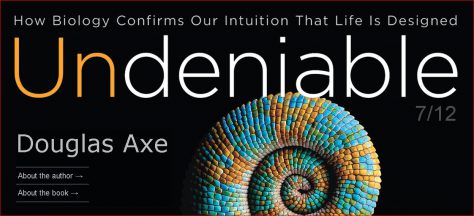
Undeniable: How Biology Confirms Our Intuition That Life Is Designed

The host of the Cross Examined radio show Dr. Frank Turek talks with Stephen C. Meyer and Doug Axe about a recent conference of Royal Society scientists discussing the problems with the theory of macro-evolution.

The MP3 file is here.

Summary:

  • about the Royal Society conference
  • the main topic was whether naturalistic mechanisms can produce new body plans and new organ types
  • no one disputes micro-evolution: beaks changing size, antibiotic resistance
  • many of the naturalistic scientists admitted the problems with current naturalistic theories, but they don’t want to embrace the need for a designer
  • none of the proposals that were debated solved the real problems with macro-evolution
  • Problem #1: the sudden origin of body plans in the fossil record
  • Problem #2: the origin of information (e.g. – in protein molecule)
  • Problem #3: need for favorable early mutations (for body plans)
  • Problem #4: the problem of epigenetics
  • Problem #5: the universality of the design intuition

Some of these problems have actually gotten worse for naturalistic evolution as our scientific knowledge has grown.

If you want the two best books on intelligent design, get Dr. Meyer’s “Signature in the Cell” and “Darwin’s Doubt”. I should note that Dr. Meyer is not a young Earth creationist, and has defended the Big Bang cosmology as a solid evidence for a Creator of the universe. Being in favor of an old universe and an old Earth is compatible with being opposed to evolution – because of scientific reasons.

Stephen C. Meyer debates intelligent design with two scientists on NPR

British Spitfire and German Messerschmitt Me 109 locked in a dogfight

Evolution News reported on a 27-minute debate featuring Dr. Stephen C. Meyer – probably the best proponent of intelligent design there is.

Description:

We often say that Darwinists are reluctant to debate advocates of intelligent design, but here are two who deserve a tip of the hat. Keith Pannell is a chemist at the University of Texas at El Paso who hosts a program, Science Studio, on the NPR station there. He invited Stephen Meyer on to talk about the science of ID, pegged to the Dover anniversary.

Clearly Pannell is an ID critic so he gets kudos for being willing to have a civil and informative conversation. Perhaps feeling insecure about facing the author of Darwin’s Doubt by himself, Dr. Pannell invited a biologist colleague, Ricardo Bernal, to serve as “co-host.”

So it was two against one, but no worries. Meyer is, as always, superb, and the discussion sounds like it was an education for the two Texas scientists. Listen and enjoy.

I took a back-up of the MP3 file here.

Summary:

  • How did Dr. Meyer get interested in science?
  • What is intelligent design? (origin of life, fine-tuning)
  • What is creationism? (young Earth, different epistemology)
  • Who does Dr. Meyer think the intelligent designer is?
  • Finding the best explanation from multiple competing hypotheses
  • Critic: aren’t you arguing for a designer from ignorance, then?
  • The importance of naturalists acknowledging what they do and do not know about the origin of life
  • We do have experience with intelligent causation, whenever we sequence symbols to have meaning and purpose, e.g. – writing
  • Critic: information in DNA is not digital information, is it?
  • Information in the cell follows a 4-character alphabet
  • the sequences are composed of many parts / symbols
  • the sequences themselves are specified to have function
  • Critic: the complexity just emerges from change over time
  • the origin of the first life is immune to explanation of change over time, because there is no replication – this is the first replicator
  • Critic: but isn’t it just ignorance about the origin of life?
  • what we do is look at a number of competing hypothesis and what they are capable of, and see whether each cause is capable of generating the effects we observe in nature
  • Critic: where is the experimental verification of your theory?
  • well, in the appendices of Signature of the Cell, we predicted that the non-coding regions of DNA (junk DNA) would be found to have function, and that was later proven out
  • the Darwinists said that non-coding regions of the DNA was junk, but that’s not what has been proven experimentally
  • Critic: where was this prediction written up, who wrote it?
  • intelligent design theorists predicted it: Dembski, Kenyon, Mims, Sternberg
  • Critic: but we used the scientific method to disprove the Darwinian predictions, you don’t like the scientific method
  • intelligent design proponents love science, and the scientific method, and they do work in labs to confirm their hypotheses, (WK:for example, the probability of generating a protein by chance)
  • Critic: what about the Dover court case that you lost?
  • the Discovery Institute objected to actions taken by the Dover school board
  • Critic: what about the molecular machines, how are they related to intelligent design?
  • even in the simplest living organisms, there are tiny machines that are tightly integrated, and cannot be built up in a stepwise fashion
  • Critic: I’ve worked with the ATP-synthase and other molecular machines, but “you can kind of begin to tease how some of these molecular machines have come about” – pieces have multiple functions, and they are co-opted into larger systems
  • the problem with the co-option argument breaks down when you look at the specific details of different machines
  • for example – the type III secretory system cannot be an precursor to the bacterial flagellum, it is younger, not older than the bacterial flagellum
  • Critic: what would it take for your view to be falsified?
  • demonstrable undirected processes that are capable of creating functional information in DNA, or processes that can build up an irreducibly complex molecular machine within the time available with a decent probability

If you like this debate, check out Stephen C. Meyer’s two books: “Signature in the Cell” and “Darwin’s Doubt”. They are now out as audio books, too.