Tag Archives: Obama

Jay Richards explains how welfare forces people into dependency

Christian philosopher Jay Richards writing for the Heritage Foundation.

Excerpt:

More than 77 government welfare programs—which are spread across several federal departments and provide cash, food, housing, medical care, and targeted social services to poor and low-income persons—are “means-tested.” That is, beneficiaries qualify if they are below a specified income level.

Regardless of their intention, means-tested programs by their very nature pose disincentives for households to increase their incomes and risk termination of their benefits. Thus, the welfare system effectively set up roadblocks to the two main avenues for economic progress: marriage and employment. A single mother would be ensured of her benefits package as long as she did not take a job or marry an employed husband. Given this scenario, it’s not surprising that dismal societal trends have followed.

Unwed childbearing is the major cause of child poverty in America. Since 1965, the rate of unwed births has soared from 7 percent to 39 percent (and among blacks, to 69 percent). Children born and raised outside marriage are nearly seven times more likely to live in poverty than children born to and raised by a married couple. Moreover, unwed childbearing is concentrated among low-income, less educated women in their early 20s—those who have the least ability to support a family by themselves.

Low levels of parental work is the second major cause of child poverty in the United States. In a typical year, only about one-fourth of all poor households with children have combined work hours of adults equaling 40 hours a week. The typical poor family with children is supported by only 800 hours of work during a year, an average of 16 hours of work per week. If work in each family were raised to 2,000 hours per year—the equivalent of one adult working 40 hours per week through the year—nearly 75 percent of poor children would be lifted out of poverty.[6]

Marriage and one parent working = no child poverty. Why is government undermining that? Because broken homes produce children that require government intervention = more government = higher taxes = greater “equality” of wealth through government-run redistribution.

The article explains several government policies that would reduce dependency on government.

Richards explains:

The Welfare Reform Act of 1996 reduced some of these damaging incentives in one major program, Aid to Families with Dependent Children. Under AFDC, states were given more federal funds if their welfare caseloads increased, and funds were cut whenever the state caseload fell. In other words, states were basically encouraged to swell their welfare rolls.

Welfare reform replaced AFDC with a new program, Temporary Assistance to Needy Families (TANF), which provided incentives to move recipients toward self-sufficiency. Funding to each state remained constant regardless of the size of caseloads, and states were allowed to retain savings from caseload reductions.

In addition, states were required to have at least half of their welfare recipients engaged in work or activity that would prepare them for employment. Rather than anticipating depending on the government indefinitely, recipients were limited to five years on the welfare rolls. (Under the old AFDC program, recipients spent an average of 13 years on the rolls.) These reforms in funding structure and incentives made a substantial difference.

Despite dire predictions by opponents of reform that work requirements and benefit limitations would lead to a surge in poverty, just the opposite occurred. States had the flexibility to design programs that best fit the needs of their constituents. State welfare agencies were transformed overnight into job placement centers, while social workers helped recipients access child care, housing, transportation, or other support that was necessary to move them into jobs and toward self-sufficiency.

Within 10 years, welfare caseloads shrank by more than half: 2.7 million fewer families were dependent on welfare checks. As the welfare caseloads fell, the employment of single mothers surged upward, and 1.6 million fewer children were living in poverty.[7] In 2001, despite the recession, the poverty rate for black children was at the lowest point in America’s history.[8]

Unfortunately, Obama rolled back welfare reforms in order to incentivize people to go back onto government dependence.

Keep in mind that Arthur Brooks of the AEI has shown that the amount of wealth a person has (over the poverty level) is not what makes them happy. What makes a person happy (above the poverty level) is that a person is making their own way and earning their own bread by their own work. That’s what makes people happy.
CBO finds that Obama understated budget deficits by 2.3 TRILLION

From the Hill. (H/T Michelle Malkin)

Excerpt:

The Congressional Budget Office on Friday released its analysis of President Obama’s 2012 budget proposal and found it does less to rein in deficits and the debt than the administration had estimated.

CBO estimates Obama’s plan would produce 10 years of deficits totaling $9.5 trillion. By 2021, it would increase the debt held by the public to 87 percent of gross domestic product.

The administration, using different methods, estimated budget deficits would total $7.2 trillion over the next 10 years under the 2012 budget. It forecast that total debt in 2021 would be 77 percent of GDP.

The White House also said total deficits over the next decade would be $1.1 trillion more without the recommendations included in Obama’s budget.

Marc Goldwein, policy director for the Committee for a Responsible Federal Budget, said that CBO has found the effects to be almost nil.

He explained that the difference between the CBO’s $9.5 trillion estimate and OMB’s $7.2 trillion estimate comes from two sources: rosy economic growth assumptions by OMB and offsets for the Medicare doc fix as well as transportation spending OMB did not specify in the budget and which CBO will not factor in.

The most important aspect of CBO’s analysis is that, while OMB claimed the president’s budget “stabilized” the debt at 77 percent of GDP over the 10-year window, CBO estimates the debt will grow throughout the period and end up at 87 percent, he said.

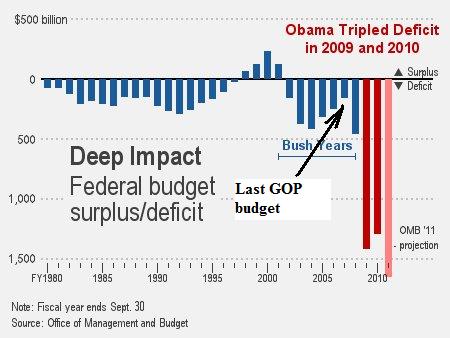
Here’s Michelle Bachmann explaining that since the Democrats took control of the budget in 2007, over 5 trillion dollars has been added to the debt.

The chart Michele is talking about:

Barack Obama Budget Deficit

The last Republican budget was in 2006. The recession started in 2007, along with the spending.

Meanwhile, the Obama will attend his fourth party event of the month. It’s party time! Just like in college!

Government report: US has world’s largest supply of oil, natural gas and coal

Here’s the press release. (H/T Canada Free Press)

Abstract:

Sen. James M. Inhofe (R-Okla.), Ranking Member of the Senate Committee on Environment and Public Works, and Sen. Lisa Murkowski (R-Alaska), Ranking Member of the Senate Energy and Natural Resources Committee, today released an updated government report from the Congressional Research Service (CRS) showing America’s combined recoverable oil, natural gas, and coal endowment is the largest on Earth. America’s recoverable resources are far larger than those of Saudi Arabia (3rd), China (4th), and Canada (6th) combined.  And that’s not including America’s immense oil shale and methane hydrates deposits.

Details:

Oil

CRS offers a more accurate reflection of America’s substantial oil resources.  While America is often depicted as possessing just 2 or 3 percent of the world’s oil – a figure which narrowly relies on America’s proven reserves of just 28 billion barrels – CRS has compiled US government estimates which show that America, the world’s third-largest oil producer, is endowed with 163 billion barrels of recoverable oil. That’s enough oil to maintain America’s current rates of production and replace imports from the Persian Gulf for more than 50 years.

Natural Gas

Further, CRS notes the 2009 assessment from the Potential Gas Committee, which estimates America’s future supply of natural gas is 2,047 trillion cubic feet (TCF) – an increase of more than 25 percent just since the Committee’s 2006 estimate.  At today’s rate of use, this is enough natural gas to meet American demand for 90 years.

Coal

The report also shows that America is number one in coal resources, accounting for more than 28 percent of the world’s coal. Russia, China, and India are in a distant 2nd, 3rd, and 5th, respectively. In fact, CRS cites America’s recoverable coal reserves to be 262 billion short tons. For perspective, the US consumes just 1.2 billion short tons of coal per year.  And though portions of this resource may not be accessible or economically recoverable today, these estimates could ultimately prove to be conservative.  As CRS states: “…U.S. coal resource estimates do not include some potentially massive deposits of coal that exist in northwestern Alaska.  These currently inaccessible coal deposits have been estimated to be more than 3,200 billion short tons of coal.”

Oil Shale

While several pilot projects are underway to prove oil shale’s future commercial viability, the Green River Formation located within Colorado, Wyoming, and Utah contains the equivalent of 6 trillion barrels of oil.  The Department of Energy estimates that, of this 6 trillion, approximately 1.38 trillion barrels are potentially recoverable.  That’s equivalent to more than five times the conventional oil reserves of Saudi Arabia.

Methane Hydrates

Although not yet commercially feasible, methane hydrates, according to the Department of Energy, possess energy content that is “immense … possibly exceeding the combined energy content of all other known fossil fuels.” While estimates vary significantly, the United States Geological Survey (USGS) recently testified that: “the mean in-place gas hydrate resource for the entire United States is estimated to be 320,000 TCF of gas.” For perspective, if just 3% of this resource can be commercialized in the years ahead, at current rates of consumption, that level of supply would be enough to provide America’s natural gas for more than 400 years.

The press release has lots of informative graphs.

The PDF of the full report is here.

Obama keeps blocking energy production at home, and sending taxpayer money (and jobs) to countries in the Middle East, some of who don’t like us very much. What would possess a president to undermine the national security and economy of his own country that way? Why does he want to raise the cost of living for his fellow citizens and send jobs overseas to the Middle East?