Tag Archives: New Testament

What do ancient non-Christian sources tell us about the historical Jesus?

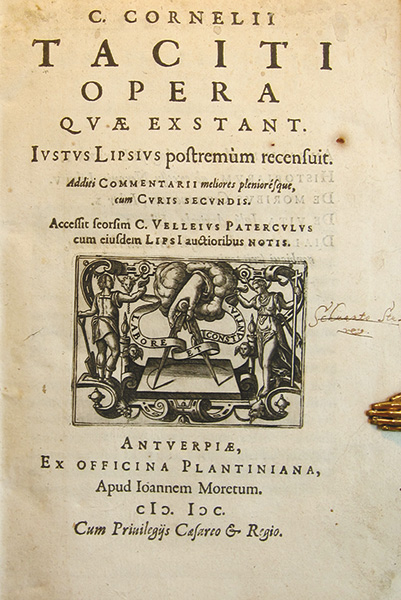
The Annals, by Roman historian Tacitus

This article from Biblical Archaeology covers all the non-Christian historical sources that discuss Jesus.

About the author:

Lawrence Mykytiuk is associate professor of library science and the history librarian at Purdue University. He holds a Ph.D. in Hebrew and Semitic Studies and is the author of the book Identifying Biblical Persons in Northwest Semitic Inscriptions of 1200–539 B.C.E. (Atlanta: Society of Biblical Literature, 2004).

Here are the major sections:

  • Roman historian Tacitus
  • Jewish historian Josephus
  • Greek satirist Lucian of Samosata
  • Platonist philosopher Celsus
  • Roman governor Pliny the Younger
  • Roman historian Suetonius
  • Roman prisoner Mara bar Serapion

And this useful excerpt captures the broad facts about Jesus that we get from just the first two sources:

We can learn quite a bit about Jesus from Tacitus and Josephus, two famous historians who were not Christian. Almost all the following statements about Jesus, which are asserted in the New Testament, are corroborated or confirmed by the relevant passages in Tacitus and Josephus. These independent historical sources—one a non-Christian Roman and the other Jewish—confirm what we are told in the Gospels:31

1. He existed as a man. The historian Josephus grew up in a priestly family in first-century Palestine and wrote only decades after Jesus’ death. Jesus’ known associates, such as Jesus’ brother James, were his contemporaries. The historical and cultural context was second nature to Josephus. “If any Jewish writer were ever in a position to know about the non-existence of Jesus, it would have been Josephus. His implicit affirmation of the existence of Jesus has been, and still is, the most significant obstacle for those who argue that the extra-Biblical evidence is not probative on this point,” Robert Van Voorst observes.32 And Tacitus was careful enough not to report real executions of nonexistent people.

2. His personal name was Jesus, as Josephus informs us.

3. He was called Christos in Greek, which is a translation of the Hebrew word Messiah, both of which mean “anointed” or “(the) anointed one,” as Josephus states and Tacitus implies, unaware, by reporting, as Romans thought, that his name was Christus.

4. He had a brother named James (Jacob), as Josephus reports.

5. He won over both Jews and “Greeks” (i.e., Gentiles of Hellenistic culture), according to Josephus, although it is anachronistic to say that they were “many” at the end of his life. Large growth
in the number of Jesus’ actual followers came only after his death.

6. Jewish leaders of the day expressed unfavorable opinions about him, at least according to some versions of the Testimonium Flavianum.

7. Pilate rendered the decision that he should be executed, as both Tacitus and Josephus state.

8. His execution was specifically by crucifixion, according to Josephus.

9. He was executed during Pontius Pilate’s governorship over Judea (26–36 C.E.), as Josephus implies and Tacitus states, adding that it was during Tiberius’s reign.

Some of Jesus’ followers did not abandon their personal loyalty to him even after his crucifixion but submitted to his teaching. They believed that Jesus later appeared to them alive in accordance with prophecies, most likely those found in the Hebrew Bible. A well-attested link between Jesus and Christians is that Christ, as a term used to identify Jesus, became the basis of the term used to identify his followers: Christians. The Christian movement began in Judea, according to Tacitus. Josephus observes that it continued during the first century. Tacitus deplores the fact that during the second century it had spread as far as Rome.

I remember reading the 1996 book by Gary Habermas entitled “The Historical Jesus: Ancient Evidence for the Life of Christ“. This book is a little before the time of most of you young Christian apologists, but back before the time of Lee Strobel and J. Warner Wallace, this is the stuff we all read. Anyway, in the book he makes a list of all that can be known about Jesus from external sources. And fortunately for you, you don’t have to buy the book because you can read chapter 9 of it right on his web site.

From Tacitus he gets this:

From this report we can learn several facts, both explicit and implicit, concerning Christ and the Christians who lived in Rome in the 60s A.D. Chronologically, we may ascertain the following information.

(1) Christians were named for their founder, Christus (from the Latin), (2) who was put to death by the Roman procurator Pontius Pilatus (also Latin), (3) during the reign of emperor Tiberius (14 37 A.D.). (4) His death ended the “superstition” for a short time, (5) but it broke out again, (6) especially in Judaea, where the teaching had its origin.

(7) His followers carried his doctrine to Rome. (8) When the great fire destroyed a large part of the city during the reign of Nero (54 68 A.D.), the emperor placed the blame on the Christians who lived in Rome. (9) Tacitus reports that this group was hated for their abominations. (10) These Christians were arrested after pleading guilty, (11) and many were convicted for “hatred for mankind.” (12) They were mocked and (13) then tortured, including being “nailed to crosses” or burnt to death. (14) Because of these actions, the people had compassion on the Christians. (15) Tacitus therefore concluded that such punishments were not for the public good but were simply “to glut one man’s cruelty.”

And from Josephus he gets this:

(1) Jesus was known as a wise and virtuous man, one recognized for his good conduct. (2) He had many disciples, both Jews and Gentiles. (3) Pilate condemned him to die, (4) with crucifixion explicitly being mentioned as the mode. (5) The disciples reported that Jesus had risen from the dead and (6) that he had appeared to them on the third day after his crucifixion. (7) Consequently, the disciples continued to proclaim his teachings. (8) Perhaps Jesus was the Messiah concerning whom the Old Testament prophets spoke and predicted wonders. We would add here two facts from Josephus’ earlier quotation as well. (9) Jesus was the brother of James and (10) was called the messiah by some.

So when you are reading the New Testament, these facts are the framework that you read within. It’s a good starting point when dealing with people who have never looked into who Jesus was and what he taught and what his followers believed about him, right from the start.


Walter Bradley asks: what is religion really supposed to be about?

Dr. Walter L. Bradley

This lecture is based on the book “Truth in Religion” by famous philosopher Mortimer J. Adler. At the time of writing the book, he was not a Christian, but there is still a lot of value in the book for Christians who are trying to understand what religion should really be about.

About the speaker

The speaker is one of my top 3 favorite speakers of all time in Christian apologetics, Dr. Walter Bradley. (The other two are Dr. Stephen C. Meyer and Dr. Michael Strauss)

Here’s a biography:

Dr. Bradley received his B.S. in Engineering Science and his Ph.D. in Materials Science from the University of Texas in Austin.

Dr. Bradley taught for eight years at the Colorado School of Mines before assuming a position as Professor of Mechanical Engineering at Texas A&M University (TAMU) in 1976.

During his 24 years at Texas A&M, Dr. Bradley served as Head of the Department of Mechanical Engineering at Texas A&M University and as Director of the Polymer Technology Center, and received five College of Engineering Research Awards. He has received over $4,500,000 in research grants and has published over 140 technical articles and book chapters. He has also co-authored “The Mystery Of Life’s Origin: Reassessing Current Theories. He is a Fellow of the American Society for Materials and of the American Scientific Affiliation and serves as a consultant for many Fortune 500 companies.

You can read more about his recent research on how to use coconuts to make car parts in this article from Science Daily.

The MP3 file is here. (31 minutes + Q&A)

Topics:

  • what is pluralism?
  • what is multiculturalism?
  • what is relativism?
  • some propositions are true culturally – just for certain groups in certain times (cultures)
  • some proposition are true trans-culturally – true independently of what anyone wants or feels
  • Mathematical truth is trans-cultural – it is true regardless of cultural fashions
  • Scientific truth is trans-cultural – it is true regardless of cultural fashions
  • Some truths are not like this – cooking traditions, clothing traditions and greeting traditions
  • These kinds of truths are NOT trans-cultural, they vary by culture
  • The question is – is religion true like math and science, or true depending on the culture
  • Some people think that your religion depends on where you were born or what your family believes
  • Religions make conflicting claims about the way the world really is, so they can’t all be true
  • And these conflicts are at the core of the religions – who God is, how can we be related to him, etc.
  • So if religions convey trans-cultural truth, then either one is true or none are true
  • If they are not trying to convey trans-cultural truth, then they are not like math and science
  • Let’s assume that religion is the same as trans-cultural truth
  • How can we know which religion is true? 1) the laws of logic, 2) empirical testing against reality
  • Logical consistency is needed to make the first cut – self-contradictory claims cannot be true
  • To be true trans-culturally, a proposition must at least NOT break the law of non-contradiction
  • According to Mortimer Adler’s book, only Christianity, Judaism and Islam are not self-contradictory
  • All the others can be excluded on the basis of overt internal contradictions on fundamental questions
  • The others that are self-contradictory can be true culturally, but not trans-culturally
  • The way to proceed forward is to test the three non-contradictory religions against science and history
  • One of these three may be true, or they could all be false
  • We can test the three by evaluating their conflicting truth claims about the historical Jesus
  • Famous skeptics have undertaken studies to undermine the historical Jesus presented in the Bible
  • Lew Wallace, Simon Greenleaf and Frank Morrison assessed the evidence as atheists and became Christians
  • There is a lot of opposition in culture to the idea that one religion might be true
  • But if you take the claims of Jesus at face value, he claims to be the unique revelation of God to mankind
  • Either he was telling the truth about that, or he was lying, or he was crazy
  • So which is it?

Why don’t religious people ask if their religion is true?

People seem to be chicken these days about claiming that their religion is true. It’s easier to say that my religion is true for me, and your religion is true for you – reduce it to personal preferences. So long as everyone is sincere about what they believe, then that’s the most important thing, right?

But it is NOT TRUE that you can believe whatever you want as long as you are sincere – sincerity doesn’t mean that you can’t be mistaken. I can jump off the top of the Sears Tower and be sincere in my belief that I will float down like a feather, but that doesn’t make my belief true. If you want to have a good relationship with God, you have to know things about him, not just have sincere beliefs. You have to know whether he exists and what he is like – really. It’s not enough to have sincere beliefs that are not actually true.

I think that God’s existence and character can be assessed and known based on logic and evidence. I think that God exists independently of whether I want him to or not, and I think that his character and desires are not the same as my character and desires. And I don’t really care what my neighbors think of my disagreeing with them, my goal is not to keep silent and to just get along with them and be happier in my community.

God’s first commandment to us is not to love our neighbor – that’s number two. Number one is to love him. And how can we love him, if we don’t want to know him. And how can we love him, if we don’t tell people the truth about him when they ask us?

That message is not going to win us a lot of friends, but our job as Christians is to tell how and why God stepped into history. Jesus expects us to be his ambassadors and to carry out the task of evangelism faithfully, and to suffer with him and – if necessary – to be rejected like he was rejected.

William Lane Craig lectures on the evidence for the resurrection of Jesus

Sherlock Holmes and John Watson: let's take a look at the facts
Sherlock Holmes and John Watson: let’s take a look at the facts

Here is Dr. William Lane Craig giving a long-form argument for the historical event of the resurrection of Jesus, and taking questions from the audience.

The speaker introduction goes for 6 minutes, then Dr. Craig speaks for 35 minutes, then it’s a period of questions and answers with the audience. The total length is 93 minutes, so quite a long period of Q&A. The questions in the Q&A period are quite good.

Introduction:

  • Many people who are willing to accept God’s existence are not willing to accept the God of Christianity
  • Christians need to be ready to show that Jesus rose from the dead as a historical event
  • Private faith is fine for individuals, but when dealing with the public you have to have evidence
  • When making the case, you cannot assume that your audience accepts the Bible as inerrant
  • You must use the New Testament like any other ancient historical document
  • Most historians, Christian and not, accept the basic minimal facts supporting the resurrection of Jesus

Fact #1: the burial of Jesus following his crucifixion

  • Fact #1 is supported by the early creed found in Paul’s first letter to the Corinthians (1 Cor 15)
  • Fact #1 is supported by the early Passion narrative which was a source for Mark’s gospel
  • Fact #1 passes the criterion of enemy attestation, since it praises one of the Sanhedrin
  • Fact #1 is not opposed by any competing burial narratives

Fact #2: on the Sunday following his crucifixion, Jesus’ tomb was found empty by some women

  • Fact #2 is supported by the early Passion narrative which was a source for Mark’s gospel
  • Fact #2 is implied by the early creed found in Paul’s first letter to the Corinthians (1 Cor 15)
  • Fact #2 is simple and lacks legendary embellishment, which argues for an early dating
  • Fact #2 passes the criterion of embarrassment, because it has female, not male, witnesses
  • Fact #2 passes the criterion of enemy attestation, since it is reported by the Jewish leaders

Fact #3: Jesus appeared to various people in various circumstances after his death

  • Fact #3 is supported by the early creed found in Paul’s first letter to the Corinthians (1 Cor 15)
  • Fact #3 is supported by multiple, independent reports of the events from all four gospels
  • Fact #3 explains other historical facts, like the conversion of Jesus’ skeptical brother James

Fact #4: the earliest Christians proclaimed their belief in the resurrection of Jesus

  • Fact #4 explains why the earliest Christians continued to identify Jesus as the Messiah
  • Fact #4 explains why the earliest Christians were suddenly so unconcerned about being killed

Dr. Craig then asks which hypothesis explains all four of these facts. He surveys a number of naturalistic hypotheses, such as the hallucination theory or various conspiracy theories. All of these theories deny one or more of the minimal facts that have been established and accepted by the broad spectrum of historians. In order to reject the resurrection hypothesis, a skeptic would have to deny one of the four facts or propose an explanation that explains those facts better than the resurrection hypothesis.

I listened to the Q&A period while doing housekeeping and I heard lots of good questions. Dr. Craig gives very long answers to the questions. One person asked why we should trust the claim that the Jewish leaders really did say that the disciples stole the body. Another one asked why we should take the resurrection as proof that Jesus was divine. Another asks about the earthquake in Matthewand whether it is intended to be historical or apocalyptic imagery. Dr. Craig is also asked about the Jewish scholar Geza Vermes, and how many of the minimal facts he accepts. Another questioner asked about the ascension.

If you are looking for a good book to read on this topic, the best introductory book on the resurrection is “The Case for the Resurrection of Jesus” and the best comprehensive book is “The Resurrection of Jesus“.