Tag Archives: National Debt

U.S. per person debt now $53,378 – 35% higher than in Greece

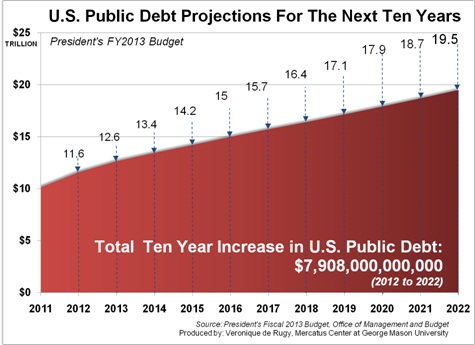
Obama 2013 Budget Debt Projection

From the Weekly Standard. (H/T WGB)

Excerpt:

“According to estimates from the International Monetary Fund, America’s total government debt will be $16.8 trillion by the end of the calendar year, compared to $441 billion for Greece,” the Republican side of the Senate Budget Committee explains.

“On a per person basis, that means U.S. debt is $53,400 for every man, woman, and child, compared to $39,400 for every man, woman, and child in Greece. The disparity between per capita debt in the U.S. and Greece has grown 40 percent (roughly $8,400) since 2011. Now, U.S. per person debt is 35 percent higher than that of Greece, and is also higher than per capita debt in Portugal, Italy, or Spain (which together with Greece make up the so-called PIGS countries).”

That’s based on total government debt.

And from CNS News, this for Americans under the age of 18:

If Americans under the age of 18 were required as a group to pay off the entirety of the federal government’s debt in equal shares, each would now need to pay about $218,676.

That is more than the $130,468 average price tag for four years at a private college or the $173,100 median price for an existing one-family home in the United States.

During the time Barack Obama has been president, the U.S. government debt has increased from approximately $143,255 per American under 18 to approximately $218,676 per American under 18–a climb of $75,421 or about 53 percent.

If you know anyone under the age of 18, it might worth explaining this to them.

UPDATE:

H/T The Elusive Wapiti.

New jobs report: unemployment rises and 70% chance of recession

James Pethokoukis of the American Enterprise Institute explains:

The May jobs report was a complete and utter disaster for the economy and, perhaps, President Obama’s chances for reelection.

Employers created just 69,000 jobs last month, the Labor Department said on Friday. That’s the fewest since May of last year. Economists had been expecting nonfarm payrolls to increase by 150,000. (In fact, the result was lower than what any economist polled by Reuters had predicted.)

Moreover, companies added 49,000 fewer jobs than previously estimated in March and April. Talk about a slowdown. The average monthly gain was 226,000 in first quarter vs. an average of just 73,000 in April and May.

Oh, and the U-3 unemployment rate rose to 8.2% from 8.1%. The broader U-6 gauge, which also measures underemployment, rose to 14.8% from 14.5%. The labor force participation rate did, finally, tick up to a still-low 63.8%, lending credence to the idea that the shrinking workforce reflects discouraged workers and not just demographics.

And here’s the forecast: WE’RE DOOMED.

So what is the true state of the labor market?

– If the size of the U.S. labor force as a share of the total population was the same as it was when Barack Obama took office—65.7% then vs. 63.8% today—the U-3 unemployment rate would be 10.9%. (Now, this doesn’t take into account the aging of the Baby Boomers, which should lower the participation rate due to rising retirements. But is that still a valid assumption given the drop in wealth since 2006?)

–  If you take into account the aging of the Baby Boomers, the participation rate should be trending lower. Indeed, it has been doing just that since 2000. Before the Great Recession, the Congressional Budget Office predicted what the participation rate would be in 2012, assuming such demographic changes. Using that number, the real unemployment rate would be 10.5%.

– Of course, the participation rate usually falls during recessions. Yet even if you discount for that and the aging issue, the real unemployment rate would be 9.5%.

– We continue to be stuck in the longest period of 8% unemployment or higher since the Great Depression, 40 consecutive months.

– And, as the above chart shows — originally from Obama economists Christina Romer and Jared Bernstein in January 2009 –the current 8.2% unemployment rate is 2.5 percentage points above where Team Obama predicted it would be right now if Congress passed his trillion-dollar stimulus plan.

–  The median duration of unemployment rebounded to 20.1 weeks in May, and 42.8% were unemployed for longer than a half year.

– Total hours worked fell 0.2% on weakness in the work week.

– Average hourly earnings rose just 0.1%. Coupled with a very stable overall inflation rate, real wages were likely flat in May.

The big question now: Does this report suggest the U.S economy is heading into recession, especially given the sharp slowdown in global economic activity from Europe to India to, perhaps most worrisome, China?

Consider this: Last year, the U.S. grew at just a 1.7% pace. Research from the Federal Reserve finds that that since 1947 when year-over-year real GDP growth falls below 2 percent, recession follows within a year 70 percent of the time. We are firmly within the Recession Red Zone.

Facebook friend WGB pointed me to this story in CNS News:

The number of American women who are unemployed was 766,000 individuals greater in May 2012 than in January 2009, when President Barack Obama took office, according to data released today by the Bureau of Labor Statistics.

In January 2009, there were approximately 5,005,000 unemployed women in the United States,according to BLS. In May 2012, there were 5,771,000.

[…]The number of women employed in the United States peaked at 68,102,000 in April 2008, according to BLS.  The number of women employed in the United States today is 1,216,000 less than that.

Remember, the Democrats got control of Congress in January 2007, and had control of spending in the 2008 fiscal year. My take is that the hiring is still going on in places like Canada and Chile and Sweden, where government isn’t taxing and regulating job creators into oblivion. Companies are still hiring and expanding and drilling for oil – just not here.

Paul Ryan’s Path to Prosperity plan balances the budget without raising taxes

Americans for Tax Reform explains what’s in it.

Excerpt:

The main details are:

Revenue neutrality.  The budget calls for the House Ways and Means Committee to produce a tax reform package with a tax revenue target of between 18 and 19 percent of GDP.  This is in line with historical revenue figures.  By contrast, big government budgets like “Gang of Six,” “Simpson-Bowles,” and the Obama budget call for a long-range revenue target of over 20 percent of GDP.  The Ryan budget is a no tax hikes budget.

Six personal rates down to two.  The Ryan budget replaces the current six-rate personal income tax structure (10, 15, 25, 28, 33, and 35 percent) with a two-rate system of 10 and 25 percent.  This will result in a lower tax rate on the majority of small business profits, from 33 or 35 percent down to 25 percent.

Repeals Obamacare tax hikes.  The Ryan budget eliminates the entire Obamacare law.  This includes repealing the 20 new or higher taxes which have taken or are about to take effect from that law.

Eliminate the AMT.  The Ryan budget eliminates the AMT, instead favoring a simpler system with lower rates and a broad tax base.

Lower rates on businesses.  As said above, the Ryan budget lowers the tax rate on the majority of small business profits to 25 percent.  It also lowers the federal income tax rate on larger corporate employers from 35 percent (the highest in the developed world) to 25 percent (closer to the developed nation average).  While this makes American companies more competitive, it would still leave us with a higher corporate income tax rate than the developed nation average, Canada, and the United Kingdom.  In order to make us truly internationally-competitive, the federal rate must fall to 20 percent or less.

No more picking winners and losers in the tax code.  In order to target revenues at 18-19 percent of GDP with tax rates no higher than 25 percent, the Ways and Means Committee will have to curtail or eliminate most tax exclusions, adjustments, deductions, and credits.  That means that all consumed income will be taxed once and only once.  No longer will the tax code favor one type of economic behavior over another.

Moves tax code from “worldwide taxation” to “territoriality.”  The Ways and Means Committee is directed to shift our tax code from one which seeks to tax income earned all over the world to one which only seeks to tax income earned in America.  This is known as “territoriality,” and it’s already been adopted by and large by our trading competitors.  By retaining a worldwide tax regime, we’re exposing our own countries to double taxation–once when they pay the foreign nation’s income tax, and again when they try to bring the money home.

This is what the budget does: (Debt as % of GDP)

Paul Ryan's 2013: The Path to Prosperity

Doug Ross has three nice charts explaining the details.

Is Barack Obama going to do anything about the debt?

According to CBS News, Obama has exploded our national debt, so there is no reason to trust anything he says about reducing the debt.

Excerpt:

The National Debt has now increased more during President Obama’s three years and two months in office than it did during 8 years of the George W. Bush presidency.

The Debt rose $4.899 trillion during the two terms of the Bush presidency. It has now gone up $4.939 trillion since President Obama took office.

The latest posting from the Bureau of Public Debt at the Treasury Department shows the National Debt now stands at $15.566 trillion. It was $10.626 trillion on President Bush’s last day in office, which coincided with President Obama’s first day.

The National Debt also now exceeds 100% of the nation’s Gross Domestic Product, the total value of goods and services.

Mr. Obama has been quick to blame his predecessor for the soaring Debt, saying Mr. Bush paid for two wars and a Medicare prescription drug program with borrowed funds.

The federal budget sent to Congress last month by Mr. Obama, projects the National Debt will continue to rise as far as the eye can see. The budget shows the Debt hitting $16.3 trillion in 2012, $17.5 trillion in 2013 and $25.9 trillion in 2022.

[…]His latest budget projects a $1.3 trillion deficit this year declining to $901 billion in 2012, and then annual deficits in the range of $500 billion to $700 billion in the 10 years to come.

If Mr. Obama wins re-election, and his budget projections prove accurate, the National Debt will top $20 trillion in 2016, the final year of his second term. That would mean the Debt increased by 87 percent, or $9.34 trillion, during his two terms.

Some of Bush’s debt total can be explained by considering that Nancy Pelosi and Harry Reid raised the debt by $5 trillion dollars over 4 years when they took control of the House and Senate in January of 2007. But they’re Democrats, and that’s what Democrats do.

Related posts