
Tag Archives: Morality

Mark D. Linville: does Darwinian evolution make morality rational?

A conflict of worldviews

Have you ever heard an atheist tell you that naturalistic evolution is an answer to the moral argument? I have. And I found a good reply to this challenge in the book “Contending With Christianity’s Critics“. The chapter that responds to the challenge is authored by Dr. Mark D. Linville. It is only 13 pages long. I have a link to the PDF at the bottom of this post.

First, a bit about the author:

Blog: The Tavern at the End of the World
Current positions:

  • PhD Research Fellow
  • Tutoring Fellow in Philosophy

Education:

  • PhD in Philosophy with a minor in South Asian Studies and a specialization in Philosophy of Religion, University of Wisconsin-Madison
  • MA in Philosophy, University of Wisconsin-Madison
  • MA in Philosophy of Religion, Trinity Evangelical Divinity School
  • MA in Theology, Cincinnati Christian Seminary
  • BA in Biblical Studies, Florida Christian College

Here is his thesis of the essay:

Darwin’s account of the origins of human morality is at once elegant, ingenious, and, I shall argue, woefully inadequate. In particular, that account, on its standard interpretation, does not explain morality, but, rather, explains it away . We learn from Darwin not how there could be objective moral facts, but how we could have come to believe—perhaps erroneously—that there are.

Further, the naturalist, who does not believe that there is such a personal being as God, is in principle committed to Darwinism, including a Darwinian account of the basic contours of human moral psychology. I’ll use the term evolutionary naturalism to refer to this combination of naturalism and Darwinism. And so the naturalist is saddled with a view that explains morality away. Whatever reason we have for believing in moral facts is also a reason for thinking naturalism is false. I conclude the essay with a brief account of a theistic conception of morality, and argue that the theist is in a better position to affirm the objectivity of morality.

And here’s a sample to get your attention:

But even if we are assured that a “normal” person will be prompted by the social instincts and that those instincts are typically flanked and reinforced by a set of moral emotions, we still do not have a truly normative account of moral obligation. There is nothing in Darwin’s own account to indicate that the ensuing sense of guilt—a guilty feeling—is indicative of actual moral guilt resulting from the violation of an objective moral law. The revenge taken by one’s own conscience amounts to a sort of second-order propensity to feel a certain way given one’s past relation to conflicting first-order propensities (e.g., the father’s impulse to save his child versus his impulse to save himself). Unless we import normative considerations from some other source, it seems that, whether it is a first or second-order inclination,one’s being prompted by it is more readily understood as a descriptive feature of one’s own psychology than material for a normative assessment of one’s behavior or character. And, assuming that there is anything to this observation, an ascent into even higher levels of propensities (“I feel guilty for not having felt guilty for not being remorseful over not obeying my social instincts…”) introduces nothing of normative import. Suppose you encounter a man who neither feels the pull of social, paternal or familial instincts nor is in the least bit concerned over his apparent lack of conscience. What, from a strictly Darwinian perspective, can one say to him that is of any serious moral import? “You are not moved to action by the impulses that move most of us.” Right. So?

The problem afflicts contemporary construals of an evolutionary account of human morality. Consider Michael Shermer’s explanation for the evolution of a moral sense—the “science of good and evil.” He explains,

By a moral sense, I mean a moral feeling or emotion generated by actions. For example, positive emotions such as righteousness and pride are experienced as the psychological feeling of doing “good.” These moral emotions likely evolved out of behaviors that were reinforced as being good either for the individual or for the group.2

Shermer goes on to compare such moral emotions to other emotions and sensations that are universally experienced, such as hunger and the sexual urge. He then addresses the question of moral motivation.

In this evolutionary theory of morality, asking “Why should we be moral?” is like asking “Why should we be hungry?” or “Why should we be horny?” For that matter, we could ask, “Why should we be jealous?” or “Why should we fall in love?” The answer is that it is as much a part of human nature to be moral as it is to be hungry, horny, jealous, and in love.3

Thus, according to Shermer, given an evolutionary account, such a question is simply a non-starter. Moral motivation is a given as it is wired in as one of our basic drives. Of course, one might point out that Shermer’s “moral emotions” often do need encouragement in a way that, say, “horniness,” does not. More importantly, Shermer apparently fails to notice that if asking “Why should I be moral?” is like asking, “Why should I be horny?” then asserting, “You ought to be moral” is like asserting, “You ought to be horny.” As goes the interrogative, so goes the imperative. But if the latter seems out of place, then, on Shermer’s view, so is the former.

One might thus observe that if morality is anything at all, it is irreducibly normative in nature. But the Darwinian account winds up reducing morality to descriptive features of human psychology. Like the libido, either the moral sense is present and active or it is not. If it is, then we might expect one to behave accordingly. If not, why, then, as a famous blues man once put it, “the boogie woogie just ain’t in me.” And so the resulting “morality” is that in name only.

In light of such considerations, it is tempting to conclude with C. S. Lewis that, if the naturalist remembered his philosophy out of school, he would recognize that any claim to the effect that “I ought” is on a par with “I itch,” in that it is nothing more than a descriptive piece of autobiography with no essential reference to any actual obligations.

When it comes to morality, we are not interested in mere descriptions of behavior. We want to know about prescriptions of behavior, and whether why we should care about following those prescriptions. We are interested in what grounds our sense of moral obligation in reality. What underwrites our sense of moral obligation? If it is just rooted in feelings, then why should we obey our moral sense when obeying it goes against out self-interest? Feelings are subjective things, and doing the right thing in a real objective state of affairs requires more than just feelings. There has to be a real objective state of affairs that makes it rational for us to do the right thing, even when the right thing is against our own self-interest. That’s what morality is – objective moral obligations overriding subjective feelings. I wouldn’t trust someone to be moral if it were just based on their feelings.

The PDF is right here for downloading, with the permission of the author.
New study: conservatives are more likely to be happily married than progressives

If you want a very happy marriage, don't be a progressive
If you want a very happy marriage, don’t be a progressive

New study from social science researchers W. Bradford Wilcox and Nicholas Wolfinger.

It’s written up in The Federalist.

Excerpt:

In the General Social Survey (GSS), one of the best barometers of American society, ideology is measured by asking respondents to rate their political attitudes on a liberal-conservative continuum (1 = extremely liberal, 7 = extremely conservative). We coded those men and women answering 1 to 3 as “liberal,” those answering with a 4 as “moderate,” and those answering 5 to 7 as “conservative.”

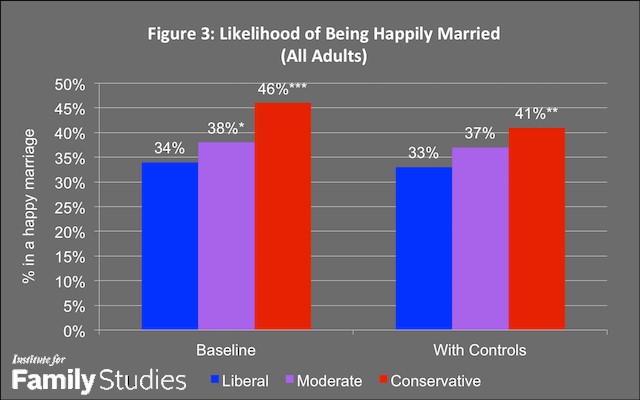
Figure 1 indicates that conservatives are significantly more likely to be married than are moderates and liberals. In fact, they are about 15 percentage points more likely to be married than their liberal fellow citizens. Moreover, this relationship remains strong after controlling for race or ethnicity, age, sex, and… income and education.

[…]Figure 3 examines the effects of political ideology on the chances of being in a very happy marriage among all Americans, not just those who are currently married, as Figure 2 depicted. Figure 3 shows that in the baseline model, conservatives are 12 percentage points more likely to be in happy marriages than are liberals. This gap persists, albeit to a diminished extent, after controlling for race or ethnicity, age, sex, income, and education. After adjusting for these differences between General Social Survey respondents, conservatives are about eight percentage points more likely than liberals to be in a happy marriage.

So basically, if you are a leftist, then you are much less likely to be happily married. And if you are a conservative, then you are much more likely to be happily married.

Why?

The answer lies in the design of marriage. Marriage is not about two people moving in together so that they can feel good about doing whatever they want to do. Marriage is a design that works best with a man and a women who are equipped at the worldview level with the capacity for resilient, self-sacrifice love.

Progressives are not equipped for the kind of self-denial, self-control, and self-sacrifice that marriage requires. They don’t believe in God, generally, so they don’t believe in objective morality. And if you don’t believe in objective morality, then there is no foundation there for self-sacrificial love, and honoring moral obligations when it goes against your self-interest. Atheism as a worldview doesn’t have the foundation for the kinds of behaviors that marriage entails. And that’s why you see Peter Atkins, Richard Dawkins, Richard Carrier, Michael Shermer, etc. divorcing their wives. The atheist worldview and the atheist community do not enable the sort of character that is suited for the design of marriage.

In contrast, conservatives typically do have a rationally-grounded morality. They tend to believe in God, and so the rightness of following the moral law when it goes against their self-interest makes sense to them. They think that there is a design to marriage, and design for the flourishing of children. They are more likely to be able to compromise and solve problems in order to keep a commitment going. There is an “ought to do” there in the conservative worldview that is objective – it exists independent of their feelings. The obligations to override selfishness is there regardless of how unfair life seems – it is resilient to challenges.

One of the ways you can tell how serious someone is about their religion, and therefore their morality, is by looking at the person’s church attendance. Church attendance is typically not as fun as other things you can do in life. So people who go are indicating that they put their relationship with God and their dedication to following the moral law above their own self-interest. So does that tendency help religious people to stay married?

Yes it does:

Brad Wilcox, director of the National Marriage Project at the University of Virginia, agrees there’s been some confusion.

“You do hear, both in Christian and non-Christian circles, that Christians are no different from anyone else when it comes to divorce and that is not true if you are focusing on Christians who are regular church attendees,” he said.

Wilcox’s analysis of the National Survey of Families and Households has found that Americans who attend religious services several times a month were about 35% less likely to divorce than those with no religious affiliation.

Nominal conservative Protestants, on the other hand, were 20% more likely to divorce than the religiously unaffiliated.

“There’s something about being a nominal ‘Christian’ that is linked to a lot of negative outcomes when it comes to family life,” Wilcox said.

So the bottom line is that marriage is a moral enterprise. It works better when each spouse has a worldview and a community that recognizes objective, prescriptive morality. And objective, prescriptive morality has no rational foundation in a non-theistic worldview. Progressives tend to be non-theists, so of course they are going to struggle with any enterprise that requires them to set aside their natural self-centeredness in order to honor moral obligations to another person.

New study: belief in free will linked to ability to behave morally and to help others

J. Warner Wallace: God's Crime Scene
J. Warner Wallace: God’s Crime Scene

So, Monday night I finally finished “reading” God’s Crime Scene, the new book by J. Warner Wallace. I was listening to the audio book, because it is hard to speed along with the top down and read at the same time. For now, here’s my one line review: this is a book for people who like evidence – he has collected a ton of evidence on everything people should be puzzling about, and sometimes on surprising topics. Anyway, I wanted to post something about some studies he mentioned in Chapter 6, on free will. This is one of the places where he found evidence in a surprising area.

Wallace says that free will makes more sense if theism is true, because we have non-material souls that interact with our bodies, but are not causally determined by them. On atheism, only matter exists, and you can’t get free will (or consciousness) from matter. So atheists like Sam Harris and Alex Rosenberg, for example, deny free will, because they are materialists and atheists.

Anyway, here’s what he writes on p. 256:

In 2008, researchers from the University of Minnesota and the University of British Columbia conducted experiments highlighting the relationship between a belief in determinism and immoral behavior. They found students who were exposed to deterministic literature prior to taking a test were more likely to cheat on the test than students who were not exposed to literature advocating determinism. The researchers concluded those who deny free will are more inclined to believe their efforts to act morally are futile and are, therefore, less likely to do so.

In addition, a study conducted by researchers from Florida State University and the University of Kentucky found participants who were exposed to deterministic literature were more likely to act aggressively and less likely to be helpful toward others.” Even determinist Michael Gazzaniga conceded: “It seems that not only do we believe we control our actions, but it is good for everyone to believe it.”” The existence of free will is a common characteristic of our experience, and when we deny we have this sort of free agency, there are detrimental consequences.

I decided to look up these studies.

Here’s the abstract for first study: (2008)

Does moral behavior draw on a belief in free will? Two experiments examined whether inducing participants to believe that human behavior is predetermined would encourage cheating. In Experiment 1, participants read either text that encouraged a belief in determinism (i.e., that portrayed behavior as the consequence of environmental and genetic factors) or neutral text. Exposure to the deterministic message increased cheating on a task in which participants could passively allow a flawed computer program to reveal answers to mathematical problems that they had been instructed to solve themselves. Moreover, increased cheating behavior was mediated by decreased belief in free will. In Experiment 2, participants who read deterministic statements cheated by overpaying themselves for performance on a cognitive task; participants who read statements endorsing free will did not. These findings suggest that the debate over free will has societal, as well as scientific and theoretical, implications.

And the abstract for the second study: (2009)

Laypersons’ belief in free will may foster a sense of thoughtful reflection and willingness to exert energy, thereby promoting helpfulness and reducing aggression, and so disbelief in free will may make behavior more reliant on selfish, automatic impulses and therefore less socially desirable. Three studies tested the hypothesis that disbelief in free will would be linked with decreased helping and increased aggression. In Experiment 1, induced disbelief in free will reduced willingness to help others. Experiment 2 showed that chronic disbelief in free will was associated with reduced helping behavior. In Experiment 3, participants induced disbelief in free will caused participants to act more aggressively than others. Although the findings do not speak to the existence of free will, the current results suggest that disbelief in free will reduces helping and increases aggression.

So what to make of this?

If you’re an atheist, then your worldview is telling you that what you are doing now is the result of genetic programming and sensory inputs. You’re not conscious. You can’t reason. You make no free choices, including moral choices. Naturally, someone who believes this is going to struggle with prescriptive morality, including self-sacrificial care and concern for others. Their worldview undermines the rationality of the moral point of view. You might find atheists acting morally for their own purposes, but their worldview doesn’t rationally ground it. This is a big problem for people who can see objective morality woven into the universe – and themselves – because they have the awareness of objective right and wrong.

I think what atheists like to say is “I can be moral, too”. That’s not interesting. What is interesting is whether it is rational for you to be moral when things start to get a bit uncomfortable. When I look at the adultery of Dawkins, the polyamory of Carrier, the divorces of Shermer and Atkins, etc. I am not seeing anything that really wows me. They all deny free will of course, and think that trying to resist temptation is a waste of time. What difference would it make if they did, anyway – there’s no afterlife on atheism.

Wallace explains how the awareness of free will and moral choices caused him to turn away from atheism, in this blog post.

He writes:

As an atheist, I chose to cling to naturalism, in spite of the fact that I lived each day as though I was capable of using my mind to make moral choices based on more than my own opinion. In addition, I sought meaning and purpose beyond my own hedonistic preferences, as though meaning was to be discovered, rather than created. I called myself a naturalist while embracing three characteristics of reality that simply cannot be explained by naturalism. As a Christian, I’m now able to acknowledge the “grounding” for these features of reality. My philosophical worldview is consistent with my practical experience of the world.

I think atheists who want to be honest about their own experience of first-person consciousness, free will, moral realism, etc. will do well to just accept that theism rationally grounds all of these things, and so you should accept theism. Theism is real. If you like morality, and want to be a virtuous person, then you should accept theism.