Tag Archives: Misandry

New study: children who grow up with single parents more likely to see domestic violence

Domestic violence least likely in married homes

This is from Family Studies. (H/T Brad Wilcox)

Excerpt:

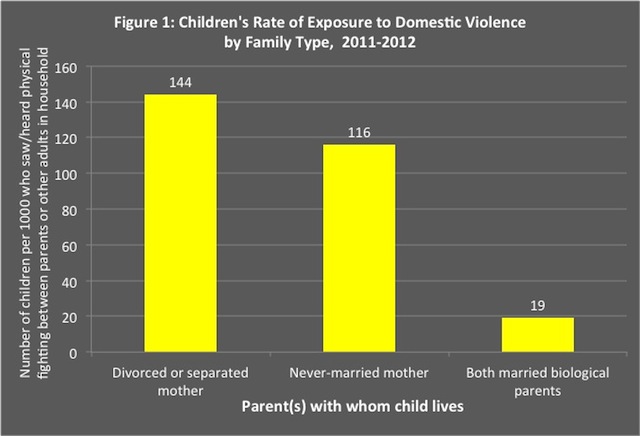
In the 2011-2012 National Survey of Children’s Health, conducted by the U.S. National Center for Health Statistics, parents of 95,677 children aged 17 and under were asked whether their child had ever seen or heard “any parents, guardians, or any other adults in the home slap, hit, kick, punch, or beat each other up.” Among children living with both married biological parents, the rate of exposure to family violence was relatively low: for every 1,000 children in intact families, 19 had witnessed one or more violent struggles between parents or other household members. By comparison, among children living with a divorced or separated mother, the rate of witnessing domestic violence was seven times higher: 144 children per 1,000 had had one or more such experiences. (See Figure 1.) These comparisons are adjusted for differences across groups in the age, sex, and race/ethnicity of the child, family income and poverty status, and the parent’s education level.

One might suppose that women who had never married would be less likely to get into violent arguments with the fathers of their children than separated or divorced mothers. Yet the rate of witnessing domestic violence among children living with never-married mothers was also elevated. It was 116 per 1,000, six times higher than the rate for children in intact families. (Some of these fights involved subsequent partners or boyfriends of the mother, rather than the father of the child.) Even children living with both biological parents who were cohabiting—rather than married—had more than double the risk of domestic violence exposure as those with married birth parents: 45 out of 1,000 of these children had witnessed family fights that became physical. Note also that a child’s family structure was a better predictor of witnessing family violence than was her parents’ education, family income, poverty status, or race.

Experiencing family violence is stressful for children, undercuts their respect and admiration for parents who engage in abusive behavior, and is associated with increased rates of emotional and behavioral problems at home and in school. For example, among children of never-married mothers who had witnessed family violence, 58 percent had conduct or academic problems at school requiring parental contact. The rate of school behavior problems for those who had not been exposed to family fights was significantly lower, though still fairly high (36 percent). Likewise, among children of divorced or separated mothers, nearly half of those exposed to family violence—48 percent—had had conduct or academic problems at school. Even among the small number of children in intact families who had witnessed family violence, just over half—51 percent—presented problems at school. This was twice the rate of school problems among students from intact families who had not witnessed domestic violence. (See Figure 2.) These figures are also adjusted for differences across groups in age, sex, and race/ethnicity of children, family income and poverty, and parent education levels. Children experiencing domestic violence were also more likely to have repeated a grade in school and to have received psychological counseling for emotional or behavioral problems. This was true in intact as well as disrupted families.

A good book to read on this topic is Theodore Dalrymple’s “Life at the Bottom“, which offered this memorable anecdote about about how and why women choose men who abuse them.

Introduction:

The disastrous pattern of human relationships that exists in the underclass is also becoming common higher up the social scale. With increasing frequency I am consulted by nurses, who for the most part come from and were themselves traditionally members of (at least after Florence Nightingale) the respectable lower middle class, who have illegitimate children by men who first abuse and then abandon them. This abuse and later abandonment is usually all too predictable from the man’s previous history and character; but the nurses who have been treated in this way say they refrained from making a judgment about him because it is wrong to make judgments. But if they do not make a judgment about the man with whom they are going to live and by whom they are going to have a child, about what are they ever going to make a judgment?

“It just didn’t work out,” they say, the “it” in question being the relationship that they conceive of having an existence independent of the two people who form it, and that exerts an influence on their on their lives rather like an astral projection. Life is fate.

Chapter one:

All the more surprising is it to me, therefore, that the nurses perceive things differently. They do not see a man’s violence in his face, his gestures, his deportment, and his bodily adornments, even though they have the same experience of the patients as I. They hear the same stories, they see the same signs, but they do not make the same judgments. What’s more, they seem never to learn; for experience—like chance, in the famous dictum of Louis Pasteur—favors only the mind prepared. And when I guess at a glance that a man is an inveterate wife beater (I use the term “wife” loosely), they are appalled at the harshness of my judgment, even when it proves right once more.

This is not a matter of merely theoretical interest to the nurses, for many of them in their private lives have themselves been the compliant victims of violent men. For example, the lover of one of the senior nurses, an attractive and lively young woman, recently held her at gunpoint and threatened her with death, after having repeatedly blacked her eye during the previous months. I met him once when he came looking for her in the hospital: he was just the kind of ferocious young egotist to whom I would give a wide berth in the broadest daylight.

Why are the nurses so reluctant to come to the most inescapable of conclusions? Their training tells them, quite rightly, that it is their duty to care for everyone without regard for personal merit or deserts; but for them, there is no difference between suspending judgment for certain restricted purposes and making no judgment at all in any circumstances whatsoever. It is as if they were more afraid of passing an adverse verdict on someone than of getting a punch in the face—a likely enough consequence, incidentally, of their failure of discernment. Since it is scarcely possible to recognize a wife beater without inwardly condemning him, it is safer not to recognize him as one in the first place.

This failure of recognition is almost universal among my violently abused women patients, but its function for them is somewhat different from what it is for the nurses. The nurses need to retain a certain positive regard for their patients in order to do their job. But for the abused women, the failure to perceive in advance the violence of their chosen men serves to absolve them of all responsibility for whatever happens thereafter, allowing them to think of themselves as victims alone rather than the victims and accomplices they are. Moreover, it licenses them to obey their impulses and whims, allowing them to suppose that sexual attractiveness is the measure of all things and that prudence in the selection of a male companion is neither possible nor desirable.

Often, their imprudence would be laughable, were it not tragic: many times in my ward I’ve watched liaisons form between an abused female patient and an abusing male patient within half an hour of their striking up an acquaintance. By now, I can often predict the formation of such a liaison—and predict that it will as certainly end in violence as that the sun will rise tomorrow.

At first, of course, my female patients deny that the violence of their men was foreseeable. But when I ask them whether they think I would have recognized it in advance, the great majority—nine out of ten—reply, yes, of course. And when asked how they think I would have done so, they enumerate precisely the factors that would have led me to that conclusion. So their blindness is willful.

The blindness is wilful, because the emotions cannot be corrected by evidence. And everything in the culture affirms women in this craziness, even after they fail over and over again with men – cohabitating with the bad ones for years, and then turning away from the good ones. They freely choose the wrong men, and freely pass by the good ones. And almost no one tells them that it’s entirely their fault. Everyone just tells them “follow your heart”. This emotional craziness causes harm to innocent children, and it needs to stop. We have to stop the man-blaming and hold women accountable for making decisions with their emotions and then expecting craziness to “work out”.

You can read the Dalrymple book online for free in this post.

What’s the best book a woman can read to prepare herself for marriage?

Does government provide incentives for people to get married?
A good marriage is more than fun and feelings – it takes planning and work

I found a great lecture by Sue Bohlin, who works at Probe Ministries. The lecture is about the book “The Proper Care and Feeding of Husbands” by Dr. Laura Schlessinger. I recommend this book more highly than any other book to Christian women. It really does a lot to give young women a different perspective on men and marriage. Don’t be thrown off by the funny title, it’s really good.

The MP3 file is here. (48 minutes)

Here is a blog post that Sue wrote that captures most of the material in the lecture.

Here’s the introduction:

Talk show host Dr. Laura Schlessinger has written a book that is improving thousands of marriages: The Proper Care and Feeding of Husbands. We need this book because millions of wives either don’t know how to love their husbands wisely and well, or they’re too self-centered to see it as important. Dr. Laura credits this dismal condition to forty years of feminist philosophy, “with its condemnation of just about everything male as evil, stupid, and oppressive, and the denigration of female and male roles in families.” While the women’s movement certainly had a hand to play in the disintegration of relationships and the family, I believe the core cause is our sinful self-centeredness, just as the Bible says.

Which is why we need help, and God instructs older women to train younger women to love their husband and children, to be self-controlled and pure, to be busy at home, to be kind, and to be subject to their husbands, so that no one will malign the word of God. The Proper Care and Feeding of Husbands is a great resource for learning these important values and skills.

And here’s the first part I thought was most important:

A listener to Dr. Laura’s radio show named Edgar wrote, “There are a few things that men want so bad they would do anything for it. I think a good number of men want respect more than love. They like to feel they have some power. I nearly cry when you tell a woman caller to respect her husband. There is so much selfishness in the world—in marriages. Prosperity has allowed women to be so independent, and thus so selfish. I always feel as though I come last—my feelings come last, my needs come last.”

“A good number of men want respect more than love.” God knew this when He made us. His commands to husbands and wives in Ephesians 5:33 reflects each one’s deepest needs: “Each one of you also must love his wife as he loves himself, and the wife must respect her husband.” Dr. Emerson Eggerichs of LoveandRespect.com points out that this verse commands a husband to love his wife. Why? She needs love like she needs air to breathe. This same verse commands a wife to respect her husband. Why? He needs respect like he needs air to breathe.

  • Respect means treating someone in a way that builds him up and doesn’t tear him down, never denigrating or attacking.
  • Respect means always treating the other person with the dignity they deserve as a person made in the image of God.
  • Respect means grasping that a man’s needs and wants are every bit as valid and important as a woman’s needs and wants.
  • Respect means not venting to others, especially the children. One woman wrote to Dr. Laura, “No emotional outlet is worth damaging my husband’s reputation.”

There are three A’s that men long for from their wives: attention, affection, and affirmation. Respect involves paying attention to what they do simply because they’re the ones doing it.

Yes, respect is very important to men, but the thing is, a woman can’t respect every man equally. She should choose a man who does things that are respectable. Then respecting him will be easy. Sometimes, women overestimate how easy men are to change after marriage. It’s better to just pick one who does all the important things instead of thinking that you can pick a good-looking one and make him do the important stuff like be faithful to you, hold a steady job, save money, argue without getting angry, etc. later. Men don’t change much, so pick one who does things that you respect and then give him respect.

And this part also seemed important to me:

A man named Roy wrote to Dr. Laura with some good advice for wives: “If you can’t accentuate the positive, at least acknowledge it. The world is full of messages to men that there are standards we don’t meet. There is always another man who is more handsome, more virile, or more athletic than we are. None of that matters if the most important person in our life looks up to us, accepts us as we are, and loves us even though we aren’t perfect. . . . All I know is that the husband who has a wife who supports him and praises him for the positive things he does is the envy of all the other men who have to live with criticism, sarcasm, and constant reminders of their failures.”

Men desperately want and need the support of their wives. This is reflected in what God reveals in His Word when He says, “It is not good for man to be alone. I will make a helper suitable for him.” And through the apostle Paul, God instructs wives to relate to their husbands in a way that meets this need when He says, “Wives, submit to your husbands as to the Lord.”

Submission is basically giving support with a willing, cooperative heart.

A wife’s submission includes knowing her gifts and strengths, and using them to serve her husband and family.

Service has a bad name, but both husbands and wives are called to serve God first and then each other; husbands are called to sacrificially love and serve their wives with Jesus as their pattern.

So what does support look like?

  • Believing in him. Telling him, “You have what it takes.” Being his #1 fan.
  • Cultivating a cooperative heart.
  • Being generous and openhearted—willing to use your gifts and strengths to help him succeed.
  • Understanding the importance of making him look good: never saying anything negative in public.
  • Creating a home that’s a safe haven from the world.
  • Having a warm heart with a positive, cheerful demeanor. Women set the temperature of the home; we are thermostats, not thermometers, of the family. (On the other hand, Proverbs says “A quarrelsome wife is like a constant dripping on a rainy day; restraining her is like restraining the wind or grasping oil with the hand.”)
  • Being interested in him and his life.
  • Showing thoughtfulness. What does he like? Do it.
  • And though by no means exhaustive, it also means being a person of faithfulness and integrity. That means keeping your promises and being dependable. As Proverbs 31 puts it, “Her husband has full confidence in her and lacks nothing of value.”

Support and encouragement is SO important to a man. A man can continue to function fine if the whole world opposes him, but not if the woman he loves doesn’t support him. When a man falls in love, a woman has to realize the enormous power she has over him, and be careful not to hurt him. Men are vulnerable to the woman they choose. Although they look pretty tough on the outside, they can easily be hurt by insults or discouragement.

Parting thoughts

So, this lecture and the book are good, but young women should also seek out the advice of older Christian women who have been married successfully for some time. Read Titus 2:3-4 – the Bible encourages older women to mentor younger women! This is really important because we are in a time where young women are often pulled by the culture in many wrong directions, and they need help from people who know what they are doing.

One last point – I actually bought the audio version of the Dr. Laura book and noticed that it was just over two hours long. It turns out that the audio version is abridged – it is not as complete as the actual book. I noticed that Sue was quoting from the book passages that I had not heard in the audio recording. So, if you want the full content, get the book, not the audio recording.

Three UVA students who knew “Jackie” challenge Rolling Stone rape story

This is from the leftist Washington Post, of all places.

Excerpt:

It was 1 a.m. on a Saturday when the call came. A friend, a University of Virginia freshman who earlier said she had a date that evening with a handsome junior from her chemistry class, was in hysterics. Something bad had happened.

Arriving at her side, three students —“Randall,” “Andy” and “Cindy,” as they were identified in an explosive Rolling Stone account — told The Washington Post that they found their friend in tears. Jackie appeared traumatized, saying her date ended horrifically, with the older student parking his car at his fraternity, asking her to come inside and then forcing her to perform oral sex on five men.

In their first interviews about the events of that September 2012 night, the three friends separately told The Post that their recollections of the encounter diverge from how Rolling Stone portrayed the incident in a storyabout Jackie’s alleged gang rape at a U-Va. fraternity. The interviews also provide a richer account of Jackie’s interactions immediately after the alleged attack and suggest that the friends are skeptical of her account.

The scene with her friends was pivotal in the article, as it alleged that the friends were callously apathetic about a beaten, bloodied, injured classmate reporting a brutal gang rape at the Phi Kappa Psi fraternity. The account alleged that the students worried about the effect it might have on their social status and how it might reflect on Jackie during the rest of her collegiate career and that they suggested not reporting it. It set up the article’s theme: That U-Va. has a culture that is indifferent to rape.

“It didn’t happen that way at all,” Andy said.

Instead, the friends remember being shocked. Although they did not notice any blood or visible injuries, they said they immediately urged Jackie to speak to police and insisted that they find her help. Instead, they said, Jackie declined and asked to be taken back to her dorm room. They went with her — two said they spent the night — seeking to comfort Jackie in what appeared to be a moment of extreme turmoil.

[…]They said there are mounting inconsistencies with the original narrative in the magazine. The students also expressed suspicions about Jackie’s allegations from that night. They said the name she provided as that of her date did not match anyone at the university, and U-Va. officials confirmed to The Post that no one by that name has attended the school.

Also, photographs that were texted to one of the friends showing her date that night were actually pictures depicting one of Jackie’s high school classmates in Northern Virginia. That man, now a junior at a university in another state, confirmed that the photographs were of him and said he barely knew Jackie and hasn’t been to Charlottesville for at least six years.

The friends said they were never contacted or interviewed by the pop culture magazine’s reporters or editors. Although vilified in the article as coldly indifferent to Jackie’s ordeal, the students said they cared deeply about their friend’s well-being and safety.

[…]They also said Jackie’s description of what happened to her that night differs from what she told Rolling Stone. In addition, information Jackie gave the three friends about one of her attackers, called “Drew” in the magazine’s article, differ significantly from details she later told The Post, Rolling Stone and friends from sexual assault awareness groups on campus. The three said Jackie did not specifically identify a fraternity that night.

[…]The article’s writer, Sabrina Rubin Erdely, did not respond to requests for comment this week.

Rolling Stone also declined to comment, citing an internal review of the story.

The leftist site Slate has an article by well-known radical feminist Hanna Rosin, who analyzes the Washington Post article.

She writes:

The Washington Post has an update on Rolling Stone‘s UVA story that strongly implies, without outright saying so, that the gang rape at the center of Sabrina Rubin Erdely’s article might be fabricated. Post reporter T. Rees Shapiro spoke at length with the three friends who met up with Jackie, the student who says she was raped, on the night in question. In the Rolling Stone story this scene was crucial. Erdely described Jackie as standing mute in her bloody dress, the Phi Kappa Psi house where the alleged rape happened looming in the background, as her friends callously debated whether they should take her to the hospital and risk ruining their social reputations. This set up the larger theme of a university culture and social scene indifferent even to the most brutalized victims of rape.

Earlier, those friends told the Post that Jackie told them she’d been forced to have oral sex—a much different story than what Jackie told Rolling Stone. This new Post article adds some details that make the entire account seem more suspicious. Jackie had told her friends—referred to by the pseudonyms “Cindy,” “Andy,” and “Randall” in the original story and in the Post’s follow-ups—that she had a date on Sept. 28, 2012, with a handsome junior in her chemistry class. (In the version she told to Rolling Stone, that date was with someone she’d met at her lifeguarding job.) But in the Post story, the friends imply that this junior might not exist and may have been invented by Jackie to make Randall jealous.

When the friends first heard about this junior, they were intrigued and asked Jackie for his number. They started exchanging text messages with him, and he described Jackie as a “super smart hot” freshman. He complained, though, that she liked a “nerd 1st yr”— meaning Randall—who is “smart and funny and worth it.” Jackie’s friends could never find this junior in the UVA database nor on social media. She provided her friends with a picture of him, but the Post has since learned that the guy in the picture is a high school classmate of Jackie’s who does not go to the University of Virginia and was in another state participating in an athletic tournament on the night of the alleged rape. (More recently, Jackie gave her friends the name of a different guy. The Post also contacted him, and he said he’d never met Jackie.)

[…]Jackie has now given her friends two different names for the man she was with that night. Neither of them was in fact with her, ever dated her, or even knew her all that well. She appears to have invented a suitor, complete with fake text messages and a fake photo, which suggests a capacity for somewhat elaborate deception. Jackie, though, has not recanted her story. Her attorney would not answer questions for the Post‘s story on Wednesday and has told reporters to stop contacting Jackie.

Here’s the most disturbing journalistic detail to emerge from the Post‘s reporting: In the Rolling Stone story, Erdely says that she contacted Randall, but he declined to be interviewed, “citing his loyalty to his own frat.” Randall told the Post he was never contacted by Erdely and would have been happy to be interviewed.

A web site called GotNews is claiming to have identified the Jackie from the story, and the Jackie they identified was a student activist in high school. That woman’s Pinterest page sported a lot of radical feminist “rape culture” memes. Also, the author of the Rolling Stone piece is a well-known feminist activist and she has in the past confessed to “shopping around” for victims in order to further her feminist agenda. That link takes you to a Youtube video where she explains her feminist agenda in her own words. This is what students learn as gospel in college, though. Our laws and our culture are built around this Sabrina / Rolling Stone view of men.