Tag Archives: Medicare

Paul Ryan’s Path to Prosperity plan balances the budget without raising taxes

Americans for Tax Reform explains what’s in it.

Excerpt:

The main details are:

Revenue neutrality.  The budget calls for the House Ways and Means Committee to produce a tax reform package with a tax revenue target of between 18 and 19 percent of GDP.  This is in line with historical revenue figures.  By contrast, big government budgets like “Gang of Six,” “Simpson-Bowles,” and the Obama budget call for a long-range revenue target of over 20 percent of GDP.  The Ryan budget is a no tax hikes budget.

Six personal rates down to two.  The Ryan budget replaces the current six-rate personal income tax structure (10, 15, 25, 28, 33, and 35 percent) with a two-rate system of 10 and 25 percent.  This will result in a lower tax rate on the majority of small business profits, from 33 or 35 percent down to 25 percent.

Repeals Obamacare tax hikes.  The Ryan budget eliminates the entire Obamacare law.  This includes repealing the 20 new or higher taxes which have taken or are about to take effect from that law.

Eliminate the AMT.  The Ryan budget eliminates the AMT, instead favoring a simpler system with lower rates and a broad tax base.

Lower rates on businesses.  As said above, the Ryan budget lowers the tax rate on the majority of small business profits to 25 percent.  It also lowers the federal income tax rate on larger corporate employers from 35 percent (the highest in the developed world) to 25 percent (closer to the developed nation average).  While this makes American companies more competitive, it would still leave us with a higher corporate income tax rate than the developed nation average, Canada, and the United Kingdom.  In order to make us truly internationally-competitive, the federal rate must fall to 20 percent or less.

No more picking winners and losers in the tax code.  In order to target revenues at 18-19 percent of GDP with tax rates no higher than 25 percent, the Ways and Means Committee will have to curtail or eliminate most tax exclusions, adjustments, deductions, and credits.  That means that all consumed income will be taxed once and only once.  No longer will the tax code favor one type of economic behavior over another.

Moves tax code from “worldwide taxation” to “territoriality.”  The Ways and Means Committee is directed to shift our tax code from one which seeks to tax income earned all over the world to one which only seeks to tax income earned in America.  This is known as “territoriality,” and it’s already been adopted by and large by our trading competitors.  By retaining a worldwide tax regime, we’re exposing our own countries to double taxation–once when they pay the foreign nation’s income tax, and again when they try to bring the money home.

This is what the budget does: (Debt as % of GDP)

Paul Ryan's 2013: The Path to Prosperity

Doug Ross has three nice charts explaining the details.

Is Barack Obama going to do anything about the debt?

According to CBS News, Obama has exploded our national debt, so there is no reason to trust anything he says about reducing the debt.

Excerpt:

The National Debt has now increased more during President Obama’s three years and two months in office than it did during 8 years of the George W. Bush presidency.

The Debt rose $4.899 trillion during the two terms of the Bush presidency. It has now gone up $4.939 trillion since President Obama took office.

The latest posting from the Bureau of Public Debt at the Treasury Department shows the National Debt now stands at $15.566 trillion. It was $10.626 trillion on President Bush’s last day in office, which coincided with President Obama’s first day.

The National Debt also now exceeds 100% of the nation’s Gross Domestic Product, the total value of goods and services.

Mr. Obama has been quick to blame his predecessor for the soaring Debt, saying Mr. Bush paid for two wars and a Medicare prescription drug program with borrowed funds.

The federal budget sent to Congress last month by Mr. Obama, projects the National Debt will continue to rise as far as the eye can see. The budget shows the Debt hitting $16.3 trillion in 2012, $17.5 trillion in 2013 and $25.9 trillion in 2022.

[…]His latest budget projects a $1.3 trillion deficit this year declining to $901 billion in 2012, and then annual deficits in the range of $500 billion to $700 billion in the 10 years to come.

If Mr. Obama wins re-election, and his budget projections prove accurate, the National Debt will top $20 trillion in 2016, the final year of his second term. That would mean the Debt increased by 87 percent, or $9.34 trillion, during his two terms.

Some of Bush’s debt total can be explained by considering that Nancy Pelosi and Harry Reid raised the debt by $5 trillion dollars over 4 years when they took control of the House and Senate in January of 2007. But they’re Democrats, and that’s what Democrats do.

Related posts

Paul Ryan questions Chief Actuaries of Medicare, Medicaid and Social Security

I found all of this stuff on the House Budget Committee web site.

Medicare and Medicaid

Paul Ryan interviews Richard Foster, Chief Actuary of the Centers for Medicare and Medicaid Services.

Excerpt of transcript:

HBC CHAIRMAN RYAN: As you may know, I’ve been working across the aisle with a member of the Oregon delegation from the Senate on a premium support plan that uses competitive bidding to help determine the contribution. Competitive bidding we’ve seen has worked well in Medicare Part D and Medicare Advantage.  I’d like to get your thoughts on choice and competition as it relates to these previous successful reform plans. Given what we’ve seen in these aspects of Medicare, do you believe that competitive bidding is a process that can be successfully applied Medicare-wide?

CMS CHIEF ACTUARY FOSTER: Yes, I think it can. Obviously, it would represent a large change from the status quo, but I think it could work. We’ve seen the signs of this – you mentioned the Part D prescription drug program, for example, where the different drug plans compete against each other on the quality of their benefit package and the premium level. And we’ve seen – every year since Part D started – a migration of beneficiaries to more efficient plans with lower premiums. So that can help. We’ve also seen for durable medical equipment that competitive bidding, in this particular area of Fee-For-Service Medicare, reduced prices that we had to pay by 40 percent.

RYAN: By forty percent?

FOSTER: Forty percent, that’s right.

RYAN: Those are the kinds of cost savings we’re going to have to achieve if want to make good on the promise of the Medicare guarantee.  This should not be a partisan issue. Competitive bidding is something Alice Rivlin has been a champion of, Ron Wyden has been talking about, the Bipartisan Policy Center, and more. There is a lot of data out there that competitive bidding when applied Medicare-wide can achieve the benefit of keeping these benefits going while attacking the root cause of cost growth.

It sounds to me like there is a real crisis, that Ryan has a plan to solve it, and that the person who is the most aware of the finances of these two entitlements agrees with Ryan.

Social Security

Paul Ryan interviews Stephen Goss, Chief Actuary of the Social Security Administration.

Excerpt of transcript:

HBC CHAIRMAN RYAN:  If we do [nothing], then we have an across-the-board cut of about 23 percent that occurs in benefits. Is that correct?

SSA CHIEF ACTUARY GOSS: Exactly… The Commissioner standing at that time would simply have 77 cents available for every dollar of scheduled benefits, and would not be permitted to spend more than that. We do not have borrowing authority. So a decision would have to be made about who would get the money. We could have an across-the-board 23% cut immediately, or a Commissioner could say, ‘Well we’re not going to pay the March benefits in March. We’ll wait until April – wait until more revenues come in to allow full payment a month late.’ After a few months we would perhaps then have to start paying benefits twomonths late. So this would be a way that it could be handled. Of course, if people have to pay rent on time, that would be a difficulty. There’s no easy way out on this… We hope and pray that Congress would indeed act well before we ever hit the Trust Fund reserve exhaustion.

RYAN: Given that we have this abrupt 23% cut that occurs in law – current law – is it not wise so start reforming now, sooner, so that the distribution of the change is spread more broadly and evenly across income cohorts? Let me ask it this way: does that abrupt 23% cut hit current senior cohorts? A person who is turning 62, or 65 today – that affects them as well, correct?

GOSS: It certainly would. They would be at an older age at that time but clearly it would affect them. That is assuming that we wait and do absolutely nothing until that point.

RYAN: So if one provides reforms soon, could you not prevent these kinds of effects from hitting those current cohorts? Could you not phase reforms in gradually that prevent that 23% cut from happening so it doesn’t affect people who are currently in or near retirement? Could you structure reforms that prevent that from happening if you act sooner?

GOSS: Absolutely. We have a number of proposals – including yours Chairman Ryan – and many other proposals that would take exactly that approach. Our trustees and everybody who speaks on this has opined extensively about the value of acting sooner rather than later, so that we can have gradual changes phased in and we have more options if we act relatively soon.

In 2006, Nancy Pelosi was asked when she would be willing to fix these entitlement programs. Her reply? “Never. Is never good enough for you?“. Democrats hate children – they want to pile debt upon debt onto future generations, who will not even have mothers and fathers to take care of them. First they smash the family with no-fault divorce and same-sex marriage. Then they run up trillions and trillions of dollars in debt handing out bailouts and green energy grants to their election fundraisers. It’s sick.

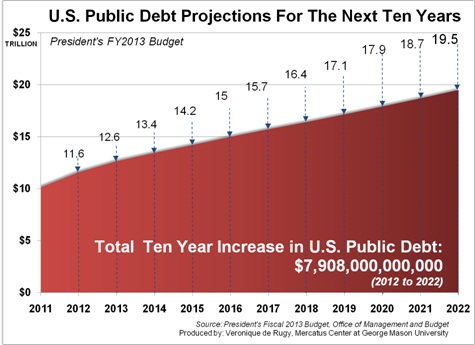
Obama’s new budget adds $8 trillion to the debt over the next 10 years

Obama 2013 Budget Debt Projection

What does the liberal Associated Press think?

Excerpt:

Taking a pass on reining in government growth, President Obama unveiled a record $3.8 trillion election-year budget plan Monday, calling for stimulus-style spending on roads and schools and tax hikes on the wealthy to help pay the costs. The ideas landed with a thud on Capitol Hill.

Though the Pentagon and a number of Cabinet agencies would get squeezed, Obama would leave the spiraling growth of health care programs for the elderly and the poor largely unchecked. The plan claims $4 trillion in deficit savings over the coming decade, but most of it would be through tax increases Republicans oppose, lower war costs already in motion and budget cuts enacted last year in a debt pact with GOP lawmakers.

[…]By the administration’s reckoning, the deficit would drop to $901 billion next year – still requiring the government to borrow 24 cents of every dollar it spends – and would settle in the $600 billion-plus range by 2015.The deficit for the current budget year, which ends Sept. 30, would hit $1.3 trillion, a near record and the fourth straight year of trillion-plus red ink.

Obama’s budget blueprint reprises a long roster of prior proposals: raising taxes on couples making more than $250,000 a year; eliminating numerous tax breaks for oil and gas companies and approving a series of smaller tax and fee proposals. Similar proposals failed even when the Democrats controlled Congress.

The Pentagon would cut purchases of Navy ships and F-35 Joint Strike Fighters – and trim 100,000 troops from its rolls over coming years – while NASA would scrap two missions to Mars.

But there are spending increases, too: The Obama plan seeks $476 billion for transportation projects including roads, bridges and a much-criticized high-speed rail initiative.

The Heritage Foundation has more.

Excerpt:

Spending in the President’s budget rises inexorably from today’s $3.8 trillion to $5.8 trillion in 2022. Throughout the decade, outlays hold stubbornly above 22 percent of gross domestic product (GDP), more than twice the New Deal’s share of the economy in its peak years. In constant dollars, outlays are more than three times the peak of World War II.

In 2012, his budget results deliver a fourth consecutive annual deficit exceeding $1 trillion and then make it worse with another round of not-so-shovel-ready construction projects and government “investments” totaling $178 billion. Among these are the typical road, bridge, and school construction, but then they go alarmingly beyond the usual “infrastructure” arguments to fund teachers’ pay.

Obama’s future deficit reduction comes mainly from Budget Control Act cuts already in place, $848 billion in discredited phantom “savings” from the wind-down of operations in Iraq and Afghanistan, taking credit for reductions in 2011 appropriations, and roughly $1.8 trillion in unnecessary tax increases on those earning above $250,000 and the oil and gas industry.

Yet even with the hefty tax increases and illusory savings, the President’s deficits over the next decade never fall below $575 billion (in 2018) and climb back to $704 billion (in 2022)—but again only assuming the tax increases and mystical savings cited above.

Debt held by the public in the President’s budget rises from 74.2 percent of GDP today to an economically hazardous 76.5 percent of GDP in 2022. These are historically high debt levels: the post–World War II average is just 43 percent. Moreover, the President’s debt estimates are low because of the unreal nature of much of his proposed deficit reduction.

Regarding the most critical fiscal challenge of the day—the need to restructure Medicare, Medicaid, and Social Security—the President has once again taken a pass. By the middle of this century, these three programs and Obamacare will consume about 18 percent of GDP, soaking up all the historical average of federal tax revenue. The notion of “protecting” them through benign neglect only ensures their collapse, and the longer Congress and the President wait to address the problem, the more wrenching will be the consequences. But the President merely reruns previous ideas, such as more cuts to medical providers, ignoring the need for fundamental reform.

For other entitlements, the President repeats a range of mere chipping-around-the-edges proposals from last year’s budget, many of which are really tax or fee increases, not spending reductions.

In short, the President’s budget is the same worn-out collection of higher spending and higher taxes he has offered three times before—with the same inevitable result of more spending, higher taxes, and still more government debt.

Here’s a Republican reaction from Senator Bob Corker:

The libertarian Reason magazine has more budget charts.