Tag Archives: Medicare

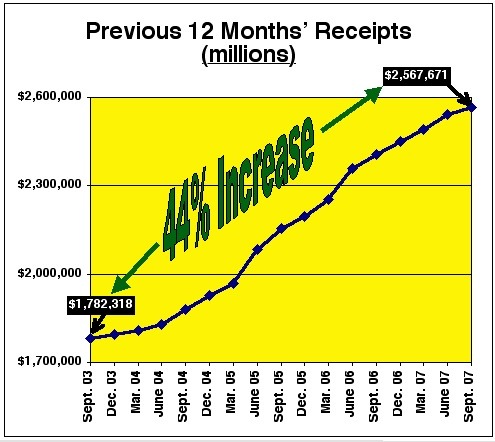
Bush’s tax cuts led to a 44% increase in revenues from 2003 to 2007

Federal Receipts 2003 through 2007

From Newsbusters. It turns out that Bush’s tax cuts in 2001 and 2003 were not responsible for adding to the deficit. They actually increased the amount of tax money being collected, as the economy grew, and more jobs were created. People pay more in taxes when they have jobs.

Excerpt:

The graph doesn’t show collections tanking, does it? Instead, the graph shows that collections increased by 44%, or almost $800 billion, in four years. Adding up the individual increments in each of the four years compared to 2003 (2004 – $98B; 2005 – $371B; 2006 – $624B; 2007 – $785B; 2008, not shown, treating IRS stimulus payments as outlays instead of negative receipts – $835B), what really happened is that in the five full fiscal years after George W. Bush got the across-the-board and investment-related tax cuts he had been pushing for since taking office in 2001, the cumulative increase in tax collections was over $2.7 trillion.

Doubtless, the static analysis crowd will claim that collections would have been even higher (I guess by a cumulative $1.6 trillion, given the AP’s Democratic Party talking point above) if the Bush cuts hadn’t been enacted. Two words, guys: Prove it. Two follow-up words: You can’t.

We can argue all day long about the how much of the increase in collections was due to the incentive effects of the tax cuts and how of the improvement might have occurred anyway, but no one can credibly act as if it’s an established fact that the Bush cuts somehow caused collections to go $1.6 trillion in the opposite direction. There is absolutely no proof for this contention, and plenty of evidence that the Bush cuts jump-started an economy and federal collections, both of which had been flat or declining during the two years leading up to mid-2003. The more reasonable conclusion to reach is that the country would already be dead in the water if the Bush tax cuts hadn’t passed in 2003. Instead, the wire service hopes that its “Bush tax cuts cost us” meme will be gullibly recited during the next several days at its subscribing newspaper, TV, and radio outlets. “Disgraceful” doesn’t even begin to describe this pathetic promotion of self-evident falsehood.

The fact is that the federal budget was one good year away from balancing after the $162 deficit reported in fiscal 2007. Unfortunately, that was the last budget passed by a Republican-controlled Congress, and it was the only year which showed a modest increase in overall spending. Beginning in 2007 with effects beginning in fiscal 2008, the House and Senate controlled by Nancy Pelosi and Harry Reid began increasing spending at rates far beyond what profligate Republicans spent earlier in the decade, and, unfortunately, Bush 43 made no real effort to stop them…

Read the whole thing.

UPDATE: Reggie sent me this article showing that the Reagan tax cuts also increased revenues.

Excerpt:

In 1980, the last year before the tax cuts, tax revenues were $956 billion (in constant 1996 dollars).

Revenues exceeded that 1980 level in eight of the next 10 years. Annual revenues over the next decade averaged $102 billion above their 1980 level (in constant 1996 dollars).

The graph is here.

When you get people to start engaging in the economy, you can collect more taxes from them. They engage when they think that they will be able to keep more of what they make from their labor.

On “Face the Nation”: Marco Rubio says the President has no plan

Marco Rubio takes on Obama spokesman Bob Schieffer on CBS’ “Face the Nation”. (H/T Mariangela)

In this speech on the floor of the Senate, he lays the whole debt problem and the solutions.

I just wish that the voters would compare Obama’s class-warfare rhetoric and his performance on job create with Marco Rubio’s clear explanation of the incentives and motives of job creators. We don’t need redistribution of wealth, we need people to have jobs. When people have jobs, they feel comfortable to investing or spend money.

What produces more fraud? The free market or government-run programs?

From National Review, an article examining how government programs like Medicare and Medicaid are ripe for fraud and waste.

Excerpt:

The three most salient characteristics of Medicare and Medicaid fraud are: It’s brazen, it’s ubiquitous, and it’s other people’s money, so nobody cares.

Consider some of the fraud schemes discovered in recent years. In Brooklyn, a dentist billed taxpayers for nearly 1,000 procedures in a single day. A Houston doctor with a criminal record took her Medicare billings from zero to $11.6 million in one year; federal agents shut down her clinic but did not charge her with a crime. A high-school dropout, armed with only a laptop computer, submitted more than 140,000 bogus Medicare claims, collecting $105 million. A health plan settled a Medicaid-fraud case in Florida for $138 million. The giant hospital chain Columbia/HCA paid $1.7 billion in fines and pled guilty to more than a dozen felonies related to bribing doctors to help it tap Medicare funds and exaggerating the amount of care delivered to Medicare patients. In New York, Medicaid spending on the human-growth hormone Serostim leapt from $7 million to $50 million in 2001; but it turned out that drug traffickers were getting the drug prescribed as a treatment for AIDS wasting syndrome, then selling it to bodybuilders. And a study of ten states uncovered $27 million in Medicare payments to dead patients.

These anecdotes barely scratch the surface. Judging by official estimates, Medicare and Medicaid lose at least $87 billion per year to fraudulent and otherwise improper payments, and about 10.5 percent of Medicare spending and 8.4 percent of Medicaid spending was improper in 2009. Fraud experts say the official numbers are too low. “Loss rates due to fraud and abuse could be 10 percent, or 20 percent, or even 30 percent in some segments,” explained Malcolm Sparrow, a mathematician, Harvard professor, and former police inspector, in congressional testimony. “The overpayment-rate studies the government has relied on . . . have been sadly lacking in rigor, and have therefore produced comfortingly low and quite misleading estimates.” In 2005, the New York Timesreported that “James Mehmet, who retired in 2001 as chief state investigator of Medicaid fraud and abuse in New York City, said he and his colleagues believed that at least 10 percent of state Medicaid dollars were spent on fraudulent claims, while 20 or 30 percent more were siphoned off by what they termed abuse, meaning unnecessary spending that might not be criminal.” And even these experts ignore other, perfectly legal ways of exploiting Medicare and Medicaid, such as when a senior hides and otherwise adjusts his finances so as to appear eligible for Medicaid, or when a state abuses the fact that the federal government matches state Medicaid outlays.

Government watchdogs are well aware of the problem. Every year since 1990, the U.S. Government Accountability Office has released a list of federal programs it considers at a high risk for fraud. Medicare appeared on the very first list and has remained there for 22 straight years. Medicaid assumed its perch eight years ago.

They waste money because it’s not their money – it’s your money. Private companies minimize waste because it is in their interest to minimize waste – they have to be competitive and be responsive to customers, or they don’t get paid. The profit motive reduces waste and fraud.