Tag Archives: Materialism

Angus Menuge’s ontological argument against naturalism

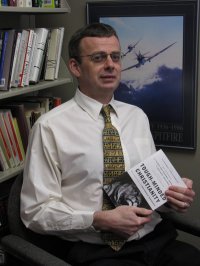
Dr. Angus Menuge
Dr. Angus Menuge

(Note: this is NOT the ontological argument, which I do not use, and do not recommend. This is the ontological argument from reason, and it’s a good argument which I would use in a debate. If you’re not good at science, use the moral argument and this argument – you can do pretty well with them!)

Here’s some information about Dr. Menuge:

Dr. Angus Menuge joined Concordia University Wisconsin in 1991. He earned his BA from the University of Warwick, England, and his MA and Ph.D. degrees from the University of Wisconsin-Madison, where he studied philosophy, computer science and psychology. Menuge’s dissertation was on the philosophy of action explanation, and his current research interests include philosophy of mind, philosophy of science and Christian apologetics.

In 2003, Menuge earned a Diploma in Christian Apologetics from the International Academy of Apologetics, Evangelism and Human Rights, which meets each July in Strasbourg, France. His thesis, a critique of scientific materialism, went on to become the book Agents Under Fire: Materialism and the Rationality of Science (Lanham, MD: Rowman and Littlefield, 2004).

Menuge has also edited volumes on C. S. Lewis, Christ and culture and the vocation of scientist, and has written several Bible studies. He is currently working with Joel Heck (Concordia Texas) on a collection of essays defining Lutheran education for the 21st century, entitled Learning at the Foot of the Cross (Concordia University Press, forthcoming).

A frequent speaker, Menuge has given presentations on Christianity and culture, science and vocation, philosophy of mind, C. S. Lewis, Intelligent Design and the case against scientific materialism. He is a member of the Evangelical Philosophical Society.

Dr. Menuge presented a paper at a recent Evangelical Philosophical Society conference for students and professors of philosophy, and you can download the paper here in Word format. (here’s a PDF version I made). I got these straight from the source, and got permission to post them, too.

Here is the introduction to the paper that Dr. Menuge read at the EPS conference:

The argument from reason is really a family of arguments to show that reasoning is incompatible with naturalism. Here, naturalism is understood as the idea that foundationally, there are only physical objects, properties and relations, and anything else reduces to, supervenes on, or emerges from that. For our purposes, one of the most important claims of naturalism is that all causation is passive, automatic, event causation (an earthquake automatically causes a tidal wave; the tidal wave responds passively): there are no agent causes, where something does not happen automatically but only because the agent exerts his active power by choosing to do it. The most famous version of the argument from reason is epistemological: if naturalism were true, we could not be justified in believing it. Today, I want to focus on the ontological argument from reason, which asserts that there cannot be reasoning in a naturalistic world, because reasoning requires libertarian free will, and this in turn requires a unified, enduring self with active power.

The two most promising ways out of this argument are: (1) Compatibilism—even in a deterministic, naturalistic world, humans are capable of free acts of reason if their minds are responsive to rational causes; (2) Libertarian Naturalism—a self with libertarian free will emerges from the brain. I argue that neither of these moves works, and so, unless someone has a better idea, the ontological argument from reason stands.

The paper is 11 pages long, and it is awesome for those of you looking for some good discussion of one of the issues in the area of philosophy of mind. The thing you need to know about Dr. Menuge is that he is quite strong and forceful in his writing and presentation, and to me, that is an excellent thing for a scholar to be. Very direct, and very confrontational. You can even read an account of his debate with that radical atheist nutcase P.Z. Myers in 2008 here.

By the way, the epistemological argument from reason (P(R) on N & E is low) is the argument made by the famous Christian philosopher Alvin Plantinga. I blogged about that argument before. It’s good to know BOTH of these arguments. They both work, and they are both awesome. If you put these two arguments together with William Lane Craig’s moral argument, that’s three strong philosophical arguments that are easy to use, but backed by solid analytic philosophy.

Powerpoint slideshow

But there is more than just the paper! At the EPS apologetics conference, which is meant for lay people as well as scholars, he presented this Powerpoint slideshow, (here’s a PDF version I made) . The slides are easier to understand than the paper, but the paper is not too bad.

And here is another article by Dr. Menuge on intelligent design.

Study by UCLA neuroscientist Jeffrey Schwartz falsifies materialist determinism

Apologetics and the progress of science

Here’s a summary of the research of UCLA professor Jeffrey Schwartz, authored by William Dembski.

Excerpt:

Schwartz provides a nonmaterialist interpretation of neuroscience and argues that this interpretation is more compelling than the standard materialist interpretation. He arrived at this position as a psychiatrist specializing in the treatment of obsessive-compulsive disorder (OCD). OCD sufferers recognize obsessive-compulsive thoughts and urges as separate from their intrinsic selves. For instance, after a few washings, the compulsive hand-washer realizes that his hands are clean and yet feels driven to keep washing them. It was reflection on this difference between the obvious truth (the hands are clean) and the irrational doubts (they might still be dirty) that prompted Schwartz to reassess the philosophical underpinnings of neuroscience.

From brain scans, Schwartz found that certain regions in the brain of OCD patients (the caudate nucleus in particular) exhibited abnormal patterns of activity. By itself this finding is consistent with a materialist view of mind (if, as materialism requires, the brain enables the mind, then abnormal patterns of brain activity are likely to be correlated with dysfunctional mental states). Nonetheless, having found abnormal patterns of brain activity, Schwartz then had OCD patients engage in intensive mental effort through what he called relabeling, reattributing, refocusing, and revaluing (the 4 Rs). In the case of compulsive hand-washing, this involved a patient acknowledging that his hands were in fact clean (relabeling); attributing anxieties and doubts about his hands being dirty to a misfunctioning brain (reattributing); directing his thoughts and actions away from handwashing and toward productive ends (refocusing); and, lastly, understanding at a deep level the senselessness of OCD messages (revaluing).

Schwartz documents not only that patients who undertook this therapy experienced considerable relief from OCD symptoms, but also that their brain scans indicated a lasting realignment of brain-activity patterns. Thus, without any intervention directly affecting their brains, OCD patients were able to reorganize their brains by intentionally modifying their thoughts and behaviors. The important point for Schwartz here is not simply that modified thoughts and behaviors permanently altered patterns of brain activity, but that such modifications resulted from, as he calls it, “mindful attention”-conscious and purposive thoughts or actions in which the agent adopts the stance of a detached observer.

So mind-brain interaction is not a one-way street. Everyone knows that you can alter your consciousness, beliefs, moods, sensations, etc. by changing your brain, e.g. – with drugs. But it turns out that you can also will to focus your thoughts on certain things in order to change your brain chemistry. So the causation is not just bottom-up, but also top-down.

Now mindfulness therapies – which are documented in the research papers published by Schwartz (like this one and this one and this one)- assume the existence of free will. Naturalists don’t like these scientific publications because naturalists don’t believe in free will, as the famous naturalist philosopher Alex Rosenberg explained in his debate with William Lane Craig.

This post from Uncommon Descent explains the naturalist conundrum.

Excerpt:

The issue, for Schwartz, turns on whether or not there is such a thing as free will. The assumption of free will is critical to mindfulness therapies for practical purposes.

Philosophies and religions have various opinions about ultimate free will. The therapist must ask, is my patient capable of carrying out a program that requires that he choose to focus his attention on A and not B? In practice, this turns out to be true for many patients, which makes the therapy useful. There is neuroscience evidence for brain reorganization as a result, showing that it is not merely an imagined effect.

Now, if someone wishes to claim, as many outspoken advocates of Darwinian evolution have, for example, that free will is impossible, the only thing that a mindfulness therapist can say is, go away. Either they are mistaken or the research results from mindfulness therapies are.

By the way, if you like this topic, and want a resource to show your friends, be sure and get a hold of the debate on mind vs. brain between Jeffrey M. Schwartz and Michael Shermer.

Michael Behe and Keith Fox debate theistic evolution vs intelligent design

Two Rams butting heads: may the best ram win!

Michael Behe and Keith Fox debate evolution and intelligent design. (See below for link to video)

Details:

Michael Behe is professor of biochemistry at Lehigh University, Pennsylvania and the founder of the modern Intelligent Design movement. His book “Darwin’s Black Box” ignited the controversy 14 years ago when it claimed that certain molecular machines and biological processes are “irreducibly complex” and cannot be explained by Darwinian evolution.

Keith Fox is Professor of biochemistry at the University of Southampton and chairman of Christians in Science. As a theistic evolutionist he believes that Evolution is the best explanation going for the complexity we see and that ID is a blind scientific alley and theologically unappealing to boot.

They debate whether micromachines in the cell such as the “bacterial flagellum” could have evolved by a Darwinian process of evolution. When inference to design is and isn’t acceptable in science. Whether random mutation can mathematically stack up to complex life, and whether God is reduced to a divine “tinkerer” by ID.

Here’s the debate:

Summary

Note: the following debate summary is rated “S” for Snarky. Reader discretion is advised.

Michael Behe:

  • ID is not Biblical creationism
  • ID is not religion
  • ID is a scientific research program
  • People refuse to discuss ID because of personal philosophical assumptions
  • ID is like the Big Bang – it is based on evidence, but it has broad religious implications

Keith Fox:

  • ID is not Biblical creationism, but it isn’t science

Michael Behe:

  • ID is compatible with common descent
  • ID is only opposed to unplanned, unguided evolution (Darwinism)
  • ID is not necessarily opposed to long periods of time

Behe’s first book – the bacterial flagellum

Keith Fox:

  • Here are a couple of papers that show how parts of the flagellum evolved
  • They are possible pathways

Michael Behe

  • No, those are studies that show that there are similarities between bacterial flagella in multiple organisms
  • Similarities of proteins between different organisms do not necessarily imply a developmental pathway
  • The problem of having the instructions to BUILD the flagellum still remains

Keith Fox:

  • Maybe parts of the flagellum had other functions before they were used in the flagellum
  • Maybe you can use the parts of the flagellum for other purposes
  • Maybe, one can imagine, it’s possible that!

Michael Behe:

  • No, parts have to be modified and re-purposed in order to be used for other functions

Keith Fox:

  • But maybe the proteins can be used in other systems for other things
  • I re-purpose parts from of designed things to other purposes in my house when I do maintenance

Michael Behe

  • Uh, yeah – but aren’t you an intelligent designer? What does your home maintenance have to do with Darwinian evolution?

Is ID another God-of-the-gaps argument?

Michael Behe:

  • Well consider the Big Bang… there was a build-up of scientific evidence for that theory
  • Just because a theory has religious implications, doesn’t mean that it isn’t true
  • You really have to look at the specific evidence for a theory, and not decide in advance

Keith Fox: (I’m paraphrasing/inventing/mocking from now on)

  • But the Big Bang is based on discoveries, and intelligent design is based on gaps in our scientific knowledge
  • What if I did have evidence of a step by step pathway (which I don’t right now)? Then I would win the argument – what would you do then?

Michael Behe:

  • Well, if tomorrow you do manage to find expiremental evidence of a pathway, which you don’t have today, then I would be wrong
  • ID is falsifiable by experimental evidence
  • But what about your your view? Is that falsifiable by experimental evidence?
  • What if someone goes into a lab (someone like Scott Minnich?) and performs gene knockout experiments, and publishes the results
  • You knock out a gene from the bacterial flagellum, you wait for a large number of generations, and it never develops the missing gene
  • You repeat this with every one of the 50 genes in the bacterial flagellum and it never recovers for any of the 50 genes
  • There is no pathway to build up even one of the 50 genes – according to actual experiments
  • What do Darwinists do with experimental evidence that falsifies Darwinism?

Keith Fox:

  • No, I would not accept that experimental evidence could falsify Darwinism
  • Just because known published experimental evidence that we have today falsifies Darwinism, it doesn’t mean Darwinism is false because it’s not falsifiable
  • We don’t know how Darwinism even works – it happened so long ago, and it’s not repeatable or testable, so how could lab ,experiments falsify it?
  • Darwinism is science and intelligent design is faith, though

Which side has the experimental evidence?

Michael Behe:

  • Consider the largest longest-running lab experiment of evolution, Richard Lenski’s experiments on e. coli
  • Lenski has presided over 50,000 generations, (millions of years of evolution)
  • The bacterium did evolve and they did get better but not by evolving features, but by disabling features

Keith Fox:

  • But those are just LAB EXPERIMENTS! What do lab experiments prove?
  • What if? What if? What if? You don’t know, it happened so long ago, and you weren’t there! You weren’t there!
  • (clutches Flying Spaghetti Monster idol tighter and sobs pitifully)

Michael Behe:

  • See, the thing is that I have actual experiements, and here’s some more evidence that just got published last week
  • So I’ve got evidence and then some more evidence and them some other evidence – experimental evidence
  • And all the evidence shows that adaptation is done losing traits not by gaining traits
  • And the published observations are what we see in nature as well

Keith Fox:

  • But doesn’t Darwinism explain some things that we observe?

Michael Behe:

  • Well, I am not saying that micro-evolution doesn’t explain some things – it explains bacterial resistance, and other micro-evolution
  • it just doesn’t explain macro-evolution, and that’s what the experiments show

Keith Fox:

  • But ID is a science stopper! It stops science! You can’t produce experimental evidence to falsify Darwinism – that would stop science!

Michael Behe:

  • Well, you have to understand that the Big Bang postulated a non-material cause to the entire physical universe and yet the experimental evidence was allowed to stand because it was testable and verifiable evidence, even if the theory does have religious implications
  • All explanations in science are design to settle a question and it stops rival explanations that are not as good at explaining the observations
  • Finding the best explanation stops further study because it is better than rival explanations

Keith Fox:

  • Well you have to come up with a materialist explanation because that’s the only kind that a functional atheist like me will allow

Michael Behe:

  • Well, what if the best explanation for an observed effect in nature is non-material, as with the Big Bang?

Keith Fox:

  • But I have to have a material explanation because I am a functional atheist! (i.e. – a theistic evolutionist = functional atheist)

Michael Behe:

  • Well what about the cosmic fine-tuning argument? Do you accept that?
  • That’s an inference to design based on the latest scientific discoveries

Keith Fox:

  • Well I do accept that argument, but I don’t accept design in biology
  • When you apply it to biology, somehow it’s bad and you can’t do that or you losing research money and get fired
  • Anyway, your argument is based on a gap in our current knowledge

Michael Behe:

  • No, back in Darwin’s time we had a gap in our knowledge – we didn’t know what the cell was – we thought it was jello
  • Now, we know what the cell is really like, it’s irreducibly complex, and you can’t build up those molecular machines in a step-wise manner
  • The inference to design is based on the progress of science revealing the increasing levels of complexity
  • In experiments, Darwinian mechanisms cannot build anything useful, instead genes are disabled or dropped
  • You guys don’t have the evidence to prove your view that naturalistic mechanisms can do the creating
  • You keep issuing promissory notes

Keith Fox:

  • Well, you’re just seeing design subjectively, because you are a non-scientist
  • I’m being objective when I tell you that we will discover a materialist explanation later on – really really soon now, maybe even tomorrow, yeah
  • You won’t accept my speculations and you insist on these published experiments
  • You’re subjective and I’m objective
  • Just give me more research money so I can hide the decline better

Michael Behe:

  • Uh, you’re the one who is subjective – I cited evidence, and you are the one who is speculating
  • You have arguments from credulity, and I’ve got the lab experiments
  • You refuse to be skeptical, I am the one who is being skeptical

Keith Fox:

  • Maybe, maybe, maybe! Maybe tomorrow! Maybe in a parallel universe! Maybe aliens from Planet 9 from Outer Space!
  • Who knows! I certainly don’t know! And that somehow means you don’t know either! See?

Michael Behe:

  • Well, to prove me wrong, go into the lab, and run experiments and evolve some new genes (using Darwinian mechanisms) that have new useful functionality

Are there limits to what evolution can do?

Michael Behe:

  • You need multiple changes in the genome to get a new helpful feature (let’s say two specific mutations)
  • One specific change is possible
  • the odds are against getting multiple beneficial changes are really really small – you need two SPECIFIC changes to occur in order

Keith Fox:

  • Well, lots of things are really unlikely – any permutation of dice rolls is as unlikely as any other

Michael Behe:

  • Well, we are talking about TWO SPECIFIC mutations that are needed to get a beneficial function – lots of other mutations are possible, but we are looking for a specific outcome that requires two SPECIFIC mutations out of the whole genome
  • You aren’t going to get useful outcomes unless you direct the mutations

Keith Fox:

  • But then why does God allow evil!!!!1!1!!one!!!