
Tag Archives: Marriage

Five liberal Democrat policies that hurt minorities

Marriage and Poverty

The five policies are:

  • higher minimum wage rates
  • opposition to school voucher programs
  • releasing criminals from jail
  • affirmative action
  • single mother welfare

This article is by Jason L. Riley, and it appeared in the Wall Street Journal.

Excerpt:

At the urging of labor unions, President Obama has pushed for higher minimum wages that price a disproportionate percentage of blacks out of the labor force. At the urging of teachers unions, he has fought voucher programs that give ghetto children access to better schools.

Both policies have a lengthy track record of keeping millions of blacks ill-educated and unemployed. Since the 1970s, when the federal government began tracking the racial achievement gap, black test scores in math, reading and science have on average trailed far behind those of their white classmates. And minimum-wage mandates have been so effective for so long at keeping blacks out of work that 1930, the last year in which there was no federal minimum-wage law, was also the last year that the black unemployment rate was lower than the white rate. For the past half-century, black joblessness on average has been double that of whites.

Last week the Justice Department said it would release some 6,000 inmates from federal prison starting later this month. The goal, according to the White House, is to ease overcrowding and roll back tough sentencing rules implemented in the 1980s and ’90s.

But why are the administration’s sympathies with the lawbreakers instead of their usual victims—the mostly law-abiding residents in low-income communities where many of these inmates eventually are headed? In dozens of large U.S. cities, violent crime, including murder, has climbed over the past year, and it is hard to see how these changes are in the interest of public safety.

The administration assures skeptics that only “nonviolent” drug offenders will be released, but who pays the price if we guess wrong, as officials have so often done in the past?

When Los Angeles asked the Rand Corp. in the 1990s to identify inmates suitable for early release, the researchers concluded that “almost no one housed in the Los Angeles jails could be considered non-serious or simply troublesome to their local communities” and that “jail capacity should be expanded so as to allow lengthier incarceration of the more dangerous.”

A 2002 federal report tracked the recidivism rate of some 91,000 supposedly nonviolent offenders in 15 states over a three-year period. More than 21% wound up rearrested for violent crimes, including more than 700 murders and more than 600 rapes. The report also noted the difficulty of identifying low-risk inmates. Auto thieves were rearrested for committing more than a third of the homicides and a disproportionate share of other violent offenses.

Keep in mind that when criminals are release, they don’t go move into wealthy progressive neighborhoods. It’s not the wealthy leftists elites who have to deal with the released inmates. It’s the poor, low-income minority neighborhoods that have to deal with them.

By the way, I covered the minimum wage argument here, and I covered the school choice argument here.

That covers the first 3 policies. This article from The College Fix covers the fourth policy, affirmative action.

It says:

A UCLA law professor critiques affirmative action as detrimental to the very people it strives to aid: minority students.

Professor Richard Sander, though liberal-leaning, has deemed affirmative action practices as harmful, a notion that contradicts a liberal view in college admissions, said Stuart Taylor, a nonresident senior fellow at the Brookings Institution.

[…]Sander began teaching law at UCLA in 1989. After a few years he garnered an interest in academic support and asked permission to analyze which strategies most effectively assist struggling students.

After reviewing statistics on performance, especially those of students with lower academic merit, he noticed correlations between race and academic success.

“I was struck by both the degree to which it correlated with having weak academic entering credentials and its correlation with race,” Sander said in a recent interview with The College Fix. “And as I looked into our admissions process I realized that we were giving really a large admissions preference.”

Sander noticed that students admitted into the law school with lower academic credentials than their peers had significantly lower percentages of passing the Multistate Bar Examination, Sander said. This especially pertained to minority students who were given special consideration in the admittance process due to their race rather than their academic preparedness.

He then began thinking about whether or not these students would have better chances of succeeding if they went to a less elite university, he said.

He called this discrepancy a mismatch; when minority students with lower credentials than their peers are accepted into more challenging universities and then suffer academically as a result.

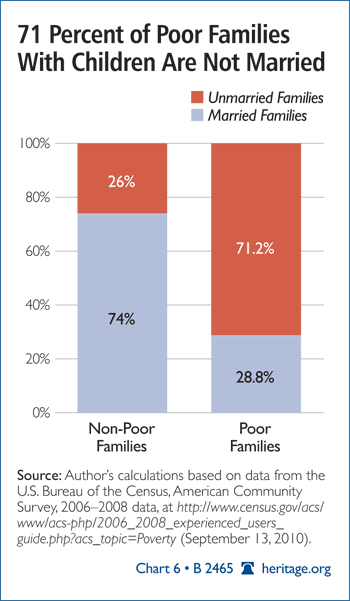
And the fifth policy is welfare. Welfare encourages women to not marry the men that they have sex with, since they will lose their single mother benefits if they do. Children who are raised fatherless are more likely to struggle in a number of areas, and they are especially likely to be poor. What we should be doing (if we really want to help the poor) is paying people to get married and stay married. But Democrats are opposed to that. The connection between welfare, fatherlessness, poverty and crime is explained in a previous post.

Women who delay marriage for casual sex surprised to be single in their mid-30s

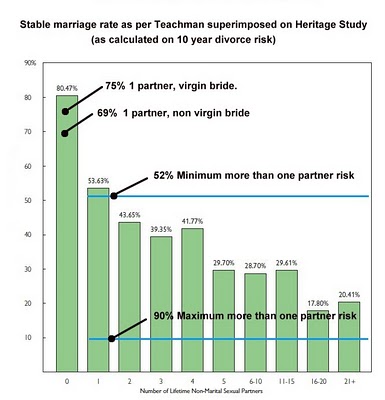
Divorce risk and number of pre-marital sex partners

Dr. Mark Regnerus is a sociologist at the University of Texas at Austin. He has published books on the changing nature of relationships with Oxford University Press. His newest book argues that the Sexual Revolution has caused men to lose interest in marriage because women are now giving them sex for free, without them having to prove their husband credentials first. This causes men to be disinterested in the traditional ways of impressing a woman, namely, getting a job, moving out, being willing to commit, and being able to provide for children who may appear.

The Daily Signal provides a case study taken from Regnerus’ latest book “Cheap Sex”, which illustrates the problem.

Excerpt:

Sarah is 32 years old and recently moved to Texas from New York, looking for a new start—in more ways than one.

Brooklyn had grown too expensive for her hipster pocketbook. A relationship she had hoped would blossom and mature there had instead withered. So to Austin she came, hoping she could improve upon her modest $22,000 annual earnings the previous year.

Her most recent sexual partner—Daniel—was not actually a relationship per se. He was not the reason she moved. Rather, he was a 23-year-old American she had met in China four years before during a three-week language immersion program.

[…]When they first met, and slept together, Sarah was in a relationship with David, the man for which she had moved to, and then away from, New York. She ended up “cheating on him,” that is, David, several times.

[…]If you’re having trouble keeping times, dates, and boyfriends straight, it’s understandable. Sarah herself laughs at the drama of it all.

[…]Getting serious was never much of an option. He was 23, and she was 32: “We both knew … he was graduating from college and, you know, like we both, at least I knew it was never gonna work out. I think he kind of felt the same way.”

[…]When asked how rapidly her relationships tend to become sexual, Sarah replied, “the first or second date.” That account did not stand out from those of many other interviewees.

The numbers are on her side, too. In the 2014 Relationships in America survey, sex before the relationship begins was the modal—meaning the most common—point at which Americans report having first had sex in their current relationships.

Is her timing of sex intentional? No. “It just happens,” she reasoned.

[…]This, she claims, is the standard approach to dating among her peers, if not necessarily the most optimal: “I don’t think it’s unusual, but I think that for a lasting relationship, it’s not the best approach.”

[…]Three years later, now 35, Sarah continues to live in Austin and continues to find commitment elusive. She does not dislike her life, but it is not the one she envisioned a decade earlier.

Daniel is a musician, which doesn’t surprise me at all. A musician, student or other unemployed penniless bad boy will not make any demands on the woman, because he almost certainly has no plan for the future.  This is what many women today want: someone for right now who doesn’t want her to do anything  to prepare for marriage, e.g. – get a real job, stop the thrill-seeking, stop traveling the world. No matter what a woman says about marriage,  if her actions now show an interest in fun and thrills, then she doesn’t want marriage.

The typical woman’s plan for marriage is simply to imagine marriage happening later somehow, without her having to do anything that she doesn’t feel like doing right now. It would be like “planning” for your retirement by taking trips all over the world right now, while imagining living off the interest from a million dollars in savings at age 55. This problem is what happens when the culture tells women that they should not aspire to marriage, and should not measure men to see if they will make good husbands and fathers. If a woman cannot expect a man to be a man (protector, provider, moral and spiritual leader), then she will choose men on other criteria.

This is what women today want:

  • hot appearance
  • confident words about the future
  • empty resume
  • empty bank account
  • several years younger than they are
  • no firm convictions about morality
  • no firm convictions about theology
  • progressive political views, especially on abortion

Men who have no jobs and no money don’t lead women, and are much easier for women to manipulate. The problem with these men is – as any married woman knows – is that those men do not commit. Why not? Because they cannot afford to commit. Marriage, put simply, costs money. Starter houses cost a quarter million. Children cost a quarter million each, not counting college. Retirement costs a quarter million per spouse. And so on. But there is no one in this society telling women that they need to care about choosing men who are serious about the objective duties of the husband role.

Women love to believe that they can choose a hot, irresponsible bad boy who gives them feelings, and then magically mold him into a husband: able to work hard, save money, be self-controlled, faithful and good with children. Feelings determine the choice of man, and feelings tell them that the man can be magically transformed into a husband somehow. Perhaps by giving him premarital sex! That will make him responsible. After all, you can put out a fire with gasoline, right? This is the most common approach women today take to relationships: get drunk, have sex with hot bad boy, shack up with him, wait for him to propose marriage.

I frequently tell my female friends about women I know like the one in the article – many raised by two married parents in Christian homes. They have arts degrees, empty resumes, empty bank accounts, and histories of alcoholism, bulimia, promiscuity and/or divorce. My female friends give me the same advice: “YOU NEED TO LOWER YOUR STANDARDS OR YOU’LL NEVER GET MARRIED”. If that’s the best that they can do, then it’s no wonder that men are not interested in marriage.

If you want men to be interested in marriage, fix the root cause. The root cause of the marriage rate declining is not men. The root cause is feminism.

Why sexual permissiveness is not compatible with the welfare of children

Gay activist Terry Bean and Barack Obama

Here is a striking essay from the Public Discourse. It talks about how we, as a society, have generally taken on an anything-goes approach with respect to sex. The one exception (for now) is pedophilia, which is the sexual abuse of children by adults. The essay points out that there is no moral reason for having this one exception, on secularism. The exception exists because of a sort of “ick” factor – not because we have a moral framework that makes anything right or wrong objectively. The essay argues that we are not shy about harming children in a million other ways, and lists some examples. I just want to quote a few and then I’ll comment about my own moral views around sexuality.

Quick summary of his argument:

The moral structure of pedophilia is simply this: the welfare of children is subordinate to the sexual gratification of adults.

[…]We should be thankful that the Sanduskys and Laheys are still considered monstrous. But in contemporary America that condemnation rests on sentiment and not on moral reasoning. No one can simultaneously explain why their actions were so vile and uphold the first commandment of the sexual revolution: fulfill thy desires.

[…]No, it isn’t how Sandusky and Lahey did what they did, or under what circumstances, that explains the disgust. It’s what they did—but nobody wants to acknowledge that.

The reason for that reluctance becomes clear, if we keep in mind the moral structure of pedophilia. Sexual gratification trumps. Thank goodness that for now, there aren’t many men who are sexually attracted to youngsters. In that single case, we raise the banner for the children. But in no other case.

That’s his argument.

Now, a quick excerpt:

If we altered the question, and asked not how many people have done sexually abusive things with children, but how many people have done sexual things that redounded to the suffering of children, then we might confess that the only thing that separates millions of people from Jerry Sandusky is inclination. Everything that was once considered a sexual evil and that is now winked at or cheered, everything without exception, has served to hurt children, and badly.

We might point here to divorce. Unless it is necessary to remove oneself and one’s children from physical danger and moral corruption, the old wisdom regarding divorce should hold, if children themselves have anything to say about it. Parents will say, “My children can never be happy unless I am happy,” but they should not lay that narcissistic unction to their souls. Children need parents who love them, not parents who are happy; they are too young to be asked to lay down their lives for someone else. It is not the job of the child to suffer for the parent, but the job of the parent to endure, to make the best of a poor situation, to swallow his pride, to bend her knees, for the sake of the child.

We might point to births out of wedlock. The child has a right to enter more than a little nursery decorated with presents from a baby shower. He should enter a human world, a story, a people. He should be born of a mother and a father among uncles and aunts and cousins and grandparents, stretching into the distant past, with all their interrelated histories, with his very being reflected in all those mirrors of relation, not to mention his eyes and his hair, the talents in his fingers and the cleverness in his mind. This belonging to a big and dependable world can be secured only in the context of the permanent love of his mother and father, declared by a vow before the community and before the One in whom there is no shadow of alteration.

And now my comments about this article.

So pretty much all my regular readers know that I take extremely conservative views on social issues, since I am an evangelical Protestant Christian. But I don’t just have conservative views – I am also chaste at a personal level. I am not one of these re-virgins – I have never had sex. Not once. And I don’t mean I have never had sexual intercourse only, I mean that I have never even kissed a woman on the lips. I am a radical on the issue of chastity. I don’t view chastity as depriving oneself of something good, I view it is as a thing that serious Christian men do when we want to enable and develop other capabilities. It’s my conviction that chastity enables the capability to see women as God sees them, which is a precursor to growing them up to serve him. That’s what women are for, on my view – exactly like men are for knowing and serving God. It’s my belief that once a man has premarital sex, it becomes much harder for him to view women that way.

So, I am really really really against any kind of sexual activity of any kind prior to marriage. I think that if a man wants to show affection to a woman, then sex before marriage is not the way to do that. There are other ways, and men ought to know how to speak the language of love to a woman in many different ways apart from sex, assuming that this is his goal for her. A man needs to create a context for sex before he can have it. Marriage is how a man provides a context for sex. Not just by giving a woman safety, but by specifying a shared vision which the woman agrees to support when she agrees to marriage. Men shouldn’t have intimate experiences with women who are not committed to a constructive partnership with specific goals, e.g. – birthing or adopting children in order to give them a stable, loving sane environment to grow up in. That is so rare nowadays, especially on college campuses which are inundated with sexual liberalism, thanks to radical feminism. My conviction that sex is not something that should be done before marriage emerges partly from a concern that children should have the best opportunity for that stable environment. And that’s what I want to focus on – sexual restraint as a means of providing for children and protecting children.

First, premarital sex creates a situations where abortion happens. Men and women should not engage in activities for recreational reasons that could possibility lead to the death of another human being, period. I am not one of these people who thinks “oh, poor woman who is pregnant, what a beastly man who did that to her – but she can do the right thing and keep the baby”. I think that women are equally to blame with men for even having sex before marriage – the mistake was having sex in the first place. So getting pregnant and keeping the baby is good, but preventing fatherlessness and not putting burdens on taxpayers is much, much better. People who engage in premarital sex are not only selfish, immature and irresponsible, but they are actually acting in a negligent fashion towards the child that may result from their choices. We should not make choices that put innocent children at risk. Premarital sex can be compared with driving while drunk in that regard. You might think it’s fun, but it’s not a good, moral thing to do because of the harm that may result. Saying “but I didn’t mean to” after the fact doesn’t change the harm.

Second, I’ve blogged before about many studies (like this one) that show that premarital sex reduces relationship stability, duration, and quality. Another study I blogged about showed that the number of sexual partners that a man or woman has before marriage directly affects the probability that the relationship will provide a stable environment for raising children. So one of my reasons for being chaste is to maximize the probability of giving my future children that stable environment. Another reason to be chaste is to give my future wife that gift of fidelity. When a man has proven that he has the ability to restrain himself with his wife during the courtship, that is a signal to her that he is good at self-control. The ability to court without premarital sex shows her that he is able to think about her as a person, and that he is able to evaluate her objectively for the purpose of filling the roles of wife and mother. And that this is, in fact, his whole purpose for her. A purpose that will survive the decline of her appearance and youth. Security is another gift that a chaste man gives his wife, so that she can age confidently.

Thirdly, I have in the past blogged about research on gay unions showing how various factors that are more probable in gay relationships, (e.g. – elevated rates of domestic violence, low relationship stability, drug abuse, high rates of promiscuity, etc.), undermine the stability of the environment in which children grow up. More here. Dr. Ryan Anderson has argued that the norms present in gay relationships will undermine the norms of traditional marriage, (permanence, sexual exclusivity, etc.), if marriage is redefined to eliminate the gender requirement. I think we need to keep the traditional definition of marriage because it’s better for children if we do (and there are other reasons to prefer natural marriage, as I’ve written about before).

I think I’ve said enough here to show that very often when it comes to sexual activity what is driving my conservative views is concern for others. Concern not just for the future children, but for the future wife. And not just for them, but for society as a whole, who would have to pay the social costs of things like divorce, and the social costs of children of divorce, etc. And not just for society, but also for God, who intends sexuality for a very specific purpose – it is a form of communication for two people who have been bonded to each other for life. Marriage has to count for God and achieve his goals. One of those goals is raising up children well for his sake. And adults need to control themselves in order to provide children with what they need.