Tag Archives: Logic

Sean McDowell takes a closer look at the Mormon Scriptures

Brian Auten of Apologetics 315 tweeted this article from Conversant Life.

Excerpt:

The view of faith in the Mormon Scriptures differs from the Bible. Alma 32:17 says, “Yea, there are many who do say: If thou wilt show unto us a sign from heaven, then we shall know of a surety; then we shall believe. Now I ask, is this faith? Behold, I say unto you, Nay; for if a man knoweth a thing he hath no cause to believe, for he knoweth it.” In other words, faith involves believing something we do not know. If we knew it, there would be no need for faith. But the Bible proposes a different relationship between faith and reason. Rather than being opposites, the Bible presents a view of faith that is based upon what we do know. As philosopher J.P. Moreland put it, “Faith is trusting what we have reason to believe is true.”

For instance, in Exodus 7-14 Moses performs various miracles so the people will know there is a God and then in turn trust him (see 7:14 and 8:10). The pattern is:

1.  God performs a miracle

2.  The people have knowledge about God

3.  They are called to believe

Exodus 14:31 says, “When Israel saw the great power that the Lord used against the Egyptians, the people feared the Lord and believed in Him and in His servant Moses.” The miracle that they could see and know came first, not the belief.

Knowledge is not the opposite of belief, as the Mormon scriptures suggest. Faith does not involve believing something without evidence. Rather, it is a trust in God in light of what weknow to be true. Jesus healed the paralytic so the people would know that he has the authority of God (Mark 2:10).

I suspect the reason the Book of Mormon has this view of faith and knowledge is that the Mormons’ claims cannot be investigated. The cities mentioned in the Book of Mormon have not been located (i.e. Zarahemla), the gold plates cannot be examined, the hill Cumorah cannot be excavated because LDS scholars can’t even agree whether it’s in North or Central America, and the millions of bodies destroyed in the Americas are nowhere to be found. When there is no convincing external evidence corroborating a belief, it must be based upon experience, feeling, and blind faith. This may be the view of faith in the Book of Mormon, but it is decidedly not the biblical view (see John 20:30-31).

This reminded me of a comment written by a Mormon named “Stacie” over at Answering Mormons:

I feel very sad that you are so lost. I also find it sad that you do so much more ‘research’ on why the LDS beliefs are ‘wrong’ rather than simply living your life as you believe you should. I know that the Church of Jesus Christ of Latter-Day Saints is true. I have received confirmation that it is true, that every aspect of the LDS church is true. Joseph Smith was a true prophet and all prophets that have succeeded him have been and are true prophets of God. I know that the Book of Mormon is true. I know that the Bible is true as far as it is translated correctly. I know that Heavenly Father hears and answers our prayers, whether you are LDS or not. I know that Jesus Christ died for our sins and that through His Atonement and resurrection we have the ability to return to our Heavenly Father. I won’t use any more of my time to read anything on this blog, but I know that if you truly read the Book of Mormon, pray about it, do all that you can to learn about the LDS church and believe that Heavenly Father will answer your prayers then you, too, will know the truth of the Gospel. If we based our faith on logic it wouldn’t be faith would it? Faith is believing in something that you cannot see or feel. I wish you all the best and pray that you may find the peace and happiness that comes with the truth and light of the Gospel of Jesus Christ.

This view by Stacie is consistent with my own experiences dealing with Mormons over the past two decades. Many of them can be quite “nice” and talented in every area except religion. When it comes to the religion, feelings and blind faith dominate over reason and evidence, for Mormons. They believe what they believe because they want to, and that’s all there is to it. I once had a Mormon in high school tell me that Mormons didn’t care at all about what scientists could show about the origin of the universe. Whenever what scientists could show contradicted their Scriptures, they always chose their Scriptures. There was a huge divorce between their religion and the real world.

I explained in a previous post that Mormonism is not only contradicted by science, but also by history. In addition, others have shown that Mormonism is incoherent philosophically. I recommend checking those posts out if you want three clear-cut reasons why Mormonism cannot be true.

One final thought. As Mormonism becomes more widespread, might we not expect that their unBiblical, irrational, unsupported view of faith will infect the larger culture, so that the the divorce between theology and truth becomes complete in the minds of the secular world? Let’s hope that Mormonism’s view of faith does not become mainstream.

For a good explanation of the Christian view of faith, read this post.
A comparison of Mormonism and Christianity: similarities and differences

I’m seeing a lot of ignorance in the mainstream media, including in the conservative media, and even from some Republican politicians. So it’s time to set the record straight on what Mormons and Christians really believe.

Do Mormons and Christians have the same beliefs?

First, let’s take a look at what the founder of Mormonism, Joseph Smith, believes about the origin of the universe:

“The elements are eternal. That which had a beggining will surely have an end; take a ring, it is without beggining or end – cut it for a beggining place and at the same time you have an ending place.” (“Scriptural Teachings of the Prophet Joseph Smith”, p. 205)

“Now, the word create came from the word baurau which does not mean to create out of nothing; it means to organize; the same as a man would organize materials and build a ship. Hence, we infer that God had materials to organize the world out of chaos – chaotic matter, which is element, and in which dwells all the glory. Element had an existance from the time he had. The pure principles of element are principles which can never be destroyed; they may be organized and re-organized, but not destroyed. They had no beggining, and can have no end.”
(“Scriptural Teachings of the Prophet Joseph Smith”, p. 395)

A Mormon scholar named Blake Ostler summarizes the Mormon view in a Mormon theological journal:

“In contrast to the self-sufficient and solitary absolute who creates ex nihilo (out of nothing), the Mormon God did not bring into being the ultimate constituents of the cosmos — neither its fundamental matter nor the space/time matrix which defines it. Hence, unlike the Necessary Being of classical theology who alone could not not exist and on which all else is contingent for existence, the personal God of Mormonism confronts uncreated realities which exist of metaphysical necessity. Such realities include inherently self-directing selves (intelligences), primordial elements (mass/energy), the natural laws which structure reality, and moral principles grounded in the intrinsic value of selves and the requirements for growth and happiness.” (Blake Ostler, “The Mormon Concept of God,” Dialogue: A Journal of Mormon Thought 17 (Summer 1984):65-93)

So, Mormons believe in an eternally existing universe, such that matter was never created out of nothing, and will never be destroyed.

What do the best Christian theologians believe about the origin of the universe?

“By what means did you make heaven and earth?  What tool did you use for this vast work? You did not work as a human craftsman does, making one thing out of something else as his mind directs… Nor did you have in your hand any matter from which you could make heaven and earth, for where could you have obtained matter which you had not yet created, in order to use it as material for making something else?  It must therefore be that you spoke and they were made.  In your Word you created them.” (Augustine, Confessions 11.5.7.)

“As said above (Question 44, Article 2), we must consider not only the emanation of a particular being from a particular agent, but also the emanation of all being from the universal cause, which is God; and this emanation we designate by the name of creation. Now what proceeds by particular emanation, is not presupposed to that emanation; as when a man is generated, he was not before, but man is made from “not-man,” and white from “not-white.” Hence if the emanation of the whole universal being from the first principle be considered, it is impossible that any being should be presupposed before this emanation. For nothing is the same as no being. Therefore as the generation of a man is from the “not-being” which is “not-man,” so creation, which is the emanation of all being, is from the “not-being” which is “nothing”.” (Summa Theologica, part 1, question 45)

“Let this, then, be maintained in the first place, that the world is not eternal, but was created by God.” (John Calvin, Genesis)

“We firmly believe and simply confess that there is only one true God … the Creator of all things visible and invisible, spiritual and corporeal; who from the very beginning of time by His omnipotent power created out of nothing both the spiritual beings and the corporeal.” (The Fourth Lateran Council of 1215)

So who is right? Has the universe always existed or did it come into being out of nothing?

Breaking the tie

To break the tie, we must use the ordinary tools of investigation – logic, science, historical methods, and so on. Let’s use science this time.

The Big Bang cosmology is the most widely accepted cosmology of the day. It is based on several lines of evidence, and is broadly compatible with Genesis. It denies the past eternality of the universe. This peer-reviewed paper in an astrophysics journal explains. (full text here)

Excerpt:

The standard Big Bang model thus describes a universe which is not eternal in the past, but which came into being a finite time ago. Moreover,–and this deserves underscoring–the origin it posits is an absolute origin ex nihilo. For not only all matter and energy, but space and time themselves come into being at the initial cosmological singularity. As Barrow and Tipler emphasize, “At this singularity, space and time came into existence; literally nothing existed before the singularity, so, if the Universe originated at such a singularity, we would truly have a creation ex nihilo.

[…]On such a model the universe originates ex nihilo in the sense that at the initial singularity it is true that There is no earlier space-time point or it is false that Something existed prior to the singularity.

Christian cosmology requires such a creation out of nothing, but this is clearly incompatible with what Mormons believe about the universe. The claims about the universe made by the two religions are in disagreement, and we can test empirically to see who is right, using science.

Taking religion seriously

You can find other disagreements between Christianity and Mormonism, if you are not so busy putting on make-up like politicians and journalists are. For example, Christianity is monotheistic (one God) and Mormonism is polytheistic (many gods). That means Mormonism is more like Hinduism than it is like Christianity – Mormonism and Hinduism even agree on the eternally oscillating universe. You can read all about it, with citations from Mormon scholars, in this article, authored by Baylor University professor Francis J. Beckwith. Or you could take a look at the history of Mormonism, and see if the claims made in the religious texts of Mormonism are historical. Or you could take a look at the prophetic claims of the founder of Mormonism and see if they were accurate.

Here’s an examination of the historical basis for the Mormon Scriptures, for example:

This is how responsible people evaluate religions to see whether they are all the same as the others, and, more importantly, if one is true. The point of religion is not to make people feel good, or to make them have a sense of community. The point of religion is to know how we got here, where we are going, and what we are supposed to be doing – as matters of fact.

As long as you don’t assume, before doing any research, that all religions are the same, and that all of their claims are equally untestable, then you can actually investigate things and come to some conclusions. Investigating is good, but watching debates with different views that feature public, testable evidence is also a good idea. The important thing is that you are serious about evaluating the testable claims of different religions, and that you don’t assume that choosing a religion is just like taste in clothes or taste in food, which varies by time and place and is really not making objective propositional claims about reality, instead of subjective claims about individual tastes and preferences. Just because you were born into a country that believed that the Earth was flat (or round) that wouldn’t take away the obligation on you to test those views and go looking at other views using the tools of logic, science and historical analysis.

What is the Christian doctrine of the Trinity?

The Christian doctrine of the Trinity

I have a friend who is considering Christianity and he is stuck on the doctrine of the Trinity. Tom, this one’s for you.

Excerpt:

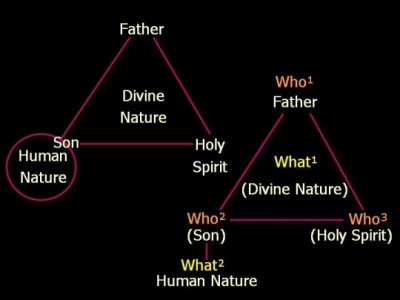
So, what exactly do we mean when we talk about the Trinity? Writing in the early third century, in hisAgainst Praxeas, Tertullian is credited with first employing the words “Trinity”, “person” and “substance” to convey the idea of the Father, Son and Spirit being “one in essence — but not one in person”. Indeed, Tertullian writes,

“Thus the connection of the Father in the Son, and of the Son in the Paraclete, produces three coherent Persons, who are yet distinct One from Another. These Three are, one essence, not one Person, as it is said, “I and my Father are One,” in respect of unity of substance not singularity of number.”

This concept was established as church orthodoxy at the famous Council of Nicaea in A.D. 325. The Nicene Creed speaks of Christ as “God of God, Light of Light, very God of very God, begotten not made, being of one substance with the Father.”

It is this definition that I am going to assume in the discussion that follows. Succinctly, then, the doctrine of the Trinity may be defined thusly: Within the one being or essence that is God, there exists three co-equal and co-divine distinct persons — namely the Father, Son and Holy Spirit — who share that essence fully and completely. This concept is not to be confused with polytheism, which maintains that there are multiple gods. While orthodox Christianity emphatically holds there to be only one God, we nonetheless understand God to be complex in his unity. The concept is also not to be confused with the ancient heresy of modalism, which maintains that God exists in three different modes. The Son has never been the Father and the Holy Spirit has never been the Son or the Father. Modalism is refuted by the picture given to us in all four gospels (Matthew 3:16-17; Mark 1:9-11; Luke 3:21-22; John 1:32-34) in which the Holy Spirit descends on Jesus in the form of a dove and a voice is heard from Heaven “This is my beloved Son. With him I am well pleased.” Similarly, it should be noted that the Father, Son and Spirit do not each make up merely a third of the Godhead. Rather, each of the three persons is God in the full and complete sense of the word.

Having shown that Scripture emphatically rejects the notion that the Father, Son and Spirit are synonymous persons, only five propositions remain to be demonstrated in order to provide Biblical substantiation for the concept of the Trinity. Those propositions are:

  1. There is only one eternal God.
  2. The Father is the eternal God.
  3. The Son is the eternal God.
  4. The Holy Spirit is the eternal God.
  5. Although the Father, Son and Holy Spirit are non-synonymous persons, the concept of the Trinity does not violate the law of non-contradiction.

Let’s take a look at each of these in turn.

He then takes a close look at what the Bible says about God with respect to those assertions. There can be no doubt that the Bible teaches that God is one divine substance, and three persons.