Tag Archives: Logic

A Harvard University student explains how evidence changed her mind about God

Harvard University student discovers apologetics

Here’s a must-read article  about the effectiveness of apologetics on college campuses in Christianity Today.

Excerpt:

I don’t know when I first became a skeptic. It must have been around age 4, when my mother found me arguing with another child at a birthday party: “But how do you know what the Bible says is true?” By age 11, my atheism was so widely known in my middle school that a Christian boy threatened to come to my house and “shoot all the atheists.” My Christian friends in high school avoided talking to me about religion because they anticipated that I would tear down their poorly constructed arguments. And I did.

As I set off in 2008 to begin my freshman year studying government at Harvard (whose motto is Veritas, “Truth”), I could never have expected the change that awaited me.

It was a brisk November when I met John Joseph Porter. Our conversations initially revolved around conservative politics, but soon gravitated toward religion. He wrote an essay for the Ichthus, Harvard’s Christian journal, defending God’s existence. I critiqued it. On campus, we’d argue into the wee hours; when apart, we’d take our arguments to e-mail. Never before had I met a Christian who could respond to my most basic philosophical questions: How does one understand the Bible’s contradictions? Could an omnipotent God make a stone he could not lift? What about the Euthyphro dilemma: Is something good because God declared it so, or does God merely identify the good? To someone like me, with no Christian background, resorting to an answer like “It takes faith” could only be intellectual cowardice. Joseph didn’t do that.

And he did something else: He prodded me on how inconsistent I was as an atheist who nonetheless believed in right and wrong as objective, universal categories. Defenseless, I decided to take a seminar on meta-ethics. After all, atheists had been developing ethical systems for 200-some years. In what I now see as providential, my atheist professor assigned a paper by C. S. Lewis that resolved the Euthyphro dilemma, declaring, “God is not merely good, but goodness; goodness is not merely divine, but God.”

Joseph also pushed me on the origins of the universe. I had always believed in the Big Bang. But I was blissfully unaware that the man who first proposed it, Georges Lemaître, was a Catholic priest. And I’d happily ignored the rabbit trail of a problem of what caused the Big Bang, and what caused that cause, and so on.

By Valentine’s Day, I began to believe in God. There was no intellectual shame in being a deist, after all, as I joined the respectable ranks of Thomas Jefferson and other Founding Fathers.

I wouldn’t stay a deist for long. A Catholic friend gave me J. Budziszewski’s book Ask Me Anything, which included the Christian teaching that “love is a commitment of the will to the true good of the other person.” This theme—of love as sacrifice for true good—struck me. The Cross no longer seemed a grotesque symbol of divine sadism, but a remarkable act of love. And Christianity began to look less strangely mythical and more cosmically beautiful.

Now, I’m going to get into a lot of trouble for saying this, but I think that if you are a Christian and you are in a secular university, then you really need to have put in the effort to study the areas of science, history and philosophy that are relevant to the Christian faith. This is regardless of your personal abilities or field of study. We must all make an effort regardless of how comfortable we are with things that are hard for us to learn.

Granted, most people today are not interested in truth, because we just have this cultural preoccupation with having fun and feeling good and doing whatever we want to do whenever we want to do it. Most atheists I’ve met are like that, but some are more honest, open-minded, and they just have never encountered any good reasons or evidence to think that God exists and that Jesus is anything other than a man. There are a lot of atheists like that who are just waiting to hear some decent evidence. Our job is to prepare for them and then engage them, if they are willing to be engaged.

I think that definition of love she cited – self-sacrifice for the true good of another person – is important. I don’t think that ordinary Christians like you or me spends time on apologetics because we “like” it. I know lots of Christians who are in tough, expensive academic programs trying to get the skills they need to defend truth in areas that matter. They do this because they know that there are people out there who are interested in truth, and who are willing to re-prioritize their lives if the truth is made clear to them. We need to be willing to serve God by doing hard things that work.

Positive arguments for Christian theism

William Lane Craig discusses faith and reason with university students

William Lane Craig lecturing to university students

This is an interview of Dr. William Lane Craig before college students at the University of Central Florida. (95 minutes)

You can get an MP3 of the lecture here. (33 MB)

Questions from the interviewer: (40 minutes)

  • What started you on his journey of studying faith and reason?
  • How would you define the word “faith”?
  • Are faith and reason compatible? How are they related?
  • How can reasonable faith help us to avoid the two extremes of superstition and nihilism?
  • Who makes the best arguments against the Christian faith?
  • Why are angry atheists like Dawkins and Hitchens more well known than better-informed academic atheists?
  • Does the Bible require Christians to give the unbeliever reasons for their faith?
  • How does faith spur Christians to think carefully about the big questions in life?
  • Should the American church prod churchgoers to develop their minds so they can engage the secular culture?
  • When talking about Christianity intellectually, is there a risk of neglecting the experience of being a Christian?
  • Which Christian apologist has shaped your thinking the most?
  • Which Christian philosopher has shaped your thinking the most?
  • Does the confidence that comes from apologetics undermine humility and reverence?
  • If you had to sketch out a 5 minute case for Christianity, what would you present?
  • Can non-Christians use their reason to arrive at truth?
  • Are there cases where atheists must affirm irrational things in order to remain atheists?
  • Can the universe have existed eternal, so that there is no need to explain who created it?
  • Even if you persuade someone that Christianity is true, does that mean they will live it out?

There is also a long period of questions, many of them hostile, from the audience of students (55 minutes).

  • Haven’t you said nasty things about some atheists? Aren’t you a meany?
  • What do you make of the presuppositional approach to apologetics?
  • Can a person stop being a Christian because of the chances that happen to them as they age?
  • Why did God wait so long after humans appeared to reveal himself to people through Jesus?
  • Can a person be saved by faith without have any intellectual assent to truth?
  • How do you find time for regular things like marriage when you have to study and speak so much?
  • How would you respond to Zeitgeist and parallels to Christianity in Greek/Roman mythology?
  • Do Christians have to assume that the Bible is inerrant and inspired in order to evangelize?
  • If the universe has a beginning, then why doesn’t God have a beginning?
  • Can you name some philosophical resources on abstract objects, Platonism and nominalism?
  • How can you know that Christianity more right than other religions?
  • Should we respond to the problem of evil by saying that our moral notions are different from God’s?
  • Define the A and B theories of time. Explain how they relate to the kalam cosmological argument.
  • How can Christians claim that their view is true in the face of so many world religions?
  • What is the role of emotions in Christian belief and thought?
  • Can evolution be reconciled with Christian beliefs and the Bible?
  • When witnessing person-to-person, should you balance apologetics with personal testimony?
  • Is there a good analogy for the trinity that can help people to understand it? [Note: HE HAS ONE!]
  • How can Christians reconcile God’s omniscience, God’s sovereignty and human free will?

This is a nice introductory lecture that is sure to get Christians to become interested in apologetics. As you watch or listen to it, imagine what the world would be like if every Christian could answer the questions of skeptical college students and professors like Dr. Craig. What would non-Christians think about Christianity if every Christian had studied these issues like Dr. Craig? Why aren’t we making an effort to study these things so that we can answer these questions?

It is really fun to see him fielding the questions from the skeptical university students. My favorite question was from the physics student who sounds really foreign, (at 1:19:00), then you realize that he is a Christian. I do think that Dr. Craig went a little far in accommodating evolution, but I put that down to the venue, and not wanting to get into a peripheral issue. I’m also surprised that no one asked him why God allows humans to suffer and commit acts of evil.

If you are looking for a good basic book on apologetics, then I would choose “Is God Just a Human Invention?” by Sean McDowell and Jonathan Morrow. And you can even be part of a reading group that Brian Auten of Apologetics 315 just announced, that I will be participating in. We will all be reading the book together, chapter by chapter, and lots of people will be available to answer your questions.

Who is William Lane Craig?

About William Lane Craig:

William Lane Craig is Research Professor of Philosophy at Talbot School of Theology in La Mirada, California.

Dr. Craig pursued his undergraduate studies at Wheaton College (B.A. 1971) and graduate studies at Trinity Evangelical Divinity School (M.A. 1974; M.A. 1975), the University of Birmingham (England) (Ph.D. 1977), and the University of Munich (Germany) (D.Theol. 1984). From 1980-86 he taught Philosophy of Religion at Trinity… In 1987 they moved to Brussels, Belgium, where Dr. Craig pursued research at the University of Louvain until assuming his position at Talbot in 1994.

He has authored or edited over thirty books, including The Kalam Cosmological Argument; Assessing the New Testament Evidence for the Historicity of the Resurrection of Jesus; Divine Foreknowledge and Human Freedom; Theism, Atheism and Big Bang Cosmology; and God, Time and Eternity, as well as over a hundred articles in professional journals of philosophy and theology, including The Journal of Philosophy, New Testament Studies, Journal for the Study of the New Testament, American Philosophical Quarterly, Philosophical Studies, Philosophy, and British Journal for Philosophy of Science.

Craig’s CV is here.

Craig’s list of publications is here.

William Lane Craig is, without a doubt, the top living defender of Christianity. He has debated all of the most famous atheists, including Christopher Hitchens, Sam Harris, etc. as well as academic atheists like Quentin Smith, Peter Millican, etc. if you search this blog, you’ll find many debates posted here, sometimes even with snarky summaries.

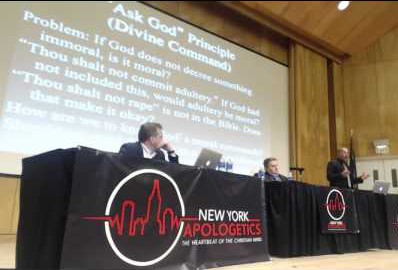
Atheist Michael Shermer tries to rationally ground morality in debate with Frank Turek

Michael Shermer debates Frank Turek: atheism and morality

The topic of the debate was on the grounding of morality – which worldview (theism or atheism) is better at grounding morality?

And here is the MP3 for the cross-examination only, which is what I will be summarizing. (12.5 Mb)

The full debate can be seen here and can be heard here.

Turek’s cross-examination period starts at 74m22s and ends at 89m20s.

Shermer’s cross-examination period starts at 89m50s and ends at 105m0s.

Topics of Turek’s cross-examination:

  • evolution produces Shermer’s moral sense and Hitler’s moral sense
  • why does Shermer think his is better than Hitler’s, since both were produced by the same evolution?
  • what makes right or wrong if evolution is the source of morality?
  • why is Stalin’s opinion of right and wrong less valuable than the herd’s opinion of right and wrong?
  • do the Founding Fathers ground inalienable rights in a Creator, or in evolution?
  • can atheism ground the existence of inalienable rights?
  • can you ground objective moral values and objective moral duties by asking people how they feel?
  • can you ground objective human rights on atheism by shouting like a madman and interrupting?
  • how can you trust your thinking if they are the result of an unguided, random process of evolution?
  • how can you have rational thoughts if materialism is true, and you are a machine made out of meat?
  • can you ground objective moral values and objective moral duties on personal preferences?
  • how do the personal preferences of some individuals create an objective moral duty for other individuals?
  • does naturalistic evolution orient human beings toward survival or truth?
  • on materialism, what is the chemical composition of justice?

Topics of Shermer’s cross-examination:

  • Radical muslims are exactly the same as evangelical Christians, and have the same God (Allah is the same as the Triune Christian God)
  • Radical muslims would assert that their God is the same as the Triune Christian God, with Jesus and the Holy Spirit also being God
  • Therefore, we can lay the blame for what radical muslims do on the backs of evangelical Christians
  • Radical muslims and evangelical Christians are the same, because “you’re enthusiastic, they’re enthusiastic”
  • The Bible’s notion of indentured servitude to pay off debt is the identical to the idea of slavery based on race
  • The Bible’s notion that masters and slaves are equal in the sight of God forms a basis for thinking they are unequal
  • The Bible teaches things that I disagree with, like the idea that marriage should provide children with a mother and a father
  • Gay marriage is solidly grounded in evolution, even though the morality that evolution produces varies by time and place
  • Atheists can ground objective moral values and objective moral duties by asking people how they feel
  • Can atheists who want to legalize gay marriage because “they’re in love” prohibit polygamy or incest as marriage?
  • Is shouting “you’re on the wrong side of history” a way to rationally ground morality in an accidental atheistic universe?
  • Is it loving for atheists to celebrate a lifestyle that exposes gay men to sickness and premature death?
  • Is it “bigotry” for the Center for Disease Control to warn men who have sex with men about higher health risks?
  • How do Christians decide what is right and wrong when they are confronted with a moral dilemma?
  • How do humans sense the objective moral standard that is required for them to make moral judgments
  • Can enlightenment philosophers who merely imagine human rights actually create those human rights?
  • If revelations change over time for Mormons, does that undermine the need for God to ground objective morality?

I apologize for the poor quality of the video and audio. The moderator was extremely ineffective, letting Shermer go on and on making speeches instead of asking questions during his questioning time. Also, Shermer apparently thought that shouting at Turek and waving his finger at Turek was a good strategy to defend against Turek’s use of logic and evidence.

My thoughts on Michael Shermer

I do want to make some general comments about what Shermer said. Shermer’s view of morality is “what is best for the greatest number of people”. There are no inalienable rights that act as a break on the will of the majority. Shermer has no objection to anything that the majority has decided in any time or in any place. If he were there, he would agree that whatever they decided was morally right.

Two hundred years ago, Shermer would have endorsed slavery. And if he were in Germany 50 years ago, he would have endorsed the Holocaust. If he lived in a Pakistan today, he would endorse stoning women for wearing the wrong clothes. Atheists always think that whatever the majority is doing in a particular time and place is right for them. There are no inalienable human rights that exist apart from human opinions, on atheism.

Another problem is that Shermer is constantly making moral judgments when his own view is that morality is constantly changing in different times and places. He condemns the moral values of other times and places without having any standard in his worldview that can decide between different moral values and duties. It is like saying that lunch is better than breakfast because lunch is here and now, and breakfast was then and there. That is literally what atheists do when they make moral judgments. They have no standard that applies to different times and places, just the ever evolving opinions of the majority of people in different times and places.

Is Michael Shermer concerned about morality?

Finally, I want people to understand what kind of person Michael Shermer is. You can read a post by PZ Myers on his blog Pharyngula to get the picture. I think it’s useful to know about Shermer’s own morality since he seems to like to make moral judgments so much during debates. In my own experience in dealing with atheists, although they will talk about slavery and the Crusades, there is nothing in an atheist’s moral system that makes things wrong for all times and all places. They bring it up to stop you from judging them about the things that they care about. When an atheist says “the Crusades! Slavery!” what they really mean is “I need to shame you for having a basis for moral judgments against me, so that you won’t say anything about me getting married women drunk then raping them”. That’s what atheistic use of moral language is really about.

What atheists really think about morality

Atheist Richard Dawkins says atheists have no objective moral standards:

In a universe of blind physical forces and genetic replication, some people are going to get hurt, other people are going to get lucky, and you won’t find any rhyme or reason in it, or any justice. The universe that we observe has precisely the properties we should expect if there is, at bottom, no design, no purpose, no evil and no good, nothing but blind, pitiless indifference… DNA neither knows nor cares. DNA just is. And we dance to its music. (Richard Dawkins, River Out of Eden: A Darwinian View of Life (1995))

So, when Shermer tries to shame Christians for behaviors in other times and places which our society here and now disagrees with, what he really means is “morality, objectively speaking, is nonsense, but I will use your moral sense that comes from your non-atheistic worldview to shame you, so that you won’t have the confidence to judge me for my immoral behavior”. And we need to get used to understanding this about atheists. Morality is nonsense to them, and their real goal is to get you off their back for their hedonism. For atheists, morality is just complying with arbitrary social customs which vary by time and place. There is nothing more to it than aping their neighbors (at least when their neighbors are watching). And they would have aped slave-owners, widow-burners and Nazi prison guards too, if they lived in that time and place. And shouted at Christians for disagreeing with them, just like Shermer did about gay marriage.

If you like the way that Frank Turek debates, then be sure and check out his new book “Stealing From God“. I highly recommend it.