Tag Archives: Liberty

If Ron Paul were President, 16 to 28 states would keep abortion legal

Which states would Ron Paul allow to legalize abortion?

From the Weekly Standard. (H/T Triablogue)

Excerpt:

“[Ron Paul] has an outstanding chance of winning in Iowa,” according to Bob Vander Plaats, who served as Mike Huckabee’s 2008 state campaign chairman. “There’s a lot about Ron Paul that people like,” Vander Plaats says, pointing to Paul’s “almost prophetic” vision of our economic problems and his commitment to do away with “politics as usual.”

But Paul could face trouble with values voters in Iowa, where 60 percent of GOP caucusgoers are evangelical Christians. Vander Plaats says his socially conservative umbrella organization, the Family Leader, has ruled out endorsing Paul because “sometimes [Paul’s] libertarian views trump his moral compass.”

“On abortion, [Paul] believes that’s a states’ rights issue, we believe that’s a morality issue,” says Vander Plaats. In a post-Roe v. Wade world, “We don’t believe abortion should be legal in Maine and illegal in Iowa.” (Paul voted for the Partial-Birth Abortion Ban Act in 2003, but expressed deep reservations about voting for a federal law on abortion.)

“We’re very concerned” about Paul’s position that the government shouldn’t recognize civil marriage, Vander Plaats continues. The group also balks at some of Paul’s foreign policy views. ”Even though we may agree with him that we’re not called to be the policeman of the world, we do believe we’re called to stand shoulder to shoulder with Israel,” says Vander Plaats. “And we do believe [a nuclear-armed] Iran is a definite threat not only to Israel, but to our freedom as well.”

[…]Vander Plaats says he doesn’t think very many Iowa voters are aware that Paul thinks it should be up to states to decide whether or not to protect human life. But now that Paul leading in the Iowa polls, his positions may come under greater scrutiny.

Here’s a 2006 USA Today article listing the states that would make abortion legal under Ron Paul’s plan.

Excerpt:

Twenty-two state legislatures are likely to impose significant new restrictions on abortion. They include nearly every state in the South and a swath of big states across the industrial Rust Belt, from Pennsylvania to Ohio and Michigan. These states have enacted most of the abortion restrictions now allowed.

Sixteen state legislatures are likely to continue current access to abortion. They include every state on the West Coast and almost every state in the Northeast. A half-dozen already have passed laws that specifically protect abortion rights. Most of the states in this group have enacted fewer than half of the abortion restrictions now available to states.

Twelve states fall into a middle ground between those two categories. About half are in the Midwest, the rest scattered from Arizona to Rhode Island.

[…]The 22 states likely to enact new restrictions include 50% of the U.S. population and accounted for 37% of the abortions performed in 2000, the latest year for which complete data were available.

The 16 states likely to protect access to abortion include 35% of the U.S. population and accounted for 48% of the abortions performed.

So Ron Paul, far from being pro-life, would allow abortion on demand in 16 to 28 states, many of them the most populous states in the union – like California and New York. I understand that he calls allowing abortion in 16 to 28 states “pro-life”, but voters have to think and decide – is that really pro-life? Is it really pro-life when the number of abortions per year will drop from 1.1 million to 550,000? Is that pro-life? (Assuming that the people in the pro-life states don’t just cross the border to get an abortion elsewhere – which is false, of course). Paul’s position is that he is personally pro-life, but he thinks that other people should be allowed to decide if an unborn baby can be killed or not, at the state level. Isn’t that pro-choice though?

Similarly, Paul would allow states to redefine marriage to be anything they want it to be, since he thinks that the definition of marriage is an issue that states should decide. That’s his view. Is that pro-marriage? Does that position take seriously the need for children to be raised by a mother and a father?
Pro-religious liberty protesters arrested for praying outside White House

From Life Site News. (H/T Mommy Life via Mary)

Excerpt:

Six pro-life activists, including one Catholic priest, were arrested this morning in front of the White House while holding a peaceful prayer vigil in protest against the Obama administration’s birth control mandate. They were released shortly thereafter, after paying a $100 fine.

Fr. Denis Wilde, the Associate Director of Priests for Life, told LifeSiteNews that by their arrests the protesters hoped to send a “wake-up call” to President Obama that opposition to his mandate is not going away.

The six were arrested on a charge of “disobeying a lawful order.” The priest explained that while it is legal to hold protests in front of the White House, protesters are not allowed to remain stationary, including if they kneel down and pray.

“Occupy Wall Street protesters have been occupying federal property for months, but when we kneel in prayer, the police are called in and we are arrested,” Father Wilde said. “We knew that was the risk when we gathered today, and we will do it again regardless of the risk. What people of faith – of every faith – need to do now is stand with us.”

My previous story on Obama’s war on religion is here: The Becket Fund assesses Obama’s “compromise” on the contraception mandate.

Related posts

New paper on income inequality: Does taxing the rich hurt the middle class?

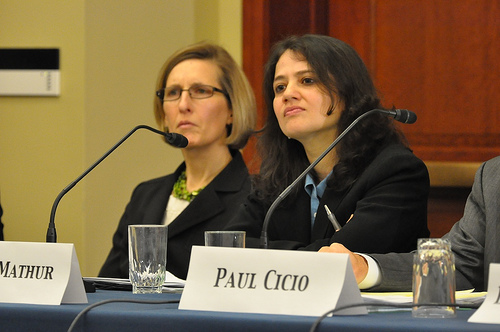
Aparna Mathur (right)

Here’s an article by Indian economist Aparna Mathur.

She writes (in part):

In a recent paper that I co-authored with Kevin Hassett, we explored the effect of high corporate taxes on worker wages. The motivation for the paper came from the international tax literature (summarized by Roger Gordon and Jim Hines in a 2002 paper1) that suggested that mobile capital flows from high tax to low tax jurisdictions. In other words, in any set of competing countries, investment flows are determined by relative rates of taxation. The current U.S. headline rate of corporate tax is 35 percent. The combined federal and state statutory rate of 39 percent is second only to Japan in the OECD. With Japan set to lower its statutory rate later this year, the U.S. rate will soon be the highest in the OECD and one of the highest in the world. What effect do these high rates have on worker wages?

When capital flows out of a high tax country, such as the United States, it leads to lower domestic investment, as firms decide against adding a new machine or building a factory. The lower levels of investment affect the productivity of the American worker, because they may not have the best machines or enough machines to work with. This leads to lower wages, as there is a tight link between workers’ productivity and their pay. It could also lead to less demand for workers, since the firms have decided to carry out investment activities elsewhere.

Our paper was one of the first to explore the adverse effect of corporate taxes on worker wages. Using data on more than 100 countries, we found that higher corporate taxes lead to lower wages. In fact, workers shoulder a much larger share of the corporate tax burden (more than 100 percent) than had previously been assumed. The reason the incidence can be higher than 100 percent is neatly explained in a 2006 paper by the famous economist Arnold Harberger.2 Simply put, when taxes are imposed on a corporation, wages are lowered not only for the workers in that firm, but for all workers in the economy since otherwise competition would drive workers away from the low-wage firms. As a result, a $1 corporate income tax on a firm could lead to a $1 loss in wages for workers in that firm, but could also lead to more than a $1 loss overall when we look at the lower wages across all workers.

Following our paper, several academic economists substantiated our results, using different data sets and applying varied econometric modeling and techniques. Some examples of these studies include a 2007 paper by Mihir A. Desai and C. Fritz Foley of Harvard Business School and James Hines Jr. of Michigan University Law School, a 2007 paper by R. Alison Felix of the Federal Reserve Bank of Kansas City, a 2009 paper by Robert Carroll of The Tax Foundation, and a 2010 paper by Wiji Arulampalam of the University of Warwick and Michael Devereux and Giorgia Maffini of Oxford.3 A recent Tax Notes article that I co-authored summarizes these various studies and also the lessons from the theoretical literature on the topic. The general consensus from theory and empirical work is that while we may argue academically about the size of the effect, there is no disagreement among economists that a sizeable burden of the corporate income tax is disproportionately felt by working Americans. On average, a $1 increase in corporate tax revenues could lead to a dollar or more decline in the wage bill.

Conservatives and liberals have the same goal. We both want to help the poor. Liberals think that taking money from the rich and giving it to the poor helps, but all it does it cause the rich to move their capital and jobs elsewhere, leaving the poor poorer. Conservatives let the rich keep their money and encourage them to risk it trying to make more money by engaging in enterprises that create wealth – creating products and services from less valuable raw materials. In a socialist system, the rich get poorer, but so do the poor. In a capitalist system, the rich get very rich, but the poor also gain more wealth. That’s what happens when corporations like Apple make IPads out of junky raw materials. That’s how wealth is created – by letting people who want to make things keep more of what they earn. We all benefit from encouraging people to make new things and provide value for their neighbors.

Related articles