
Tag Archives: Learning

An economist explains her ideas for teaching kids how to be responsible

Look at this great editorial from Fox News.

There are 7 rules in the article.

This one is obvious:

Rule 2: Economic Incentives — Offer Plenty of Jobs

Teach kids chores at an early age and pay them reasonable rates. For us, the seemingly endless loads of dishes — about three every day — became the main chore. Even small children can handle dishwasher take-out loads, at least if you first remove the sharp knives and use plastic glasses. And to them, it is a new learning experience.

Not tall enough? Just have a sturdy stepping stool and allow them to climb up on the counter to reach most shelves. If they still cannot reach safely, let them stack dishes neatly on the counter.

Seasonal outdoor job have included weeding (a great chore for anyone old enough to enjoy digging with a plastic shovel.) Explain why the root of the dandelion and plantain weed has to be dug up. Ten cents can be reasonable per weed, with extra bonus for big roots. Soon enough they learn not just biology but counting, too, as they see how much more they need in order to afford that toy at the store.

If you live near a town center, older children can be offered work running errands — buying a few items at the corner grocery store, picking up the Chinese food or taking a package to the post office.

But some are controversial:

Rule 5: Respect for Property Rights

The family provides basic family games that anybody can use — chess, Monopoly etc. Beyond that, games and toys are viewed as a luxury and can be accumulated by saving up and buying them or maybe receiving them as gifts one day. However, there naturally arises an asymmetry where the older ones possess much more than the younger ones.

Should the oldest be obligated to share with multiple little siblings, or should the younger ones have to wait until they have saved up to buy their own? Some people might argue that, out of fairness, the older child should share his ample possessions. But if he had to work hard, doing dishwasher loads etc. to buy himself the games, is it really so fair that his siblings would share in the fruits of his labor?

The solution? The budding entrepreneurs figured this one out by themselves: a fee for rental.

Parental monitoring might needed if siblings are a bit too young to understand exactly how much they are charged. The fee can be translated into something easy to comprehend, such as the equivalent of dishwasher loads or weeds pulled.

Actually, there are even more benefits to allowing the pay-to-play setup. Expecting a possible rental market with younger siblings, older ones figured they could recoup some of the purchase price for a new game, possibly even making a profit. That made them consider the tastes of their siblings — i.e. potential customers — when considering investing in new games.

And it went even beyond than that in creativity. Our oldest son even conjured up elaborate board games of his very own, with his younger siblings liking them enough to pay to play.

Property rights also mean you are free to sell off a game or toy to a sibling, as long as the buyer fully understands the consequences of the deal.

It made me feel a lot better about all my weird ideas about parenting. I can see how these rules would work to make children more responsible, but are they just too strict? It reminds me of the tiger mother article – about how Amy Chua parents her kids. I agreed with tiger mother, but I was in the minority of readers of this blog, if I recall correctly. Of course, her kids are all great successes now. Hmmmn.
 

Douglas Groothuis’ 752-page Christian apologetics book is now under $22

Christian Apologetics

Looking for a good textbook on apologetics that covers everything you need to know? Check out Dr. Groothuis’ book. It’s now under $22 on Amazon.

Here are the chapters:

Part I: Apologetic Preliminaries
1 Introduction: Hope, Despair and Knowing Reality
2 The Biblical Basis for Apologetics
3 Apologetic Method: Evaluating Worldviews
4 The Christian Worldview
5 Distortions of the Christian Worldview–or the God I Don’t Believe In
6 Truth Defined and Defended
7 Why Truth Matters Most: Searching for Truth in Postmodern Times
8 Faith, Risk and Rationality: The Prudential Incentives to Christian Faith

Part II: The Case for Christian Theism
9 In Defense of Theistic Arguments
10 The Ontological Argument
11 Cosmological Arguments: A Cause for the Cosmos
12 The Design Argument: Cosmic Fine-Tuning
13 Origins, Design and Darwinism
14 Evidence for Intelligent Design
15 The Moral Argument for God
16 The Argument from Religious Experience
17 The Uniqueness of Humanity: Consciousness and Cognition
18 Deposed Royalty: Pascal’s Anthropological Argument
19 Jesus of Nazareth: How Historians Can Know Him and Why It Matters by Craig L. Bloomberg
20 The Claims, Credentials and Achievements of Jesus Christ
21 Defending the Incarnation
22 The Resurrection of Jesus

Part III: Objections to Christian Theism
23 Religious Pluralism: Many Religions, One Truth
24 Apologetics and the Challenge of Islam
25 The Problem of Evil: Dead Ends and the Christian Answer
26 Conclusion: Take It to the Streets

Appendix 1 Hell on Trial
Appendix 2 Apologetic Issues in the Old Testament by Richard S. Hess

Here’s a review of the book by Michael D. Stark.

Introduction:

Contemporary Christians interested in apologetics can now turn to another text that is bound to become one of the most-used textbooks in apologetics. Douglas Groothuis’ Christian Apologetics: A Comprehensive Case for the Biblical Faith (InterVarsity, 2011) may have more breadth both in content and wisdom than any apologetics text to date. The subtitle is justified as the book, over 700 pages and 26 chapters long (not including two appendixes), presents the need for apologetics and explores the main philosophical arguments for the existence of God. Unlike other apologetics texts, Groothuis includes chapters examining truth in postmodern society, religious pluralism, and a tactful approach to dealing with Islam. Furthermore, biblical scholars (and Denver Seminary colleagues) Richard Hess and Craig Blomberg build on an already strong text by writing chapters on apologetics in the Old Testament (Appendix 2) and a historical approach to the person of Christ and the gospels, respectively.

Here’s a snip from the review:

The chapter on cosmological arguments is superb and only further qualifies Groothuis as a proficient thinker. This chapter without question is the chapter I learned the most from. Groothuis engages very difficult scientific and philosophical concepts and communicates them in a way that even the beginner will be able to grasp. Though there are many different versions of the cosmological argument, the chapter hones in on the kalam cosmological argument as put forth by William Lane Craig. The kalam argument is superior to other cosmological arguments in that it supposedly secures the theistic doctrine of ex nihilo if the arguments proves successful (note: a minor quibble of this chapter is that Groothuis purports that the Thomistic cosmological argument does not endorse ex nihilo. I believe this to be false). This specific chapter was sensational – however I was left disappointed that no time was given to addressing the cosmological argument posited by Aquinas. In some respects, the Thomistic cosmological argument is the simplest form for people new to apologetics. The Thomistic version does not get into the technical issues of the metaphysics of time and Big Bang cosmology that the kalam version uses, nor does it require knowledge of the principle of sufficient reason that the Leibnizian version necessitates. While the kalam and Leibnizian versions are logical and sound arguments, they may confusing to people new to apologetics. Because of this, beginners ought to take the time to read this chapter slowly and more than once because of the finer technical details.

Chapters 12-14 are devoted to the design argument and issues relating to it. Groothuis opposes macroevolution and thus goes to great extent to battle Darwinism. Those interested in the philosophy of science will be drawn to these chapters. The chapter focused on intelligent design relies heavily on the work of William Dembski and Michael Behe. These chapters serve as a valuable introduction for those new to discussion between Christian and naturalistic sciences.

Chapter 15 is perhaps the most successful chapter of the entire book as it deals with the moral argument. It is my belief that the moral argument is the most successful argument for the existence of God as it appeals to everyone, Christian, atheist, and non-Christian religious persons. Ethical theory may perhaps be the most widely debated philosophical topic throughout history and thus Groothuis could have taken many approaches when discussing the moral argument. The way he structured his chapter, however, is nearly flawless. Building off his chapter examining truth in the postmodern culture (chapter 7), Groothuis correlates the denial of objective truth to the ridding of objective moral value. He unmercifully attacks moral relativism and brilliantly shows its dangers. He states that cultural relativism reduces to individual relativism, which, in turn, ultimately rests on nihilism. The setup of this reductio ad absurdum points the reader to a moral system that does not reduce to nihilism. Thus, a worldview that embraces objective moral truths must be embraced. Groothuis makes the claim that the source of objective moral truths is found in the absolute Being – God. Groothuis puts for the notion that God is the source of all perfect moral code because he himself is incapable of an evil act as it would be a contradiction of God’s Being.

I think that the big advantage you get from Doug Groothuis is his worldview. He has the most fully-integrated worldview of any Christian scholar I know.

I bought one copy of Dr. Groothuis’ book, but I gave it away. So I got myself another one. It’s a must have. My favorite four apologetics books are this one, “Philosophical Foundations for a Christian Worldview” by William Lane Craig and J.P. Moreland, Michael Licona’s “The Resurrection of Jesus” and Stephen C. Meyer’s “Signature in the Cell”. I think that if you add Wayne Grudem’s “Politics According to the Bible” to that list, then that’s a very practical set of tools.

On wargames, history and heroes: “this story shall the good man teach his son”

Memoir '44: Pegasus Bridge setup
Memoir ’44: Pegasus Bridge setup

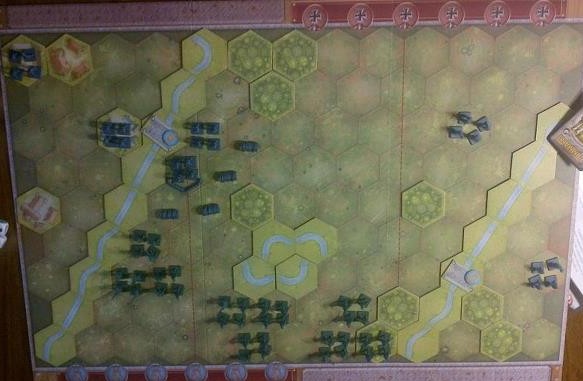
Last night, I played through the Pegasus Bridge scenario from the Memoir ’44 wargame with Dina a few times. We actually played the online version of the game, using Steam. She was very gracious to play a wargame with me, which I don’t think is necessarily the first thing on most women’s lists of things to do on a Thursday night! I appreciated her agreeing to learn how to play and then playing with me several times. I think that Christians need to plan and execute more “together” activities like that – activities that involve interaction, co-operation, communication and engagement. We try to avoid doing things where we are both spectators. Playing wargames is not the only thing we do – we also do Bible study and cooking lessons (for me), for example.

Anyway, the point of this post is to express the deeper meaning behind playing wargames. I think that it is important to recognize and celebrate those who have demonstrated good character, whether it be now, or in the past. I think that it is important for us to search out the best role models ourselves, so that they will influence the way we act in our own lives. The second world war was a clear example of good versus evil. Anyone on the Allied side who demonstrated bravery and courage should be celebrated for safeguarding the security, liberty and prosperity that we enjoy today. In the case of Pegasus bridge, the hero is Major John Howard of the British paratroops.

Here is a quick re-cap of his exploits that day from the New York Times:

Maj. John Howard, the commander of glider-borne British infantrymen who seized the strategically vital Pegasus Bridge in the first battle of the D-Day invasion of Normandy, died Wednesday in a hospital in Surrey, England. He was 86 and had lived in Burford, near Oxford.

Under cover of night on June 6, 1944, six gliders carrying 181 officers and men of the Second Oxfordshire and Buckinghamshire Light Infantry landed on the eastern flank of a 60-mile invasion front on the northern coast of France. The regiment had a heritage going back to the battles of Bunker Hill and New Orleans, to Waterloo and to World War I. Now its soldiers were in the vanguard of the invasion of Hitler’s Europe.

Major Howard’s D Company was ordered to seize two bridges, one over the Caen Canal and the other spanning the parallel Orne River. If the Germans held on to those bridges, panzer units could move across them in a counterattack isolating 10,000 British paratroopers jumping behind the British invasion beach known as Sword, where infantry forces would arrive at daybreak. And Major Howard’s men sought to strike swiftly to prevent the Germans from blowing up the bridges if they were overwhelmed; the British needed those bridges to resupply their airborne units.

British Halifax bombers towed the gliders over the English Channel, then cut them loose.

Major Howard’s lead glider landed at 12:16 A.M., only 50 yards from the Caen Canal bridge, but the glider’s nose collapsed on impact, knocking everybody aboard unconscious for a few seconds. The soldiers quickly emerged, and over the next five minutes the men directly under Major Howard killed the surprised German defenders.

The nearby Orne River bridge was captured by other troops in Major Howard’s unit, and soon the words ”Ham and Jam,” signifying mission accomplished, were radioed to the airborne.

Two British soldiers were killed and 14 wounded in the operation.

Over the next 12 hours, British paratroopers and commandos reinforced Major Howard’s men, and British forces were able to move toward the city of Caen, their flank having been protected by the capture of the bridges.

On July 16, Major Howard received the Distinguished Service Order, Britain’s second-highest award for valor. On the 10th anniversary of D-Day, he received the Croix de Guerre Avec Palme from the French Government, which had renamed the Caen Canal span Pegasus Bridge, for the flying horse symbolizing the British airborne. The road crossing the bridge was later renamed Esplanade Major John Howard.

Why is this important? Well, it’s important to think on the things that are excellent. There are so many things in the culture that are not excellent that we are confronted with every day. We have to make it our business to do things together where goodness is celebrated. Especially when manly virtues like courage are celebrated. We don’t do that much anymore. And I think there’s a connection between wargames and Christian apologetics that we need to deliberately encourage.

Here’s an excellent passage from Shakespeare’s “Henry V” that makes the point:

This day is called the feast of Crispian:
He that outlives this day and comes safe home,
Will stand a tip-toe when this day is named,
And rouse him at the name of Crispian.
He that shall live this day, and see old age,
Will yearly on the vigil feast his neighbours,
And say, ‘To-morrow is Saint Crispian:’
Then will he strip his sleeve and show his scars,
And say, ‘These wounds I had on Crispin’s day.’
Old men forget: yet all shall be forgot,
But he’ll remember with advantages
What feats he did that day. Then shall our names,
Familiar in his mouth as household words,
Harry the King, Bedford and Exeter,
Warwick and Talbot, Salisbury and Gloucester,
Be in their flowing cups freshly remembered.
This story shall the good man teach his son;
And Crispin Crispian shall ne’er go by,
From this day to the ending of the world,
But we in it shall be rememberèd;
We few, we happy few, we band of brothers;
For he to-day that sheds his blood with me
Shall be my brother; be he ne’er so vile
This day shall gentle his condition:
And gentlemen in England, now a-bed
Shall think themselves accursed they were not here,
And hold their manhoods cheap whiles any speaks
That fought with us upon Saint Crispin’s day. (4.3.43)

This is from the famous speech in which King Henry charges his men to fight well before the famous Battle of Agincourt.

You can read more about the history of the British Airborne division and Pegasus bridge. The famous historian of the second world war Stephen E. Ambrose also wrote a history of the Pegasus bridge battle, called “Pegasus Bridge: June 6, 1944“. You won’t find many military historians better than Stephen E. Ambrose!

You might be surprised how many men are interested in military history and wargames, precisely because men instinctively look up to men like John Howard who embody qualities like bravery and courage. We have a dearth of moral character in this society. And we don’t do much to teach young men about manly virtues, even in the church. I think that it is important for us to think of creative ways for us to present good character to our young men. Young women should also learn about good character, because they must separate out the good men from the bad when they are courting.

Thanks to Dina for helping me to edit this post!