Tag Archives: Layer

Obama: private sector job creation is “doing fine”

From CNS News.

Excerpt:

“The private sector is doing fine,” Obama said at a press conference on Friday. “Where we’re seeing weaknesses in our economy, have to do with state and local government — oftentimes, cuts initiated by governors or mayors who are not getting the kind of help that they have in the past from the federal government and who don’t have the same kind of flexibility as the federal government in dealing with fewer revenues coming in.”

State and local leaders were not the only ones to blame for a bad economy, as the president also blamed Republicans in Congress.

What are the facts? Is Obama right?

Here is a comparison of public and private pay in Ohio, for example:
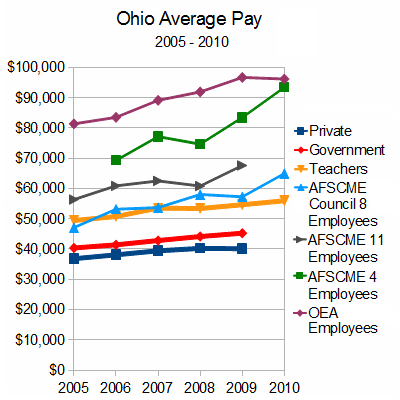
Ohio Average Pay: Public vs. Private

Does Obama know how to create jobs? Let’s compare him to Bush:
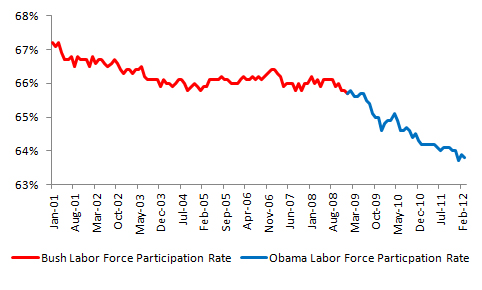
Labor Force Participation 2012 (click for larger image)

There is no recovery. We haven’t created any jobs. We’ve actually lost 5 million jobs since the Democrats took over the House and Senate in January 2007.

When George W. Bush was President, we had unemployment around 4 or 5 percent for 8 years, which deficits as low as $160 billion in 2007. Barack Obama has had four budget deficits of a trillion or more in a row, and his unemployment rate has been double Bush’s rate. Bush has an MBA from Harvard and had private sector job creation experience. Obama doesn’t know anything about economics. He’s a lawyer who benefited from affirmative action, and who has never released his grades. You can’t elect an unqualified person and get performance.

Woman who made false rape accusation gets zero jail time

Story here in the UK Daily Mail.

Excerpt:

A woman who accused a student of rape after dragging him into a public toilet for sex was spared jail yesterday.

Bisexual Sarah-Jane Hilliard, 20, seduced Grant Bowers when the two bumped into each other during a night out clubbing.

[…]She had denied perverting the course of justice.

Mr Bowers – who says he is now afraid to speak to women – said: ‘It’s absolutely ridiculous. That’s not even a slap on the wrist. She’s been let off and I’m still having to sneak around because there are still people after me who think I did it.’

It was more than a week after his arrest that Mr Bowers discovered he was not to be charged.

But during that time Hilliard, who was in a relationship with a woman, contacted the Criminal Injuries Compensation Board in the hope of claiming up to £7,500.

Mr Bowers’s father Tony, 48, said: ‘My son was facing up to ten years in prison for rape on the strength of her lies. The least I expected was for her to have been given a prison sentence.

[…]Hilliard’s lie began to unravel when police were unable to find CCTV footage of the pair leaving the club.

A friend admitted they had been at another nightclub called Colors and detectives found CCTV evidence of Hilliard and Mr Bowers, who was 19 at the time, kissing and holding hands.

How should men feel about stories like this?

ECM had sent me this article from the ABA Journal a few days back.

Excerpt:

A judge’s race or gender makes for a dramatic difference in the outcome of cases they hear—at least for cases in which race and gender allegedly play a role in the conduct of the parties, according to two recent studies.

The results were the focus of a program about “Diversity on the Bench: Is the ‘Wise Latina’ a Myth?,” sponsored by the ABA Judicial Division at the ABA Midyear Meeting in Orlando on Saturday afternoon.

In federal racial harassment cases, one study (PDF) found that plaintiffs lost just 54 percent of the time when the judge handling the case was an African-American. Yet plaintiffs lost 81 percent of the time when the judge was Hispanic, 79 percent when the judge was white, and 67 percent of the time when the judge was Asian American.

The comprehensive study, by professors from the University of Pittsburgh School of Law and Carnegie Mellon University’s Tepper School of Business, examined a random assortment of 40 percent of all reported racial harassment cases from six federal circuits between 1981 and 2003.

A second study (PDF), looked at 556 federal appellate cases involving allegations of sexual harassment or sex discrimination in violation of Title VII of the Civil Rights Act of 1964. The finding: plaintiffs were at least twice as likely to win if a female judge was on the appellate panel.

Are courts impartial?