
Tag Archives: Keynesianism

New jobs report: unemployment rises and 70% chance of recession

James Pethokoukis of the American Enterprise Institute explains:

The May jobs report was a complete and utter disaster for the economy and, perhaps, President Obama’s chances for reelection.

Employers created just 69,000 jobs last month, the Labor Department said on Friday. That’s the fewest since May of last year. Economists had been expecting nonfarm payrolls to increase by 150,000. (In fact, the result was lower than what any economist polled by Reuters had predicted.)

Moreover, companies added 49,000 fewer jobs than previously estimated in March and April. Talk about a slowdown. The average monthly gain was 226,000 in first quarter vs. an average of just 73,000 in April and May.

Oh, and the U-3 unemployment rate rose to 8.2% from 8.1%. The broader U-6 gauge, which also measures underemployment, rose to 14.8% from 14.5%. The labor force participation rate did, finally, tick up to a still-low 63.8%, lending credence to the idea that the shrinking workforce reflects discouraged workers and not just demographics.

And here’s the forecast: WE’RE DOOMED.

So what is the true state of the labor market?

– If the size of the U.S. labor force as a share of the total population was the same as it was when Barack Obama took office—65.7% then vs. 63.8% today—the U-3 unemployment rate would be 10.9%. (Now, this doesn’t take into account the aging of the Baby Boomers, which should lower the participation rate due to rising retirements. But is that still a valid assumption given the drop in wealth since 2006?)

–  If you take into account the aging of the Baby Boomers, the participation rate should be trending lower. Indeed, it has been doing just that since 2000. Before the Great Recession, the Congressional Budget Office predicted what the participation rate would be in 2012, assuming such demographic changes. Using that number, the real unemployment rate would be 10.5%.

– Of course, the participation rate usually falls during recessions. Yet even if you discount for that and the aging issue, the real unemployment rate would be 9.5%.

– We continue to be stuck in the longest period of 8% unemployment or higher since the Great Depression, 40 consecutive months.

– And, as the above chart shows — originally from Obama economists Christina Romer and Jared Bernstein in January 2009 –the current 8.2% unemployment rate is 2.5 percentage points above where Team Obama predicted it would be right now if Congress passed his trillion-dollar stimulus plan.

–  The median duration of unemployment rebounded to 20.1 weeks in May, and 42.8% were unemployed for longer than a half year.

– Total hours worked fell 0.2% on weakness in the work week.

– Average hourly earnings rose just 0.1%. Coupled with a very stable overall inflation rate, real wages were likely flat in May.

The big question now: Does this report suggest the U.S economy is heading into recession, especially given the sharp slowdown in global economic activity from Europe to India to, perhaps most worrisome, China?

Consider this: Last year, the U.S. grew at just a 1.7% pace. Research from the Federal Reserve finds that that since 1947 when year-over-year real GDP growth falls below 2 percent, recession follows within a year 70 percent of the time. We are firmly within the Recession Red Zone.

Facebook friend WGB pointed me to this story in CNS News:

The number of American women who are unemployed was 766,000 individuals greater in May 2012 than in January 2009, when President Barack Obama took office, according to data released today by the Bureau of Labor Statistics.

In January 2009, there were approximately 5,005,000 unemployed women in the United States,according to BLS. In May 2012, there were 5,771,000.

[…]The number of women employed in the United States peaked at 68,102,000 in April 2008, according to BLS.  The number of women employed in the United States today is 1,216,000 less than that.

Remember, the Democrats got control of Congress in January 2007, and had control of spending in the 2008 fiscal year. My take is that the hiring is still going on in places like Canada and Chile and Sweden, where government isn’t taxing and regulating job creators into oblivion. Companies are still hiring and expanding and drilling for oil – just not here.
Greeks withdraw $894 million from Greek banks in one day

I found this article from MSNBC on The Other McCain.

Excerpt:

Political leaders in Athens were due to discuss an emergency government Wednesday to deal with a possible run on banks as it emerged Greeks withdrew almost $900 million in a single day, fearing their country could crash out of the euro currency by the end of the week.

An interim government would take the country through to new elections on June 17, triggered by the collapse on Tuesday of talks to form a coalition between winners of the inconclusive May 6 election.

Greeks are withdrawing euros from banks, apparently afraid of the prospect of rapid devaluation if the country leaves the European single currency and returns to the drachma.

President Karolos Papoulias warned of “great fear that could develop into a panic,” the minutes of Papoulias’ negotiations with political leaders showed, according to Reuters.

[…]Several banking sources told Reuters similar amounts had also been withdrawn on Tuesday. Nevertheless, there was no sign of panic or queues at bank branches in Athens on Wednesday. Bankers dismissed suggestions that a bank run was looming. A senior executive at a large Greek bank told Reuters: “There is no bank run, no queues or panic. The situation is better than I expected. The amount of deposit withdrawals the president mentioned referred to three days, not one.”

[…]Greeks have already been withdrawing their savings from banks at a sharp clip – nearly a third of bank deposits were withdrawn between January 2010 and March 2012, reducing total Greek household and business deposits to 165 billion euros.

What I find really striking about stories like this is that Greece just had an election. 75% of them want to stay in the European Union and keep the Euro as a currency. But that can only happen if they accept that they are spending too much and they are not producing anything. They have to cut spending, lower taxes and deregulate so that there is economic growth. So what did they do? They voted against austerity. They think that by refusing to meet the conditions of the people who can bail them out, that they will get a bailout. It’s just insane. Like whipping a thirsty camel with the expectation that whipping can somehow satiate its thirst and cause it to get up and keep moving.

Bank run in socialist Europe begins

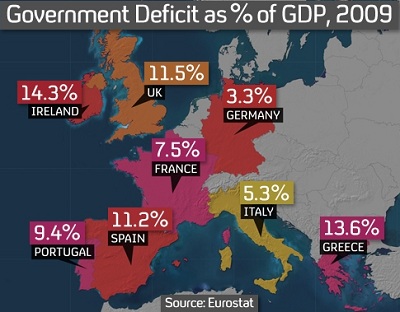
Europe: Annual Budget Deficit as % of GDP

From CNBC.

Excerpt:

Money-market funds in the United States have quite dramatically slammed shut their lending windows to European banks. According to the Economist, Fitch estimates U.S. money market funds have withdrawn 42 percent of their money from European banks in general.

And for France that number is even higher — 69 percent. European money-market funds are also getting in on the act.

Bond issuance by banks has seized up because buyers have gone on strike.

From the Economist’s Free Exchange Blog:

In the third quarter bonds issues by European banks only reached 15 percent of the amount they raised over the same period in the past two years, reckon analysts at Citi Group. It is unlikely that European banks have sold many more bonds since.

Corporate depositors are also pulling their cash.

Free Exchange:

“We are starting to witness signs that corporates are withdrawing deposits from banks in Spain, Italy, France and Belgium,” an analyst at Citi Group wrote in a recent report. “This is a worrying development.”

And there are troubling signs that banks are even running out of collateral to back their borrowings from the European Central Bank .

So far the liquidity of the European Central Bank (ECB) has kept the system alive. Only one large European bank, Dexia, has collapsed because of a funding shortage. Yet what happens if banks run out of collateral to borrow against?

And from the leftist New York Times.

Excerpt:

The flight from European sovereign debt and banks has spanned the globe. European institutions like the Royal Bank of Scotland and pension funds in the Netherlands have been heavy sellers in recent days. And earlier this month, Kokusai Asset Management in Japan unloaded nearly $1 billion in Italian debt.

At the same time, American institutions are pulling back on loans to even the sturdiest banks in Europe. When a $300 million certificate of deposit held by Vanguard’s $114 billion Prime Money Market Fund from Rabobank in the Netherlands came due on Nov. 9, Vanguard decided to let the loan expire and move the money out of Europe. Rabobank enjoys a AAA-credit rating and is considered one of the strongest banks in the world.

American money market funds, long a key supplier of dollars to European banks through short-term loans, have also become nervous. Fund managers have cut their holdings of notes issued by euro zone banks by $261 billion from around its peak in May, a 54 percent drop, according to JPMorgan Chase research.

This is really disturbing. I wonder if any of my economics-minded commenters can explain to me what happens when there is a run on banks. I am guessing that there will be some rioting over benefits as austerity measures are imposed, and interest rates will go up.