
Tag Archives: Judgment

Hate crime hoax: Houston Muslim arrested for setting his own mosque on fire

Suspect arrested for arson of Houston mosque, liberals hardest hit

Here’s the raw story from the leftist Houston Chronicle.

It says:

A Houston man has been arrested in connection with a suspected arson at a mosque on Christmas Day, but the motive for the crime remains a mystery, with the suspect maintaining he was a regular at the mosque.

A spokeswoman for the federal Bureau of Alcohol, Tobacco, Firearms and Explosives confirmed that the suspect, 37-year-old Gary Nathaniel Moore of Houston, was arrested early Wednesday. Moore appeared in court at 7 a.m., spokeswoman Nicole Strong said, and bond was set at $100,000.

According to a charging instrument released by the Harris County District Clerk, Moore told investigators at the scene that he has attended the storefront mosque for five years, coming five times per day to pray seven days per week.

Moore said he had been at the mosque earlier on Dec. 25 to pray, and had left at about 2 p.m. to go home, according to authorities and court papers. Moore said he was the last person to leave the mosque and saw no smoke or other signs of fire when he departed, authorities said. He maintained he had returned to the scene after hearing about the fire from a friend.

Now, I wouldn’t post this if there was not something to learn from it at a higher level, and there is. There is something to learn about the left-wing, shame the good, praise the evil, mindset.

Breitbart News documents the initial reactions from the mainstream media to the story before it was known who the guilty person was.

Excerpt: (links to other sites removed)

CBS News:

Advocacy groups believe there has been a spike in anti-Muslim incidents across the United States in recent weeks that can be linked to the mass shooting in California and the inflammatory rhetoric of Donald Trump and other Republican presidential candidates. And they say that Muslims are fearful the backlash could lead to further harassment and violence.

CNN:

The Houston chapter of the Council on American-Islamic Relations called on authorities to investigate the fire for an anti-Muslim motive.

“Because of the recent spike in hate incidents targeting mosques nationwide, we urge law enforcement authorities to investigate a possible bias motive for this fire,” Mustafaa Carroll, the chapter’s executive director, said in a statement.

NBC News:

The Houston chapter of the Council on American-Islamic Relations called on authorities to investigate a possible bias motive in the case, citing what it called a “recent spike in hate incidents targeting mosques nationwide.

Now that a devout Muslim has been charged, the DC Media will forget all about the incident.

The media’s playbook is always to immediately use any disaster or crime as a means to make the GOP answer for it. Then, once the facts come out and point to a member of the Protected Class, the story is memory-holed and the accusation against the Republican lingers.

That was very bad, and it should teach you a lesson about how anxious the media is to make traditional groups (conservatives, Christians, orthodox Jews, etc.) feel ashamed, while protecting and praising radical Islamists. They want to force everyone to be “equal” on the moral scale, so that no one can judge anyone else. The problem is, as we see in this story, that not shaming evil causes evil people to more evil, not less evil.

Anyway, all that is well and good, but we haven’t seen the worst media bias. That prize goes to the radically, radically leftist Salon, which not only put up a story blaming conservatives for the arson, but then took it down once the news came out about who was arrested for it: (H/T Weasel Zippers)
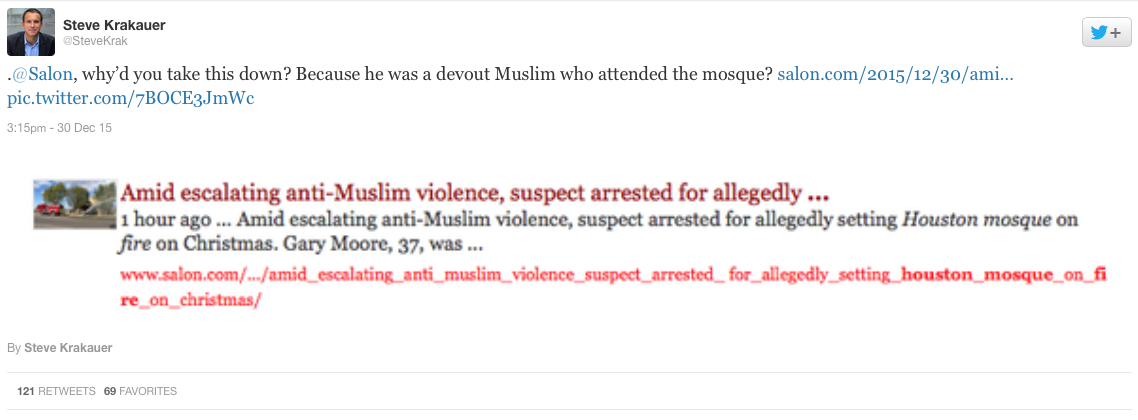
Salon took down their entire post to protect radical Islamists

(click for larger image)

Why did they do it? Because the story only had value to them when it could give America, Christians, Republicans, etc. a black eye. When it gave radicalized Muslim terrorists a black eye, then Salon had to take it down. They didn’t want to make their allies in the culture war look bad. And do you know what else Salon doesn’t report on? Crucifixions, torture, rape and murder by radical Muslims (often against other Muslims!) in other parts of the world. That doesn’t fit their narrative, either.

Do you ever wonder where so many people have an emotional reaction of sympathy for people who do evil? It’s because they’ve been conditioned by the media to think that somehow, some way, evil people are actually justified in doing their evil. And somehow, some way, good people are all hypocrites who shouldn’t judge anyone, because it is mean and makes people feel bad. If you went to public schools in America and listened to the mainstream media, you’ve been indoctrinated in that from birth to present day. It all comes from the shame that people on the left feel for their own immoral actions, and their desperate desire to stop all moral judging as a way of escaping from the misdeeds they committed in the past. This is their way of dealing with their own guilt – stopping everyone else from making moral judgments about anything.

To learn more about media bias from peer-reviewed studies that document it, click here.

Does God pose an authority problem for you?

I have a key that will unlock a puzzling mystery

I’m going to steal this entire post from Tough Questions Answered to get a conversation started:

Many of the people I know who reject God or who have crafted a God that makes no demands on them have a fundamental problem with authority.  They don’t want anybody telling them what to do.

For a person who wants complete autonomy, who chafes at the thought of anyone having authority over them, a creator God who makes demands is way inconvenient.

Many people who believe in God, but also have this authority hang-up, create their own version of God.  This God gives them what they want when they want it.  He approves of everything they do, as long as they are just trying to be happy.  He encourages them to follow their desires, wherever they lead.  C. S. Lewis compared this God to a senile, old grandfather who never says “no” to his grandchildren.  You want chocolate for breakfast, lunch, and dinner?  No problem!

Is this the Christian God?  Philosopher Paul Moser answers the question:

It would be a strange, defective God who didn’t pose a serious cosmic authority problem for humans.  Part of the status of being God, after all, is that God has a unique authority, or lordship, over humans.  Since we humans aren’t God, the true God would have authority over us and would seek to correct our profoundly selfish ways.

If you are “worshiping” a God who makes no demands on you, you’re worshiping no God at all.  You’re just trying to find a deity to make you feel good about your selfish choices.  What’s the point?

I’m posting this because I’m looking for comments. Do you know anyone like this? I’ll help by getting you started with some sample atheists.

Famous atheists agree: God is not the boss of them

Consider the words of Thomas Nagel, a famous atheist philosopher:

“In speaking of the fear of religion, I don’t mean to refer to the entirely reasonable hostility toward certain established religions and religious institutions, in virtue of their objectionable moral doctrines, social policies, and political influence. Nor am I referring to the association of many religious beliefs with superstition and the acceptance of evident empirical falsehoods. I am talking about something much deeper–namely, the fear of religion itself. I speak from experience, being strongly subject to this fear myself: I want atheism to be true and am made uneasy by the fact that some of the most intelligent and well-informed people I know are religious believers.

I want atheism to be true and am made uneasy by the fact that some of the most intelligent and well-informed people I know are religious believers. It isn’t just that I don’t believe in God and, naturally, hope that I’m right in my belief. It’s that I hope there is no God! I don’t want there to be a God; I don’t want the universe to be like that.”(”The Last Word” by Thomas Nagel, Oxford University Press: 1997)”

And what about atheist Richard Lewontin: (and when he says “science” below, he means “naturalistic science”)

“Our willingness to accept scientific claims that are against common sense is the key to an understanding of the real struggle between science and the supernatural. We take the side of science in spite of the patent absurdity of some of its constructs, in spite of its failure to fulfill many of its extravagant promises of health and life, in spite of the tolerance of the scientific community for unsubstantiated just-so stories, because we have a prior commitment, a commitment to materialism. It is not that the methods and institutions of science somehow compel us to accept a material explanation of the phenomenal world but, on the contrary, that we are forced by our own a priori adherence to material causes to create an apparatus of investigation and a set of concepts that produce material explanations, not matter how counterintuitive, no matter how mystifying to the uninitiated. Moreover, that materialism is absolute, for we cannot allow a divine foot in the door.” (Richard Lewontin in New York Review of Books, January 9, 1997, p. 28)

Interesting. He’s willing to tell people lies to keep the Divine Foot outside the door.

And one last one from Aldous Huxley:

“I had motives for not wanting the world to have a meaning; consequently assumed that it had none, and was able without any difficulty to find satisfying reasons for this assumption. The philosopher who finds no meaning in the world is not concerned exclusively with a problem in metaphysics, he is also concerned to prove that there is no valid reason why he personally should not do as he wants to do, or why his friends should not seize political power and govern in the way that they find most advantegous to themselves… For myself, the philosophy of meaningless was essentially an instrument of liberation, sexual and political.” — Aldous Huxley in Ends and Means, 1937

So this is pretty widespread among famous atheists. How about among ordinary atheists?

Survey says

Arthur Brooks’ survey showed that atheists certainly give less in charity and do less community service as religious people on the right and left.

Quote:

Drawing on some ten data sets, Brooks finds that religiosity is among the best predictors of charitable giving. Religious Americans are not only much more likely to give money and volunteer their time to religious and secular institutions, they are also more likely to provide aid to family members, return incorrect change, help a homeless person, and donate blood. In fact, despite expecting to find just the opposite, Brooks concluded: “I have never found a measurable way in which secularists are more charitable than religious people.”

Consider some examples. Religious citizens who make $49,000 gave away about 3.5 times as much money as secular citizens with the same income. They also volunteered twice as often, are 57 percent more likely to help homeless persons, and two-thirds more likely to give blood at their workplace. Meanwhile, those who insist that “beliefs don’t matter as long as you’re a good person” are not as good as those who do think beliefs matter. The former group gave and volunteered at much lower rates.

Yet even these findings tend to obscure the impact of religion on charity. This is because some of the survey respondents that Brooks classified as secular are indirectly affected by religion if they were raised in a religious household.

Keeping the Divine Foot outside the door has advantages – you don’t have to worry about giving away your own stuff to others.

Atheists also divorce more than committed Christians:

Quote:

It’s a number that is trumpeted from the rooftops — and the pulpit: Half of marriages among Christians and non-Christians alike end in divorce.

But the reality is that Christians who attend church regularly get divorced at a much lower rate.

Professor Bradley Wright, a sociologist at the University of Connecticut, found that among people who identify as Christians but rarely attend church, 60 percent have been divorced. Of those who attend church regularly, 38 percent have been divorced.

W. Bradford Wilcox, a leading sociologist at the University of Virginia and director of the National Marriage Project, found a nearly identical spread between “active conservative Protestants” who regularly attend church and people with no religious affiliation.

Professor Scott Stanley from the University of Denver, who is working on the Oklahoma Marriage Initiative, said couples with a vibrant religious faith have more and higher levels of the qualities that marriages need to avoid divorce.

“Whether young or old, male or female, low-income or not, those who said that they were more religious reported higher average levels of commitment to their partners, higher levels of marital satisfaction, less thinking and talking about divorce and lower levels of negative interaction,” he said. “These patterns held true when controlling for such important variables as income, education and age at first marriage.”

Again, keeping the Divine Foot outside the door has advantages. You don’t have to make a commitment that goes against your self-interest. When you don’t feel good in a relationship, you can get out.

I have found that atheists think that even if Christianity were true, atheists have no intention of changing the way they live. Even if they don’t personally engage in tons of obvious immorality, they frequently advocate for a society where Judeo-Christian values have disappeared completely, e.g. – abortion, same-sex marriage. Atheism, if it means anything, means that the strong should be allowed to pursue their own pleasure at the expense of the weak. And God has to go, because he gets in the way of that unrestrained pursuit of pleasure.

I hope that more atheists look in the mirror and are honest with themselves about what’s really going on. Is it really such a terrible thing to have a relationship with the person who cares the most about you and wants the best for you? Is fun really that important that people have to push away the Creator of the universe just because he requires self-denial? You can’t get the experience of choosing to imitate God in order to be in solidarity with him if you shut him out because you want your autonomy. And that’s what we are all here to do – to know him, to be his friend, to act in a way that allows us to feel what he feels, and to have sympathy with him.

J. Warner Wallace explains and defends the doctrine of Hell in five podcasts

I have a key that will unlock a puzzling mystery

Straight talk on the doctrine of Hell from cold case homicide detective J. Warner Wallace.

Number 1:

In the wake of Rob Bell’s new book, “Love Wins,” many people are beginning to question the nature and existence of Hell and how exactly God decides who must go there. For many, the idea that our temporal, finite sin on earth should deserve an eternal punishment of infinite torment in hell is ridiculously inequitable. Why would God torture infinitely those who have only sinned finitely? Jim addresses this objection and answers listener email.

The MP3 file is here.

Number 2:

A loving God would never create a place like Hell, would He? Any God that would send people to a place of punishment and torment is unloving by definition, right? In this podcast, Jim responds to these foundational objections to the existence of Hell. In addition, Jim comments on the Harris / Craig debate and answers listener email related to hearing God’s voice.

The MP3 file is here.

Number 3:

In this podcast, Jim answers the objection that God would send people like Gandhi to Hell (simply because they are not Christians) alongside people like Hitler (who have committed unspeakable atrocities). How can a reasonable and just God be the source of such inequitable punishment? Also Jim answers listener email related to the power of prayer, the importance of evidential apologetics and the grounding for objective morality.

The MP3 file is here.

Number 4:

Isn’t it unfair for God to penalize people who are otherwise good, just because they haven’t heard about Jesus? A good God would not send good people to Hell. Jim responds to this objection and answers listener email related to the Craig/Harris debate, pre-existing mythologies that are similar to Jesus, and the difficult, exclusive nature of “election”.

The MP3 file is here.

Number 5:

If God is all-loving, why doesn’t he “reform” people rather than simply “punish” them in Hell? Skeptics sometimes argue that a God who simply punishes his children in Hell is a sadistic and vengeful God, unworthy of our worship. Jim responds to this objection and answers listener email related to the nature of “election”, the evidence for “annihilationism”, and a political quote related to same sex marriage.

The MP3 file is here.

Good listening to help you defend a doctrine that is very unpopular with people who think God should be their cosmic butler.